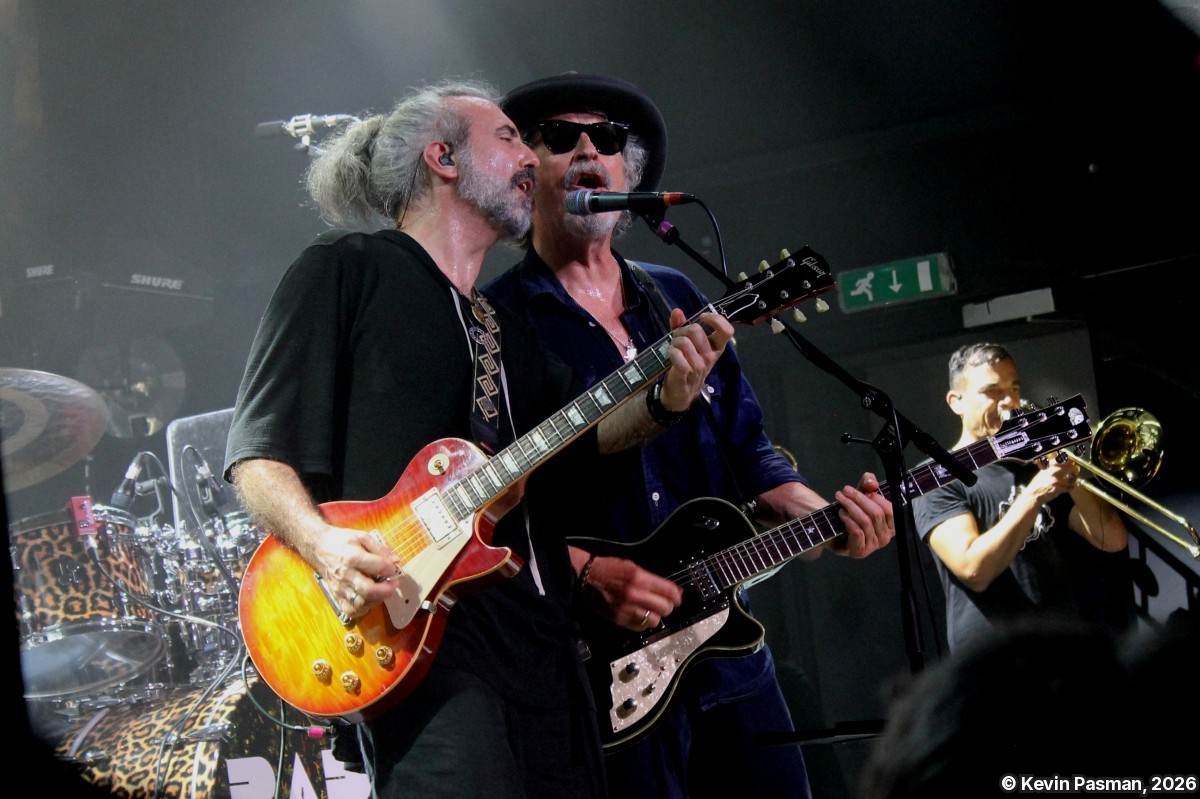
BAP is about to embark on a tour to celebrate their fiftieth anniversary. Although guitarist Ulrich Rode did not join the pioneers of Kölschrock – or rock music in the Cologne dialect – until 2014, his versatile guitar playing and compositions has become an indispensable part of the band’s sound. Rode gives an insight into how BAP works and how he approaches session work, such as his work on the popular German television show ‘Sing meinen Song’.
“After Wolfgang (Niedecken, BAP’s singer, guitarist and sole remaining original member) had his stroke, everything needed to be a little more downsized”, Rode explains. “So not as loud, and sitting down and everything. That’s when we played this beautiful ‘Das Märchen vom gezogenen Stecker’ tour. That is the first time we worked together under the BAP moniker. We had already worked together on the promo tour for ‘Zosamme Alt’ (2013), a solo album Wolfgang recorded in Woodstock with American musicians. It was produced by Julian Dawson.
When that album was released here, Wolfgang also wanted to play a couple of concerts, like radio concerts and small promo things. That’s when I joined him for the first time. There are a lot of country instruments on the album, like lap steel and pedal steel, mandolin, and dobro. My wife Anne (de Wolff, multi-instrumentalist in BAP) already played in the band, and that’s how Wolfgang found out I also play those instruments. We played around five concerts in a small line-up for this solo tour.
That worked so well, that a band tour developed from that, which was also unplugged. It was from that spirit that ‘Lebenslänglich’ (2016), our first album together, evolved. At that time, it wasn’t clear yet how much we would rock, or if it was really still that unplugged way of thinking. Also, the line-up was completely new; we worked together for the first time in the studio. We were still tiptoeing a bit. It wasn’t until the tour for that album that we really found out what the band sound actually was.
Actually, I would love to re-record ‘Lebenslänglich’ at some point. I’m sure some things will sound quite different. It was truly a transitional period. I like a lot of those songs, but the arrangements were still half unplugged, half electric. We were in between worlds at the time.”
The Entire Band on Board
“After ‘Lebenslänglich’, I imagined: what would I really want a new BAP album to sound like? How would such an album start? Which tempos are important? Do we have good uptempo songs? Of course, we would need two or three good ballads, and something a bit more experimental, something like ‘Ruhe vor’m Sturm’ or something like that, which sounds a bit bigger.
For ‘Alles Fliesst’ (2020), I started making demos, and recorded vocal melodies in broken English. Then, of course, Wolfgang had to find something he could work with. Fortunately, he wrote lyrics to all the songs, and every time lyrics came in to a song, they were exactly how I wished it would be. Wolfgang also wrote a set of lyrics to ‘Volle Kraft Voraus’ that didn’t really fit the music, so we translated he music to fit those lyrics.
In BAP, all band members contribute to writing the music. Anne came up with ‘Hauptjewinn’, and the closing ballad ‘Wenn ahm Ende des Tages’, was an idea from Michael (Nass, keyboard player). It was also very important for us to involve the band very early on in the process. We let Wolfgang sing the demos, changed the music accordingly a bit, and planned a listening session with the band.
During a tour, we got together in a conference room, played the demos to the band, and we collected their ideas for the songs. I thought that was a really good process. Knowing that the entire band was on board was something that was very important to us. We didn’t want to tell them what to play without them having the chance to contribute something. This was good for the band.”
Neck Hair Check
While BAP’s sound is instantly recognizable, there are significant differences between how the band sounded in their early-eighties breakthrough days compared to now. “Honestly: that was a very enjoyable process”, Rode smiles. “Obviously, these songs from the eighties sound very different. However, we did try and capture the essences of the songs. Obviously, I don’t play a Soldano like Major (former guitarist Klaus Heuser) used to do. And things obviously sound a little different these days. We wanted to keep the riffs, but also bring the arrangements up to date a bit.
Of course, it is important to me that the music is something I can work with. But that hasn’t been difficult at all. I never thought: oh god, I have such big shoes to fill. The songs have informed me how they wanted to be played. We also are very lucky that we can take the best of all worlds. We can take the musical ideas from back in the day, so the raw riffs and the unusual instrumental parts, and combine those with the sounds of today, and the experience we have.
Fortunately, Wolfgang doesn’t mind at all. He gives us free rein. The only thing he has is what he calls the neck hair check. When he hears something, the hairs on the back of his neck do need to stay down. And when everything works, we have a lot of freedom. It’s great when you really actually get to play in a band.
Obviously, it’s important to us that he simply feels good as well. That’s why we always want to make sure that the key is the right one. After all, Wolfgang is the one who needs to get the story across. In every musical setting, it is important to me that the front person feels safe and secure, that they get maximal support. That’s when a band functions best. And that is no different here.”
Secondary Virtues
“When I work with other people, I always try to find out what the artist wants. When we do ‘Sing meinen Song’, it’s really all about accompanying an artist, and finding out: what do they miss? What can we do so they can comfortably do their thing? That has always been an essential factor for me. Understanding. Musical empathy, you could say. Maybe that’s what gives artists a sense of security, because they know: that functions, and he doesn’t do anything that has nothing to do with what I do.
And then, of course, there are all the secondary virtues: being reliable, being prepared, being kind. After all, there is a lot of time you spend together while not on stage. No one wants to spend a lot of time with unpleasant characters who ruin your time. Because life is a little bit too short for that.
It’s been an enormous privilege to make this my job. I’m 52 years old now, I have been making my living playing music since I was 19, and I still don’t have to do anything else. Knock on wood. It’s amazing that it still works somehow. Especially in times like these, as it hasn’t exactly become easier for young musicians.”
No Distance Between Musician and Music
“Primarily, I make my living as a sideman for other people. And I’m happy that all of these jobs are things I enjoy doing. Fortunately, the days where I would think ‘well, at least I can pay my rent with this’ are far behind me. These days, I exclusively work on projects that I am glad to be involved with. But in all honesty, I have always tried to find an aspect that resonates with me in everything that I have done, regardless of what it is.
Even with pop things, like Rosenstolz or the tour we did with Helene Fischer, there was an aspect within the style that was fun for me, so there is no distance between me and whatever I’m playing. Or at least as little as possible. That is a mindset that is simply essential to me. Since I do a lot for other people, I do everything I can to familiarize myself with their word, and especially with front persons.
On my computer, I have a murks. folder, in which I gather everything that can’t happen anywhere else. And that can be anything. I have studied jazz in Hannover, which is something completely different harmonically, and something I always try to expand upon and do more often. Unfortunately, that is the first thing that is left on the shelf when there is a tour to do or when I have a studio project with other people. In that case, my own project is always the thing of which I say: alright, I’ll do that later.
That’s also why I don’t really do any live shows with it. For that, people would need to have time, and I would like to be able to pay them, which isn’t realistic at this time. It’s really a studio thing, and there’s a lot of stuff on my computer that I can release. In July, I even released a small acoustic number under the name At the Cactus Lounge. Also something I would like to explore more.”
A Guitarist’s Glasses
“A great aspect of the band right now is that all of us have this bird’s eye view of the band’s music. That is what makes working together so pleasantly as well, because all of us keep an eye on how everything we play sounds within the context of the band. None of us minds changing a part if it doesn’t function within the musical context.
That’s the case for all of us. We have a very collective musical way of thinking. That is truly something beautiful. And it makes working together considerably more convenient. There is always this back-and-forth. That is a truly beautiful way of creating music together for me.
It’s always been the way I tried to mix myself into the music. Or rather a way of looking what’s happening within the music as a whole, and trying to understand what the essential elements of a song are.
Obviously, a guitarist will always look at a song through a guitarist’s glasses, and I love hearing guitarists play myself as well, also in instrumental music and things like that. But when I’m working within a pop music context, I try to take off my guitarist’s glasses as much as possible to try and really understand and enhance the songs.”
A Tool for Riffs
“The set-up I use for BAP, so with two amps and a big board, is something I really only use here. For other projects, I have a smaller set-up – an amp and a small board. We are lucky with BAP, because we have a technical crew that can build up and tear down everything. That allows us to bring a few more things, which is something I don’t do otherwise.
For ‘Sing meinen Song’, for example, we will be working on a George Harrison program in a few days. That, of course, requires a completely different set-up. There, I will be playing a Tele, a small Princeton, a small board, and an SG for a couple of slide things. Obviously; it’s George Harrison, so you can’t do it without one.
My Tele I play very frequently for things outside of BAP. I love that guitar. I also have a Gibson ES-335 that I like a lot. That one sounds a bit fuller. Nearly all of my guitars have been equipped with Kloppmann Pickups, by Andreas Kloppmann from Bremen-Stuhr. Great guy.
Last year, I upgraded my Les Paul for BAP. I used to have a Les Paul Standard, but I am playing a Custom Shop Les Paul, which is a little hotter and a little fatter. That is really a tool for BAP, so for the riffs. It response super well. It does have a mega-thick neck. Almost too thick for me. But it simply plays very well for these riffs.
The Sunburst Tele that Anne plays these days is mine as well. I have played big band things with that. Playing that Tele on its neck pickup is great for jazz things. It’s a very flexible and invulnerable guitar. That makes things very stress-free for me. My blond Tele was made in 1976, and that is the guitar I tend to use the most. For studio things, that one is surprisingly tight and versatile as well.”
Total Harakiri
“Since the previous BAP tour, I have been working with a dirty amp and a clean amp. Before that, I had two amps as well, but used differently. Back then, I always had a Fender-style amp and a Vox. The Vox was the solo sound, and the sound engineer would turn up the Vox whenever there would be a solo or a melodic theme. The Fender would always be on. That one was the bread and butter, and the Vox was there for a little extra bite when necessary.
These days, I have a dirty side and a clean side, and switching happens through the GigRig. And somehow, that works really well. It’s one option of many, but in BAP, I’m doing it like this, and I’m trying to be as analog as possible, so with real amps, real pedals, real speakers, and whatnot. Everything is relatively analog; only the switching happens digitally, because that was a simple way to make our job easier.
Admittedly, there are some digital effects. I have an Eventide H90 in my system. That is a digital effect, obviously. But apart from that: the tremolo is analog, my vibe pedal is analog, my Leslie is a Strymon Lex, so that’s analog as well… That is something I try to put in practice.
However, since about two years, I have entered the Fractal Audio world, especially for ‘Sing meinen Song’, because we have to play 52 songs for various artists that are partly so different that it would have been total harakiri to make that work in a full-analog setting. So that’s when one would need five amps and twelve guitars. The first step is always to try and downsize that. That’s where I made my peace with working digitally.”
Somewhat Fancy
“For the acoustic stuff, I have a somewhat fancy DI box from Fractal. But apart from that, analog is still the best option. Recently, I came across the Tone King Imperial, this pre-amp modeler. That pre-amp actually has valves, and I am truly amazed how well such a small thing sounds.
Most of the acoustic guitars we have with us here are Wolfgang’s. I only have a Gibson J-45 of my own with me. And the Gibson Hummingbird that Anne plays is also ours. There are only three songs with acoustic guitars in the set we are playing right now. That’s why we don’t have many things that we may have had with us in the past, like nylon-string guitars.
Wolfgang also plays a Hummingbird, and he brought a couple of electric guitars as well, like his Duesenberg. Ingo Renner from Duesenberg also gave me one to use. An old Starplayer, I think, so a semi-acoustic guitar. That one, I have been using for one song, because it has been tuned to open D.”
A Certain Relevance
Rode doesn’t naturally speak the Cologne dialect BAP sings in, but he does carry a lot of the backing vocals. “It helps to have a Teleprompter to look at every now and then for sure”, he laughs. “Being able to read it definitely also helps with understanding things. I find that quite difficult when I only hear it. Reading something also makes you access language in a different way.
I’m from near Hannover, which is where people tend to speak the cleanest High German there is. No accent whatsoever. And of course, BAP is a completely different story altogether. That’s why parts that don’t sound like a native Kölsch speaker slip through every now and then. But I’m trying to prevent that from happening as much as I can.
After all, the lyrics are the key to BAP’s music. On the one hand, the lyrics being in Kölsch are a trademark of the band, but it’s also the Neil Young and Bob Dylan music tradition that Wolfgang embodies, and the fact that the lyrics are always topical. They are political, but they are lyrical as well. There are literary references and themes that appeal to educated people. Also, he has a very good manner of expressing things.
That is definitively the main reason why the band has existed for as long as it has. These lyrics resonate with people, and because of that, the songs have a certain relevance for a lot of people. Some choruses just stick because of what they mean. That is still the case to this day.
In the early days of the band, other band members have urged Wolfgang to write lyrics in High German, so that more people can understand them. But obviously, Wolfgang never did that. However, we are currently playing two songs in High German, ‘Kristallnaach’ and ‘Ruhe vor’m Sturm’, simply because Wolfgang thinks the message is so important that he wants everyone to be able to understand them. Not just people who understand Kölsch.”
A Bit of Rock ‘n’ Roll
“My older brother had a cover band called Shark, which rehearsed in our basement. They played songs from The Shadows, like ‘Apache’ and ‘Walk, Don’t Run’ and stuff like that. My brother also was a big Shaking Stevens fan, so he was quite good at playing a bit of rock ‘n’ roll. But Shark also had stuff like ‘Samba pa Ti’ on its setlist. When they played that in between Roger Whitaker songs, I thought: wow! I absolutely loved it.
Obviously, I went ahead and attended their rehearsals, and started playing a bit of tambourine, which eventually led to me picking up the guitar as well. Initially as an acoustic guitarist with a singer, which is where I learned how to do song accompaniment. Campfire chords and singing things myself, that sort of thing.
Once I started playing the electric guitar, I became a little more ambitious. That started when I was about 14 years old. Shark’s guitarist started giving me lessons, and I started borrowing his folder of songs in order to start playing them myself with a friend from school who played keyboards. All in a very small setting, but it was cool. I wouldn’t have missed that for the world.
We started learning things from Queen as well; we had ‘A Kind of Magic’ in our set. That was song 82 in the folder, I believe. We even had ‘Verdamp Lang Her’ in our set. That was number 50. I have actually sang that song back then, even though I barely understood a word of it.
At the time, I was still playing an Ibanez Flower Power JEM guitar with a Hughes & Kettner amp and a Yamaha FX500 multi-effects unit. I have no idea how that must have sounded. But it did make me ambitious, and made me follow this road further, playing with other bands, and eventually studying jazz, rock, and pop in Hannover.”
An edited version of this interview appeared in Gitarist 426 (September 2026)
Leave a Reply