
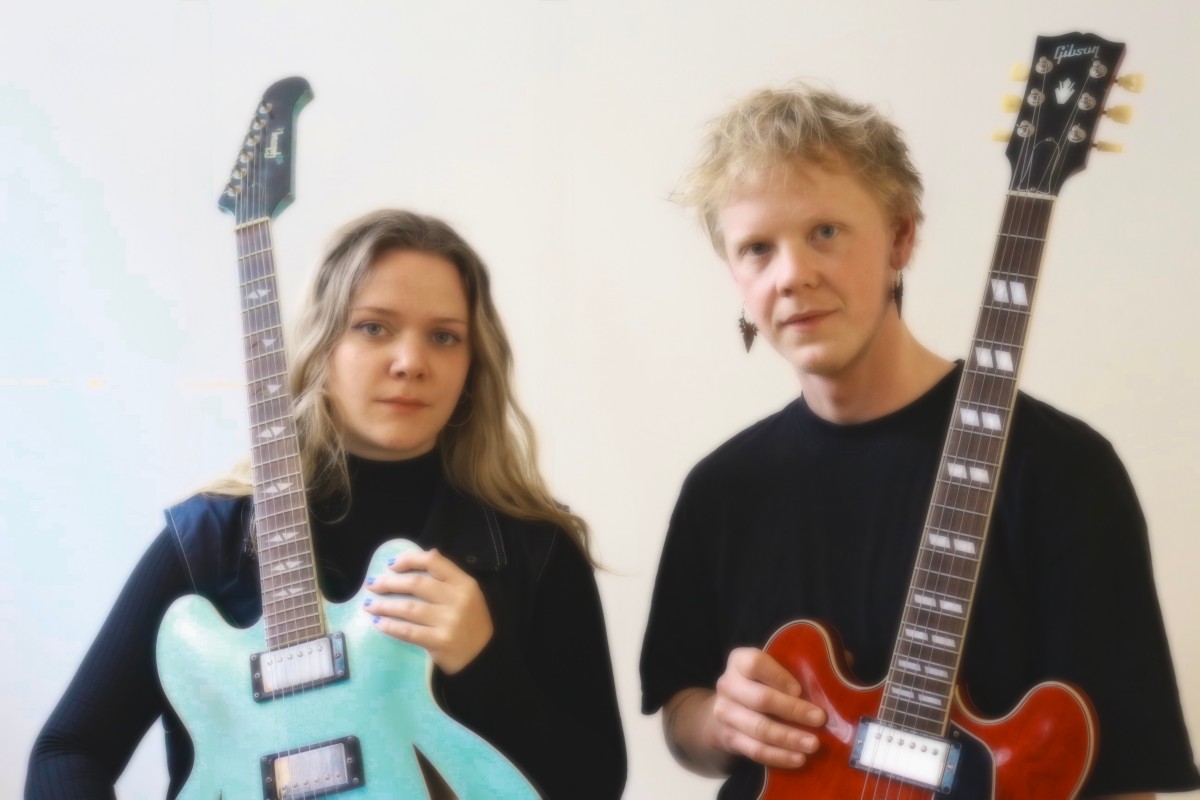
One of the more remarkable guitar collaborations of 2026 is ‘Dark Yellow: Music for Two Guitars’, the duo album of Ella Zīriņa and Teis Semey. Despite being known for vastly different approaches on their own material – Zīriņa for her exquisite sense of melody, Semey for his fearless experimentation – their guitars come together in a harmonically pleasing and natural-sounding way.
“We started playing together because we have just been around each other for so long in the guitar world of Amsterdam”, Semey explains. “I think we knew of each other really well, and we were also in the same school for a bit. We met up and played here and there. It’s just a close-knit community. It’s like asking a couple when their first date was: they don’t always agree.
But I think the first concert we did, where I really felt that this had to be a thing, was the initiative of the venue, actually. A place called Dox Under the Tracks, from Dox Records. I think they asked me to organize something, and I suggested doing the show with Ella, or vice versa. But we have known each other for so long through the extended guitar scene.
To me, it just felt very obvious that we had to do something together, but the perfect time to organize it wasn’t there yet. So that took another half year or year, playing various gigs here and there, where we kept doing this. And then at some point, we thought: you know what? Let’s write some songs. Let’s do this.”
Expressing Things Differently
“It’s not like we knew that this was going to work together”, Zīriņa says. “I really admire Teis’ playing. Maybe it’s a bit different, but I see a lot of the same language guitar-wise as well. Also, we had just played together, and for me personally, it felt really organic and easy to play with him. I feel that he has this very spontaneous way or playing. Or he is going for some kind of idea, and I don’t expect it, but then that also just inspires me to go somewhere else I wouldn’t go otherwise.
So it’s challenging, and I always have to listen to him. Sometimes duos really go for what’s comfortable, but I feel like this duo really challenges me. It’s kind of hard to explain, but it just works together. It’s not a matter of knowing, it’s a matter of playing and finding something that’s right.”
“I feel the same”, Semey nods. “The first few times we played together, I could hear that we kind of grew up listening to similar music, we just express it differently. For me, it’s really comfortable to have a place to express myself where I don’t have to put on this jacket of extremely wild, aggressive guitar playing. It feels very natural, and it’s a comfortable place to explore different worlds, be creative and challenge each other.”
Co-Creation Space
“I see myself as a bit of a composer”, Semey says. “Or at least I have always been writing music, and I’m personally really interested in trying to break that jazz idiom of just doing a few courses and then soloing over it. I think there is more to get from compositions. And then you can still have all the themes, all the melodies and all the solos, but kind of arrange it in a different way. That makes it more interesting to me.”
“We both brought a couple of compositions to the sessions”, Zīriņa explains. “And Teis also had small sketches, with things like polychords, or he would play a layer, and then let me play another layer. We had a couple of pieces, but not every idea came out the way we wanted it to. But there are also things like Teis’ piece ‘Arpeggios for Two Guitars’, which is based on one idea, and each of the parts has a really clear idea of how it functions.”
“We would bring in a bunch of pieces that were written for the two of us, and ideas that we had”, Semey adds. “For me, it was a matter of bringing in ideas or pieces that I had a specific idea for, but then also bringing them into this kind of co-creation space, and just see where that goes. What happened when we started playing them live is that every single song just went somewhere new. That was even better.”
Building Something Together
It might not be too surprising that Zīriņa was going to record a duo album at some point, as ‘Nine Stories from Maarten van der Grinten and Jesse van Ruller’ was one of the key things that inspired her to study music in the Netherlands. “Maybe that was somewhere in my subconscious”, she says. “But for me, this duo just felt exciting. I wanted to make it happen. I wanted to invest energy into it. It felt inspiring. It’s just a different feeling.
So I don’t know if it was always a plan, but when we started talking about the idea, or when we started playing together more often, it felt like it was something I really wanted to do. It’s super fun. I enjoy it. I feel it in my heart that this is the right thing to do.
Somehow, it’s also just a really comfortable setting. I love to play solo, but this is even more comfortable. You add another guitar, so there is the interplay, and the guitar still shines, but there is someone who is supporting you. There is the interplay of building something together. That’s where the two worlds of what I love come together.”
Room for the Natural Sound of the Guitar
“This way of digging into a much more organic guitar sound, and kind of like a foresty way of playing, with all these small extra things and details, is a thing I don’t feel like I often am able to really get out when there’s a whole band blasting behind me”, Semey says. “Also, the music we play as a duo is specifically written for this. There are pieces that I don’t think I would be able to do with other projects.”
“For me, it was actually much easier to find my place”, Zīriņa says. “At least, I felt like it was. Also, there’s just two guitars. It’s very much what it is. It feels like there is more room for the natural sound of the guitar, even if we play electric guitars. Possibly because I’m used to playing in a trio, and there’s always drums and bass. Not that it obscures some frequencies, but ultimately, I end up playing a bit different.
This setting is in a way very intimate. So the guitar is just what it is. Because of that, I feel like I have a lot of space for nuances and details. And in a way, it’s also simpler, because there are not so many issues with the volume, for instance. It feels very balanced for me. The two-guitar setting was very easy for me.”
Accentuating the Contrast
“Despite the different sound, my set-up is near-identical for me”, Semey admits. “Guitar into a Deluxe Reverb ‘65 reissue, and that’s it. I think Ella has pretty much exactly the same set-up.”
“Yeah, the only difference is that I also played classical guitar on two songs for these fingerpicking things”, Zīriņa confirms. “Usually, I don’t do that. Maybe I have done a recording of it once before, somewhere on a solo records, but never in a trio or a band setting. So this was a really cool thing to bring to this duo, because I think this works really well. It even accentuates the contrast between the two types of guitars even more. It’s really pretty. I like the combination of the classical and the electric guitar parts.”
“It blends so nicely”, Semey nods. “It’s the way I always wanted it to sound, but it’s so difficult when you have a band blasting behind you. So I always end up in this very aggressive place. Because I like it when everybody else plays loud, but then it’s really difficult to be soft and subtle. I think that’s part of why I like the duo as well. It really gives a nice blanket to just play guitar dry through an amp. It feels like it can be so warm and thick and comfortable-sounding. It’s a cool thing how natural electric guitars can sound sometimes.”
“And the colors are also fun”, Zīriņa adds. “Great contrast. It’s great.”
“For me, at least, it’s also a conscious choice to play with as few effects as possible”, Semey emphasizes. “Just to really highlight the personalities behind the guitar, and not so much hide behind a blanket of additional effects or something.”
A Secret Homage
One of the songs on ‘Dark Yellow’ is the duo’s interpretation of ‘I Loves You, Porgy’ from the Gershwin opera ‘Porgy and Bess’. Zīriņa already interpreted the song on her debut album ‘Intertwined’. “We just ended up playing this song”, she says. “It wasn’t even like we needed to have an additional song on the album. We just thought: okay, we both know it, so let’s record it. It was nice to play, and we just ended up playing it. It was beautiful.
Maybe that’s the fun thing about playing jazz standards, or taking music that has been written by someone else. You know you have this common language. You know these pieces, so you can just play them with anyone else you meet for the first time and create something new, and connect this way. It’s not very different from what I maybe could imagine the song to be, but it still is a very different approach to play it in a duo setting. And I just love the song.”
“For me, it’s almost like a secret homage to Ella”, Semey smiles. “One of the first times I heard her play was when we were still students, and there was this masterclass with John Scofield where we both played for him. I remember Ella coming up and playing ‘I Loves You, Porgy’ for him, and I was just shocked about how lyrical she was.
I just couldn’t get over how good everything was sounding, and how real it was. I remember it to this day, the feeling of hearing her play and thinking: oh my god, this is so beautiful! What is she doing? So I always really wanted to play that song with her.”
The Same Interpretation of a Personality
“Most songs were done in two or three takes”, Semey says. “Only ‘Dark Yellow’ took a bit longer. When a song has a bit of a bit of an ambivalent personality to it, then it’s hard to find out how to express it in a way where both people have the same interpretation of that personality. We actually did two recording sessions, and it was about finding a way to highlight the character of the song while still being comfortable in that world at the same time.
It’s not that it didn’t click with the first ones, but it just needed some time. Also, for me, it took some time to feel comfortable tempo-wise. It’s a tricky tempo, because there are so many small things that are happening, but it still has to be a bit brisk, and not get lost in the small details. It was about finding a way to incorporate everything into the song. That took a moment to settle, I think.
But I think that’s also the way we approached it. It’s not about playing the song perfectly; it’s more like a weirdly spiritual way to find out what the personality of the song is, and let that be a comfortable space for us. Because I think that if we can trust it, and we feel comfortable with it, then it can project to a listener. Also, it’s just fun to do different takes of different things.”
A Relatively Low Success Rate
“The recording set-up for both sessions was the same”, Semey explains. “And pretty simple, because there are only two guitars. So it wasn’t really an issue to do as many recordings as we wanted. It was all recorded in my studio, so I also did some sound engineering here and there, and mixing. It’s so convenient. It’s nice, because it allows you to really focus on the music. You don’t have to spend half a year fundraising, fixing studios and planning things. It’s very easy to just focus on the music and the playing of it.
Also, I never really liked guitar amps in studio rooms. They deaden the sound so much. It often sounds so digital and electric. And I think a guitar amp in a wooden room is the most heavenly, beautiful thing. That’s always how I practice as well, so that’s who I want to hear my guitar. I get that sound in my practice space, so that’s where I want to record guitars. I also want to put down the mics myself, and I want to make sure I like everything. I have a relatively low success rate with audio engineers and guitar sounds. My own success rate is higher.”
“Since we did this more DIY, we could really choose to go: hey, I don’t like my sounds, can we do this, this, and this?”, Zīriņa adds. “It’s much easier to do than in the studio, where sometimes, there is also time pressure, and your drummer needs maybe three hours to properly set up. So it was really easy-going, and it felt like it was much easier to communicate if you needed something else in your sound.
Like Teis, I love the sound of just having the guitar as it is. Not having fancy rooms, or going through some kind of digital system somewhere in the basement. Sometimes that adds to the music, but this time, for this setting, this was the perfect character for the music.”
Nuggets of Guitar Things
While there aren’t any extensive touring plans yet, the first few shows with the ‘Dark Yellow’ material have already been played. “There are many more songs that we can add live, that we also have in the pocket”, Semey says. “Also, the live situation gives you the chance to open up a lot of things and experiment more. You get to take songs into a different world. That’s not impossible on an album, but personally, I also like albums to be a bit concise.
Live gives us the opportunity to open every little section and let them flower into nuggets of guitar things, and explore in all kinds of different directions. It’s nice to have the time to do that. And there’s more songs. So it wouldn’t be hard to play a two-hour set with these.
If you play with a rock band, you put a song in your setlist, and you know it takes three minutes and forty-six seconds. That does allow for a lot of really cool ways of doing live shows too. But I really enjoy the idea of playing live as a space where you can also do something new for an audience, and also react to that audience: how they’re feeling, what the vibe of the room is, and then explore that.”
An edited version of this interview appeared in Gitarist 424 (July 2026)
 Kevy Metal
Leave a comment