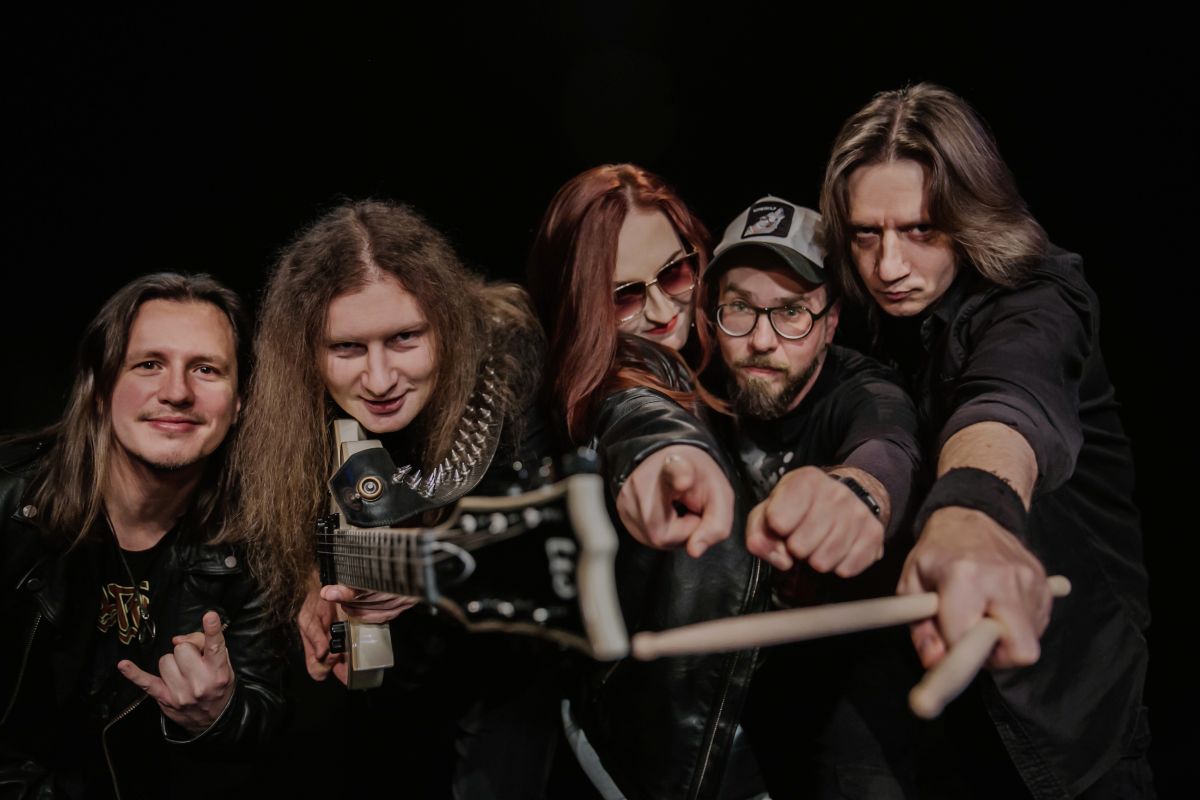
Ever since the release of their 2022 debut ‘Ślad’, Slave Keeper has been one of the most promising hard rock and heavy metal bands in Poland. Having just wrapped up the touring cycle for their strong sophomore album ‘Podwójna Gra’ (2025), the quintet hopes to continue the upward trajectory. Guitarist Piotr Jakubowicz tells us about the past, present and future of Slave Keeper.
“With our first album, we set the bar quite high for ourselves”, Jakubowicz says. “Although the truth is that it exceeded all of our expectations. Originally, it was meant to be a record ‘for the drawer’ – something for ourselves, our families, and our friends; a lasting souvenir of the band’s work. Instead, we sold out two pressings, and due to continued demand, we are already considering another reissue. That success meant that the second album became something of a test for us. We knew people would be paying attention, so we did everything we could to rise to the challenge.
We also became much more confident in our own identity. During the making of ‘Ślad’, we were still discovering what kind of band we wanted to be. By the time we started working on ‘Podwójna Gra’, we had a much clearer vision of our sound and strengths. Without a doubt, ‘Podwójna Gra’ is a more mature, cohesive, and carefully crafted album. It reflects the growth we have experienced as musicians and as a band. We gained valuable experience from recording and releasing our debut, and that allowed us to approach the new material with much greater confidence and clarity.
The album was also created under very different circumstances. The songs were written in a significantly shorter period of time than those on our debut album, and the recording process itself only took nine months. Compared to our first album, everything was more focused and efficient, while still allowing us to maintain the level of detail and care that is important to us.”
The Initial Spark
“There are no strict rules when it comes to our songwriting process. Every Slave Keeper song is the result of collective effort and shared ideas. Usually, one band member brings the initial spark for a new composition. Sometimes it’s a vocal melody, sometimes a guitar riff or a bass intro, and sometimes just a distinctive rhythm. From that point on, everyone contributes and helps shape the final version of the song.
Maybe we are a bit old-fashioned in that regard, but for us, a band is something more than just five individual musicians. We don’t argue about who came up with a particular melody or who wrote a solo. With only a few exceptions, where the lyrics are written by someone outside the band, both the music and lyrics are credited simply to Slave Keeper. This reflects how we see ourselves: as a group creating together, rather than a collection of separate authors.
The vocal abilities of Marta (Biernacka, singer) give us enormous freedom when it comes to songwriting. She is an incredibly versatile singer with a wide vocal range, excellent technique, and remarkable consistency. Because of that, we rarely have to limit our ideas to what is technically possible for her. More often than not, Marta finds a way to bring those ideas to life.
When Piotr (Szalak), our drummer, and I founded the band in 2014, we knew from the very beginning that our musical vision required a truly strong vocalist. That is one of the reasons why the final line-up did not come together until early 2016, when Marta joined the band.
Since then, she has continued to develop and surprise us with what she can do with her voice. What she has been delivering at our most recent shows has left not only us, but especially our fans truly amazed. We are already looking forward to the next recording sessions, because we feel there is still more of that incredible voice to capture.”
Obsessive Perfectionists
It took Slave Keeper another six years to release their debut album. “The first two years were spent completing the line-up and writing our first songs”, Jakubowicz explains. “The years that followed were dedicated to developing the material and playing occasional shows, both locally and further afield. Along the way, we recorded a few songs live in the studio, but the idea of recording a full-length album did not really take shape until 2018. After some minor health-related setbacks in 2019, we finally began working on the album. In the end, the recording process took nearly three years.
First of all, we had absolutely no idea what we were getting ourselves into. We wanted the final result to meet a high quality standard, but we were learning the entire process as we went along. Secondly, nobody was rushing us. We did not have a label setting deadlines, so we could work at our own pace. Then, of course, the pandemic hit the world and disrupted everyone’s plans. And finally, we are obsessive perfectionists. We tend to keep refining details until we are convinced that they were exactly as they should be.
Looking back, I do not think we were intentionally waiting until we were ready. The album simply came out when we felt it truly represented the band and met the standards we had set for ourselves.”
Good Old-Fashioned Loudness
“We are not particularly obsessed with gear. For us, the player and the song always matter more than the equipment itself. But at its core, the Slave Keeper sound comes from a very traditional setup: guitars, bass, drums, and vocals. Those elements are the foundation of everything we do.
That said, we are not afraid to expand the sonic palette in the studio. We often incorporate synthesizers, symphonic arrangements, choirs, and various atmospheric effects to add depth and character to the songs. These elements help us create the mood and dynamics we are looking for without losing the heavy metal spirit at the heart of the music.
Overall, though, our approach to heavy metal is quite traditional. On stage, we still rely on tube amplifiers and good old-fashioned loudness. There is something special about that raw, organic energy that is difficult to replicate any other way. It is part of what gives us excitement as performers, and that energy is something we try to share with the audience every time we step on stage.
There is no strict division of roles between Piotr (Miećko, guitarist) and me. We develop the guitar parts together and try to complement each other as effectively as possible. Both of us play riffs, both of us play solos, and we are happy to switch roles whenever a particular part suits one of us better. Rather than thinking in terms of ‘rhythm guitarist’ and ‘lead guitarist’, we focus on what serves the song best.
The essence of our collaboration can probably be heard in the twin guitar harmonies that have become a characteristic part of our sound. We grew up listening to bands like Iron Maiden, and we still love that classic approach to guitar interplay. Those harmonized melodies are often the moments where our musical partnership is most evident.”
Adapted for the Stage
“Our songs definitely sound different on stage than they do on the album. And in my opinion, that is a good thing. After all, people come to a concert to experience a live performance, not to hear a perfect recreation of a studio recording. We have never tried to hide the fact that we enjoy elaborate arrangements, and fortunately, modern recording technology allows us to bring many of those elements to the stage as well.
We use samples for the parts that simply cannot be performed by five musicians alone – choirs, orchestral arrangements, and various electronic embellishments. Everything else is played live. Occasionally, some guitar arrangements are adapted for the stage because the studio environment allows for more layers and overdubs, but I would not say the songs lose anything because of that.
In fact, we much more often hear people say that there is even more fire and energy in our live performances than on our records, which is probably the best compliment a metal band can receive. The goal has never been to reproduce the album note for not. The goal is to deliver the strongest possible live experience, and I think our songs benefit from that approach.”
Communicating Emotions Effectively
Despite the English band name, the vast majority of Slave Keeper’s lyrics is in Polish. “We originally planned to write and record our songs in English”, Jakubowicz nods. “However, we moved away from that idea fairly quickly. Polish is our native language, and it simply allows us to express ourselves more naturally. Writing lyrics, conveying emotions, and telling stories feels much more authentic when we do it in our own language. For us, the emotional impact of a song is more important than reaching the widest audience, and we believe we can communicate those emotions most effectively in Polish.
That said, traces of our original plan can still be found on our debut album. Two songs – ‘Heaven’ and ‘Watchmaker’ – remained in English and serve as a reminder of the direction we initially considered. We are not opposed to recording more songs in English in the future, but for now, Polish remains the language that best represents who we are as a band.
I think music performed in a more exotic or unfamiliar language can actually be something initriguing for many listeners. While English is undoubtedly a very effective language for rock and metal music, and the lyrics are naturally easier to understand for an international audience, we have been fortunate enough to gain many fans outside of Poland despite singing primarily in Polish.
What matters most is whether the music itself connects with people. A powerful melody, a memorable chorus, or an emotional performance can transcend language barriers. In our experience, many listeners are willing to give music a chance even when they do not immediately understand every word.
Fortunately, modern technology has also made things much easier. These days, translating lyrics on a phone takes only a few seconds, so the language barrier is far less significant than it used to be. Because of that, I think listeners are becoming increasingly open to bands that choose to perform in their native languages rather than English.”
Inseparable from the Human Experience
“Neither of our albums was designed as a concept album – at least not intentionally – but both ended up having a strong thematic coherence. ‘Ślad’ (‘Trace’) was intended to be exactly what its title suggests: something that we, as Slave Keeper, would leave behind for future generations. The songs explore themes that are inseparable from the human experience: dreams, struggles, love, loss, and the passage of time. In many ways, it is an album about life itself and the marks we leave behind.
‘Podwójna Gra’ (‘Double Game’) revolves around a different central idea. The album cover depicts a devil and an angel playing cards, both held by our Keeper figure. In this case, the Keeper represents every one of us. The album explores the dual nature of humanity: the constant struggle between good and evil that takes place within each person. Ultimately, each of us becomes the arbiter who decides the outcome of that game.
Looking at both records together, I would say that our lyrics are primarily focused on the human condition. We are interested in the choices people make, the emotions they experience, and the internal conflicts that shape who they become.”
An Encouraging Trend
Slave Keeper’s hometown of Lublin is not traditionally one of the metal hotspots in Poland. “The metal scene in Lublin has definitely been growing stronger in recent years”, Jakubowicz emphasizes. “And we are very happy to see that happening. One thing I particularly appreciate is that there is very little sense of rivalry between local bands. Instead, there is a spirit of cooperation. We support each other, share opportunities, play shows together, and generally try to help the scene grow as a whole, rather than compete for the same small piece of the audience.
Lublin may not be as widely associated with metal as cities like Katowice, Poznań or Kraków, but that also gives the local scene a certain character. Bands often have to work harder to make things happen, which creates a strong sense of commitment and community. Over the last few years, we have seen more concerts, more active bands, and growing interest from audiences. It is an encouraging trend, and we hope it continues, because every strong local scene helps strengthen the Polish metal scene as a whole.
One advantage of being from Lublin is that we are not constantly compared to dozens of other bands from the same scene. It gives us a little more room to develop our own identity.”
Not Even Dared to Dream
The seal of approval from one of Poland’s greatest metal legends has already been earned, with former Turbo and current CETI singer Grzegorz Kupczyk guesting on ‘W Obliczu Wojny’ from the debut album. “To be honest, we still ask ourselves how that happened”, Jabukowicz smiles. “The idea originally came from Łukasz Suszko, the man responsible for the sound on both of our albums. During one of our recording sessions, he suddenly said something that left us speechless: I can hear Kupczyk singing this song.
As it happened, Łukasz had worked with Grzegorz before, so getting in touch with him was actually possible. At first, Grzegorz politely agreed to the idea, but I had the impression that he was not particularly excited about it. Then came a rather long period of uncertainty. For two or three months, we had no idea whether anything would actually come out of it.
Finally, one day, he listened to the song itself. His reaction completely changed. He became genuinely enthusiastic about the project and recorded all of his parts within just two days. The final result exceeded everyone’s expectations, including those of one of the greatest legends in Polish heavy metal. As lifelong fans of Turbo, having Grzegorz Kupczyk appear on one of our songs was both an honor and a dream come true. To be honest, we had not even dared to dream about it.”
A Huge Sense of Unfinished Business
“We have just wrapped up our nationwide ‘Podwójna Gra’ tour. Over the past few months, we have visited numerous cities, played for fantastic audiences, and gathered experiences that make us very optimistic about the future. The response to the new album and the tour has exceeded our expectations and has given us even more motivation to keep moving forward.
In the coming months, we will play some summer open-air shows. After that, we plan to divide our time between performing live and working on new material. We would feel a huge sense of unfinished business if we stopped after just two albums. There are still plenty of ideas waiting to be turned into songs, so it is safe to say that we are already getting back to work. The story of Slave Keeper is far from over.”
 Kevy Metal
Leave a comment