
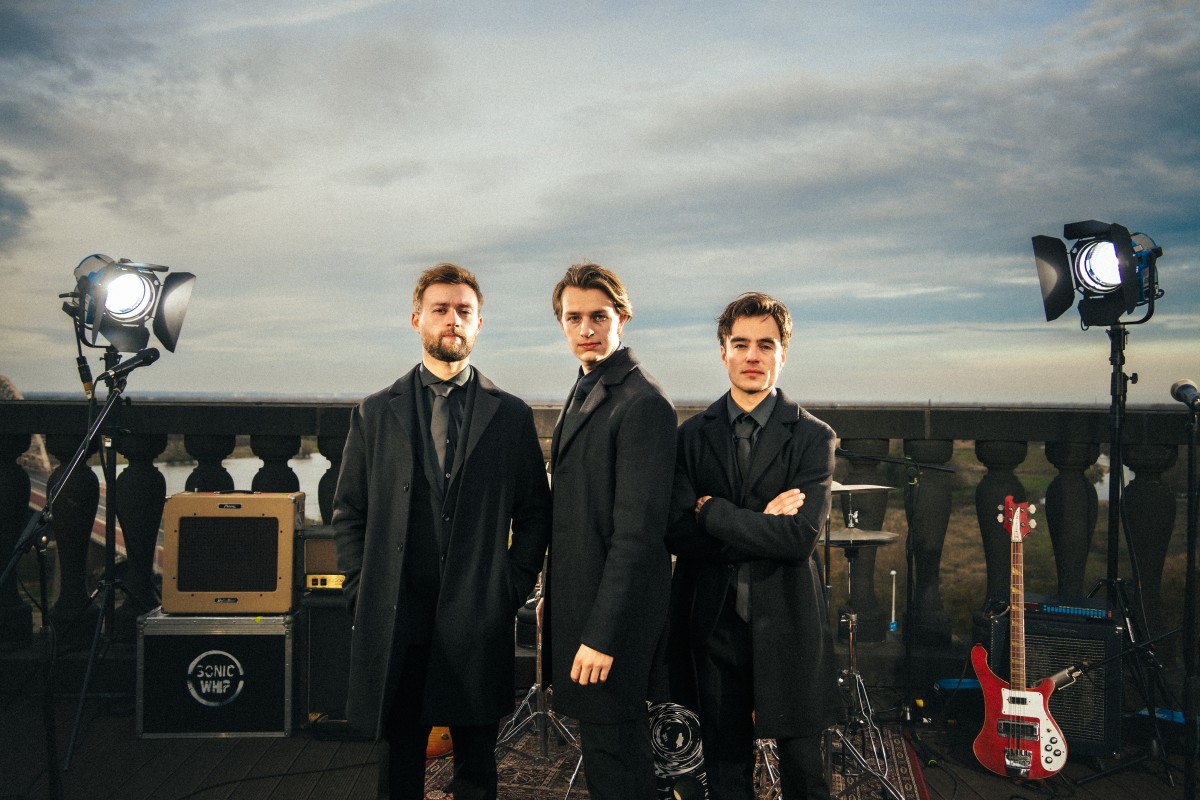
Dutch rock trio Sonic Whip approached their self-titled second album as a new beginning, one characterized by the sound of their energetic live shows first and foremost. The band shares their story about recording the album.
“For our first album (‘Triskelion’, 2021), we allowed ourselves to dream big”, singer/guitarist Meryn Bevelander explains. “So we asked ourselves: what do we want to do? We were big fans of Navarone – we still are – and they recorded ‘Oscillation’ at Sandlane Recording Facilities in Rijen. We thought that album sounded awesome. So we thought: let’s aim high and record there as well.
Navarone recorded every song on ‘Oscillation’ layer by layer, with the exception of ‘Days of Yore’. That’s what made the sound so punchy, which is something we thought was really cool. We have done the EP (‘Spinning Around’, 2023) the same way: we recorded guide tracks at home, then Florian went ahead and recorded drums for two days, after which I recorded by guitar parts, Kevin recorded his bass, and then I started singing. That was all done bit by bit.
This album feels like a new beginning. We felt that we are at our best live, and that’s what we enjoy most about making music. The foundation is the three of us, in one room, looking at each other, feeling what the others will do and reacting to that.”
Vision of Recording Music
“When we were on tour in England, we got in touch with producer Michael Smith”, Meryn continues. “A DJ at Radio Wigwam had played us to him, and he came to watch a show of ours in London. We briefly met him before the show, and we already talked about his vision of recording music. He’s a very old school guy, who is very focused on the creation process. His vision was a good fit for us. After the set, he approached us and said: I want to make a record with you guys. That’s when the fire was truly awakened.”
“It wasn’t something we thought out too much”, bassist Kevin Clerence adds. “We had the songs and the demos, but the cool thing about recording something with each other, is that you can react to each other, but also that things develop in the moment. When that happens, maybe not every detail is perfect, but it’s something you came up with together, and that’s what makes it great. I think that’s the feeling of this album: very organic, rather than being very on the grid.”
“Whenever I listen to this album, it feels like we are there recording the album together”, Meryn says. “I have recorded almost every guitar solo lie as well. The moment I played that solo when we did ‘Jump in the Fire’ is very clear in my memory. Knowing that you did all of that together is a very rewarding feeling to have as a musician.”
A Ghost Studio
‘Sonic Whip’ was recorded at the GAM Studio in the Belgian Ardennes. “We needed a place where you could sleep as well”, drummer Florian Bevelander explains. “So we could be in a selective bubble, without any distractions, for about two weeks. However, a few weeks before we were scheduled to record, the place got robbed. Nearly all microphones were stolen. Fortunately, Michael was able to bring most of the things that were missing from England. But in the end, it turned out that more things were missing than what was originally communicated with us.”
“It was kind of a ghost studio”, Meryn nods. “At first, we thought: what should we do now? Michael told us we had a few options: either we schedule a new recording, but there’s a risk that everything had already been booked, or we would go ahead and do it anyway, and he would bring the stuff that was missing. So that’s what we ended up doing.
The studio was freezing cold. We recorded in the winter months, in February, and there was snow everywhere. It was a gorgeous view, but the building wasn’t ready for a winter recording. The living quarters were heated by a pellet heater, and the studios weren’t actually heated at all. They all had separate radiators. It was probably literally freezing at night, and then we turned the radiators on in the morning, so temperatures went from zero to twenty degrees, and we quickly had to make use of everything that worked.”
“I never broke as many cymbals as I did for this album”, Florian smiles. “Which is something I never do, despite hitting quite hard. But on day one, I already broke two of them. Since I never break any, I didn’t have any spares with me, but Wouter Derks from Stockenhoef Muziek in Nijmegen really helped me out there.”
“There was a day on which we couldn’t record all afternoon, because the WiFi wasn’t working”, Meryn adds. “But everything turned out great in the end. It’s a fantastic place to record music.”
“All of that is part of the magic of the album”, Kevin concludes.
Constantly in a State of Being Finished
“Michael brought an engineer, Marco Viscito, who engineered a lot of things”, Meryn says. “Whenever we were done doing a take, he would clean up the session, edit things a little bit, and prepare the projects to record vocals. Because of that, we could always record something else whenever something happened – broken cymbals or other things that would prevent us from recording. We could just go for what felt right, because everything was constantly in a state of being finished.
That was a really pleasant way to work, because it keeps you in a creative flow. Whenever we would lose the focus to keep recording as a band, we could go and record some vocals. Or vice versa: if my voice doesn’t quite work the way I want it to and there’s probably not another good vocal take in me for the day, we could go and record percussion.
Because of that, there was always something else to do, which kept the whole process feeling very organic. Recording everything separately results in having blocks of recordings. But that also means you have a block of recording vocals at the end, which means you have to sing the entire day for a couple of consecutive days. That can be very intensive. It kind of was now as well, because the vocals are always the last thing that gets recorded, but since you can go ahead and record vocals on day four or something, it becomes slightly less intensive.”
Surprises in Songs
“Since we wanted to capture our live sound, we only brought my two amps, which are a Peavey Delta Blues with a 15″ speaker, a combo, and a Marshall JCM800 from the eighties. Those Delta Blues amps have been discontinued, but they are amazing. The basic take was almost always a Maybach Lester, a Les Paul copy, over that Peavey. Michael’s vision on double-tracking was that we needed a slightly different sound in order to make everything sound bigger, as having the same sound in stereo might cancel each other out, making it almost sound like mono.
So what we ended up doing was one take on the Lester with the Peavey, then one dub Les Paul with Marshall, and one more take with a different guitar over the Peavey. That way, I had three slightly different sounds that formed the foundation of the guitar sound on the album. I have experimented with effects a little. Michael brought an Electro-Harmonix POG that allowed us to record a very heavy, low-pitched extra layer to give things a little additional push, but still gave us the option to level things, so you won’t just hear octaves when you hit a chord.”
“It’s really mostly the backline”, Florian emphasizes. “It’s also the first time I use my complete own kit. I did bring it to Sandlane, but they’ve got a hundred thousand snares and kits there, so we ended up using a mix of different things. This time, we only went for our own instruments.”
“You can hear that too”, Kevin assures. “When I hear Meryn play on this record, I truly hear him like he plays live as well. The same with Florian, as our live sound is so characteristic. So we haven’t been very experimental when it comes to equipment. We did allow ourselves to experiment with parts, however, as not everything was planned down to the finest details. There are some surprises in songs that we have added on location. That’s the most experimental part of the album. That and the percussion.”
Space to Grab
“The most important thing about creating music together and listening to each other is knowing your place”, Meryn states. “And it’s really fun to discover that. When recording as well, just listening to each other and thinking: oh, those guitars sound really big here, let me look for a little more definition. That is what I might find the coolest thing about making music: being able to listen to the music, your fellow musicians, and how everything sits together.”
“Especially in a trio”, Kevin adds. “If we would have added a keyboard player, my function as a bass player would change significantly. Now that there are just three of us, there’s quite a bit of space you can just go ahead and grab. That’s what I do sometimes. And sometimes I don’t. That’s something we have spent a lot of time figuring out. I end up playing a third instead of the root note on a chord sometimes. If I did that for a pop act, I would have been fired, haha!
The one downside to playing in the moment like we do is the moment you come home and think: what the hell have I actually done? Haha! Then you have to study on what you actually played. There are times when you wonder if things will sound as lively without the additional layers, but I think that will work out fine.”
“What I think helps is that the three of us already played these songs together”, Meryn assures. “When you’re recording layer by layer, you tend to think: let me add this, or a synth part. I remember that there were parts on the EP that we added that turned out to be main parts of which I thought: how am I going to do this live? Or should I compensate that with my vocals? In that regard, things have become a bit easier.”
An edited version of this interview appeared in Gitarist 423 (June 2026)
 Kevy Metal
Leave a comment