
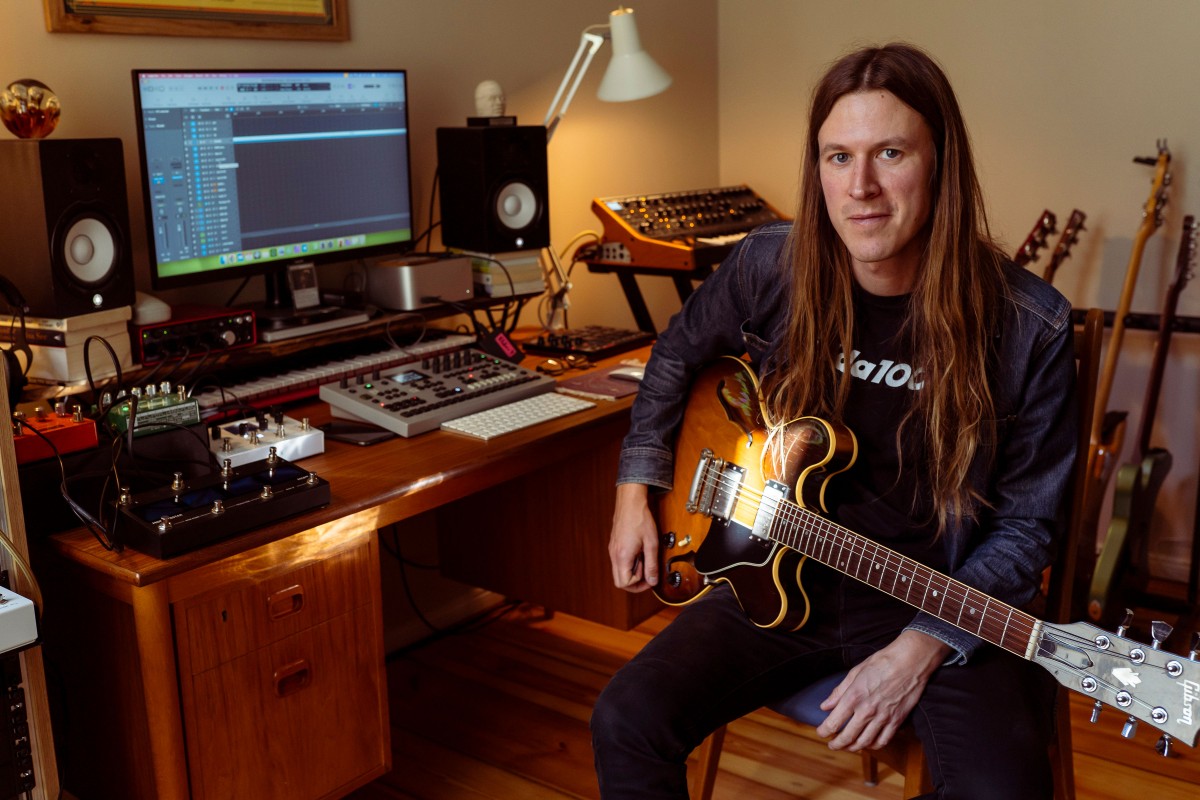
On their seventh album ‘Through Zero’, the originally American, but now Germany-based psychedelic progrocker Elder sound more transparent and dynamic than ever. According to singer, guitarist and main songwriter Nick DiSalvo, this is the sound Elder had been chasing for quite a while now.
“This is the first record for which we basically sat in the driver’s seat for the entire process”, DiSalvo explains. “Including mixing the record. Normally that’s something we mostly let the engineer shape. This time, we actually had the sessions with us while we were on tour. We all have our own kind of ad-hoc home studios too, so we had much more of a hand in crafting the sound of this record than any one that we have done before, and probably had more personal control over the sounds than on any other Elder record.
I feel like we have gotten closer to the sound that I have been chasing on an Elder record for some years: big, fat drums, super-saturated, juicy guitars, and lots of synths, but still very tight and cohesive. It has got to all sit together, or else it’s not gong to have the same impact.
Off and on, I think that kind of a pitfall for us on the last couple of records was that we didn’t consider the live situation at all. And I really wanted to make a record were the songs were going to translate super-well live. Because that’s what’s important to us when we’re making a good record: the live experience.
The songs in our catalog that really have become classics that people always want to hear live, are the ones that translate well to a live setting. So we thought about: without having to dumb down our music, how are we going to make songs that sound like us and are also going to translate well when we play just the four of us? Or the five of us, in this case, because we will have a keyboard player joining us for the next tour.”
Strange Positions and Cramped Configurations
“At this point, I would say that I am the main songwriter for the band. I write most everything. Things get changed, obviously, in the process of us working on the songs together and recording them. But the actual compositions, that usually happens in a kind of isolated manner. I’m sitting at home, writing a lot of stuff on my own, and then we’ll meet down the line to work on the songs once they have reached a more completed point.
To get these tightly interwoven guitar lines, it’s a lot of looping. Also, oftentimes, I write with different instruments. I might write guitar parts on keyboards or something, where I find a different layout of notes helps me create more interesting patterns than by just using a guitar, which I’m much more familiar with. That’s where I find myself in strange positions and cramped configurations on the fretboard by the time I try to transpose it over there.
There are solos, there are some jams, there’s some improvised stuff: that’s the stuff we jam on together in the studio. The division of guitar parts is also something we decide later on down the line. I’m much more of a meat-and-potatoes, riffy guitar player. Michael (Risberg) has got a bit more finesse, a more psychedelic kind of style. He’s got a lighter touch, and more of an ear for improvisation. So I tend to give him the parts that I think will fit his style. My guitar parts are often very much together with the rhythm section.”
A Broader Range of Tones
“My rig and the way I make dirty and clean sounds have changed. I used to just run an amp 100 percent dirty: an old Sound City amp that had a master volume, pre-gain cranked all the way up, and the only thing I would use to attenuate the gain was a volume pedal. Basically, the sound was always dirty, and it only got dirtier from there.
Now, we have a broader range of tones. And since the music is a little more intricate, we have had to kind of figure out how to get more articulate gain tones, where you can hear picking patterns, or you can actually make out chords through a hundred guitars and crashing drums and everything else going on. It doesn’t feel to me like we are that much cleaner, but there is definitely a lot more diversity in the sounds going on.
We’re in rehearsals right now, and one of the main things we’re trying to spend a lot of time on is getting the sounds just right, and making sure that there’s a very wide kind of sound stage, and a lot of work on those dynamics, and making that shine through in every regard for the upcoming live shows. In the studio, it’s much easier o twist knobs and experiment and change levels.
Live, the minute you start playing, there is adrenaline, and everyone just starts playing louder and louder and louder, and it never really comes back down. Or at least, this is my experience. So we’re trying to work on that as well.”
Swiss Army Knife
“These days, I’m using a Hiwatt, and I’m running it very clean, and I’m using it purely as a pedal platform. That’s what those amps are great at. So that way, I can still have a nice classic tube amp, and I find that I can get everything from the crunch and fuzz tones to a nice clean tone.
The songs had gotten so complicated over the years, I needed to find an easier switching system, something help coordinate all the pedals and effects. Back in the day, the songs were simpler, it was easier to just add a couple of stompboxes and a loud amp, and that was it. Nowadays, it’s just a little more complicated, and we want to make sure that all the songs sound as cohesive as they do on the record.
The clean amp with pedals has been my favorite solution for that. Also, if you do a fly-in gig or something, it’s a lot easier to find another amp and to let it just do a clean sound than it is to try and chase your perfect amp you only had one of, and you’re never going to be able to recreate.
I find the Hiwatt is kind of lifeless on its own with no help, unless it’s super-loud, so I have an Origin Cali76 compressor before it. And I always have a pre-amp pedal on as well, a Chase Bliss Automatone Mk II. I use that for ninety percent of my life sound. It’s got a really nice fuzz circuit in it as well, and it’s got a parametric kind of EQ, and a couple of different diodes.
You can really dial in most classic overdrive pre-amp and fuzz sounds with that one pedal, so that’s become my go-to Swiss army knife kind of thing on my pedal board.”
A Pretty Straightforward, Classic Sound
“My base guitar tone is Marshall-style, British overdrive. And a lot of delay. Elder is a very rhythmic band. A lot of the parts have kind of an interlocking feel, and that’s because there is a lot of delay meshing with the drum rhythms as well. But we have what I would call a pretty standard, straightforward classic rock or heavy metal sound.
I really like this classic sound. Nothing too modern, nothing too high-gain. Even though we are a modern band playing progressive rock, we want a sound that gives more nods to old school seventies, eighties stuff than modern prog rock and metal. We don’t see ourselves as having much to do with that. I don’t know if that comes through, but that is definitely my intention. We love experimenting with effects too, but the basic sound is pretty straightforward, I think.
Despite experimenting a lot, I think I more or less have had a very similar rig over the last ten years at this point. Maybe that’s just because I relocated from the States to Germany and left all of my amplifiers behind. I was playing an old Marshall JMP back in the States, and I had a Sound City, and then I came over here, and you could find Hiwatts pretty cheap in Germany on the second-hand market, so I started buying up those.”
As Much Live As Humanly Possible
“I’m pretty lame when it comes to guitars. I have four or five guitars, and almost all of them have the same pickups in them. All humbucker guitars. I play Dunables as my main instruments. I knew Sacha (Dunable), the founder of the company, for some time, because we played together in the past. And when he started building guitars, I had him build me one pretty much at the beginning of his career as a guitar builder. I really loved it, and I really wanted to continue supporting a friend.
I’m not really like a guitarist-guitarist. I don’t have too many guitars, so I just bought a couple from him. I’ve got an ES-335 that I like to play at home, and I’ve got an SG. Those have Classic ‘57 pickups. I put Lollar Imperial pickups in the rest of my guitars. I found a guitar sound that I really like, and I haven’t really stepped outside that as much.
I found this particular set-up the easiest way to find a sound I like. So pickups that are fairly middle of the road, all the pedals, and a clean amp. That will get me most of the sounds I need without having to bring around five guitars and ten amps, or having to go to the world of modeling or something like that.
This could be way easier with a small set-up that can do everything. But I find that often, we jump through hoops, and we give ourselves much bigger problems to solve than if we just use certain technology. We don’t want to use click tracks or backing tracks, so sometimes we’re using very convoluted sequencer set-ups, playing synthesizers with midi foot controllers and stuff like that. Kind of like the Rush mentality: play as much live as humanly possible. There’s enough bands that rely on tracks. I don’t want us to be one of them.”
Not So Challenging That It’s Fatiguing
“Michael plays a Tele sometimes for twangy tones, and he’s got a bunch of different amps, but he’s been using Hiwatt recently too. We’ve got a similar strategy at this point. Just because we play it different enough, there’s never much conflict with the fact that we have a similar kind of set-up that allows us to harmonize nicely on the parts where it counts.
If I go back and listen to some of our records, I do have the feeling that some stuff is a little too complicated, or too tangled up, or too much going on. Oftentimes, we have to strip back some stuff, and realize that too much of a good thing is not a good thing. In some way, I think the album was written with that in mind. This is not a simple record, but to me, it feels a little bit more straightforward than some of the stuff we have done in recent years.
I know that when we play these songs live together, they sound a little bit tighter right off the bat than some of the other stuff. I think we’re getting better at that over the years: thinking about how these things will translate to the mix that people are hearing, and not overwhelming people. The music has to be interesting, challenging enough that you’re going to come back and listen to it, but not so challenging that it’s fatiguing, and people just want to say: I can’t deal with this shit.”
 Kevy Metal
Leave a comment