
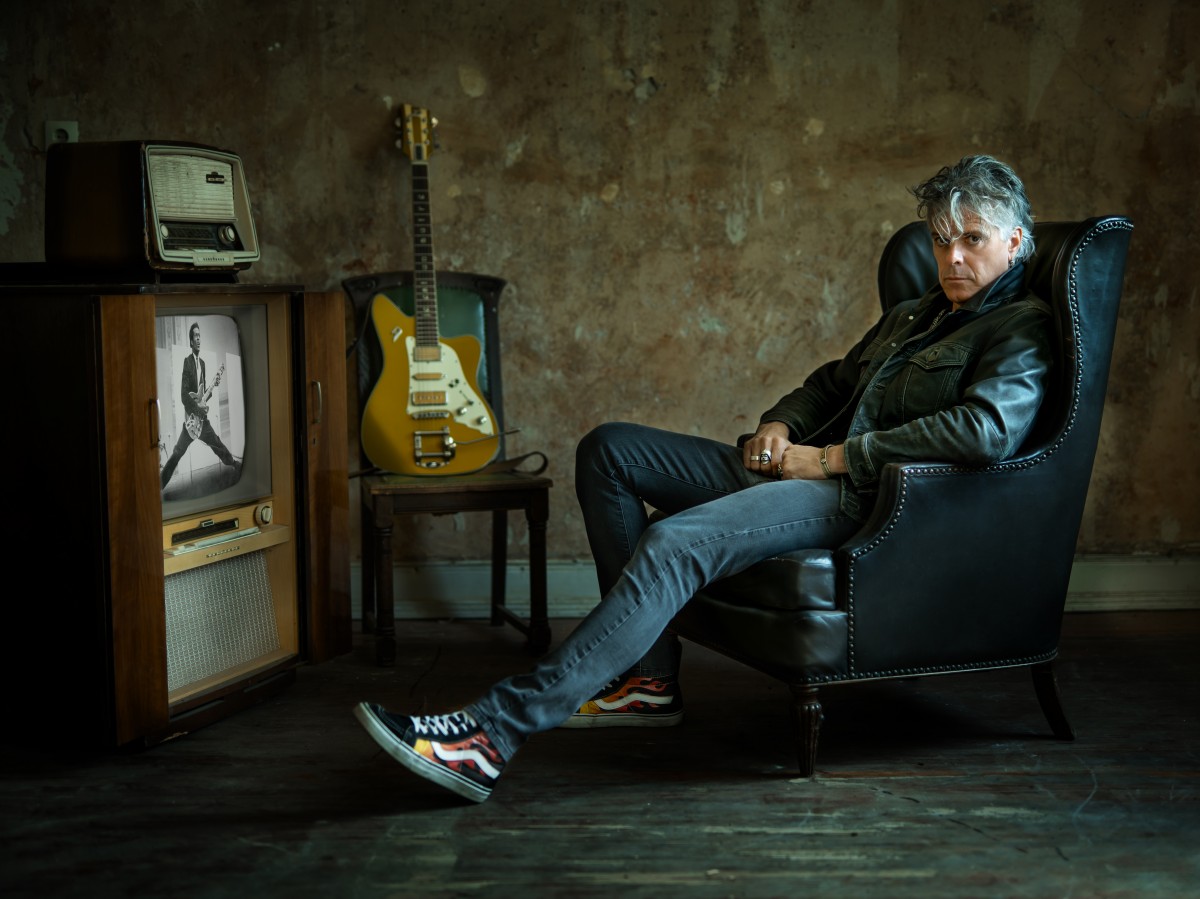
Dutch guitarist JB Meijers has an extensive resumé as a sideman. Germans might know him from his work with songsmith Peter Maffay, many in his native country will know him from his work with country rockers The Common Linnets, rock ‘n’ soul band De Dijk, and Golden Earring singer Barry Hay. ‘Rock und Roll’ is his first solo album in five years, and it rocks harder than some might think based on the work he is best known for.
“That is something I am quite happy with myself”, Meijers admits. “It has been a bit of a relief, I have to say. I completely let go of all doubts I may have had. Back in the day, I used to listen to a lot of American hardcore. Things like Black Flag really rubbed off on me, and that has been very important for me in the beginning. Metal as well: the first few Metallica albums, the first couple of Slayer albums, tons of stuff from that time.
At a certain point, you will start developing from where you started, and I started listening to The Smiths. And of course, there was always an air of ‘rock ‘n’ roll is not done, that’s really just for dumb, beer-drinking dudes’ around them. That is something I carried with me for a number of years as well.
One of the benefits of getting older, is that you reach a point where you think: so what? And what are you doing? I just like windsurfing and playing guitar. It was very liberating, in a way. Also, it doesn’t have to be dumb at all. I think my lyrics are fairly intelligent by my standards, haha!”
Very Bare-Bones
“Ronnie Degen, who runs the Zwarte Cross festival, said to me: shouldn’t we work together or something? Don’t you need a manager? I told him: if you want to try that, be my guest, what do you need? Photos and new music. Ronnie is quite straightforward. So I told him: sure, I’ll go for it.
Also, I just got back from a tour with Daniel Wirtz. And the music Daniel Wirtz makes is quite hard-edged. I would say he is kind of the German answer to Soundgarden. And Soundgarden is a band I have always thought is fantastic. Always. With that tour in the back of my mind, on which I had been playing Rectifiers and humbuckers, in DADGAD and all kinds of other weird tunings, that was the sound I was naturally drawn to. It was already in my bloodstream, so to speak.
So I just started writing songs, without really thinking about what it should be. Last Christmas, I had nothing, and on the 1st of January, I had a new album. I sent it to Ronnie. ‘Mighty good’, he said. ‘Truly my kind of music’. It was something I really enjoyed doing.
Also, I set strict limitations when it comes to the instrumentation. Just bass, drums, and guitar. Done. There isn’t a single key on the album, no acoustic guitar, not too many choirs… No trickery, basically. By my standards, it has become a very bare-bones album, though there are always ways to make it even more blunt.”
Flagships for Shred
“In a way, I have had the bad luck that I used to work with bands like De Dijk, Acda en De Munnik and The Common Linnets. Those bands weren’t exactly flagships for my shred, haha! Don’t get me wrong, I love playing with those bands, but it does lead to people thinking: oh yeah, that’s the guy who plays mandolin so beautifully. Which is something I greatly enjoy, but it’s not the only thing I do.
Peter Maffay originally asked me to join his band after seeing me play the mandolin with The Common Linnets, and he was very impressed by my multi-instrumentalism as well: pedal steel, trumpet, trombone…
To be fair, I was pretty much the odd one out with Maffay. He already had two electric guitarists in his band, so if I was going to put some screaming guitar on top of that as well, it would have been too much of a good thing. So I ended up being the pedal steel guy, the mandolin guy, and the banjo guy.
Being able to do this heavy stuff on ‘Rock und Roll’ definitely feels like kind of a liberation. However, that doesn’t mean that I think everything else I have done sucks. I simply enjoy making music, and I have a very broad and eclectic tase.”
A Refrigerator with a Ton of Switches
“What you hear on the album is all one guitar: my signature Duesenberg. Duesenberg built me a signature guitar that has more or less been based on their Paloma. It’s a type of goldtop with a P90 Gold Foil and a Telecaster pickup, though with its own specs and winding – that is something we spent a lot of time and effort on – and a killswitch.
All the sounds are made by a Neural DSP Quad Cortex. The original idea was to make demos, and then to record everything live. But then, I sent the demos to Joost Kroon – my buddy, my sounding board, and the best drummer in the world – and he told me: those guitars sound awesome! For a good while, I lied to him and told them they were recorded with Rectifiers, haha! But I had to reluctantly admit it was the Quad Cortex.
With a ton of processing, of course, with a bunch of pre-amps and compressors and whatnot. I have spent a lot of time polishing my guitar sound for the album. But the foundation of it is the Quad Cortex, which I had only kind of just gotten by the time I started working on the album.
It’s something that always goes in waves for me. At some point, I’m building towards a refrigerator with tons of switches, a Mastermind and shit like that, and then suddenly, I end up thinking ‘fuck that’, get rid of it, and go on tour with a Vox AC30 and a Tube Screamer or something like that. And then that leads to: ah, maybe another delay. And then I end up with two square meters of pedals in front of me.”
Desert Island Amp
“In recent times, I have found myself at the height of one of those digital waves again. Though I have to say that I have been playing with a hybrid set-up live. That is something I started doing when I played a little Queen block at De Vrienden van Amstel two years ago. I never really got into Brian May’s playing and sound from a guitarist’s perspective before that.
After that gig, a lot of people told me that Brian May would have wished he’d sound like that. What I had at the time was a wet-dry-wet system, which Brian May also used. Only the wet was a Quad Cortex, and the dry was a Matchless, my favorite amp, my desert island amp. It has been tweaked quite a bit, but it sounds absolutely amazing.
What I do is make a digital patch that sends my Tube Screamer, my distortion, and my delay to the Matchless, but the gorgeous reverb and chorus all go to the wet side. I heard some recordings from that performance, and I have to say that I really liked how it sounded. That is what kind of pushed me in this direction.
With Maffay, I keep things a bit simpler, as there is so much information on stage with him. If I didn’t go for a simpler set-up there, you wouldn’t even be able to hear everything. And the weird thing is: that’s where people say ‘your sound is so upfront’. Simply because it doesn’t drown in some kind of stereo warble. Since I have more space to fill with the trio I will be playing with, I will go for a broader approach there.”
One Big Accident
“Playing with only the Duesenberg was part of the limitations I set for myself for this album: let’s just do things on this guitar and see how far I get. That will save me the trouble of going: should we do this on the ’52 Telecaster or the ’58 Telecaster? Whatever, haha! Of course, a lot of it is in your fingers. I just thought: let’s do it this way, for a change.
For years, I have been in the most amazing studios full of guitars and racks, trying out whatever guitar and amp set-up was available to us. And that’s very legitimate, but this time, I just liked the idea of doing it like this. If it didn’t work with this, it wasn’t going to work at all.
Obviously, the Quad Cortex is very versatile. There are so many things you can do with it. Daniel Wirtz’s sound engineer is someone I hold in very high regard. He has worked with a number of big German artists. Daniel himself has a Diezel Herbert on which he really only has two positions. He spiked both of them, and when we were rehearsing, his sound engineer was certain it was the real Diezel, which turned out not to be true when we A/B’ed them. ‘Are you trying to mess with me?’, he asked me, haha!
That really encouraged me to just think: okay, I will leave the demos for what they are. So what you’re hearing is actually an enriched demo. I have re-recorded my vocals a couple of times, and Joost recorded drums to it, but that’s it. Nearly all of the songs are one-takers, including the solos. So there are some mistakes and slip-ups, but I thought that actually fit the title of the album really well.
After all, rock ‘n’ roll is one big accident. So I wanted to go for something very intuitive. Obviously, I have come up with those riffs, and there are a few parts I re-recorded because they needed to be tighter, but I believe my forte is my intuition, so I left most of the solos as they were.”
In the Process of Creating Something
“Layering the live feel is something I have slowly gotten the hang of through the years. The first thing I will do is turn off the click as soon as I can. Often, I record something to a click, and I will start programming things, but as soon as it’s possible, even if there is just a guitar part or a drum part, I’ll turn it off. So I never record anything with the click as a reference. That makes a hell of a difference.
What that does is make you listen to what is already there. I work with Superior Drummer a lot, and you can do a lot with tempo mapping and things like that. Back in the day, I programmed the kick and the snare, and then I humanized that. These days, there are tons of midi files that have been recorded by awesome drummers like Kenny Aronoff. In Kenny’s case, all the kicks are in the front, and all the snares are in the back. I don’t need to mess with that by putting it on grids or whatever.
That definitely contributes to having a live feel even when things are recorded separately. Once you are conscious of that… It’s a fine art. I also despise it in a way, because there is nothing more enjoyable than playing with a bunch of people in the same room. That’s how it’s supposed to be, in my opinion. But sometimes, especially when you are in the process of creating something, this will help you reach a stage where you like what you’ve done more quickly.
And that is very important. Because I don’t necessarily think that what I do is awesome, so I do always need some kind of validation. And that’s where things like these come in very handy.”
A Vanishing Art
“We recorded this as a trio, and that is how we will tour with this material as well. That isn’t born from necessity, by the way. Joost had a big impact on that. He suggested: let’s first try and play this with just the three of us. I was a bit apprehensive about that, because then you will sometimes miss the rhythm guitar and other things. But then we started rehearsing, and Joost said: that sounds awesome, doesn’t it? And damn it, he was right.
So we ended up being a power trio, which is quite liberating. It’s a path I hope to be able to explore for a long time to come. I have always had a weak spot for power trios: The Police, Dinosaur Jr., Hüsker Dü, Cream, Jimi Hendrix Experience… All bands where I never have the feeling that I miss something when I hear them.
When Joost, Jasja (Offermans, bassist) and I play, we don’t have to explain anything to each other. It’s kind of that jazz spirit: what are we going to play? Alright, count us in. We don’t have to make any arrangements, because with musicians like them, the arrangements will shape themselves on the fly. That was very pleasant for me as well.
It’s something that is a bit of a vanishing art. When I see a band these days, the first thing you see is a laptop with an Apple logo and someone bent over it. Everyone plays with in-ears and a clicktrack. And I like that, but the fact that we play with floor monitors and listen to each other is very liberating. If you play with in-ears and sixteen monitor groups, you don’t even know if everyone is listening to the same thing, while you’re supposed to play with and on top of each other.”
An edited version of this interview appeared in Gitarist 421 (April 2026)
 Kevy Metal
Leave a comment