
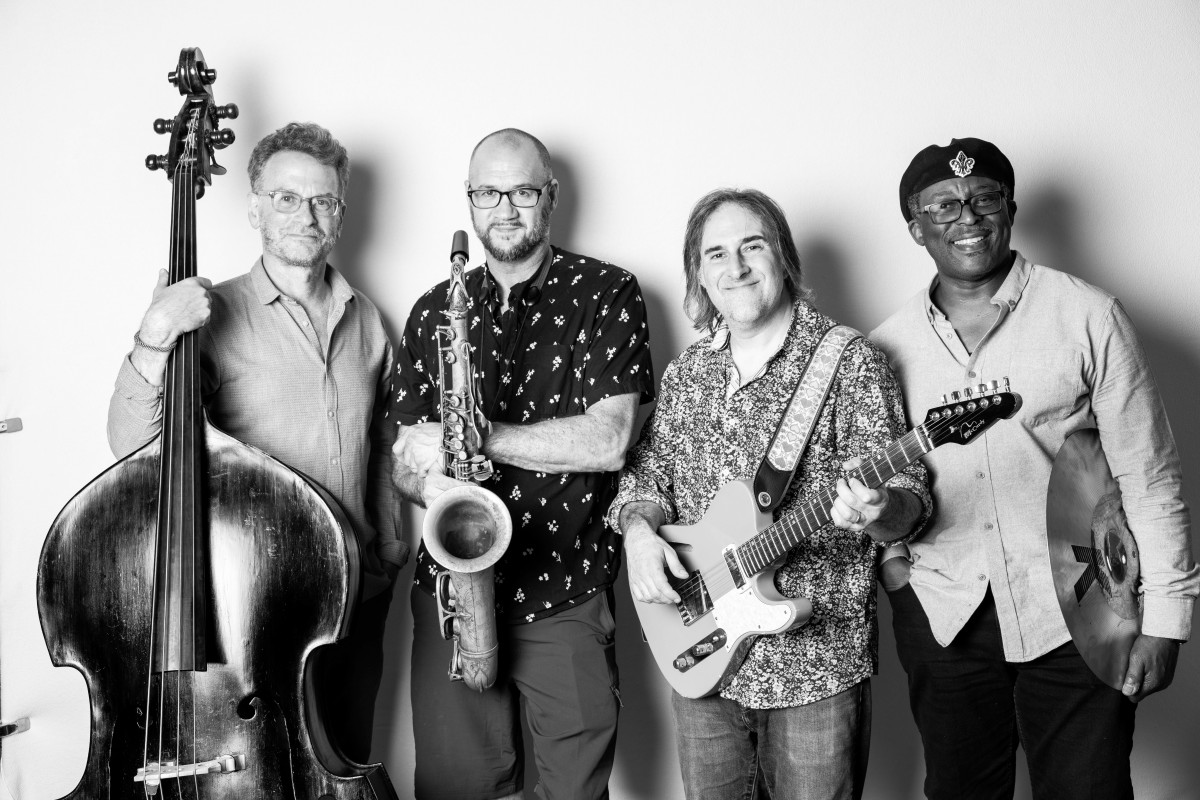
While singer and guitarist Chris Bergson mostly releases rootsy rock ‘n’ soul albums with bluesy guitar playing with singer Ellis Hooks and his own Chris Bergson Band, his new album ‘East River Blues’ is one of the most jazz-oriented albums he has released to date.
“In some ways, it’s kind of a return to my roots”, Bergson says. “Although it does have a healthy dose of blues in there too. Last year marked thirty years of living and playing music in New York. I moved to New York in January of 1995. Some of it also is related to my teaching at Berklee, where I do teach a lot of jazz as well as blues, and I teach a slide guitar and songwriting class up there.
I never really stopped playing jazz all these years, and it has been noted that it’s part of my DNA, and its influence does come out even when I’m not playing jazz per se. But I always had it in my mind that someday, I would want to record more of a jazz record, and it just seemed the right time.
One of the things that’s really cool is that we’re going to be celebrating the release of this record in New York, at Smalls Jazz Club, on the 4th of June. And that’s fitting, because actually, it was after attending a concert at Smalls in the fall of 1994 that I kind of freaked out: I’ve got to move to New York! I heard a jazz piano trio, young players playing at such a high level one night.
Smalls had actually just opened that year, in 1994. I had been going to a small liberal arts college a little bit upstate, and then taking the train down along the Hudson River to take lessons with Jim Hall when I was 18, 19 years old, and it was on one of those trips that I went to a show at Smalls, and I was blown away by the high level of these musicians playing. And I did move there, in January of 1995.”
A Magical Experience
“The bass player, Larry Grenadier, who toured with Pat Metheny and John Scofield, and he’s been a regular member of the great pianist Brad Mehldau’s trio for over thirty years, has long been one of my favorite musicians, and we had played together a little bit over twenty years ago. At one point in time, we were neighbors in Brooklyn. I always hoped to work with him again, so he was definitely my first call on bass.
I knew that he had a long history of playing with elite master drummer Al Foster, who played with Miles Davis, and my parents took me to hear him with Herbie Hancock when I was a kid. I had also heard him with Joe Henderson many times, and I knew that he and Larry had played together a lot with Joe Henderson, and had a great rapport.
I had played with Al in 2002, and it was just a magical experience playing with him, a trio, two nights, three sets a night, over the holidays. I had a friend who made a recording on MiniDisc, and I just got it digitized, and it was a trip to listen back so many years later. I had just started singing on gigs. We did a blues in each set, and Al Foster was actually really encouraging of my singing. He said something to the effect of: get them in your corner with that blues shit, and then you can play whatever you want!
Which has proven to be wise advice, haha! I guess I have sort of done that over the years. But there was a gradual transition, which started with maybe just one blues song by Robert Johnson or Muddy Waters in a set, and then it just kind of expanded from there, and I was singing maybe half the set, and I started writing more of my own songs with lyrics.”
Just a Synergy
“When I played with Al Foster, I was pretty young. It was in 2002, I wasn’t even thirty. So I always hoped to play with Al Foster again. Then I went to see him, he was playing at a club in New York last January, as I was thinking about this, and we ended up setting up this recording date. And then sadly, he passed away, just three weeks before the date of the session. Which was really sad. He was 82 years old.
Then I thought: okay, what are we going to do here? Larry Grenadier is definitely one of the busiest bass players around. So it’s hard to get him. Thankfully, it worked out by getting another amazing drummer, Herlin Riley, with whom I had just played a few months before at this two-day blues event at Lincoln center. And he was incredible.
He was basically the drummer for this two-night blues jam, and it was just amazing playing with him. His groove is just incredible. He is from New Orleans. He played with the whole Marsalis family, James Booker, and I think also with Professor Longhair, and he’s a very versatile drummer. A great jazz drummer, but his shuffle groove is just amazing.
Actually, two of the tunes we recorded, we also played at Lincoln Center: the opening cut, the Muddy Waters slow blues, ‘Mean Disposition’, and ‘Kindless Villain’, which is a shuffle I wrote. I knew I wanted to play this shuffle with him. His groove felt so good. So it worked out. Sometimes there’s just a synergy to these things. He was the first person I thought of when I heard the sad news about Al Foster, trying to see if we could still make the date work.
The crazy thing is that he lives in New Orleans, but he actually was in Connecticut for a few gigs the night before the date of the session, and he hadn’t played with Larry Grenadier before, but they were on a gig together with another artist the night before the recording session. In Connecticut. And we ended up recording in Catskill, which is just a little bit north of Woodstock. So I thought: okay, this just seems like it was meant to be. And it worked out really nicely.”
Comfortably and Authentically
“I have been very fortunate in terms of playing with great drummers. Al Foster for sure. In recent years Bernard Purdie, who is 85 now, and still very much kicking ass. And of course, Levon Helm. As well as some of the great New York guys I have played with who aren’t necessarily super famous outside of New York, but who are incredible drummers. Guys like Diego Voglino, Tony Mason, Fukushi Tanaka.
Some great, great drummers who are versatile. That’s what I realized: it’s finding people who can play jazz, but then, when it’s a backbeat or a shuffle, also have really checked that tradition out, and also can play that comfortably and authentically, which means sometimes not playing too busy.
Playing that Muddy Waters tune with Herlin at Lincoln Center made me think: oh wow! He said he grew up playing that stuff: oh yeah, that’s some stuff I used to play with my uncles! I just didn’t know what to expect. I had heard him with Wynton Marsalis, and I know he played with Ahmad Jamal. But these two nights at Lincoln Center last year, I realized there was a whole other side to his playing, more groove and blues.
He is a master, and a great guy. A real character. Funny. He brought a lot of spirit to the proceedings.”
Comfortable with the Material
“We ended up making this record in one afternoon. It was a very easy, relaxed session. I think we started recording maybe at noon, and we were done by 6 PM. But these are incredible players, and we weren’t playing any tunes that were super difficult or anything. It’s a testament to these great players. The engineer, Scott Petito, did a great job. It was just a really relaxed vibe. I was across from Larry in one big room, which I like, there was a drum booth, and I could see everyone really well.
I don’t think we did more than three takes of anything. The title track was a first take, and the waltz, ‘Sad Strains’, was a first take. Most everything was within three takes. I find that’s often the way it goes. Unless the music is incredibly difficult, usually I feel like the best performances are going to be within the first three takes, if you’re going for live, and it’s not a matter of like a very difficult piece, or a very complicated arrangement or something. That kind of thing might get better with repeated plays.
It was helpful to listen back a tiny bit as we went along, to make sure that we weren’t doing lots of takes unnecessarily. Because once you get past a few takes, the tendency can be to start thinking more, and the intellectual part of your brain enters, which may be less there in the first take. Most people, if they’re comfortable with the material, I feel like the best, most natural takes are going to be the first take or two.
This is my favorite way to record. Even when I’m recording with my full band, like our last record ‘Comforts of Home’ (2024). The bulk was also done live. For me personally, I feel like that’s how I’m able to give the best performances. And what that means to me is coming in feeling really, really comfortable with the songs. So it needs more preparation, more playing and singing the songs at home myself, with the goal to really try and get the performance in quickly.”
A Suite of Songs
“That’s also how most of my favorite albums were recorded, especially if we’re talking about classic jazz and blues records. That was the other sort of main influence on this one. Over the past few years, just for fun, I have started listening to more vinyl at home. Blue Note has been doing a really nice job reissuing a lot of classic records, sometimes with new photos and a remastered sound, and doing a great job.
Sometimes I’m buying albums now that I once had on CD, and kind of getting back in touch with some of my favorite sixties Blue Note records. That’s been a big source of inspiration. Records by Grant Green, Kenny Burrell, Hank Mobley, Lee Morgan, Herbie Hancock: that classic sixties era. And of course, all of those records were done in an afternoon as well, and it was following a tried-and-tested model.
The other piece of it is that this is my first vinyl release, in addition to CD and digital. So the thinking was also to record an album in one session that would be vinyl-length. We weren’t going for seventy or eighty minutes. And then you have the decision of: what are you going to cut? My last record wouldn’t necessarily even fit on vinyl. I tend to think of an album as a suite of songs. So we had that limit, which worked for just a nice, relaxed day, with no stress.”
Parenting Complete
“This record is dedicated to my mom and dad. For two reasons. One is I’m a parent now myself. I’ve got a 17-year-old daughter who really loves music, which just makes me so happy. She likes Grant Green, she likes Kurt Rosenwinkel, she likes Aretha Franklin, she likes Muddy Waters… Okay, parenting complete, haha!
But for this record, I was thinking of all these amazing jazz and blues concerts my parents took me to when I was a kid. They did a lot to really foster my love of music. And of the pieces we played on the album, the waltz, ‘Sad Strains’, was one of my dad’s favorite songs of mine. I remember him coming to see my band when we were doing more of a blues rock thing, and it was funny, because my dad would ask: hey son, any chance you’ve got that song ‘Sad Strings’ on the setlist for tonight?
At the time, that really didn’t fit with stuff like ‘Greyhound Station’ or ‘Are You Experienced?’ that we were playing, but he always requested it. He thought it was a really pretty melody. So for this record, I thought it was time to revisit that tune in honor of my dad.”
Playing a Whole Tune with No Pick
“I have played my Gibson ES-335 more on this record. I have been doing some more jazz-oriented gigs, and the 335 is just perfect. It seems to forgive me for not playing it as much in recent years. It’s always fun to play. That guitar has some mojo. I played with Hubert Sumlin and Levon Helm and Al Foster on that guitar. I think it’s an ‘87 dot neck reissue. It’s a great guitar. It’s been fun playing it again.
My Tele copy has become one of my main guitars. It was made by a New York City luthier: Ric McCurdy, from McCurdy Guitars. It’s a beautiful guitar. It’s super light, and it’s a Thinline, so it has a little more resonance, a little more chimeyness on the chords. I played this maybe on two tracks on the record, and I played with my fingers on both of those.
There’s something really nice about playing Tele with your fingers, something I have been doing more in recent years, which I wouldn’t have felt comfortable doing in the past, playing a whole tune with no pick at all. I did a lot of practicing playing fingerstyle during the pandemic. I had time on my hands, I had no music to learn for gigs, so I went through this whole George Van Epps method book, and really did most of it with my fingers, and actually taught myself how to fingerpick. That was a good project to work on during that time.”
Adding a Little Meat
“On this latest record, I used a sixties Blackface Fender Vibrolux for the whole record. I brought a Tweed Blues Junior as a space, which is also a nice amp, it has a Jensen speaker in there. My sixties Vibrolux is just so sensitive that I’d rather bring a back-up, and the studio also had some amps. But I ended up just going with the Vibrolux for everything, and it worked well with the 335 and the Tele.
In the past, I would have experimented with more amps, different amps maybe. Probably most of the other records I have done, I’ve done that. But it was working well, and I just kind of went with that. It was a pretty straight-ahead session. We were recording totally live, and what you hear on the record was as it went down.
I did not use a lot of effects on this record. One of the pedals I use a lot is the Xotic EP Booster. That’s a really nice clean boost. I always use that with my Tele, with it set to about twelve noon. Then with the 335, a little trick I have learned is to still have it on, but basically on zero. It just adds a little meat. Not that the 335 needs much.
One of the other pedals that I love is the Strymon Flint, for reverb and tremolo. For the reverb on here, I used a combination of the nice seventies plate reverb that’s on the Strymon Flint, mixed with the reverb that the amp has.
I sometimes use a compressor, especially with the Tele, but that’s more for playing live. I didn’t use that on the session. So it’s mostly a little bit of Xotic EP Booster and Strymon Flint. And props to the engineer. He did a fantastic job of capturing this very natural sound. He captured the feeling of three or four people playing in the room. And that’s the sound we were going for.”
Married to One Club or Scene
“In the period leading up to this record coming out, I have started doing some more jazz gigs in New York. This album is already opening up some doors in terms of different places to play. As you may know, New York is much stronger for jazz than for blues. There just aren’t a lot of blues venues in New York. A lot of national touring blues artists won’t even come through New York City. Or if they do, they play at sort of an alternative venue.
There is actually only one dedicated blues club in New York: Terra Blues in Greenwich Village. It’s tricky, especially for artists that maybe can’t sell out the Beacon. I think New York city would benefit from having some sort of great new 150-to-200-capacity venue that middle artists could do well at. Some of the other venues are too big for some artists.
Smalls and its sister club Mezzrow are doing fantastically. Both of those venues are always packed. The owner, Spike Wilner, who’s actually a great jazz pianist himself, has done a really great job, and he has actually opened a third club. Running a club is a crazy endeavor, and many don’t serve out. Already some of my favorite clubs where my band really cut our teeth are unfortunately no longer around.
I’m thinking about the 55 Bar on Christopher Street, where we played monthly. Mike Stern used to play there a lot. Or Jazz Standard, where we recorded a live album, or Rodeo Bar, just kind of like an americana dive, but a lot of fun. It’s always such a bummer when these venues close.
But the thing is: it’s a huge bummer, but what are you going to do? The music keeps going. You can’t be so married to one club or one scene. I mean… What are you going to do? Quit every time one of your favorite venues shut their doors? So I’m reminded of how resilient musicians can be. Especially New Yorkers. You keep plugging away.”
An edited version of this interview appeared in Gitarist 422 (May 2026)
 Kevy Metal
Leave a comment