
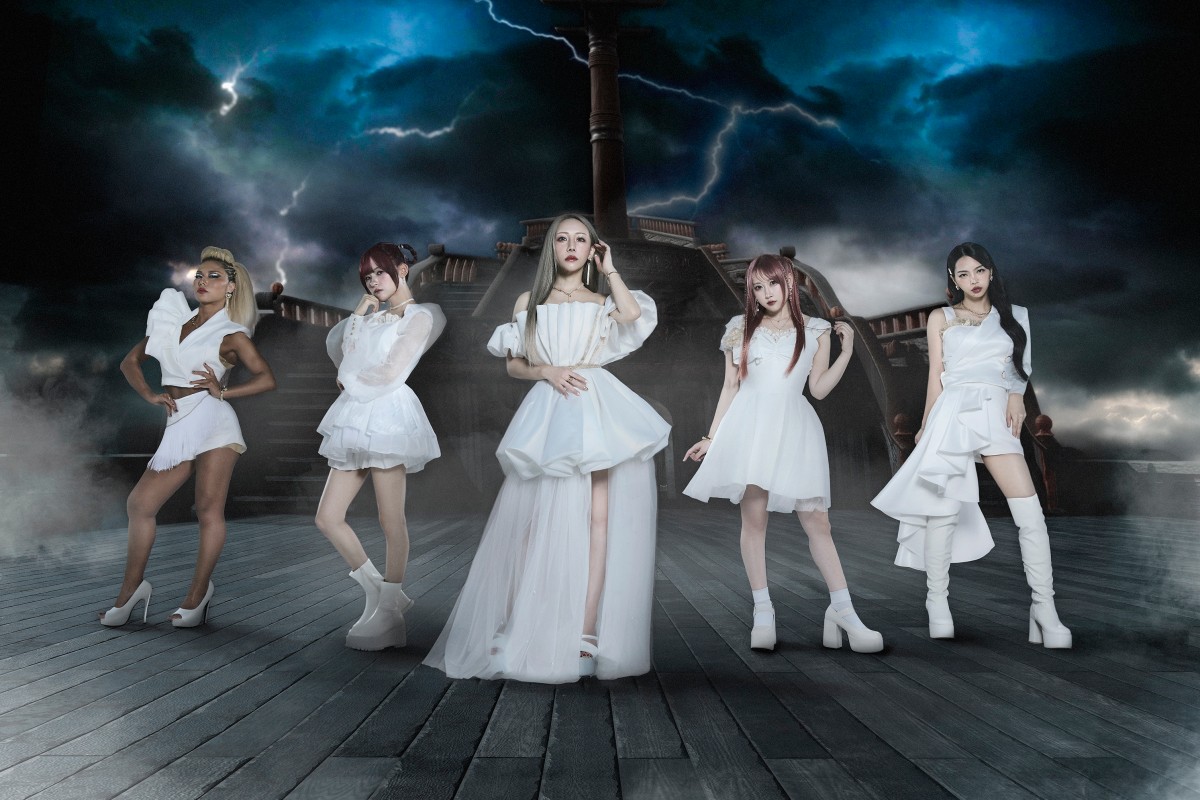
Even though power metallers Lovebites have been building up quite a sizeable following outside of their native Japan through the years, signing with Napalm Records puts them at the epicenter of the international metal scene. Their fifth album ‘Outstanding Power’ finds the band on top of its game after a somewhat turbulent time. Singer Asami and guitarist Midori share their insights into the new album and how the band has developed in the last few years.
While the album isn’t entirely devoid of upbeat power metal songs, the overall sound on ‘Outstanding Power’ is a little bit darker than usual for Lovebites. “We do discuss general directions”, Asami explains. “Such as what kind of songs we want to include on the album. But fundamentally, everyone works along the core axis of heavy metal when writing their material.”
“Since our previous album ‘Judgement Day’ (2023) leaned towards the darker side of our sound, we actually began this project with the intention of moving in a slightly brighter direction”, Midori adds. “The overall direction we are aiming for is shared among the entire team before we even start creating demos. Once we have a certain number of demos from each band member, we review the overall balance together, and discuss what kind of songs might still be needed, adding new material accordingly as we go along.”
Each Instrument Has Its Own Highlight
“This album also marks the first time that a song composed by Fami (bassist, who debuted on ‘Judgement Day’) has been included”, Midori continues. “Her musical background is strongly reflected in the brighter style of the track, and it also features more moments that highlight her as a bassist, such as the battle between the bass solo and the guitar solo.
In addition, since ‘Lovebites EP II’ (2024), we have started incorporating an approach in some songs where we intentionally simplify the guitar arrangements in order to better showcase the bass. This can also be heard on ‘Wheels on Fire’ from the new album, where Fami’s highly active bass lines have a significant impact on the overall feel of the song. As a result, we believe the album achieves a more three-dimensional sound.
I believe that having catchy vocal melodies, guitar riffs, and overall themes is essential to a good Lovebites song, as well as creating songs that naturally allow listeners to visualize the live performance. On top of that, elements such as call-and-response sections where each instrument has its own highlight serve to further enhance the appeal of the songs in a live setting.”
Carefully Crafted in Detail
“Our songwriting process typically begins by deciding on the overall direction of the track”, Midori explains. “From there, when we build a song around guitar riffs or twin guitar themes, we mainly construct it using the guitar, while vocal melodies and chord progressions are primarily developed on keyboards. By the time we present a demo to the production team, we usually have at least one full chorus completed.
Among the submitted demos, those that resonate well with the band members are then developed further into full songs. The vocal melodies we often refine in detail together with Asami from that stage onward. In addition, once a track has been selected for the album, we go through a pre-production process again, incorporating arrangement ideas from the other members as well, and use that stage to further enhance the overall quality of the song.
For the songs composed by Miyako (guitarist), she decides which solos to play, while for the other songs, I make those decisions. When it comes to the ones I decide on, I determine the solos for my own compositions during the songwriting process, and for the other songs, I make those decisions during the pre-production stage.”
Lovebites’ guitar solos tend to be full of recognizable melodies. “It varies depending on the song, but each track is carefully crafted in detail”, Midori says. “In some cases, everything is almost fully finalized during the pre-production stage, while in others, we continue refining the material repeatedly during the recording process. Since we work with a home recording setup, we can take the time to experiment and fine-tune everything until we are fully satisfied.”
Rarely Aligning Perfectly
“Since I am a vocalist, my process is basically melody-first”, Asami says. “I write while singing, focusing on how naturally the melody flows and how comfortable it is to sing. The only exception is when I write thrash-style songs; those are definitely riff-first. I usually share my songs with the band once the full chorus is written. If it doesn’t work at that stage, it’s simply: okay, next!
I fundamentally respect the melodies written by the composer. However, when I start writing the lyrics, and there are sections that are difficult to sing, or that could work better in terms of phrasing, I do adjust the melody while writing the lyrics.
Heavy metal is, first and foremost, music to be enjoyed sonically. Rather than having the meaning conveyed directly through Japanese lyrics, I prefer listeners to first enjoy the sound itself, and only later think ‘what are they singing about?’, and then read the lyrics. I want the listeners to hear the vocals as one of the instruments.
I always start in Japanese. First, I organize what I want to express in Japanese, then translate it into English. But that’s where the real challenge begins: what I want to say and what sounds good rarely align perfectly. Adjusting those two elements takes a lot of effort. For songs that benefit from strong rhymes, word choice becomes even more critical.”
Emotional Expression and Rhythmic Accuracy
Asami famously had little experience singing metal prior to starting Lovebites, her own musical background being rooted in R&B. “I had often been hired as a support vocalist for rock artists”, she clarifies. “A producer who heard me suggested: why don’t you try singing metal? And that’s how things got started. I think my emotional expression and rhythmic accuracy comes from my past experience singing R&B. How to make the vocals cut through without getting buried under the massive volume of the instruments was the biggest challenge.
Having a wide range, both high and low, is one of my strengths. This is pleasant for the rest of the band, because everyone just writes freely – and I’m always pushing beyond my limits. All Lovebites songs are difficult to sing live, but if I had to choose the most difficult one, it would be ‘Holy War’. There is almost no space to breathe, and the notes stay high throughout, while you have to sing with real force for it to cut through. Between recording sessions and on tour, I simply don’t talk. I’m very conscious about preserving my voice whenever I’m not on stage.
My possibilities have certainly expanded since I have started singing with Lovebites. I feel like parts of myself that I never knew existed have been unlocked.”
Raw and Immediate
Lovebites’ numerous live recordings reveal that their songs sound a great deal less polished on stage than they do on their studio recordings. “It’s true that we keep the backing guitar tracks in our live performances to an absolute minimum”, Midori nods. “When we perform live, the synth tracks are generally all present. On the other hand, there are very few additional guitar layers compared to the studio recordings, which allows the finer nuances of the guitar arrangements to come through more directly.
Since arrangements that work well on record and those that work well live are quite different, we focus primarily on what sounds best in the studio during the production stage of our songs. As for the live sound: the guitar team works out the details to a certain extent before we enter rehearsals with the full instrumental team, and then we further refine and reshape those arrangements through the actual rehearsal process.
In addition, the volume balance between Miyako’s guitars and mine is kept fairly even, which brings the twin guitar harmonies more to the forefront. That is why I think the live sound has a more raw and immediate feel compared to the studio version.
All of the solos are challenging, and every song contains technically demanding parts. If I had to pick one song that is the most challenging to play, ‘Thunder Vengeance’ is actually more demanding in terms of the rhythm guitar rather than the solo. The tempo is incredibly fast, and playing tightly in that context – while clearly articulating the chords within the riffs, controlling the palm muting, and adding nuances with picking harmonics and vibrato – is no easy task.”
A Great Balance
“On ‘Outstanding Power’, I primarily used my main purple E-II Horizon, and I also used a black Horizon for different tunings. I chose these guitars because they have great sounds and allow me to express myself exactly the way I intend to.
For this album, all guitar tracks were re-amped using real amplifiers. For the rhythm guitar tracks, I have been using the Peavey Invective.120 and the Diezel Herbert over the past few years. They offer a great balance in the graininess of the distortion, the tightness, and the overall power, which I feel really helps the riffs stand out.
This time around, I used an EVH for the lead guitar tracks, which provided a rich mid-range and excellent clarity, allowing the tone to cut through effectively. For the clean tones, I used a Marshall JCM800. It delivers a bright character without becoming overly full, enabling the sound to sit well within the band mix without getting buried, while also avoiding being overly prominent.
I still use Kemper for my live set-up, just as I did in the past. However, both the hardware and the overall rig have been significantly updated. Currently, I operate multiple elements simultaneously, such as MIDI control for the Kemper, additional remote control handled by my guitar technician, and a backup system. Even so, I appreciate that the setup does not require a large or complex system, but still remains extremely stable with few technical issues. There are many excellent multi-processors available today, but at this point, I feel that this system remains the best option for me.
I mainly use a setup where I plug directly into the amp during live shows, so I don’t really use any additional pedals. If I have my Kemper rig with a combination of a Victory The Kraken Mk II and a Marshall cabinet, that pretty much represents my current sound in Lovebites.
During our first European tour in 2018, I brought my own Kemper Power Rack and Remote – the same setup I use in Japan. These days, I typically just bring my data on a USB drive. The Kemper unit itself and the Remote are usually rented from a backline provider. In addition, I bring a Profiler Player and a MIDI switch as backup gear. I also use the Profiler player for practicing at hotels and similar environments.”
Awareness of Unity
“Compared to the early days, I feel that my motivation toward the creative process itself has grown significantly”, Midori admits. “In both composing and arranging, I believe I am now able to contribute more actively with guitar-oriented riffs and ideas that are more reflective of being a guitarist.
In terms of playing, when the band was formed, I think there was a stronger focus on clearly defining the roles within the twin guitar setup and fully exploring each position. Now, however, our understanding of each other’s strengths and characteristics as guitarists has deepened, allowing us to naturally build our performances and arrangements based on that. Our awareness of unity as a twin guitar team has also increased considerably compared to before.”
From the very beginning, Lovebites has been fairly open about their international ambitions. “Since the early days of the band, we have been fortunate to have many opportunities to perform overseas”, Midori confirms. “Including headline shows and festival appearances. Through these experiences, we have received more attention and bigger expectations than we initially anticipated, and we feel truly grateful for that. I believe the most important – and ongoing – objective is to consistently meet those expectations through the quality of our work.”
 Kevy Metal
Leave a comment