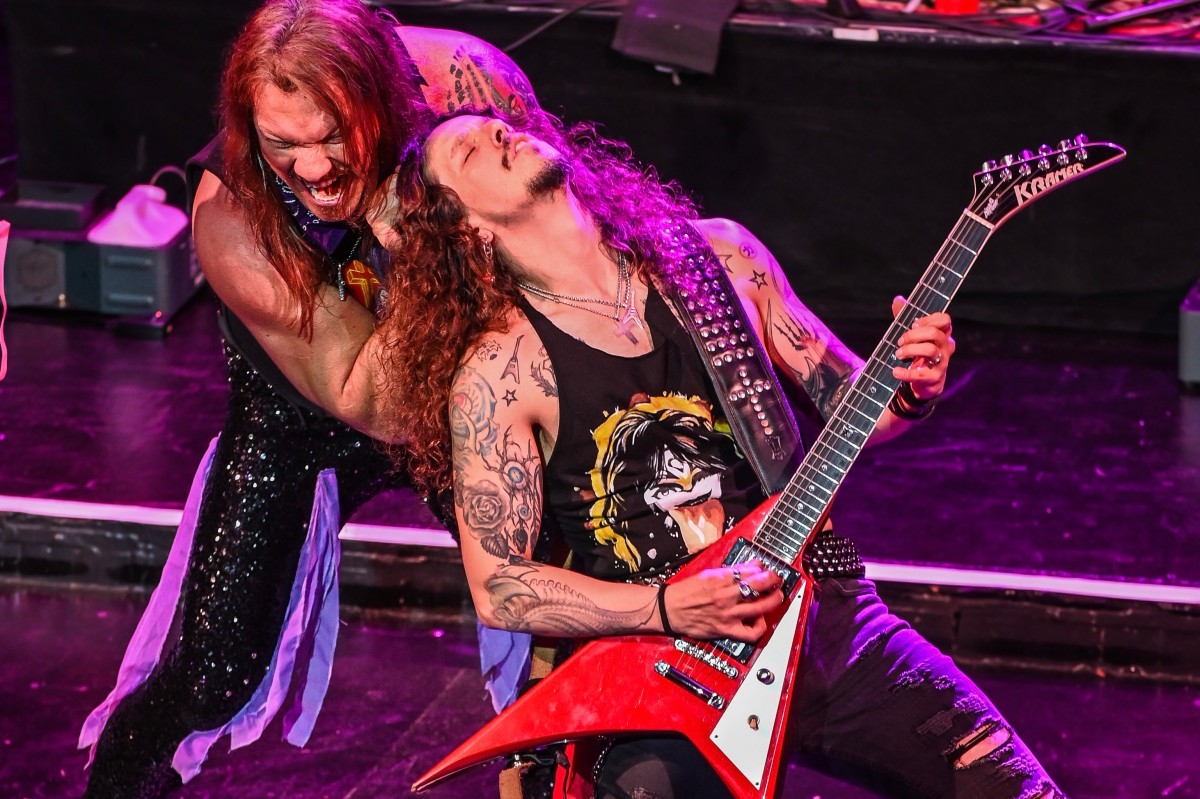
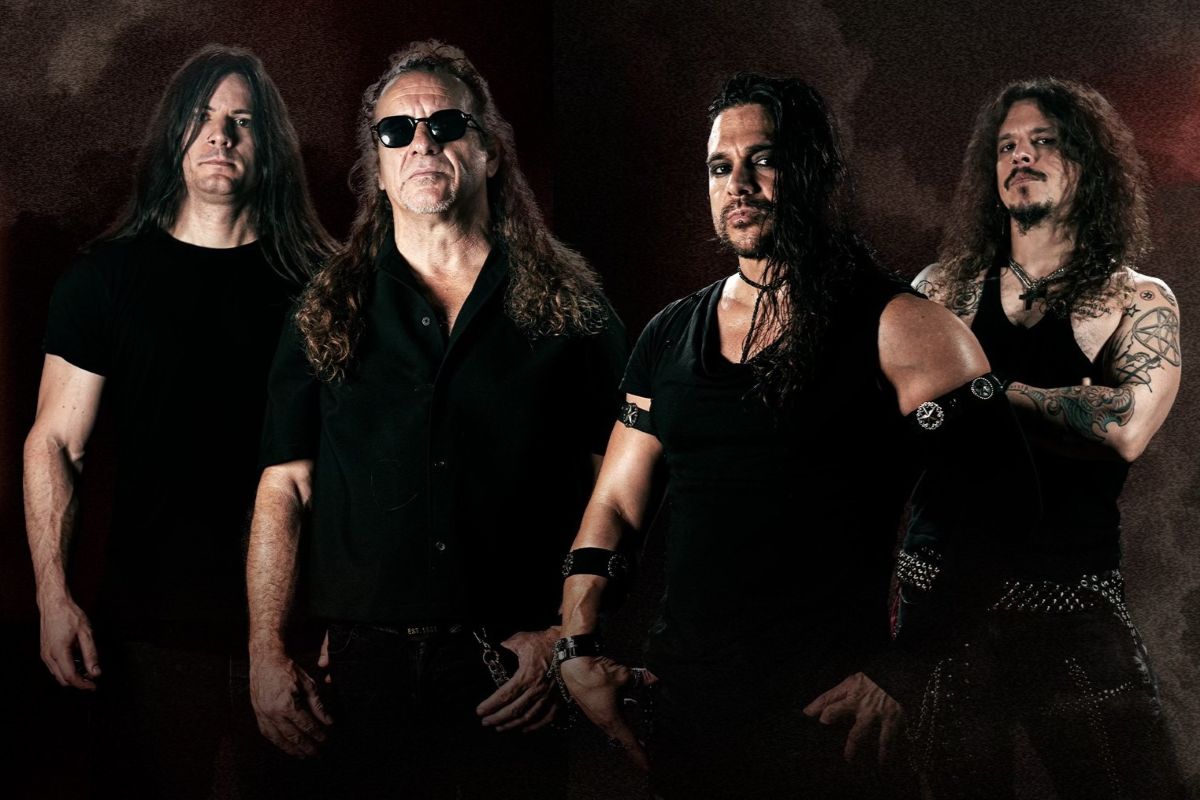
Replacing a beloved original member in an influential band with no easy feat, but on the new Saratoga album ‘En Estado Puro’, Peruvian guitarist Charlie Parra del Riego passes the test with flying colors. After touring with the Spanish heavy metal band off and on for a number of years, he was announced as their official new guitarist earlier this year, and his fingerprints are all over the album.
“Right before joining Saratoga, I was going on tour with Chris Jericho and Kuarantine in the States”, Parra says. “Which was a very sporadic thing, because at the time, Chris was wrestling most of the time, so his schedule didn’t allow for a lot of band activity. Around that time, Niko del Hierro (Saratoga’s bassist and sole remaining founding member) started watching my documentaries and live shows, which I have been posting on my YouTube channel since a long time ago.
These documentaries and live shows were actually recorded for a member of my family that is in a very bad health condition right now and cannot watch me play live anymore. It’s impossible. I recorded these shows specifically for that member of my family to watch. Honestly, I had no idea that these videos could be more important than electronic press kits. Jericho and Niko just watched these videos and saw: this is not edited, and he’s going on tour, which means he’s got experience doing it. That’s how I got those gigs.
With Saratoga, it was supposed to be only one thirteen-date tour in Mexico. It just happened, and they really liked how it went. From being one tour in Mexico, I have been in fifteen countries with Saratoga alone. It’s been four years. That’s quite a lot.”
The Most Saratoga Song on the Album
“The situation as it is now, in which I have officially joined Saratoga… I saw it coming. Their schedule right now is pretty intense. There are about thirty dates with Saratoga only in Spain, which made it a little difficult for me to synchronize my schedule with Chris Jericho and Kuarantine, but so far, everything has been perfect.
I played a lot of shows with Saratoga, just not in Spain. A couple of months ago, my first Spanish show with the band was in Málaga. Niko is such a gentleman. He made sure that everything went well. And Saratoga’s fans are really awesome.
When I joined, they already had eight songs ready, but they wanted it to make an album with a round number of ten songs. When they actually told me that they needed these two songs, I was really happy about it, because I was working on this song, which was originally instrumental. Someday, I will post the demos that I recorded on which I actually sing the songs. It’s hilarious, because that transition between the demos and the final versions is immense.
I couldn’t believe that legendary people like Tete Novoa (Saratoga’s singer) and Niko were actually playing what I asked them to play. After that, the best thing was when the record label said: Charlie’s song ‘A Toda Velocidad’ is the most Saratoga song on the album, we want to release it as a single. I did not expect that at all, but I feel pretty honored.
On those two songs that I wrote, I wanted to keep the essence of the band, even though the other song (‘Vientos de Libertad’) is way darker. But it’s very simple: I have been influenced by the band’s music very much, from all their eras. So why not put this into one track that represents my loyalty to the band, and to the fanbase of the band?”
Afraid to Do Whatever You Want
“Tete and Niko gave me all the freedom in the world for the songs they had written. But you know, when you have all that freedom, you are afraid to do whatever you want to do. I have tried to play everything the way that I think the fans are going to want to hear it.
That also applies to playing the old Saratoga songs. I think the fans would miss something if I didn’t play those the way they were written. That doesn’t mean I’m not going to play it my way. Every guitar player in the world has their own voice. But I try to stay loyal to the essence, and at the same time loyal to my essence.
So far, I have seen it in the faces of the people who listen to the band. They are happy, they’re enjoying it with this big smile. In the end, I think what I tried to do is keep it genuine. I’m not imitating anyone here. Because the worst thing you can do is try to be someone else. I think that applies to life in general. It’s keeping things good for the fans, and keeping it good also for me. Because in the end, you do this because you want to have a good time. And the community has received me with open arms.
Such a great reaction is something that I did not expect. Fans of metal bands and rock bands have a visceral relationship with their bands. As a fan, I know it. There are bands that when they change band members, it hurts. Depending on who’s coming up next. But so far, I’m having a great time with this band!”
Giving Every Guitar Its Special Moment
“With Saratoga, I have been playing two guitars so far. One is the Epiphone Prophecy Flying V, and the other is the Kramer Vanguard Charlie Parra signature; my second signature model. I wanted to use the Kramer Vanguard only for Chris Jericho’s Kuarantine, and use the Epiphone Prophecy only for Saratoga. But I think I need them both. You don’t know what’s going to happen on stage. What if a string breaks? What if the guitar has an issue with the jack input?
I have played a lot of guitars that sounded great, but I think that those two guitars are my favorites right now. I don’t even know why I have so many guitars if I’m only going to play three. But I actually recorded ‘En Estado Puro’ with five guitars. Just as a sentimental thing. I wanted to give every guitar its special moment.
The only guitar that wasn’t a V-shaped guitar is a Gibson Les Paul Standard. There’s also a Kramer Nite-V on the album, which is actually the first Charlie Parra signature model. It was released in 2015. If I have access to all this gear, why not use it, right?
Of course, this album was recorded with real tube amps and cabinets. It was a great experience. I have used an EVH 5150. My favorite amp in the world is actually a Marshall JCM800. I love it. Not even the 900, not the 2000: the 800. I love it. With a Tube Screamer or a similar pedal. That’s it. That’s pretty great. But the 5150 was way better than the JCM800 for this particular recording session.”
Permanently Digital
“The problem with the JCM800 is that whenever you find one on the road – at least in the Americas and so far in Europe – all this time that I’ve been touring, only one out of five works great. The other ones are already gone. It’s kind of hit and miss with those things. People don’t understand sometimes how amazing it is to have an alternative like a digital pedalboard. I think that technology has great things and bad thing. But I think it’s making things… Not easier, but smoother for touring musicians.
There was this show in particular that was in Mexico where every single amp – there were eight amps on stage – has tubes that were already burnt out. The speakers sounded like The Kinks, but in a bad way. If I had a digital processor with me there, it would have been the best option for everyone. But I didn’t have one, so I had to go for it. Even though it didn’t sound horrible, it did not sound good. For me at least. That’s when I said: I’m done with this, I’m going to try this digital thing, and see how it goes.
The first person I ever saw using digital equipment was Dino Cazares with Fear Factory in 2013. He was really glad that he had only this digital Line 6 thing. It was everything he needed. When I saw that, I said: I want that too. For years, I started doing that, then I went back to analog, but now I am permanently digital, at least for overseas touring.
I feel pretty blessed about the brand Valeton. They’re from China. They sent me this GP-200X, but I never actually turned it on until I needed it. It’s been a really good business relationship so far. They kind of saved my life on the road. I play with in-ears, but I do to have a wedge next to me. That is because I like the wedge sound. I think it’s important to have a real ear there, when available.”
Difficult to Make It Come from the Heart
“The soundtrack of your life is what’s going to come out of your hands. In my case, that soundtrack is mostly the eighties: Randy Rhoads, Jake E. Lee, Slash, Eddie Van Halen, Andy LaRocque… But also, the nineties. Not grunge, but ‘Street Fighter II: The World Warrior’. It’s crazy: I did this version of Ken’s theme song from ‘Street Fighter II’ a long time ago – we’re talking about fifteen years ago – and I got so many of these love/hate comments. Like: this is great, but why are you wasting your time playing video game soundtracks? You should play more metal-oriented stuff!
In the end, I ended up working with Capcom for that one. It came out great. Then I worked with Activision and Blizzard. Every one of those things came from working on things online. So I do believe that the soundtrack of your life is not necessarily going to come out of a band. It might come out of movies. It might come from an old school video game, or even some wrestler’s theme song. It’s a mixture of everything.
People sometimes say: Charlie, you should play bebop. But I don’t really listen to that kind of music, and then it’s really difficult to make it come from your heart. Maybe that’s why even though I’ve got some melodic music in my head, I also have this dark thing. Because of Killing Joke and Type O Negative. That’s dark stuff, but they’re really melodic at the same time.”
Responsibilities and Sacrifices
“Making a living off of music in Peru is something you can do, but making a living off of the music you like is a totally different story. Like most careers, you have to be prepared to take on a lot of responsibilities and make a lot of sacrifices. But the thing is: there’s not an industry for it in Peru. There is a movement. There is a scene. People actually put their money in, and try to make an industry for it, but making a decent living… Because there is survival and making a living.
Right now, I don’t think making a living playing metal in Peru is possible, unless you come from a wealthy family, or have a plan B. I do believe that for a newer generation, that’s probably going to change, because everything is so global nowadays. Everything is so connected that music from my country, which is Peru, is now going other places and not necessarily staying in our country.
The only problem is: our passports. I think that’s the only issue that we might have, because there is so much paperwork to be able to go on tour. That’s why I will always say: the most important thing for a musician is their passport. You can lose your guitar, or forget your guitar – which has happened to me – but if you lose your passport, you’re done, the tour is over.
Lose your pedals. Lose your amp. Lose your guitar. Don’t lose your passport. Because in so many ways, it’s the most important thing for a musician to make a decent living on the road.”
Meant to Be Going on Tour
Parra’s first international touring experience came with the Canadian band Kobra and the Lotus, which he toured with from 2012 to 2014. “It was a video of me performing in Colombia they saw”, he remembers. “A long time ago, at a festival, with one of my former bands. One day, I got this e-mail. It was the year 2012. It said: Charlie, we want to take you on tour with Steel Panther, Buckcherry, and Sonata Arctica. Different tours. One after another.
You get so many messages that it might be fake. But I said: okay, let’s do it. Twenty-four hours later, I had a plane ticket, so I thought: okay, this is serious. They sent me a contract. And that’s how it happened. They watched my videos, and they took me on tour. This has opened a lot of opportunities for me, besides playing covers on the internet. Because in the end, what I really wanted to do was going on tour overseas.
That experience with Kobra and the Lotus did not go well at all, but I’m really grateful that they trusted my work at that moment. And the fact that nothing worked out afterwards… It’s life. It was not meant to be. But it was meant to be that I was going on tour for the first time. Not in South America, not in Central America, not in North America, but in Europe. And you get to learn what to do and what not to do. I will always be grateful for that.”
Seven Feet Tall
“Recently, I did a masterclass tour with Niko. It has nothing to do with Saratoga. But it has been very positive, because I have had the chance to finally meet several fans who have been following me for so many years in person, and finally got to perform for them live in a pretty private and integrating space. We get to talk, we get questions and answers…
This is something that I did not expect to happen besides the Saratoga gig. Can’t complain at all. I’m really grateful for that. Also, it’s a good bonding experience. Those events in particular helped me bond with Niko and the fans; the Saratoga fans and the fans of my work through all these years.
What’s funny is that there was this one guy… He was the first guy who ever played a Charlie Parra cover, of one of my songs. When I first watched him, he was a kid. And now the kid is like seven feet tall. Things that I did not expect to happen eventually did happen. It’s crazy.”
 Kevy Metal
Leave a comment