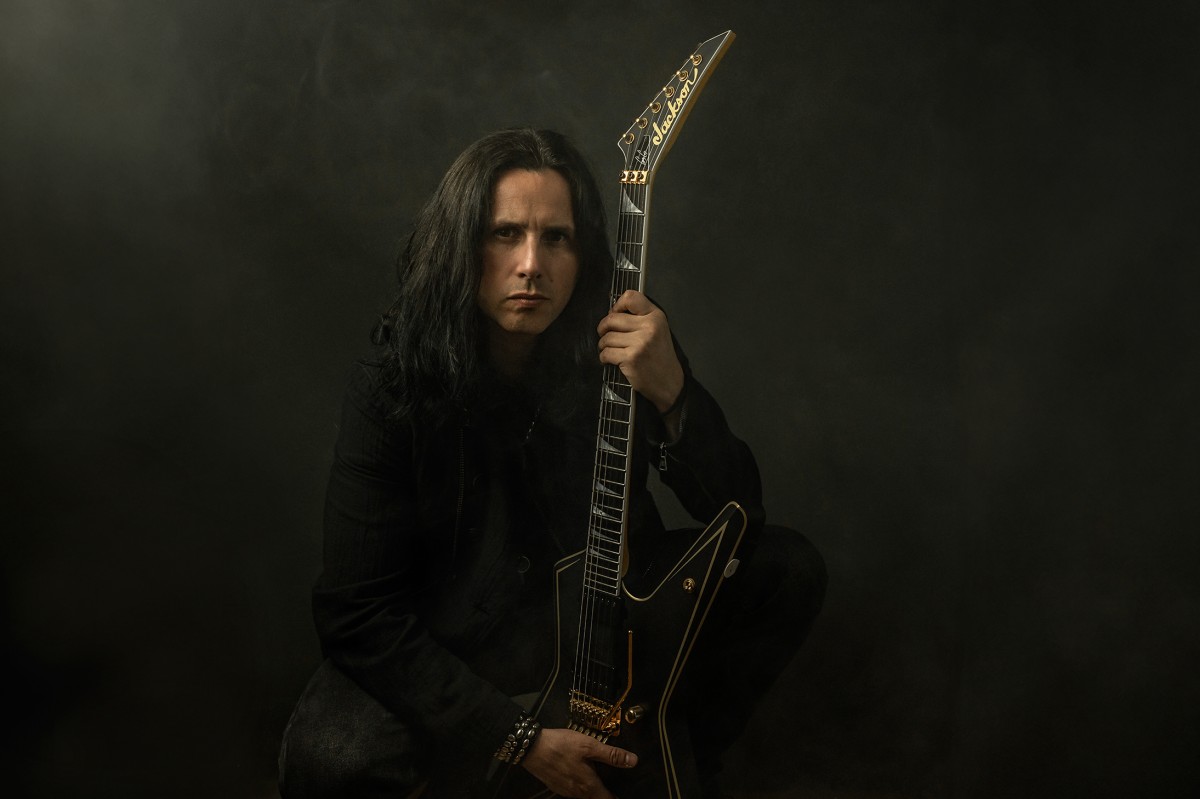
After the fully instrumental ‘Quantum Leap’ (2021), Gus G once again explores the balance between vocal songs and highly melodic instrumental guitar workouts on his new solo album ‘Steel Burner’. The Greek guitar hero shares his thoughts about songwriting, being seen as a guitar hero, and working with singers.
“Out of my five solo albums, I have only done one full instrumental record”, he says. “And ‘Quantum Leap’ was actually my most successful one so far. I don’t know why. Maybe it was because of the pandemic. It was a thing I had to overcome, to kind of find the confidence to do that instrumental record. For many years, I just thought I had nothing to offer. You’ve got Satriani, Steve Vai, Paul Gilbert, Vinnie Moore, Marty Friedman… All those guys. We’ve heard the best of it. I thought like that for such a long time.
It’s just the wrong way to think about that. I don’t know why I was so intimidated about doing it. Especially because I was never the kind of guy who was afraid to be exposed, artistically speaking. And people were on my ass about it: dude, you should do this, why aren’t you doing a fully instrumental album? And I would say: I don’t know! Haha!
Maybe when I was younger, I was kind of chasing that commercial success a bit more. Especially on the first two records, I got caught up a bit too much in that kind of American things: oh, I need to have a song on American radio. In the end, I was not successful at that, because it goes beyond the song. You need big money to get on American radio, and I didn’t have that backing.
Then I realized: you don’t have to be Three Days Grace, you don’t have to come up with radio singles, you are a guitar player. So just do what pleases you. And also: the people who like you, who listen to you, make them happy. Then I started easing my mind about it. I think the pandemic helped me think: we’re all home now, we’ve got nothing to do, I’ll just put some stuff together, what’s the worst thing that can happen? No one will listen to it. So what? I can’t tour anyway, haha!”
The Guitar Is Going to Be the Voice
“It was only then, when I kind of had to go back to square one, when I thought: I have nothing to lose here. I was surprised that when I told my label at the time, they wanted to even release the album. I thought that AFM Records was going to say: no way. But they supported the idea straight away.
Of course, I was aware that I was being seen as a guitar hero and all that stuff, but it was just one of those things where I thought there wasn’t going to be any interest in it. When I first started making records, when you could actually sell records, labels were really against releasing instrumental records. Even my old label boss, David Chastain, who was a guitar player, kept telling me: put vocals on this, instrumental music doesn’t sell.
This was in the early 2000s. With the internet, as things evolved, there is a place for everything now. I would even say that a lot of people just got tired of vocals. They only want to hear the music. There’s an audience for that out there right now. When I saw the streaming numbers, and saw what my last album was doing, I thought: wow, this is strange. Why is it doing so well? Why do these songs have their own lifespan, and they just keep going and going?
Especially the ballads, and I guess that goes back to what a lot of people compliment me on: the melodies. That’s what they like. When I did that record, I approached everything like: the guitar is going to be the voice. So we have to make melodies here. When the solo comes, yeah, I can do my widdly-widdly stuff. But the melodies are there.
Now that we are five years later, I’m still impressed by how good these songs still sound. And they are actual songs; they are compositions. I’m really glad I did that, and I’m really proud of that record.”
The Nature of the Material
“I’m really proud of the new instrumentals as well, because they are in the same vein. Even though they are technically demanding, they are real songs. I was just re-learning them again, because I was just filming some tutorials for which we are going to put out the tabs and all that stuff, and I thought: what the fuck was I thinking when I was playing this stuff? Haha! But then again, there’s a lot of nice melodies again, all over the album.
This record is obviously fifty-fifty. It’s about fifty percent instrumentals and fifty percent vocal songs. I think it was just a conscious decision that I made at some point, because of the nature of the material that I had. I just had some stuff that was meant for vocals, and then some stuff that was instrumental.
Also, by now, I have built an audience that listens to my solo music, and I know they like both. I know the demographic that listens to me, and I know they like to see me make songs with great singers, hear my guitar next to great voices. But I know they also enjoy hearing me do these instrumental guitar things. So I think it’s a good middle ground here.
Some of the music is old, some of it is new. It’s always a combination. I always have stuff in the vault, so to speak. I have riffs sitting in a folder. It’s never a lot of stuff, but there always is some material that for some reason doesn’t make it onto a record that I do, or I just compose it along the way in a dead period.
I just leave half-finished ideas in a folder, and then I revisit it later. That ‘later’ might be months or years. There’s stuff on the album that I wrote ten years ago, actually, from back when I was doing my first solo record (‘I Am the Fire’, 2014).”
Writing for the Sake of It
“Especially with the instrumentals, I write out all the parts. When I was recording the instructional videos based on the new songs the other day, I realized how much effort I put into the harmonic development and choosing the right notes for building melodies: where to fall, which notes I’m choosing, and where to highlight the chord changes. Things like that.
So without really thinking in theory terms, I rely very much on my ear, on how I want it to be. I experiment a lot with the melodies. Sometimes you’ve got stuff you hear in your head, and then sometimes, there’s nothing there, and you have to create it from nothing by thinking: how can I make this part better? How can I add a huge melody?
And then there’s solo parts that I write bar-by-bar. But that’s all created through improvisation, to be honest with you. I do a lot of takes, and then I think: this part is something I like, so I’ll use it for this bar, and then I construct the solos like that.
I was always writing for the sake of it. I like writing songs, compositions. And I think the reason why ‘Quantum Leap’ has done so well, is because it appeals to people who don’t even play guitar. Because to them, they like the melodies, and they don’t need the vocals, because the guitar takes over that role.
Of course, with instrumental music, there are things you can do that are not common with vocals. You can do crazy modulations if you want, because you don’t have to worry about a singer being able to hit those notes. The sky is the limit. But yeah, I don’t really go into that kind of prog element that much. It’s not really my thing. What I like about instrumental music is the layering. I like to add layers of guitars and harmony.”
Like a Light Switch
Some of the songs on ‘Steel Burner’, or really any of Gus G’s solo albums, could be appropriate for his main band Firewind in a slightly different arrangement. “Sometimes I write stuff that’s meant to be for a solo album, and it ends up on a Firewind record”, he admits. “There is a song on this record that’s called ‘Dancing with Death’. That is a straight-up power metal song, and originally, I wrote it with the intention of putting it on a Firewind record.
A couple of years ago, we tried to do it, and it just didn’t sound right, for some reason, or we couldn’t find the right vocal melody. So I just kind of put it aside. I was thinking for a while: maybe it’s not a good song, it’s not a good riff. But every time I listened back to the demo, I thought: that’s a good song, that’s a good metal riff, I need to do something with it, maybe I haven’t found the right person to collaborate with. So it started becoming more and more evident that it was not going to be on a Firewind record.
Then I started hanging out with Matt Barlow when he was here in Greece, and he said: we should do something together? And I said: yeah! Sometimes, that’s all it takes. You talk to somebody, you meet somebody, and you think: I’d love to do a song with that guy. And then it’s like a light switch that goes on. It was like: but I have the right song for you, bro! I’ll send you this!
And in deed, I sent him that song, and I think the nature of that song, even though it was a power metal song, was kind of closer to the Iced Earth sound than it was to Firewind. As soon as Matt put his vocals on there, I thought: well, it’s like I’m listening to Iced Earth in the nineties, haha!”
Helping Other Singers Finish Stuff
As a songwriter, Gus G is sometimes fairly involved with the vocal melodies on his songs. “It depends on the person I’m working with”, he clarifies. “Both Doro and Matt Barlow were very hands-on with it. They wrote all the vocal melodies and the lyrics for these songs. The two songs I did with Ronnie Romero were different. The vocal melodies on ‘My Premonition’ came from Dennis Ward, who is my producer, and then Ronnie completed the lyrics. The other one, I kind of wrote the whole thing myself, with a little bit of help from Dennis.
The other vocal song, the one with Dino Jelusić, the vocal melodies were co-written by another guy called Jacob Bunton. He was the singer on my second record (‘Brand New Revolution’, 2015), and we did some co-writes. And then Dino just did the lyrics.
I write a lot more lyrics for Firewind now than I did before. As a matter of fact, for the new Firewind record that’s coming out later, next year, I wrote all the lyrics. But it’s a concept album, so I had the whole story in my head, so I kind of laid it out. I have gotten more into lyric writing over the last five or six years. Necessity may have sparked that, just helping other singers finish stuff. It’s something you can practice, just like anything else, really.”
The Holy Grail for High-Gain Tones
Through the years, Gus G developed a lot of signature equipment with multiple manufacturers. Many of them can be heard on ‘Steel Burner’ as well. “Signature guitar, signature pick-ups, signature strings, signature picks, signature plug-ins… Everything!”, he smiles. “I’m using the IK Multimedia Tonex pack that I released with them, it’s called Tone Asylum. I have captured six, seven amps that I have: a bunch of my Blackstars, some of my EVH amps, and some Engl amps, as well as some of my stompboxes. Which is very convenient, because now I just open the software and all my shit is right there. It’s awesome.
It’s mainly two amps: my Blackstar and an EVH 5150. For the rhythms, for the heavy stuff, it’s the EVH. You can’t go wrong with that. I have been using that for so many records. I love the Blackstar on stage, actually. It’s very versatile, and it has a lot of rich harmonics. The EVH is like the holy grail for high-gain tones, I think, but it’s just this one sound. You can’t do much more with it. With a Blackstar amp, I can just roll the volume knob down, and you can go from almost this semi-distorted sound to something clean. It’s just a bit more versatile when it comes to that.
There’s obviously some acoustic guitars as well. There is a song called ‘Closure’, the final song, and that was basically an acoustic sequence that I had, and I kind of built it up into this electric song. I used an old Alvarez guitar I had for that.”
Each Option Has Its Purpose
“I have been playing with a modeler, the Tonex, for the last couple of years. Last year, when I went on tour with Ronnie Romero, I took my Blackstar St. James out again, and if you’re used to the modeler thing and then going back to the tube amp, it was a bit different. But when I do a more free-form rock show like I do with Ronnie Romero – because we do old Deep Purple, Rainbow and Ozzy and things like that – that sort of thing just needs a real tube amp on stage.
Obviously, the modelers are very convenient. Especially for your in-ear monitor guy. Firewind has a time-coded show, so we do midi program changes. For that sort of thing, this is perfect. When we do fly-in gigs for the weekend, having a modeler at hand is very convenient as well. Each option has its purpose.
Luckily for me, I can just call up the guys from Blackstar, and they will send me amps wherever I want them to. So it’s not like I have to carry them through airports or anything. But even if you’re doing the festival circuit, and you have maybe ten minutes of changeover and no soundcheck, you want a quick sound that works, and make your front-of-house guy’s life easier, so he will have a good overall sound for the band.
Technology has come a long way for sure. It’s pretty insane how close it has gotten to the sound of a real amp. And it’s all been a massive improvement when it comes to playability. If you’ve got a good capture, you can’t tell the difference when you close your eyes. They’ve got it so close. I don’t know how they do it.”
‘Immortals’ on Steroids
The upcoming Firewind album will feature returning singer Henning Basse, who also sang on 2017’s ‘Immortals’. “And he sounds really good, I can tell you”, the guitarist assures about Basse’s performance on the concept album. “If you liked ‘Immortals’, you’re going to love the new one. It’s like ‘Immortals’ part two, but on steroids. It’s a concept album and it’s going to be fucking epic. I’m excited about it!”
 Kevy Metal
Leave a comment