
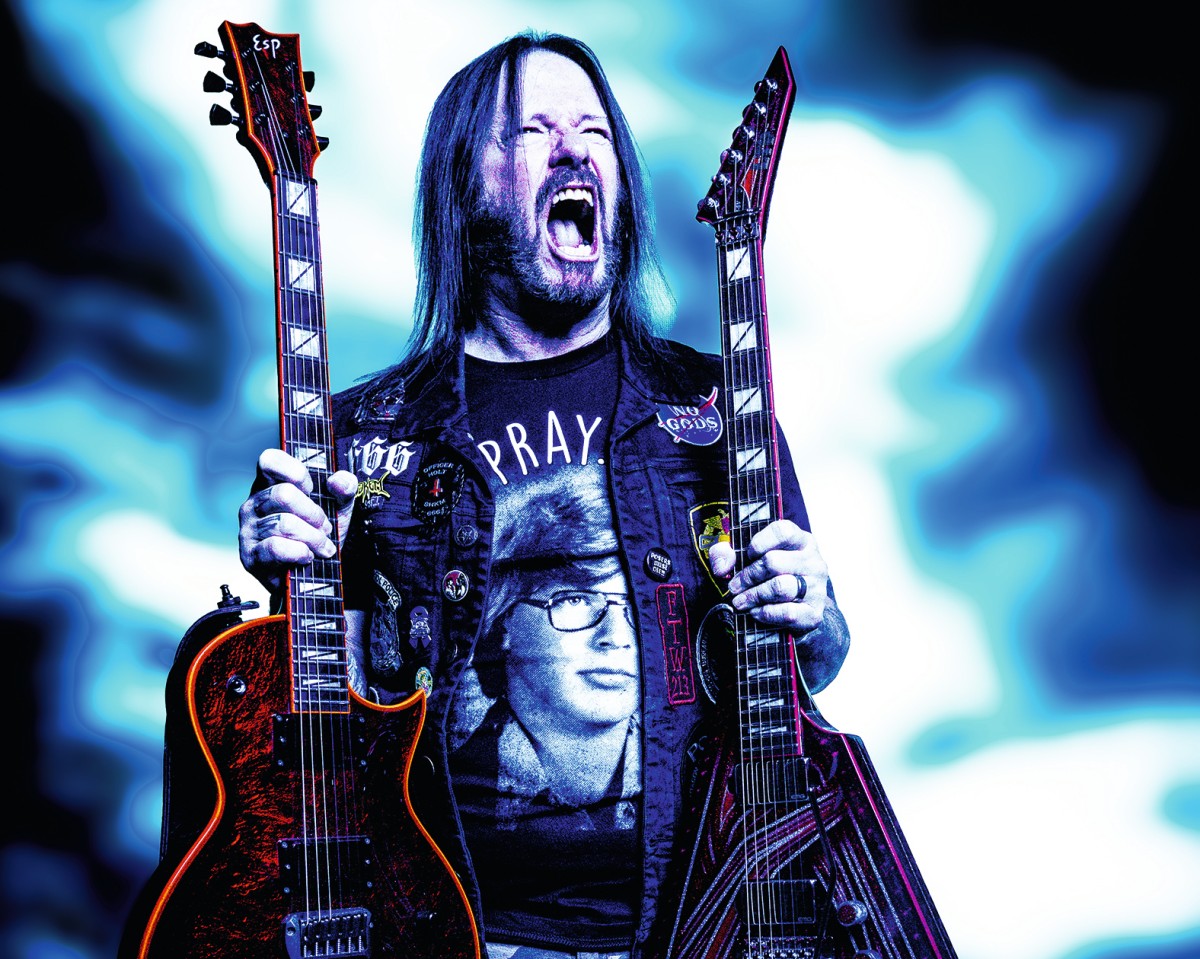
With ‘Goliath’, thrash metal legends Exodus have just released what might be their most diverse album to date. According to guitarist Gary Holt, it also is their most collaborative one. He tells us about how the recording process, the guest musicians, and the return of vocalist Rob Dukes have influenced how the album sounds.
“No songs were written until Rob came back, and Tom (Hunting, drummer) and I got together and started jamming”, Holt explains. “I mean, I had some riffs. I’ve got thousands of riffs. Whether they get used or not. My voice recorder on my phone is full of them. And half of them when I listen to them later don’t even make sense to me, because I’m recording two-second versions of a piece of a riff, and I don’t even know what I was trying to remind myself of.
When we went into the studio, we had maybe five songs done, and we recorded eighteen songs. That’s the way we like to work these days. We book out a studio, and we leave everything set up, so we can write and track all the way through the end, rather than the old school way of walking in, you’ve got ten songs done, and then we’ll record ten songs. We’ll change everything. Lee (Altus, guitarist) wrote nearly half the album. Everybody was super-inspired. The experience was like a really creative, awesome explosion. It was killer.
Lee and I had a goal of doing two albums at once. Not that it’s a two-part thing. But just so we could take a little break for once in between albums, like maybe have a vacation. I heard they ‘re cool. I’ve never been on one that didn’t require a guitar to get there and play and stay a couple of days. I have never left all of that behind and gone somewhere.
In the end, we fell just slightly short, but by the time we go into the studio to finish the second one, we’ll have ten more, and we’ll just record them. We’ve still got some work to do, but we’ve got a huge head start. We could literally just write two more songs and have the album done.”
Riff Out and Jam
“There was never a goal other than to just riff out and jam and write songs. We don’t say: we need a song that does this or that does that. We just jam. Same as we did when we were 17 years old. And we’re super happy with the way it all came out. Maybe the diversity on the record is due to having more songwriters working on it, which I always encourage. In the past, if there’s ten songs on the record, I wrote eight, because I had to.
So Lee wrote nearly half the album, Tom wrote some lyrics, Lee co-wrote some lyrics on a song, Rob and I wrote the rest. Jack (Gibson, bassist) is the first guy I go to with arrangement opinions, so he has his stake in all of this as well. It was just awesome. All hands on deck. Everybody was just working.
But as far as the songs go, I still have anxiety over which ones we chose. Because it’s not like we chose the absolute ten and the others are pretty good. No, the other shit is insane. It’s awesome. We just like this combination of songs.
For instance: I wrote two epics, eight-minute songs, so we weren’t going to put both of them on the album. We picked ‘Summon of the God Unknown’ for this, and the other one is just eight minutes of a fucking sledgehammer on your head. Total opposite kind of epic. Just bludgeoning.”
Give Me Maximum Sadness
The collaborative nature of ‘Goliath’ extends beyond the band itself. Hypocrisy and Pain frontman Peter Tägtgren guests on ‘The Changing Me’, while violinist Katie Jacoby appears on the title track. “Lee wrote ‘The Changing Me’, and that was his vision from the start”, Holt explains. “Peter is one of our closest friends, and we have shared collaborations back and forth a couple of times.
Lee sent the track to him, and he sent multitrack clean vocals that were just awesome. Tom added cleans as well. Then at the end of the song, it’s just Peter and Rob screaming at each other, basically. That was Lee’s vision, and Peter just executed it perfectly.
When we did ‘Goliath’, and I was listening to the playback of the harmony section, my brain started imagining things. It could be LSD from the old days, I don’t know. But I heard strings. And Katie’s one of our closest friends. She’s like a kid sister to us. She played with us live when she was around 15 years old.
She was on tour with The Who at the time, so we had to bring in someone else. That performance was not good, but it showed what the idea was. It was just a scratch track. When Katie got back home, I sent it to her, and she sent back like a full fucking orchestra of strings. It was amazing. I just said: give me maximum sadness. She did it perfectly. It just set the song on a whole other level. It was just amazing.”
An Entire Recording Studio Worth of Gear
“For the recordings, we lived together in a rental house. But we’ve done that for a long time. We like to record the way bands did in the seventies. Deep Purple went to Lake Geneva, for the last album (‘Persona Non Grata’, 2021) we went to Lake Almanor, where Tom Lived. Queen would go to some chateau in the south of France; we would rend a vacation house somewhere and build a studio in it. And that way, we were tracking all day long. If my fingers are tired: next guy up.
We would leave the drums up the whole time now, so we can continue to record drums to the end. On the new album, the last song I wrote was ‘Hostis Humani Generis’, and I tracked that with no drums, because I wrote it so late. I just recorded it to the click, so that Tom could study it for a couple of days. The drums are there, ready to go, or that song would have never even been finished.
The difference is that this time we actually rented a studio. For ‘Persona Non Grata’, we went to Tom’s, and we shipped an entire recording studio worth of gear that our engineer Steve Lagudi owned. It was the pandemic; it was the only thing we could do. And that was the start of leaving drums up the whole time, which is awesome.
In terms of guitars, this time I only brought the ones that I really thought were important to have. I was only a two-hour drive away from the arsenal, but I picked out the ones that I really wanted. When we did ‘Persona Non Grata’, we were hours away up in the mountains, so I really had to select what I was taking with me.”
The Most Flawless Example
“Starting on the last album, I have done all my rhythms on this 1983 Yamaha SBG3000 that I bought. It’s awesome. It’s a Les Paul killer. And the intonation is just spotless. It’s a fixed-bridge guitar, and it’s got small frets. I love it in the studio. That guitar doesn’t leave the house. It’s really old, but it literally is the most flawless example I have ever seen. It doesn’t even have buckle rash on it. And then I had a couple of others for some different little tones here and there, like my Brian May Super on all the harmonies of ‘Goliath’. I used my ESP for all the solos.
We took a bunch of different amps in, but for the rhythm guitars, we brought my live rig, and we plugged it in and turned it on… And that’s all we did. We didn’t touch a knob. We tried other stuff, but we rolled that in, and we thought: done! That was easy, haha! Marshall and Boogie for everything. I used one of Lee’s old modded Marshalls for the leads, and he uses an old Mesa Boogie Mark III for his solos. It used to belong to a man named Kirk Hammett. It’s one of those old eighties ones.
There’s always just one rhythm guitar player on a song. It’s just a million times faster. It would slow down our process so much if I had to stop and show Lee, and him take time to master it, and vice versa. It’s easier if the mind who wrote it plays it. Fortunately, Lee is a world-class rhythm guitar player. Other bands might have a super creative musician, but they may not be the strongest rhythm player. But Lee is a monster.
The songs I wrote on the album are two tracks, and Lee’s are four, but it still sounds like one record. We’ve done that since the start with Lee in the band. In the eighties, we played all our own rhythm tracks. We were the only thrash band that did. Rick (Hunolt, former guitarist) played all his tracks. Not knocking anyone else; whatever works. A slight, little looseness does make the guitars sound bigger. You get them so perfectly tight, the signal almost becomes mono.”
No Time for Leads
“For my solos, I work out little bits in the house while sitting around, but you know, I’ll just start jamming until something starts coming to me, and an idea sticks, and I’ll fight my way through it. Sometimes it’s total improvisation. I worked really hard on this album. Because on albums in the past, I wear so many hats: I’m tracking my own stuff, I’m writing lyrics, I’m overseeing vocals, I’m there for bass and all that. I give myself no time for leads. So I short-changed myself a little bit, and I kind of stopped doing that to give myself a minute for my own playing.
My favorite solos, of course, are all on the next record, haha! That’s just the way it worked out. None of it is intentional. But I was listening, and I thought: damn, the solo on this one and the breaks on this one are so killer! But no one’s going to hear it for a couple of years, haha!
With solos, I tend to get bored really quickly, and I start improvising when we play the songs live, sometimes for better or worse. Even in Slayer, I improvised the hell out of everything. All the years in Slayer, I would look at my guitar tech Warren, and he would give me that: ooh, that was good! And then I would try something different the next time, and he would be: nah, man! Trying to keep myself involved there, haha!
I tend to overbend the notes sometimes, because I get too hot, so you just keep bending, and eventually you’ll land on one that works. That’s why I’ve got a lot of live photos – and I love them – where I’m just bending the strings clear across the fretboard. For one: I like that it makes them scream. And two: I’m probably trying to push it up another full step to get to the one I wanted. It always works. Never fails.”
Never Set in Stone
Since Rob Dukes’ departure from Exodus in 2014 was amicable, he was the logical first choice to follow up Steve ‘Zetro’ Souza once again. “He’s one of our closest friends”, Holt emphasizes. “We love the guy, and the vibe in the band is as good now as it’s ever been. We joke about maybe finding a 30-year-old with some washboard abs who can jump off a drum riser without needing a wheelchair after, unlike the rest of us. We made the same jokes when Zetro came back.
All kidding aside, though, we like familiarity. Which is insane from a band with as much of a turnover over the years, but we don’t like change. If you get a new guy: we don’t know the guy. Maybe he turns out to be a wonderful human, or maybe he’s a fucking piece of shit. You never know. And you know, we’re in our sixties. I don’t want to introduce myself to a new Exodus singer.
When I write lyrics, I’m going to write the phrasing, and then there’s a song. But also, it’s never set in stone. If a singer, be it Zetro or Rob, comes in and sings a line, and it’s different than I planned it but I like it, I leave it. As long as the end result sounds good. I’m really easy like that. If it’s not what I’m asking, but I like it: sure! As long as the timing is good, and as long as there is a sense of build-up, I don’t really care.
As I saw all these additional elements that Rob was able to bring, it does maybe subconsciously influence you in that I can write a little more towards his voice.”
Seven Minutes of 260 Beats per Minute
“Exodus is a band that can never catch a break. But it’s that chip on our shoulder that fuels us. When Zetro’s not in the band, people demand that we get Zetro back. And when we do, it’s the opposite. Neither of those poor guys can succeed. We record more fast shit than any other of our peers. Bar none. I’ll put our BPM’s against any of them, and don’t fool me with your five-second blastbeat. That doesn’t count, haha!
What counts is: are you doing seven minutes of like 260 beats per minute? We do. And when we slow down a little bit, people fucking criticize us. Some of our peers do one fast song per album, and people are like: oh, it’s back! Well, we never stopped!
Tom panics sometimes when I record something for him. But that’s because when I do home demos, I’m lazy as far as drum programming goes. I just drag a drum loop in and let it fly. And then he’ll listen to it, and the song is six minutes long, 240 beats per minute the whole time, and he says: are you going to kill me? No, this is half-time, this is slow, I just don’t want to take the time to program that shit and drag different beats in when it doesn’t matter. Lee just got introduced to Ezdrummer, and he puts everything in, every change. I just hit play and go.
There’s no one like Tom Hunting. He’s the best there is for Exodus. I have played with some really fucking great drummers, and I’m pretty honored to jam with the guys I’ve played with, but I wouldn’t trade Tom Hunting for a thousand of anyone elses. He’s my man!”
Finding Unsettling Chords
“I go through my forays of just concentrating on dissonant fucking rhythmic brutality. And I love that. I love finding chords that are just unsettling. Going to ‘The Atrocity Exhibition: Exhibit A’ (2007) and ‘Exhibit B: The Human Condition’ (2010), I just wanted to explore the fucking darkest chords I could come up with. But I like melody. I’ve written lots of melody. But ‘Downfall’ is on those albums as well, and it’s melodic as fuck. We should maybe play that song one of these days.
Putting together setlists is quite a challenge these days anyway, because we’re band that wants to play our new material. So yeah, it gets really hard. Of course, we’ve got to play ‘Blacklist’, of course we’ve got to play ‘Strike of the Beast’ and ‘The Toxic Waltz’, and usually ‘Bonded by Blood’, and sometimes ‘Fabulous Disaster’. It’s hard.
The hard part with this album is that no one song can represent the whole record, because of the variety. So every song’s going to be different. Picking singles wasn’t easy.”
 Kevy Metal
Leave a comment