
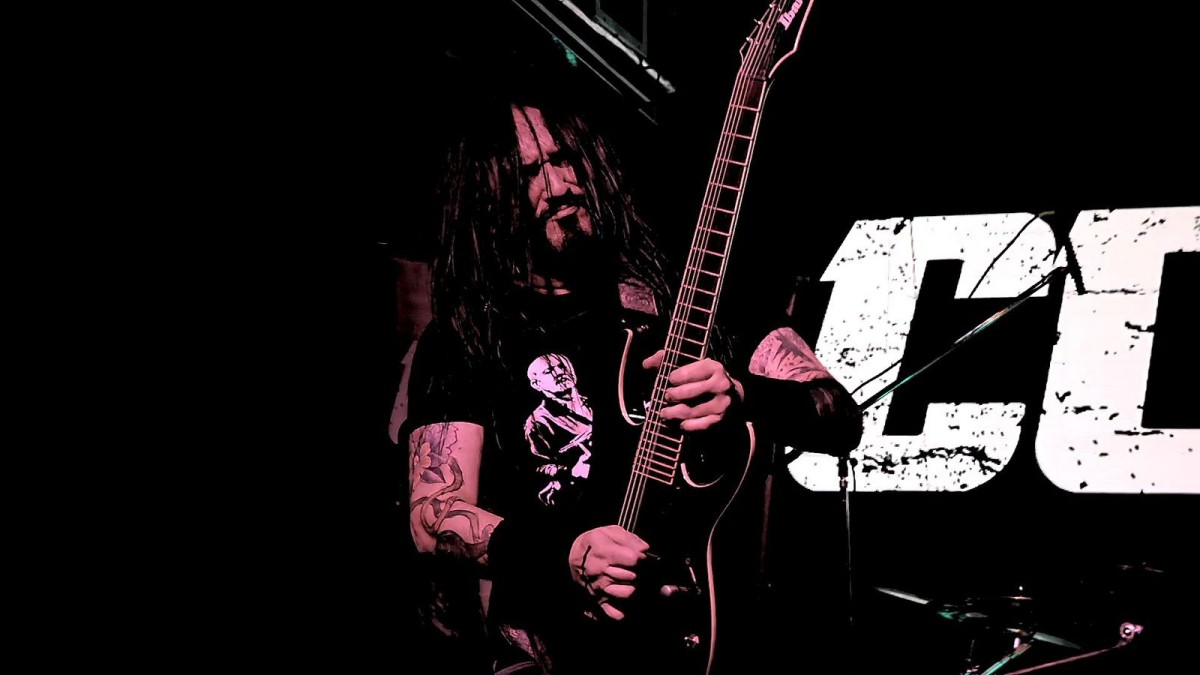
Argentinian guitarist Facundo Coral spent most of his childhood and a significant portion of his adult life in Venezuela, founding the influential band Cronos and playing with the even more influential Gillman on arguably the band’s best albums. Coral looks back on his history with multiple high-profile bands both in Venezuela and Argentina, and shares his future plans with his own band Coral.
“I was born in Argentina in 1970”, Coral explains. “But the political situation in Argentina in the seventies, during the junta time, was like hell. A lot of people fled the country, including my parents. They went to Colombia first, and then to Venezuela. I was only seven years old. I went to school in Venezuela, I studied to become a lawyer in Venezuela, I studied guitar in Venezuela, and I played a lot of music in Venezuela.
Remember that here in all of Latin America, nothing is ever calm. A lot of times, there is a lot of violence. It’s not easy to live here. In any country. And maybe, if you live here, and it is easy now, things may become problematic in ten years’ time.
But the metal is here is cool, because it’s a form of rebellion for the society of metal musicians who are active here. Remember that in Venezuela and Colombia, the music that everybody listens to is Latin music. Salsa, merengue: dance music. There are a lot of rockers in Venezuela, but nowhere near as much as in Brazil or Argentina.”
Tailored to Rock
“At the age of 10, I began touching my guitar, but it began with classical guitar, simply to get familiar with the strings, learn how to tune the guitar, and then at the age of 11 or 12, I began to take lessons, to learn musical theory at a conservatory. It was not a classical conservatory, though; it was a jazz conservatory, with Gonzalo Micó as my teacher.
It was really great. Gonzalo studied at Berklee College of Music in the seventies and early eighties, and at GIT in Los Angeles. He studied jazz guitar, but he knows I am a rocker. I like heavy metal. His classes for me were tailored to rock. He taught me some Eric Clapton, some Van Halen… I really love this guy, because in this institution, where every class was all jazz, he taught me to play rock.
Gonzalo is a great musician, and I learned a lot from him. A lot! And then, in 2000, I took some extra classes with Gonzalo. It was wonderful, because this time, I already knew how to play guitar, and Gonzalo was of course wonderful. I wasn’t that kid from the eighties anymore. This time, I was 30 years old, and we talked and played together. It was amazing.
I learned a lot from Gonzalo until 1987. After that, my teacher was the street, the clubs, the stage. I took all that I learned from Gonzalo, and applied that to what I was doing.”
A Completely Different Experience
“When I was 10 years old, I heard the first Resistencia album, and I absolutely loved it. It sounded good too; in Latin America, all the records had a bad sound, but Resistencia sounded really good. The guitars actually sounded like guitars going through an amplifier. Rodrigo Yoma was the first lead guitarist, and the solos were incredible, with the harmonic minor scales, like Arabian scales. It was really great.
I saw Arkangel and Resistencia live. When you hear Resistencia on the records, you can’t help but think: wow! The songs, the musicians, the recordings, they’re all great. But then you saw Arkangel live, and it was like our version of Iron Maiden. With a backdrop, the drum kit one meter from the floor on a riser, the long hair, all this leather… It was really a metal band! Resistencia sounded great live, but man, it’s a completely different experience. More like a seventies rock band.
When I was a kid, I had heard Deep Purple and Led Zeppelin, but I really loved bands like Iron Maiden, Judas Priest, Saxon, and Motörhead. What I wanted to see live was something like those bands. A band from Venezuela, but playing like those bands. And that band was Arkangel. At the time, Arkangel, Resistencia and La Misma Gente sold out arenas, like El Poliedro in Caracas, playing in front of 15 thousand people. That’s a lot. Only national bands, and they had tours around the country.
Fahrenheit was another great band from that time. They had a female singer, and their guitarist was like Eddie Van Halen to us. Equilibrio Vital from Maracay was also really good. It was a bit metal and a bit hard rock, but especially a lot of seventies Yes and Genesis, or maybe some Wishbone Ash. They were strange, but they were a great band. Grand Bite didn’t release their first album until 1985, and around 1986, 1987, metal started going down. But we really had a lot of good bands and concerts in Venezuela in the early eighties.”
School Friends and Neighborhood Friends
“Cronos was established when I was 13 or 14 years old. The first Cronos songs were written in 1984, if I’m not mistaking. It was my first band. Jeluz was the name before we changed it to Cronos. At first, I looked for some musicians among school friends. Then from neighborhood friends. After that, we realized that we needed a better drummer, or a better singer, who wasn’t just in it to get girls, haha!
Apart from me, the first real line-up of Cronos consisted of Eduardo Sáez on drums, who later also played with Gillman, and he is my best friend, my brother from old times, and Gabriel Vivas on bass, who went to live in the USA around 1984, studied bass there, and then went on to play with Gipsy Kings and Shakira. He played one or two songs on the last Cronos album (‘After All’, 2020). It was wonderful playing with him again after thirty, forty years. It was amazing.
Our first singer was Alain Fernández, who was from our neighborhood. Then, after a few concerts, he left the band, and José Adamez joined. He played with us a lot of times, and recorded some EP’s, some single songs. Cronos originally existed from 1984, when I was 14 years old, until 1991, when I was 21 years old. The first EP, ‘Al Fin Una Victoria’ (1991), was really successful in Venezuela, and also somewhat successful in Colombia and Ecuador.”
Not Built for Metal
“When we recorded with Cronos for the first time, I was terrified. It was in 1986, and it was in a terrible recording studio run by a friend of ours. Even though they recorded our parts, they mostly recorded cuatro music, folk music from Venezuela, salsa, prog… And it worked really well for salsa and Venezuelan folk music. But not for metal. It wasn’t built for metal.
We played two songs, ‘Al Fin Una Victoria’ and ‘El Juicio Final’, and recorded those. It was fine, because we learned a lot from it: how to produce, how to play in a studio, how to find the sound that we wanted to find… This recording session was a wonderful opportunity to learn. It’s just not that wonderful to hear, haha!
After we did this recording, maybe six months later, we wanted to record these songs again, only better. We did the instrumental song ‘Cronos’ as well, which is a typical Iron Maiden-style instrumental song. But it really was a lot better. We used these recordings to get some radio airplay, and it was wonderful for us, because it helped us play a lot of shows in Caracas and other states in Venezuela.
We did some tours, and we were only 17 years old! It was great. And all the great bands from these times – Arkangel, Gillman’s solo band, Resistencia, La Misma Gente – all those bands began to hear about Cronos. ‘What about those kids?’ Haha! And we began to play with these legendary old bands from Venezuela. That was great for us.”
Everything Out of a Few Channels
“After that second recording session, we bought a Tascam deck with four channels. We used to record all the drums on four channels, then mixed those, and then put all of them on one channel. We really tried to get everything we could out of those few channels. Now, we have computers to record everything, which is a wonderful thing. We have all the amplifiers, and all the pedals. But when you see how we recorded in the eighties, the difference is night and day.
We composed and arranged a lot of songs, and we recorded some of them on this Tascam deck. Then from 1987 to 1991, we only composed and arranged with this Tascam recorder, and then went into a real studio in Venezuela that recorded Gillman, and Laberinto, who were our brothers. Laberinto was originally known as Standard, and Standard and Cronos played together a lot of times.
Then, we recorded ‘Al Fin Una Victoria’ at a better studio, Estudio Madbox’s. And the sound guy in that studio really knew how to record rock and metal. He was a metal guy with a studio. He had good ideas of where to put the microphones for the guitar and the bass. When he was talking about room mics for the ambience, that was completely new for us. We were 20, 21 years old. We had never thought of that. In this studio, we also recorded ‘Escalofrío’ three or four years later.”
Scared to Do the Audition
“Some people told me that just before I went to join Gillman, Paul told some people that I was the guy. ‘If something happens, this is the guy’. In 1991 or 1992, after our tour for ‘Al Fin Una Victoria’ with Cronos, the universe or something else suspicious intervened. Both guitarists left Gillman around the same time, and Cronos split up.
Then I saw Gillman was looking for a guitarist. ‘Do you have time to rehearse, to travel on some tours, do you have your own amplifier, guitar and pedals?’ When I saw that, I thought: I have to give it a try. I would have to learn some Gillman and Arkangel songs, and go to an audition. There were around thirty guitar players there. There was one guitar player who played with Resistencia, after the original line-up dissolved.
I was only 21 years old, and I thought: okay, I don’t belong here, but I am here now, and I will do the best I can. I played some Arkangel songs and some Gillman songs with the band, after which the band played some accompanying parts, and I had to come up with a solo to play over it. Then, I had to perform a guitar solo like it was an eighties concert. That was the audition.
Then they called me, and I had to audition again, but this time, the thirty guitarists had gone down to only five. Once again, I went to the audition, learned a different song to play with them, and I was selected to be in the band. Honestly, I was really scared to do the audition. I was 21 years old and a fan of Arkangel and Gillman. But I think I played well. When Paul, the band, and the manager told me I was the man, it was a wonderful moment. Really happy with that.”
A Piece of History
“When I joined Gillman, the band had another drummer: Félix ‘Tucson’ Guerra, who had played with other legendary bands in Venezuela. He played with Gillman for a lot of years, but I think he moved to the USA at that time. So they organized another audition round, this time for drummers. But none of the drummers that showed up made them go: yeah, this is the guy!
So I talked to them about Eduardo Sáez, saying that I played with him all my life in Cronos. Eduardo went to one of our rehearsals, he played with us, and we immediately knew: this is the band. Churdy Toledo, the long-time bassist of Gillman, Eduardo on drums, me, and Paul Gillman. This band was very powerful live. Really powerful.
The beginning of Gillman’s sound was clearly rooted in earlier heavy metal, the early Latin American sound. For the first Arkangel record, one cable went from the guitar to the effects pedals, and then there was another cable from that to the console. No amplifiers. And you can hear that. But it was one of the first metal records in Venezuela. It’s a piece of history.
When I began to play with Paul in 1991, the first step was to arrange all the classic songs from Paul’s solo career and Arkangel in a away that gave them a new flavor. Of course, there was a lot of the typical classic metal from Judas Priest, Iron Maiden and Saxon. But those days, in the early nineties, I listened to a lot of Pantera, Sepultura, Machine Head, and Fight with Rob Halford.
If you hear the sound on the ‘Escalofrío’ album (1994), it’s like a mix of Black Sabbath and Pantera. It’s nothing like the stuff I compose now, but it was a wonderful time. We would spend maybe six or eight hours in the studio for rehearsals, arrangements, composition and pre-production of the songs, four times a week. That’s a lot. But it was wonderful. I was 21 years old, and I couldn’t believe it.
The entire band enjoyed it. We were like brothers. We would look at each other and know immediately what to play. Wonderful band members. You can’t see it, but you can feel it on the record. You can feel how united we were.”
Surprised by Distortion
“‘Escalofrío’ was my first real, professional record. I composed the music, and Paul wrote the lyrics for all of the songs on that record. When I make a composition for a song, every song, I compose that on an acoustic guitar. Not an electric guitar. Then, when I have the riffs or an outline of a song finished, and I often get surprised by how good it sounds with the distortion and everything.
All of ‘Escalofrío’ was composed on an acoustic guitar, for example. With steel strings. What helps is that I listen to a lot of different music. I had been an Arkangel fan since I was 9 or 10 years old, when I first saw some videos of them on Venezuelan television in 1979 or 1980. But I also hear salsa all the time, Latin music, and I really love blues.
‘El Tirano Aguirre’ has a really bluesy solo. But that’s how I make solos all the time. I don’t overthink the solos, and I don’t write them out. At the rehearsals, I just play the songs a lot of times. And maybe when I hear something that I like, I record it. Now it’s mp3, but it was the same when I had cassettes. Maybe after the thirteenth time we play it, I realize I have the solo. Then I take some parts, and maybe improvise rest during other rehearsals, or maybe even during the recordings.
I know I have a certain part, and the rest is my feeling at the time, at that particular moment. And then, of course, after the record hits the streets and we play it live, I will play the same solos. But to create the solo, the first time, it will be the feeling of the moment, like a bluesy guitarist.”
Everything Exploded
“We made ‘Escalofrío’, and the next record had to be another studio record. Not a live record, like we did with ‘Vivo & En Vivo’ (1996). That was a record of the two-year tour we did for ‘Escalofrío’. It has a new song, and a new version of a song from two records before, ‘Maldita Velocidad’. It really is a Pantera meets Fight song, haha! We really liked it, and we really liked playing it live.
But we had to take a lot of time to compose again, and make a record that was better than ‘Escalofrío’. The new record had to be on another level. The one studio song on the live record was supposed to be a beginning for the next record, but then someone put dynamite on Venezuela and everything exploded. It was a very difficult time, socially, politically, and economically.
Then, in 2001, maybe early 2002, Paul told us that we had the money to write a new record: let’s begin to compose, let’s begin to pre-produce, let’s begin to do anything. We started from zero. I really wanted it to be a continuation of ‘Escalofrío’, but that’s not what ‘Cuauhtemoc’ (2003) is.
It was a strange time in Venezuela, and in our lives. With the passing of time, twenty years later, I can listen to ‘Cuauhtemoc’ and say: it’s good, I like it. But in the time it came out, I didn’t like that record. At the time, I wasn’t satisfied with ‘Cuauhtemoc’. For me, it had to be better than what it was.”
A Really Happy Era
“Regardless of what side of the political spectrum you were on, it was really difficult to live in Venezuela, to work in Venezuela, to have enough money to take care of your family, of your kids… It was very difficult. At the time, there weren’t a lot of concerts either, maybe only one concert per month. It was an era when it all stopped for a lot of years.
I decided that maybe, for the first time, I should go to Europe with my friend from Laberinto. I also considered going to the US. But my family was here, and my first step was: okay, I will go to Argentina for maybe one or two years, to think about my life, and then decide whether I will go to another country, or stay in Argentina. I went to Argentina in 2004, and when I came to Argentina, I began to play with Tren Loco for about ten years. A lot of shows, in many countries.
Tren Loco had two guitarists on their first few albums. Then, one guitarist left Tren Loco, and they had only one for a while for maybe two records. But then, Gustavo Zavala, the bassist and composer for Tren Loco, wanted to have two-guitar harmonies like Iron Maiden had, and for live, he wanted to have an additional rhythm guitarist to have a more powerful sound during the solos. This is the time I entered Tren Loco. Since I joined Tren Loco, they have had two guitarists all the time; Pablo Soler took over after I left.
I really enjoyed my time in Tren Loco, because I was born in Buenos Aires, but I never played in Argentina. I played all over Venezuela, but in Argentina, I knew Buenos Aires, I knew La Plata, and nothing more. Tren Loco was touring the country every year, many times, and all of Latin America, from Mexico to Argentina. It was a really happy era.”
Never Played Death Metal Before
Before leaving Venezuela, however, Coral spent a couple of years playing guitar with extreme metal pioneers Stratuz. “Cronos and Stratuz played together a lot in the eighties, and they are really good friends of mine”, Coral says. “Stratuz’ lead guitarist at the time was a guitar student of mine. Then, when he left Stratuz, my brothers from Stratuz asked me: hey, why don’t you come play with us?
At the time, I wasn’t sure. I had Cronos, I had Gillman, of course I also had my personal life, but they told me: you are our brother, you have to do it! However, Stratuz played death metal, and I had never played death metal before. Of course, I had heard death metal, but playing something is another thing. The songs are different than you are used to, there are different scales for the solos, different types of riffs, it’s a different right-hand technique… It’s all different.
It was really difficult for me at first, because my sound is not like Stratuz. I had been playing heavy metal all my life. But I really worked on that, and maybe in a few months, we began to compose the new record, ‘The Last Angel’ (1999). After that record was released, we toured Europe for one month: Spain, Portugal, the Netherlands, and Germany. It was incredible.
I really love Europe, because you have all these great countries right near each other. It’s not like in the USA or Latin America. And Europe has a lot of history. I knew that already, but when I went to Europe, and actually saw all of that history, and I saw all the people on that tour, and learned how to organize a tour, how to play there, the venues… It was wonderful.
We were there for one month, then we came back to Venezuela, and went on to make another record (‘Spirit Seduction’, 2000). Then in 2002, we did our last show in Venezuela, after which Stratuz went to sleep for a while. For twenty years, actually. But three years ago, my brothers made a really wonderful record (‘Osculum Pacis’, 2022). It’s a more doom Stratuz, but the songs are really wonderful. I love it!”
The Best Energy
Since leaving Tren Loco, Coral has been focusing on the band that carries his last name. “I did not name the band Coral for it to be a solo band”, he emphasizes. “The first interviews I did, people said: a solo band, like Yngwie Malmsteen or Steve Vai or something. That’s not what this is. But I had to use this name, because people will recognize my name. I did not want it to say ‘this is the band of the ex-guitarist from Tren Loco’.
I never even played any Tren Loco songs at the Coral shows. There are people who ask me to play ‘Ruta’ or whatever, but no: the people who need to play that are in Tren Loco, not me. I may be a former member, but I’m playing very different music now. Maybe it’s a problem that I don’t want to play Tren Loco songs, because the promotional material always say that I played with Tren Logo. Maybe there would be more people if I did. But Coral is a new band.
We didn’t go to all the cities that we played with Tren Loco, because obviously, they are al legendary Argentinian band. But Coral did get the chance to play a lot of cities here, like Córdoba, Rosario, Mendoza… We have the best energy and the best support from Icarus Music, who released all our records.
From the moment we started Coral, we have worked with Icarus Music. This is really important. You can go to any state, any radio program, any streaming platform, television… We make a new video, and the first time you can see it, it’s on the best television program we have here in Argentina, on Vorterix. For every record we’ve done, it was like this, and that’s been really important. Every metalhead in Argentina watches that.”
Another Universe
“I really wanted to experiment with seven strings, eight strings and drop tunings. We now tune down one full step. We have all the songs for the new record in pre-production. We only have to go into the studio and maybe work on them one by one. Not like we have in the past years: all the record in one month. Maybe a few singles, maybe one or two EP’s, and then the record.
We may play some songs on eight strings, but it’s the same style of songs. It’s not like we have gone full modern death metal or something. It’s maybe another universe, another flavor. I really want to experiment every record. I don’t want to do the same thing over and over again. Of course, it’s made by the same minds, and I play the guitar the same way, but I do want to experiment.
If you hear the first records from Cronos all the way to what I’m doing now, being over fifty years old, you can hear that I’m older. We have experienced many things in our lives. And that is on my mind when I arrange and compose new songs. Maybe I want to experiment with some keyboards, more solos, with harmonies… And we have a singer who sings like a rocker. It’s not a classic heavy metal voice, and he doesn’t growl. It’s like a rocker’s voice in a metal band. It’s great!”
Thinking About the End of the World
If you still want to hear Coral’s guitar work with a more classic-styled heavy metal voice, you can hear him working with Venezuelan singer Marino Vásquez on Guerra Santa’s 2023 album ‘Éxodo: Un Nuevo Comienzo’. “Marino is my brother!”, Coral exclaims. “I have known Marino for a long time, but I had never played with him. Only as a guest musician with Guerra Santa. About eight years ago, he began to work on a new album, and he said to me: we have known each other for thirty years, but we never composed a song together. Let’s begin to write songs for this album.
And it’s wonderful, because one of my best friends is making these songs with me! I take a seat with my guitar, he starts to sing something, and I follow him on the guitar. Or maybe I will say: hey, I have this riff, and he comes up with a vocal melody on top of that riff. It was a really fun and easy process.
We recorded part of the album in 2020 during the pandemic. Only me in my house, with my computer, and the other guys in their houses with their computers. It was really strange. If you see the video for ‘Shangri-La’, it’s everyone playing in their own house. If we didn’t have that, we would just have been in our houses, thinking about the end of the world or whether we can even live another day.
When I composed a song for the Guerra Santa record, it was like therapy. But it has always been like that: whatever is bothering you, you take it out in the form of a song. And it’s wonderful. After I composed those songs, I felt relieved. ‘Escalofrío’ was therapy for me too, but at that time, it was about a girl. I am very happy with the final result of ‘Éxodo’.”
A Big Class Reunion
Along with Vásquez, Coral was involved with organizing Venezuela Metal Fest. “Venezuelan people moved to a lot of different countries”, he explains. “Argentina is the same. We have a lot of Venezuelan people living here. We were thinking of organizing a Guerra Santa concert with only bands that have Venezuelan members. This was the first edition of Venezuela Metal Fest. Live in person, no streaming, haha!
It was like a big class reunion. Everyone enjoying Guerra Santa and the other bands from Venezuela. So with that first edition being so wonderful, we wanted to organize more. But then came the pandemic. But then came the idea: let’s organize a streaming event. At this time, streaming concerts from metal band had become normal. If you play in a venue, maybe ten, a hundred, a thousand people will come to see you. But if you play on the streams, people from other countries can watch as well, including Venezuelan people in other countries.
That really was great. This party we had at the first Venezuela Metal Fest, we hen had on the chat in the streams: hey! How are you? Anybody want more beer? Haha! It was amazing. In 2022, we returned with the live shows, and we combined streaming an the live shows.
These days, I am a stage producer and a technical producer with a lot of bands, and because that requires me to travel a lot, I don’t have the time for anything anymore. We can’t even play any live shows with Coral at the moment, because maybe there will be a festival two months ahead, and I might be touring with an artist.
So I stepped out of Venezuela Metal Fest, but Marino is in charge. He is the one carrying the flag now. Metal warrior Marino is taking this idea to Uruguay, to Brazil, and now to Chile. And once a year, he plays with Venezuela Metal Fest here in Buenos Aires. It’s like a dream going to all these places and making this happen with our festival. It’s wonderful for him, for the band, for us, and for all the Venezuelan people who live in other countries.”

 Kevy Metal
Leave a reply to Interview Rubén Limas (Tetrarch): “Practice Is Everything to Me” – Kevy Metal Cancel reply