
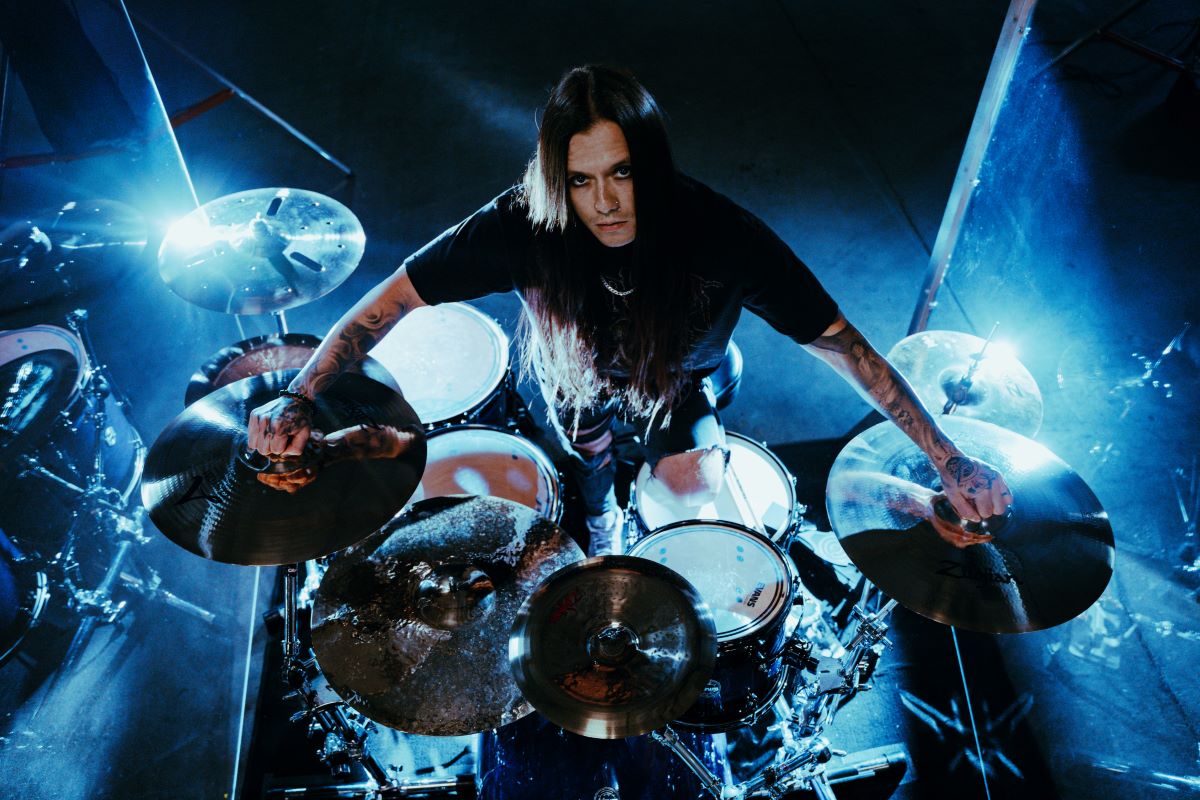
“He’s a beast”, says just about anybody I interviewed for Venezuelan Metal Season once Rubén Limas is brought up. They are right: Limás’ playing with Sifting showed a degree of technical mastery that was nearly unheard of prior to that in the Venezuelan metal scene. And ever since he joined the American nu-metal revivalists Tetrarch, the rest of the world is increasingly getting familiar with his power-hitting skills.
“Sifting is actually the band I moved to the US with”, Limas explains. “We were just tired of not getting any opportunities. The doors are closed over there when it comes to metal music, and it’s really hard to make a living off of music. People look at you as if you’re crazy. Back in the day, there used to be laws that if you had long hair and tattoos, and you’re walking outside after 9 PM, you will get sent to jail. They associate you with being a gang member or something like that.
Actually, in sixth grade, as a final test, you could choose any subject you wanted to talk about, and I talked about Slipknot. They asked me how you dance to that music. Because, you know, we play merengue and salsa and all that stuff. You dance to it. So when I started headbanging in front of the class, they straight-up sent me to the school psychologist, haha! ‘Something is wrong with this kid’.
A lot of that has changed. But I haven’t been there in so long; I didn’t go for twelve years, so I don’t really know what’s going on over there these days, honestly.”
Exploring, Practicing and Discovering
“My interest for drums started in church, actually. My parents split when I was six years old, and my mom was going through a pretty rough time because of that. She found consolation in church, and when I went there for the first time, I was taken aback by the drummer in the church band. And from that age, I knew what I wanted to do for the rest of my life.
I would go to church and see the drummer, and I just wanted to get to play a little bit. So I would ask for a drum set every Christmas, but my dad was quite close-minded about that. Eventually, though, he decided to give me a drum set. I was maybe ten years old when I got my first drum kit. And from there, I started exploring, practicing, and discovering new bands.
I was one of the rare guys in Venezuela who started with the style I play. I hit hard, and I just like heavy music. I discovered Slipknot when I was in middle school. That changed my life. I actually started listening to Metallica when I was around ten years old, because my brother played guitar and already listened to the black album and stuff like that. So I grew up with Metallica as my favorite band. But once I discover Slipknot, my mind exploded.
As a drummer especially. Joey (Jordison) was a legend. A lot of people tell me I look like him. Probably because of the hair. And obviously, I am influenced by him. He was the one that started everything. He brought the double pedal to the mainstream. That’s something big. No one had done that before. Maybe Lars (Ulrich), obviously, but that was different. Joey was just fast, aggressive and crazy.”
Between Six and Nine Hours per Day
“The funny thing is that I started playing in a ska band. I started playing that, and I got kicked out, because they said I wasn’t good enough for it. I would hit too hard. The fact that they told me that I sucked was actually what motivated me to practice, because it really hurt me. I really wanted to play the drums. I really wanted to be good.
One day, I just started creating this schedule after school, where I would try to hit between six and nine hours of playing per day. Literally in one year, my playing changed completely. That’s when I went to start doing stuff like Black Sabbath, and thrash metal like Metallica and Megadeth, just jamming with friends and that kind of stuff.
I took a few classes, but my drum teacher wasn’t knowledgeable about the stuff I really wanted to play. He taught me to play merengue, salsa, all that kind of stuff. And eventually, he told me: if you really want to learn more about double-bass drumming, you have got to go to the US. I can’t teach you anything else, this is all I know.
He was the first person who put it in my head to go to the US. So he gave me the basics of how to play double-kick drums, but I had to figure it out myself. And at the time, we didn’t have the internet like we do now, so it was hard trying to figure out how to use a double pedal.”
Obsessed with Your Intstrument
“Nobody was doing double-bass drumming like I wanted to do it at the time. It was so weird. I was born in Valencia, and we had to bring the double pedal to Valencia from Caracas, because nobody even had it available in my region. That just made me want to practice even more. I would practice for hours. Just the double pedal; just trying to figure out what to do.
Practice is the formula in life for everything, I think. Practice is everything to me. I believe in talent, but between one person who is talented, and another person who is maybe not as talented, but very committed, I feel like the latter person is going to succeed over the one who is talented, but not putting the effort in. You’ve got to get obsessed with your instrument. Especially drums. It’s so hard: one hand is doing one thing, the other hand is going with the foot, the other foot is doing something else… It’s very challenging.
I really looked up to (Cronos and Gillman drummer) Eduardo Sáez. I recorded one of Sifting’s albums at his studio. He’s really such a nice guy. You’ve got to understand: we were maybe twenty years apart. So it was really weird to start hanging out with people like Eduardo and Facundo Coral when you’re so young. My family wondered why I was hanging out with these old people: you’re a kid, you should be hanging out with kids! But these were the guys who were actually trying to do metal back then.”
Doing the Band Thing
“For a while, I was in a bunch of little local bands, but no one really took it seriously. That was my main issue: I was so committed since I was a little kid. I really wanted to do this for a living, and everyone else was trying to do something else as a career, and then play during the weekends. And as a musician, I know that if you play for just a few hours in the weekends, you’re never going to be good.
When I started going to the capital, I kind of found Sifting, and their lead singer Eduardo O. Gil was really committed. He really wanted to go for it. Also, what he was writing was the closest thing to what I used to call the American sound. Kind of like Avenged Sevenfold, maybe a little bit of Bullet For My Valentine. Sifting actually opened for Bullet For My Valentine back home.
At some point, Eduardo said: let’s move to LA. My dad didn’t want to let me go, but I just had to follow my heart and go there. We did eventually split, and I think he is working for either Telemundo or Univision, one of the two big Hispanic tv channels in America. He even won a couple of Emmy’s. He kind of wanted to do something else related to music, but I wanted to do the band thing.
That’s when I found Tetrarch. Diamond (Rowe, Tetrarch guitarist) had seen some videos of me playing in stadiums, big places, and hit me up. She told me: we are moving to our LA and our drummer doesn’t want to move there with us, are you down? I was Google Translating, because I didn’t know any English at the time. But when I saw these guys, I immediately knew they were my people, because of how committed they were.
The first time we met was at the NAMM Show in Anaheim, after they had just moved to California. We were basically communicating through sign language. I didn’t know any English, and I don’t know if you’ve ever been there, but it gets so loud, because people are playing instruments everywhere. So for someone who doesn’t know a language, it’s even harder to communicate. Tetrarch was just like that in the beginning.”
Back to the School Psychologist
“You know Avenged Sevenfold are friends from middle school, right? That’s what Diamond and Josh (Fore, Tetrarch singer/guitarist) are. They started the band when they were in middle school, and they just kept going. This is all they wanted to do for the rest of their lives. That’s when I left Sifting. We’re still good friends and everything, but when I found Tetrarch, I knew it was my thing. They became my family. And their families are now like my parents, basically.
They were still trying to find their sound. They had a bunch of EP’s before. But once we got together, that’s when we made ‘Freak’, and it brought me back to when I went to the school psychologist because of bands like Slipknot, Korn, and Kittie. No one knew these bands back home. My best friend’s brother helped me discover them, but no one else knew them, even bands like Linkin Park. So that’s how everything started. When we made ‘Freak’, that was the first taste of: this is what we like, this is what we’re going to do. And then the same for ‘Unstable’.
Diamond and Josh are the main writers, because everything in our band starts with a guitar riff. But you know, I just do whatever drums I want to do. Sometimes we change things. I help out wherever. But I definitely get the space to put my touch on the band. My fills are very particular, and different from what a lot of American metal drummers are doing.”
Like a Candy Store
Tetrarch does find Limas playing smaller kits than he used to play with Sifting, although that was not always the case. “If you look at ‘Oddity’, the first song we made a music video for, I play the double kick drums with octobans, four rack toms, two floor toms, a bunch of cymbals…”, he sums up. “But once you start touring, you realize that you want to be a little more practical.
Also, I’m kind of a small guy, and you can never see my face because my hair is in my face a lot of the time. So we started to try and figure out a way of: how can I be more seen when I’m playing drums? So for the first time in my life, I just put one tom in front of me, and I’m just using one floor tom. It was a challenge, because you only have two things to play with. But sometimes simple is better.”
Limas does still play Ddrums. “I got signed when I was back home as the first Venezuelan Ddrum artist at the time”, he says. “That’s when they took me over to their warehouse in Tampa, Florida. It was just like a candy store for me. The guy said: grab anything you like. They treat me well, and until this day, anything I need, shout-out to Mike at Ddrum. He’s their newest rep, although he’s been there for a few years now, but nothing but good things.”
Not a Place Brands Wanted to Invest in
“Getting an endorsement with Ddrum was a pretty big deal back then, because not many people were getting them. I don’t think Venezuela was a place that brands wanted to invest money in. There wasn’t really a big metal scene, nothing really going on there. But they took a shot. I’ve had different brands approach me since then, and I just said no, because I’m a loyal person. Ddrum believed in me when nobody else believed in me, and they take care of me all the time.
Ddrum were the ones to approach me. I used to play with a band called Allegro Andantino, and we played at Gillmanfest, in front of – I think it was – 45 thousand people. The people just took down the fences and started flooding in. I remember the first song we played, it was like a river, an ocean, a tsunami. I had a great time. That’s when I started getting attention around the country, I guess.
Not much later, Paul Gillman asked me to join his band, and that’s when the endorsements started coming in. I’ve been playing Zildjian for a long, long time. I use A Custom. I like how they sound. Live especially. Vic Firth and Zildjian are owned by the same people, and I’ve been with Vic Firth for over twelve years as well. So we have a long-lasting relationship.”
Happy Feet
“I don’t use any triggers at all. They say I have happy feet, haha! And when you have happy feet, to play with triggers, you have to be so precise. And I tend to lean on my left foot all the time, even when I’m not playing, and then just the minimal touch on this head triggers, and it sounds like a mistake.
I’m very passionate when I’m playing, and it’s very hard to control myself. So I’ve tried to use triggers, and I’m sure eventually we might be able to use them, but I have to work on that. I have to work on how excited I get when I’m playing, haha!
What I like about not using triggers is that it forces me to hit hard. And basically, that’s what people look for when they use triggers. They want to sound loud. They want the hits to be defined. I can tell when I’m not hitting hard enough, and I have to force myself to get there. It’s a good thing and a bad thing at the same time.
We have a few songs that are super-fast, but our newer stuff is more groovy. It’s a little different. I think the last fast songs we did is stuff like ‘Negative Noise’. That’s where it’s a challenge, because I have to hit hard to be able to hear the sixteenth notes. We play the songs ten BPM faster than on the album, so it’s even more challenging.
We use a click for some of the songs. We don’t use any tracks or none of that; the guitars you hear are Diamond and Josh, the bass is Ryan (Lerner), the vocals is them. The click is just more because when I started playing, I finished the songs faster and more intense than when we started. So it was too fast. We had to somehow control me, you know, keep me in the pocket.”

 Kevy Metal
Leave a reply to Interview Roxana Herrera (Arastral, Gillman, Darktemis): Continuously Improving Through Enriching Experiences – Kevy Metal Cancel reply