
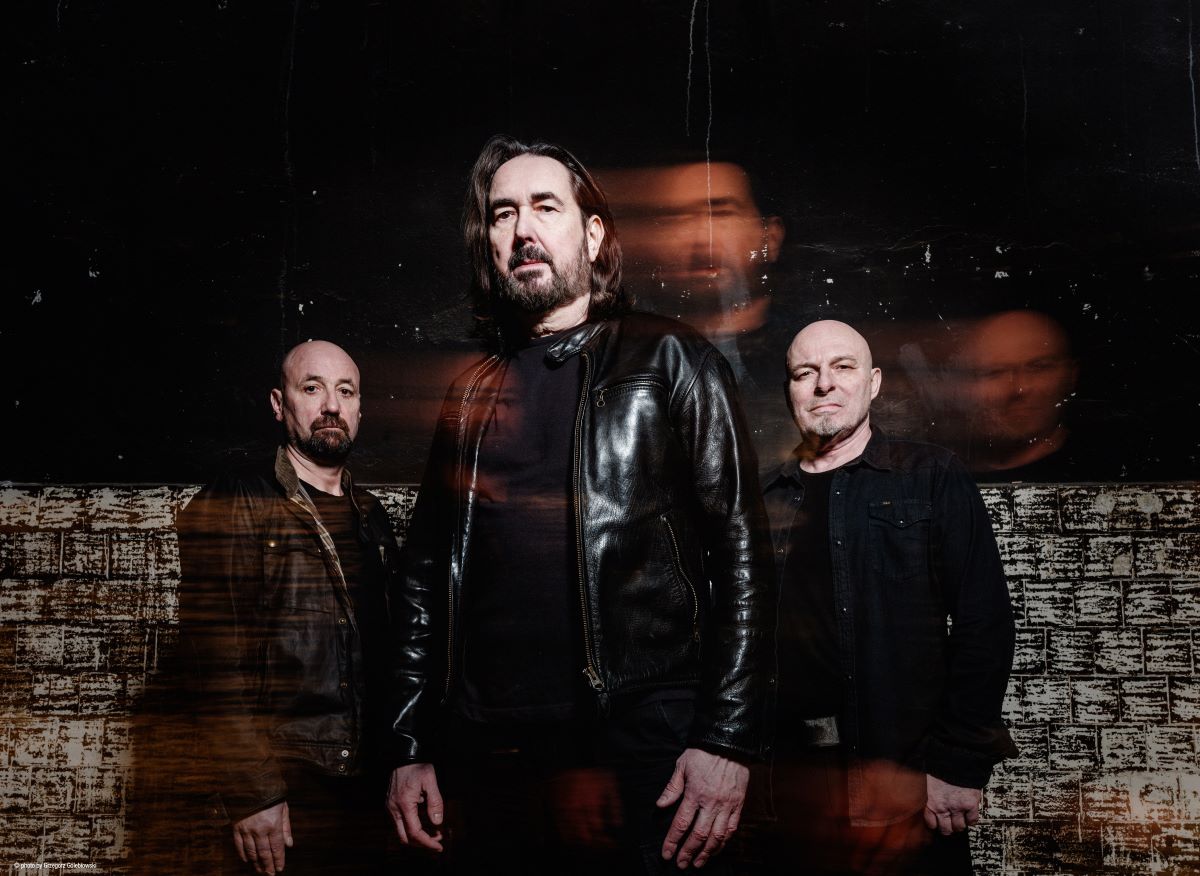
Thirty-two years is a long time to not release a studio album. Some bands are forgotten in that amount of time, but not Swiss thrash pioneers Coroner. To this day, they are consistently mentioned among the biggest innovators in thrash metal history. This has made ‘Dissonance Theory’ one of the most anticipated metal releases of the year. Guitarist and veteran producer Tommy Vetterli digs into how expectations have influenced the writing process.
“Here in my studio, I write a lot with customers”, Vetterli explains. “But for Coroner, it was something special. At first, I was thinking a lot about how the band should sound nowadays. You know, it should have this old school vibe a bit, but I don’t like the sounds of our old albums. Instead, I thought it should be modern and heavy, with a new sound, but still with an old school approach.
One of the reasons I thought a lot about the songwriting and everything is because there are opinions. Some people like the ‘Grin’ (1993) era more, a lot of people like the first three albums, and I came to the conclusion that I just had to say: fuck it, I’ll just do what comes out of me. And I thought that was a good decision.
We always wrote for ourselves. Not for a crowd. We never talked about: let’s write a song like this band, then maybe we would have more success. We simply weren’t interested in that.”
A Hundred Meters of WhatsApp Conversations
Another issue was the lyrics. These were traditionally the work of drummer Mark Edelmann, better known as Marquis Marky, who left the band in 2014 due to a disinterest of working on new material. “Everybody in the band started writing lyrics”, Vetterli says. “Ron (Broder, bassist and vocalist) came up with some stuff, and to Diego (Rapacchietti, drummer) I really had to say: just because you are the new drummer in the band doesn’t mean you have to write all the lyrics all of a sudden, haha!
They weren’t too bad, actually, but for this album, I wanted to have everything perfect. There should be a narrative between the music and the lyrics. When the music becomes heavier, the lyrics should go with it, and things like that. So it was clear we needed help. It was okay for hate, fire, blood, whatever. For those kinds of lyrics, we would be fine, but that’s not what I wanted.
So I asked my best friend Dennis Russ. We worked together on lots of different projects here in the studio. He is half-American, and a very good musician, and he writes lyrics. That’s how it started: we discussed the title, and where we wanted to go with it, long nights of discussions and stuff. Originally, I wanted to call the album ‘Oxymoron’. Then together we came up with ‘Dissonance Theory’. It’s better, because English-speaking people thought ‘Oxymoron’ was a bit weird, since the word moron is in it, haha!
Dennis wrote the lyrics for two songs, but then I needed him as a co-producer, and time was running out a little bit. That’s when I asked Kriscinda Lee Everitt. She is a published author from America, and a really smart person. She is writing a book about the band at the moment. It was worth a try, and she was super-inspired. I sent her the demos of the song, we put some piano sounds where the vocals should be, and she started writing.
Then we tried to record it with Ron, some parts didn’t work, which we re-wrote. Dennis and Kriscinda had like a hundred meters of WhatsApp conversations. They rated every word and everything. I’m super happy with it.”
A Bit of a Procrastination Problem
The fact that there was time pressure at all might be surprising, as the band first announced they had started work on new material all the way back in 2016. “You probably wonder what took so long, and I wonder myself actually”, Vetterli admits. “A lot of stuff was going on. My father died, Ron’s father died, my partner at the time was really, really sick, I went through a divorce…
The main problem here is: I work with music in my studio the whole day. And when I’m done, I’ve used all my creativity for my customers all the time. So after nine hours of recording here, I go home, and even if my wife listens to music, I hate that, haha! Unless it’s something like easy listening jazz or something.
In the meantime, I did three albums for Eluveitie, which is a lot of work. And maybe I had a little bit of a procrastination problem as well. The pressure of: can I still do it? Even before recording the solos, I sat there thinking: nowadays all guitar players are so great technically, what can I do? So I decided to just play from my heart, from the stomach and from the balls. And I don’t have to compare myself to any new kind of guitar player. I think that was the right decision.”
Showing How Much They Practiced
Despite being known for their technical proficiency, it may simply have been the fact that Coroner sounded so different that made them the beloved band they are. “I did start very early with things like different scales and arpeggios”, Vetterli says. “But now, every 15-year-old kid can play that stuff better, haha!
For me, the technical aspect is great if you can do it, but it shouldn’t be technical for the sake of being technical. Our first two albums were trying a bit too hard to show you how much we practiced back in the day. Nowadays, I’m much more interested in mood and feel and stuff like that. But if I feel like going fast, I’ll go fast. I can still do it.”
The fact that ‘Dissonance Theory’ sounds like a fairly logical follow-up to ‘Grin’ might also just indicate that Coroner was ahead of its time. “We hear that a lot”, Vetterli nods. “Probably that’s because I wrote most of the parts back in the day. So maybe it’s just what comes out of me. For me, it’s important that I have this special feeling when I write. You know it as a musician when you have something good, or something shit.
Other people’s opinions are a different story, but I have to have this: okay, this is cool, let’s go with this. I would say I had fifty riffs, and one made it to the album, haha! It was crazy. A little obsessive. Ron said that maybe I overdid it a little bit. But then I came up with a new idea and he said: okay, you’re right, it’s better, haha!”
Not Coroner Enough
Broder’s opinion is very important to Vetterli. “Of course! He has to be happy”, he says. “I wouldn’t use something he didn’t like on the album. That riff on ‘Renewal’, I remember I wrote it in 2015 during a vacation in Thailand. When I showed it to Ron, he said: ah no, this sounds more like Slayer or Metallica, it’s not Coroner enough.
That song was laying around somewhere for ten years, and when we finished recording the album, we thought we needed one more song, because the album was too short. So I started to work on this thing again, and Ron was right: it’s a bit too Metallica, for some reason. Then I kept the first riff, and I changed all the other parts. I came up with a verse, a pre-chorus, a chorus, and the entire middle part in three or four hours.
That’s the thing. People think: you weren’t creative enough? What’s the problem? No! When we worked on it, there was a lot of creativity, and there were a lot of ideas. But we did have breaks. It’s comparable to when someone goes to the gym for three months, and then has an accident or something, and can’t go there for two months. To start again after that is very hard.
Even when I work here with the band, sometimes I don’t play guitar for a few weeks. Then I had to sit for two days until I’m able to get back in the zone and play again. During covid, I had more time, but then I was more interested in trying good red wine – which is my hobby – and building a pedalboard. Sometimes, I just have the wrong priorities, I guess.”
The Distortion Morphs
One art Coroner mastered early on, and which is still present on ‘Dissonance Theory’, is the art of sounding big with just three musicians. “Sometimes I wish I would have a second guitar player who supports me a little bit”, Vetterli admits. “In the studio, it’s no problem; I just double-track the guitars. I did one left and one right, but with the same sounds.
It’s something I experiment with a lot when I work with customers. If you use the same set-up – amp, speaker and the same guitar – the sound is the tightest. If you change the guitar, the stereo image of the guitar becomes a bit wider. If you change the amp and the guitar, it gets even wider. And if you change everything, it gets even wider, but it’s not as tight. So that’s a compromise.
I change it from production to production, sometimes from song to song. But for Coroner, it was important that it was tight, and the same sounds. It shouldn’t sound like two guitar players. Of course, I did overdub stuff, and I think for live, it’s all okay this way.
The bass sound is really important. The bass needs more distortion than people think. Sometimes if you listen to the bass, it almost sounds like Motörhead’s Lemmy. But in the mix, it’s almost clean. The distortion morphs with the guitar. That’s what a lot of people do wrong here in Switzerland when they try to mix metal. They have a clean bass sound. That doesn’t work at all, in my opinion.”
Three Weeks Soundchecking
As a producer, Vetterli spent a lot of time making sure the guitar sounds on ‘Dissonance Theory’ are exactly as he wants. “There was a comment on the first single from one guy who wasn’t happy with my guitar sound”, he says. “He said: is this even an amp? The earlier sounds, in the nineties, sounded much better! No, they don’t, haha! I spent maybe three weeks soundchecking until I was happy with the guitar sound.
I think I have fourteen tube amps. Almost everything that’s relevant for rock and metal stuff. I even have an old Vox AC30. All the clean sounds on the album are a Vox AC30 from 1969. But I couldn’t find my sound. My live set-up is a Bogner amp and a Bogner speaker. But for the studio, I thought: I need something new that inspires me.
In the early 2000’s, I recorded with a band here, and the guy used an old Diezel VH4 from 1993. And this amp got stuck in my head. There were a lot of people coming with newer VH4’s, but none of them sounded like the one I had in my head. So I borrowed this amp, and that’s my sound for this album. I still have it here, but the guy wants to pick it up in a few weeks.
The prices for them are crazy, because James Hetfield bought all of them. Adam Jones from Tool also plays one like that, a Blueface. Sometimes it’s a psychological thing. I just need something new.
For the solos, I used a Friedman BE-100 Deluxe, and the speaker was an old Mesa Boogie from 2000, I think, the darker-sounding ones. You can put an SM57 in the middle of the cone, and it sounds great. If you do that with a newer one, or even one of the older ones, you have to go to the dentist, haha!”
Working a Bit Harder
“Maybe it’s because I’m older or something, but I like the sound of a tube amp. I’m not against digital, and maybe I feel more of a difference than I hear. But when I play, I definitely feel a huge difference. That’s why I picked a guitar that wasn’t too comfortable to play for the rhythm guitars. It’s a Solar. I’m a Solar endorser, but this one was a European-made one, and it’s a Gibson scale. I prefer to play Fender scales, but this guitar sounded best in this configuration.
There is a Floyd Rose on it, which is what I’m used to, but the angle of the neck was a bit different. So it was a bit harder to play, and I think that was a good thing. I had to work a bit harder. It gets even harder to play with a real tube amp. Some people, when they practice too much on a digital thing, they come back to a real tube amp, and they have problems with it sounding too clean and sober.
For the lead parts, I used a James Tyler Ultimate Weapon. It’s a weird-looking guitar. Nobody likes it. Everyone says: what’s that ugly guitar? But it’s one of my favorite guitars. For most of the solos, I used that one, and I used my signature Solar for two solos, because my signature has 24 frets, and the James Tyler only has 22. The clean guitars are the European-made Solar through a Vox AC30.
There is always an old Keeley modified Tube Screamer in front of the amp for the rhythm parts. And for the solos, I have a Boss Super Overdrive that I bought when I was like 15 years old. I have a nice collection of pedals here. On some of the songs, the clean sounds are played through a real Leslie. I love that sound. I use it in every production. Guitar players go crazy when I do that.”
No Time to Find a Sound
Vetterli’s experience as a producer and studio engineer brings him many more options than he had on Coroner’s older albums. “I think that’s part of why I started to do more with studio work”, he says. “Because we had been to all these great studios in the past, and they had all this great stuff like the Eventide H3000, but there was no time to find a sound for something.
Here in my own studio, I sometimes spend a crazy amount of time on sounds. Like with the synthesizer. We went totally crazy with that. Dennis wrote all the keyboard parts, and then we came up with sometimes twenty tracks of keyboards, all with different sounds, and we did something with all of them. We put it through a guitar amp, or through a Leslie… That was great. It took forever, but I think it was worth every second we spent on it. And it’s a lot of fun.
You don’t make that much money out of an album nowadays. Since that’s the case, it’s more important for me that I’m happy with it, and that I have fun doing it. I will never do something like a cheap home recording. For a lot of albums that come out, you can hear that the drums are programmed, and the guitar sound is a plug-in. It can sound great; for some styles, it’s a very good fit. But for Coroner, it wouldn’t be the right thing.”
Vetterli does keep an open mind, though. That includes technology like pitch correction. “There is a way I use Auto-Tune here in the studio”, he explains. “I use it in graphic mode. And if you do it right, you don’t hear that it’s manipulated. If the performance is great, and maybe one note is a bit flat, I’d rather go in and correct it a little bit than re-take it. In my opinion, the performance is more important.”

 Kevy Metal
Leave a reply to Best of 2025: The Albums – Kevy Metal Cancel reply