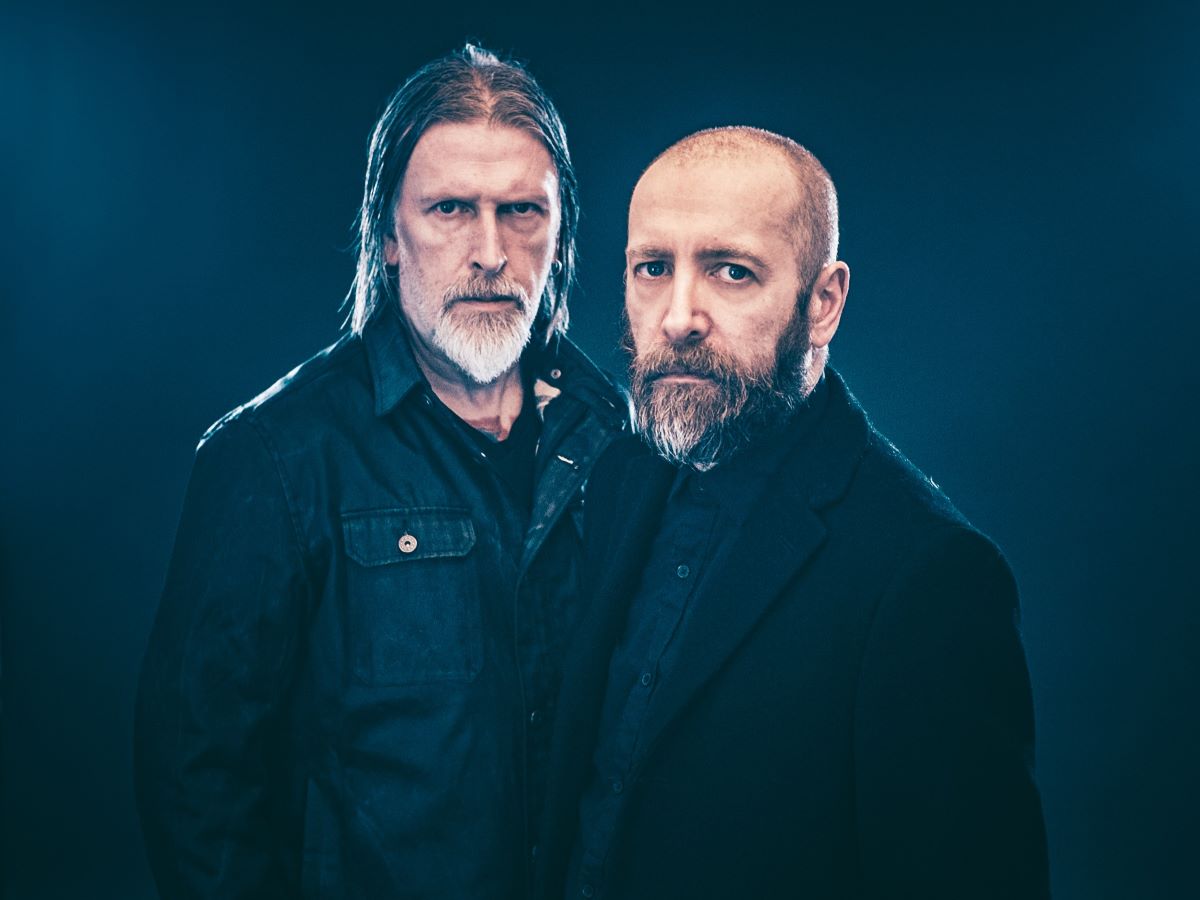
‘Ascension’ might just be the best blend of styles Paradise Lost has explored through the years. Guitarist and main songwriter Greg Mackintosh shares some insights into his approach to songwriting and playing guitar in the band, as well as his love for caveman death metal.
“Songs start from different things”, Mackintosh explains. “It doesn’t always start with a riff or a guitar melody. It can start with humming into a Dictaphone, it can start with a piano line, strumming an acoustic… It can start with anything. However it starts, that spark, that’s the inspiration. Then you build from there, slowly but sure, and try to get some kind of footing, some kind of purchase on it. Some songs come together quickly, some take a lot more work.
With this album, I started to write probably three years ago, and failed miserably. I did five or six songs, and I just wasn’t feeling it. I went through different iterations of each song, and it was: what if I do this, what if I try it this way, what if I strip it right back? And none of it was working. It got me so angry that I deleted the whole lot, took like six months off, and waited until I felt inspired again.
The inspiration started again when we did the ‘Icon 30’ (2023) re-recording. It hasn’t influenced this whole record, but it definitely kicked off the inspiration again. It rewired the brain into: ah, okay, this is what I’m going to do now, we’re going to go down this path.”
Different Identities
“We don’t discuss the sound of an album in that we want to make it different from a certain album, or similar to a certain album. It’s more like when we come to write and record the next thing, we do our best effort to forget everything from the past, and say: okay, what are we excited about right now? What would we make if we could make anything?
Obviously, subconsciously, you have little things in mind, because we have a long history, and we have a certain style of playing that is ingrained in us. But as much as possible, we do try to approach it fresh each time, as fresh as we can. And I suppose that’s why all our albums have different identities.
Also, over the course of a few years, your ideas and your views on life, your views on art, your views on everything shift slightly. And we want to represent that, because albums are a snapshot of a moment in time. And it either resonates when you bring it out or it doesn’t. Both have happened to us: being at the right place at the right time, and we’ve done the thing that was wrong for the scene at a certain time. So you can never preempt these things. You’ve got to go with your gut.
‘Host’ (1999) scratched an itch for us that was going on for a period of time, and when it came out, we were vilified for it. But then, maybe something like ten years ago, all of a sudden, the metal community was allowed to like stuff like that again. Maybe because of the dungeon synth sort of thing coming in strong. But then I had a couple of black metal guys come up to me in Norway and say they really like the ‘Host’ album. And I thought: oh shit, you’re allowed to like this now. A bit late, but never mind.”
The Entire Handbook of Writing a Song
“The only song on this record that took a little effort to tie together was the first single, ‘Silence Like the Grave’. Because I had this bombastic chorus part that sounded like a war beginning to happen or something. We thought that was really good. And then I had this collection of riffs that I knew worked together, and a couple of them I even altered the keys so that they did go together a bit better. But I was thinking: how do I transition from this to that?
The way I ended up doing it is I kind of did more leads than I usually do within a song. Out of the first chorus, I go straight into a lead guitar part, which goes into the verse, and then there’s another lead bridge part, which I wouldn’t normally do, into the next chorus. And the next time around it happens, it just goes into the chorus. That’s one of those things where you do almost like a false start into a chorus. People are expecting it to hit, and then there’s this extra bit.
It’s a constant learning curve for me. Every time I think I know the entire handbook of writing a song, I’m surprised by some new band that comes along and does something cool. Or I hear a song from the past that I’ve never heard before, and I think: wow, that’s a cool idea! But that’s my favorite part of being in a band: getting something from the back of your head onto a record. Something that you thought: how would I achieve that?”
A Sensory Thing
“You have to play to whatever strengths within the song. I often play off the vocals. So when the vocal ends, I come in, take over the melody line, and then the vocal leads off from that again. We’ve done a lot of that over the years. We’ll even do things like shift notes around on the instrumentation, if you think something should lift at the end of a line, or if you think something should drop.
We play with that all the time. We’ll get the rudiments of what we think a song should be, and then we still play with it almost like a jigsaw, but we’re missing a few pieces. And then it clicks when you put them in there. But it’s all about the shiver for me, when I get the right feeling from the song.
I do that when I listen to music too. I can’t listen to music as music. I’ve always used it as like a sensory thing, like you can almost think of it in visual terms. So you’ll hear a piece of music, and rather than thinking: oh, that’s a cool fast riff, or a heavy part, you’ll think: oh, that sounds like a storm coming over the ocean or whatever it is.
I’ll often play some of our music when I’m writing, and I’m thinking: does this make me think of a misty autumn evening? Or a crisp winter morning, or something like that. And especially on this album I did that. I mean, some of it is even Christmassy. I was writing a lot of stuff around that time: autumn, winter last year. And it really seeped into the whole mix of songwriting.”
A Sound Metal Producers Shy Away From
“For the rhythm guitars on this album, I was actually thinking of the ‘Shades of God’ (1992) album. Because in our discography, that’s the one that I think is most overlooked. I really like that record. Maybe because I have fond memories of the time as well, because it was a real prime era in our youth, in our early twenties and doing our first recording at a residential studio. We had never been in one before.
It was just so exciting. It was when we turned professional, and everything was new, everything was exciting. There’s something about that record to me that is very nostalgic. And I have always loved the rhythm guitar sound on that record. With this record, it was the first time that I thought: okay, let’s try and do something similar to that then. Because usually, I try to do something different every time. But on this record, I really was looking at the ‘Shades of God’ album, thinking that maybe we should try and get something similar, but try and bring it up to date as well.
But then a lot of that was in the guitars and the pickups that we were playing, which we no longer have. So I had to approach my guitar company, Hapas, and say: will you do me a signature pickup? They worked on it for about six months, and it’s basically modelled on an old Ibanez pickup. So you get this nice mid-hump, around 500 Hz. And also, with the matching tone pot, you roll off the top-end, and you not only take the top-end off, it kind of fattens it out a bit as well.
When you hear those single-note parts in the beginning of ‘Serpent on the Cross’, or a lot of the single-note stuff on ‘Diluvium’, that’s with the tone rolled off on these pickups. That gives you this beautiful, rounded, almost honky guitar sound, that cocked wah sound that most metal producers shy away from at the moment. They hate it. I love that boxy thing. And then you roll the tone back on for the more choppy stuff, you get that crispness back.”
Its Own Resonance
“I would like to say that I construct a new guitar sound for every record, but I have very specific things that I like with the sound of guitars, and they’ve never changed. With clean guitars, for instance, I was always impressed by early U2 The Edge. I thought that was just fantastic clean stuff. With lead guitars, because I’m not really into widdly-widdly, I love the tone on the first Candlemass album. Also, the first two or three Trouble albums, both rhythm and lead guitar sounds. Some early goth music leaks into my playing as well, even stuff like The Cult.
But there’s also another element. I try to emulate what I think various other instruments and styles of music sound like. For instance, there’s a song called ‘Salvation’ on the new album, and on most of the guitar parts of that song, I’m trying to emulate what I think pealing bells would sound like in a church, or what close-harmonized choirs in a choral section would sound like, and I’m just doing that on guitar.
Sometimes it’s like cello. I will think: what would a cello do at this part? I don’t try and copy things, because there’s no point. Because that’s a cello for a reason. It has its own resonance, its own sound. But you do an approximation of what you think would be fitting, and work with that. Ultimately, it’s all about the song.”
Finding the Sweet Spot
There are some very distinct guitar sounds on ‘Ascension’, particularly some of the very fuzzy lead guitar parts that Mackintosh plays. He apologizes in advance for not always knowing which is which. “Oftentimes, especially in the last decade, eighty percent of what I play on the demos ends up on the record”, he explains. “Because I can’t recreate it better than I did, for some reason. You just take the magic, and you keep that. Also, there’s probably a bit of demo fever involved.
I’ve got this big box and it’s just full of pedals that I’ve collected over the years, and I just try stuff out. I just click on things and think: that’s pretty weird, but that’s cool! Or: that’s too over the top. For the rhythm guitars, I basically used an old Marshall that we had in the rehearsal room. It’s just been stored there by a friend of ours, and he never picked it up again. It’s a 1984 JCM 800. We didn’t even know if it still worked, but I just plugged in, and it sounded great. So it was that, mixed with a bit of crunch from an Orange head we had, with an EQ pedal before it.
For the leads, I was just messing around with all kinds of things. It could have been the Minotaur Sonic Terrors Fuzz & Burn, I’m not sure. Also, I use Weeping Demon pedals in the studio, while live I use Morley or whatever. With the Weeping Demons, you can dial in the level of how much effect you want, the frequencies you want, the EQ, you can really, really tweak it. I have two of these, side by side. So I have a foot on each, and I’d be playing, and I’m slowly moving my feet to find the sweet spot of each note as I play.
Sometimes you would get too much break, but that’s fine by me, as long as it sounds good in context. I just like over-the-top, weeping guitar sounds. You hit a sweet spot, and to some people it may be harsh, or honky, but to me, it’s beautiful. Like the ‘Crystal Ball’ solo on the first Candlemass album. That’s my favorite solo of all time.”
Just Skipping Around
And then there is the interaction between Mackintosh and rhythm guitarist Aaron Aedy, as they hardly ever play in unison. “That comes from goth music, really”, Mackintosh explains. “With a lot of that early eighties goth music that I used to listen to, and I still listen to some of it, it was more rhythm section-based. And the guitar would be the icing, just doing things, just skipping around, doing melodies here, jangly stuff there, some delay stuff there. And then you had this driving rhythm, usually just bass, though some of those bands did have rhythm guitars.
With that, we thought: okay, we’re going to do that thing, but we’re going to do that in metal, almost. And we kind of fell into it. I was more adept at the harmony, feel, lead-y type stuff, and Aaron was much better than me at the choppy rhythm stuff. We kind of fell into our roles, and none of us ever aspired to do other things.
We have all been obsessed with the thing we do all the time. Aaron always just listens for the rhythm guitar in everything. That’s just the way he’s always been. And I’m the opposite: I’m always listening for that special harmony or hook that’s usually played on lead guitar or harmony guitar. It just works like that. I guess being simple musicians helps us, to some degree.”
Potluck with Lefties
As a young left-handed guitarist, Mackintosh did not have a large assortment of guitars to choose from. “You just had to go to second-hand shops and see what was around, really”, he says. “I was quite fortunate early in our career that I went into a local shop and I found a shark fin guitar – they call them offset V’s now, I’m not sure why – made by Jaydee, John Diggins, who made Tony Iommi’s guitars. I didn’t know that at the time, I just saw a left-handed, black shark fin guitar.
I thought it was amazing, and I saved, I put a deposit on it, and I got it. That’s what I’m playing in 1989 on the ‘Live Death’ thing. I just got it for that. I was in love with this guitar, and I’ve still got it in my studio now. It’s the only guitar I’ve kept from the old days. The Hapas guitars that I play live now are shark fins, and I modelled them on this old Jaydee that I had. But it was potluck with lefties back then.”
And Mackintosh is not even the only left-handed guitarist in Paradise Lost. “Yeah, Aaron is left-handed, but it is kind of almost a macabre story why he is ambidextrous now”, he explains. “Not just guitar. He can write with both hands. Because when we were at school in the seventies, being left-handed was seen as a bad thing, and teachers forced him to write with his right handed, even though he was left-handed.
So by default, he became almost ambidextrous. Then when we were picking up guitars, he thought: oh well, there’s more right-handed guitars, and I can kind of use both hands. And you know, I wish I would have had that foresight or opportunity. Though I’m sure he would rather have not gone through all that abuse and just play left-handed. But it’s an interesting story, and it gives him more opportunities, I guess.”
A Voracious Appetite
While Paradise Lost is slowly closing in on its fortieth anniversary, Mackintosh has no trouble keeping himself motivated. “I think it comes down to how you consume music”, he says. “I still have a voracious appetite for finding something that invigorates me. I’m still in love with the stuff I got into between the ages of 13 and 19, which is the prime age for everyone’s benchmark in music. But I also need to hear new stuff that gives me hope, and invigorates me, and inspires me, and teaches me.
It’s few and far between, but I do find it. I find it on the fringes. Especially in metal. In mainstream metal, there’s not a lot of exciting stuff happening. But on the fringes of metal, people do anything they want, and that’s where you find the interesting stuff, I think. Usually through recommendations on Bandcamp.
It can come from a very strange place. I found one the other day, like two weeks ago, actually. I really like caveman death metal. The simpler, the better. A drummer that basically can’t play. I like when drummers can’t play in death metal. And I hadn’t really heard anything really good in that vein for quite a long time. But I got one recommendation, it was this band Vorlust, and it’s so caveman, it’s ridiculous.
I’ve been watching really bad-sounding YouTube clips of them playing live in little pubs, and it’s just awesome. Some great riffs. Some stuff really ticks your boxes, you know? You find it in the weirdest places, and it’s got like 71 views on YouTube, and it’s been out eight years or something.”

 Kevy Metal
Leave a reply to Best of 2025: The Albums – Kevy Metal Cancel reply