
The return of founding guitarist – and occasional singer – Kai Hansen was one of the reasons for 2021’s self-titled album to be what was likely the most anticipated album Helloween ever released. However, it only contained one song that Hansen had written. Hansen admits to being much more inspired during the writing process of ‘Giants & Monsters’.
“It definitely was easier now that I have some experience working with this particular line-up”, Hansen says. “For the first album, it was a little more difficult for me, and I ended up just writing ‘Skyfall’. I had a lot of ideas, but none of them were good enough. This time was easier, because… Let’s give credit to that: during the corona phase, I have written a lot of songs.
In fact, during that period, I wrote so many songs, that I have also managed to compile a solo album that will probably be released in January. The songs that I ended up using for that are mostly the songs that are a little bit different. But there were a few songs that we listened to with the band, and the others could say: I want that one, that one, and that one.
Obviously, I also have a feel for which song works with which of my bands. For me, there is always the option to say: I could do this with Gamma Ray, I could do this solo, and I could do this with Helloween. All of that works fine, as far as I’m concerned. With that in the back of our minds, I would say it’s a good thing that somebody else decides sometimes.”
In a Peculiar Way
One of the most notable compositions on ‘Giants & Monsters’ is opening track ‘Giants on the Run’, which is the first song Hansen, who originally left the band in 1989, wrote with singer Andi Deris, who joined the band in 1993. Hansen is content with the results. “That all went super”, he exclaims. “It actually happened in kind of a peculiar way. We didn’t actually sit down to write the song together. He originally sent me a demo, which ran until the second chorus of the song.
What I didn’t know at the time, is that he had the complete arrangement finished already. I just listened to it, and something came to me, on which I based the middle section of the song. After I sent it to him, he said: but I already have everything! But he decided to listen to it anyway, and he liked it so much, that he decided to keep it.
After that, we took the ending part that he had written, and put everything together. I have to say that everything fits together quite wonderfully. In this situation, we both saw and learned that the both of us could deliver something, and I believe that it will happen more often in the future.”
Focusing on Teamwork
“We almost have too much talent in this band”, Hansen smiles. “And I’m happy about that. Especially now, because it has become clear to me that we operate on a certain similar wavelength. Even though the album is very diverse, when it comes to the songs. And if you want, you can identify the songwriters a little bit well upon hearing the songs. But I feel there is much more of a red thread this time around than there was on the previous album.
We all have our own trademark sounds. That’s a great thing. But on the last album, I sometimes had a little bit of a feeling that I was listening to a sampler from various songwriters. I think the new album is a lot more coherent somehow. And that is probably because we have been inspired by each other a lot. Because of that, we now have created a solid collective foundation upon which we can build our songs. And it feels good!
That goes for us as the three guitarists as well. It wasn’t so easy to put that together in the beginning. Not from a technical standpoint, because that all worked out fine. But simply the idea of: where does everyone find their place? How does that fit together, where do we get in each other’s way, things like that. That was something we really had to look into. That process demands that everyone can hold back their egos and simply focuses on teamwork. But I think we managed to do that very well.”
Everything Is Open
In our previous interview, Hansen explained that during the recordings of ‘Helloween’, everyone was free to add whatever overdubs they wanted to the recordings, after which the producer and the songwriter of each song decided which overdubs would be used. “That’s what we did this time around as well”, Hansen confirms. “However, we have been a little more careful and sparse with it this time around. On the last album, we have thrown a lot of shit at the wall when it came to overdubs.
We have done the overdubs in a similar manner for ‘Giants & Monsters’, but the process of selecting which overdubs to use has taken place in a somewhat more controlled manner. It always works according to the principle of each guitarist being on call all the time. Or at least, they are always to allowed to offer something to contribute to every single song. Whether that thing will be used or not is another question, but in principle, everything is open.
It’s a very interesting process. And in the end, it’s up the mixing engineer and whoever wrote the song to decide what will be used. Or rather what will be left out, haha! Obviously always in consultation with the guy who recorded it, who will inevitably go: no, I want to hear my overdub there, please turn it up! Haha!
Ultimately, it’s all about the greater good. It’s not about having my guitar everywhere. It’s about how the song sounds as a whole: what serves the purpose of the song, what is useful, what supports the song, and what disrupts it? Those are the things you always have to take into consideration.”
A Bit More Traditional
“The album was recorded with two guitars. Or three, if I’m being honest. One is my old ESP with EMG pickups. That’s my original ESP, and it just sounds awesome. That’s why I played just about everything with that one. Then, alternately, I had a Flying V copy with EMG’s that has been built for me by Antonio Guitars in Romania, because we were playing in different tunings. One was in 440, and the other was either tuned down half a step or a whole step.
I used that Flying V for a couple of songs that were in different tunings, because it sounds great for such parts. And then there were one or two passages on which I used my Strat, an old Fender, for cleaner bits or distorted percussive things. I love playing Strats. I like that Blackmore sound, or that Uli Roth sound. It just doesn’t always fit. But there are many things for which it is simply the best option.
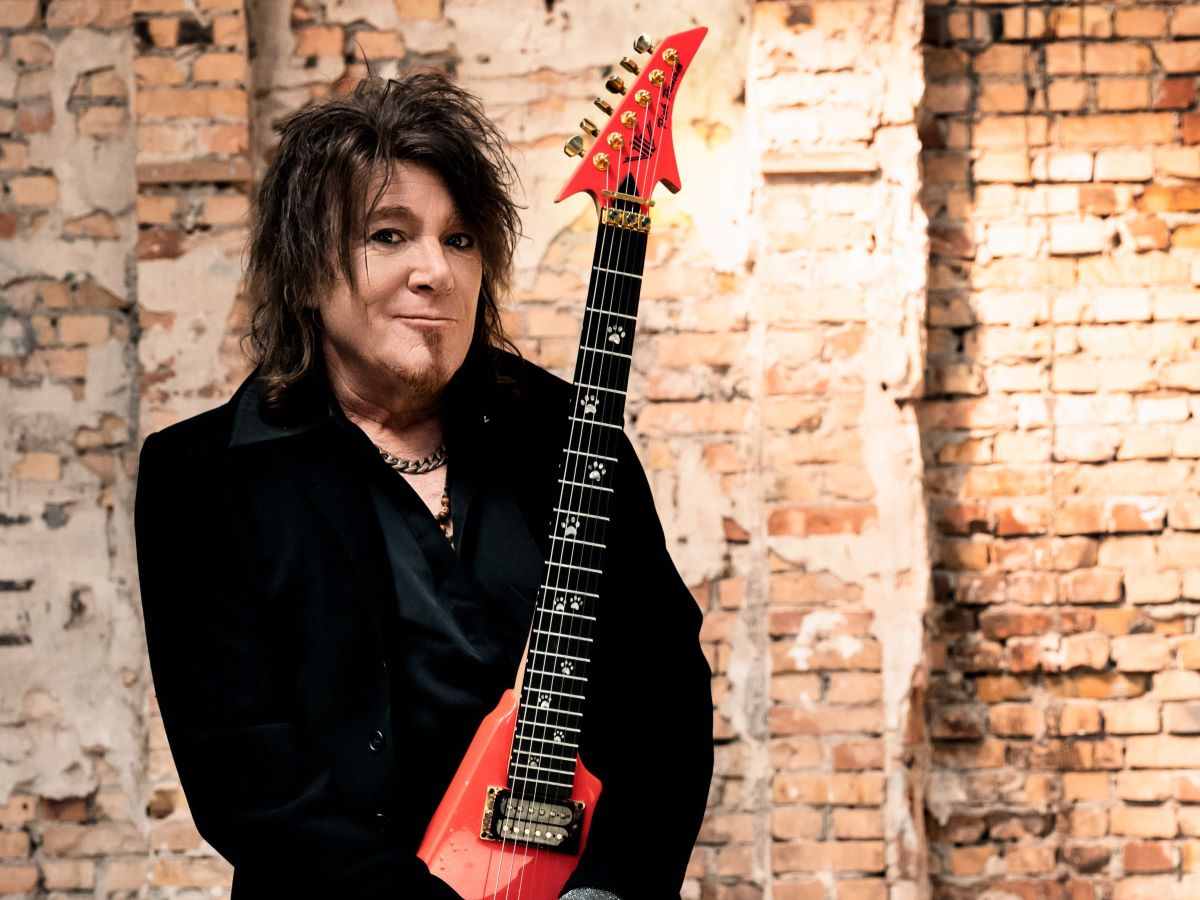
On ‘Live at Budokan’, I play a copy of my old ESP that is built by a German luthier. Igor Vidojkovic is his name, from Viv Guitars. He also built the things that Sascha (Gerstner, guitarist) uses. He’s good. I’m a bit more traditional than Sascha is when it comes to guitars. Only the shape of the headstock I designed myself. I simply wanted to have something different, and I think it worked out well. But when we were recording the album, that guitar was in our rehearsal room in Karlsruhe, which meant I couldn’t use it for the recordings.”
Differences in Sound
Although Hansen used his old Marshall amplifiers to record its predecessor, he did not use any physical amplifiers for recording ‘Giants & Monsters’. “Everything I have recorded was done with plug-ins”, he says. “Even for the solos, I used the same plug-ins that I used for the rhythm guitar recordings. It’s a pre-set pack from EZMix called With a Quack. I like that one, because it has quite a ‘nosey’ sound.
Alternately, I have used a SansAmp PSA plug-in, the Michael Schenker pre-set. I tweaked it a little bit. And then I added effects, of course. That was it for me. I also recorded the rhythm guitars with plug-ins, but I’m not sure if the guys even used to the sound I recorded in the final mix of the album. They might have re-amped it in the studio. But I do think that sound was pretty cool.
You can hear that there are differences in sound when it comes to the rhythm guitars. On the records, we generally have two rhythm guitar tracks. It’s usually Sascha and me who played the guitars. Or Weiki (guitarist Michael Weikath) and me. Or weiki and Sascha. All the rhythm guitars have been divided that way. That’s a completely different story than live, when all three of us play the whole time.”
Wobbling Right Through Each Other
“As far as the solos are concerned, we simply discuss how to divide those parts: he plays this, he plays that, and harmony solos is him and him, or one of us does the whole thing by himself, all two or three parts. And then we’ll have to divide the parts again amongst the three of us when we play the material live, of course.
Our rehearsals generally take a lot of time, because we want to be really well-prepared. The material can be quite complex, especially when we play new songs, or things that I have never played before. And then there’s the whole thing with solos that you built up piece by piece in the studio, and then you have to play them live somehow. It all takes a little time to make the band sound like a unit musically. After all, we recorded everything separately, and then you have to make sure that the pick attacks of all guitarists don’t wobble right through each other.
When I record my solos, I will improvise until I have something good. That’s how I always do it, regardless of whether it’s my own song or someone else’s. There are parts where I know it’s going to be a harmony thing, which I do work out from beginning to end, and I already have a pretty clear idea of what I want to do in mind. But for the free solos, I simply sit down and start doodling, and something will grow out of it.
Once I have the skeleton of a good solo, I’ll flesh it out. And then I’ll have to practice to make sure I can play it in one go live. I tend to stay close to what I’ve done in the studio when playing them live. Of course, it’s not always as clean as on the studio albums, but that’s what live is. That’s okay with me. I can live with that.”
Blood and Thunder
During the previous interview, Hansen admitted to reluctantly accepting amplifier simulation and in-ears to keep control over the sound coming from the stage. “Three guitarists with speakers, that would be blood and thunder”, he says. “But meh, in-ears… On the last tour, we played Fractal, and I was never happy with it. It had some sort of digital, crackling sound to it. Not a round, fat, warm sound, like I would like to hear.
These days, I have a Neural DSP Quad Cortex, and I can work with that very well. It sounds better to me. Every change in the Helloween production has been programmed with midi switchers. Programming those things is a shitty task, but after that, you can technically play the entire show with only one guitar. And everything else – the solo sounds, the clean sounds – is all done by the switches. That is definitely quite pleasant.
But I still prefer to have two speakers behind me somehow. The last few shows we did with Gamma Ray, we did that as well: old school, two speakers behind me, vocals and guitars from the monitors, and a nice board. Awesome. I love it, haha! I have seen some bootleg recordings from our last tour, and I think it came across well. There were some good recordings people made with phones that can handle the noise, and I simply wanted to see how Frank (Beck, Gamma Ray singer) and I came across vocally. It was good.
But this set-up works for me. I can hear myself enough as is. And vocally, I can work with the in-ear sound pretty well. But if it was up to me: gone with all of it, haha!”

 Kevy Metal
Leave a reply to Tools for Discovery: Gamma Ray Albums Ranked – Kevy Metal Cancel reply