
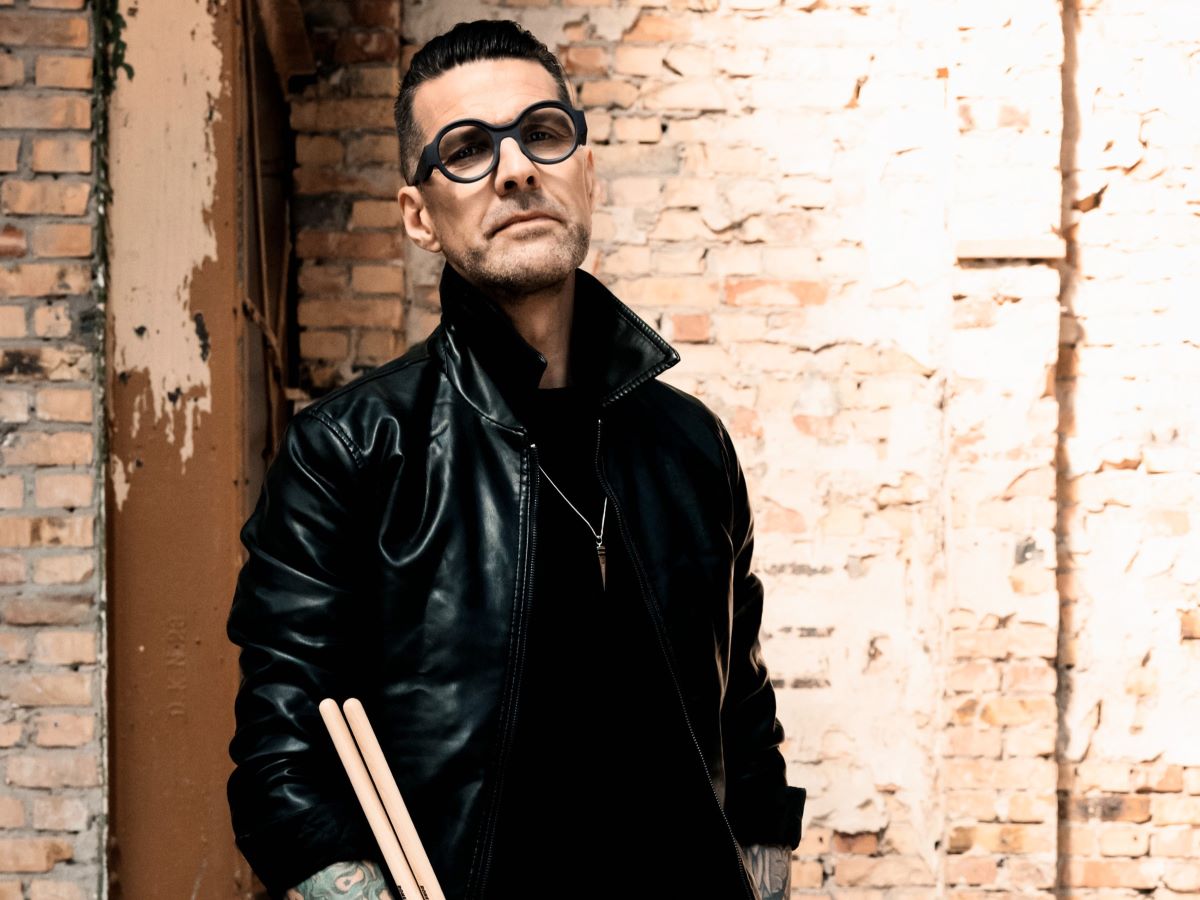
Swiss drummer Dani Löble has been the engine of Helloween for the past twenty years. Hearing him talk about the recordings of ‘Giants & Monsters’ gives the impression of a veritable playground for him as a drummer, and it has become the most elaborate drum recording of his career.
“For the last album, ‘Helloween’ (2021), we went into two or three different studios to record the drums”, Löble explains. “Simply because of the rooms; we have experimented with rooms a lot. The faster songs were recorded in smaller studios, the slower ones in larger studios. This time, we recorded everything in one giant studio in the Nuremberg region. You can walk around there for hours just for fun. Well, maybe not, but it definitely was a large room.
Fortunately, we could work with things like panels for the faster songs. Charlie (Bauerfeind, producer) is a master, honestly. One of the last big producers who knows how to make a fat drum sound with microphones, without needing to use any samples.
He and I have been working together for over twenty-five years. We know each other inside and out. He knows how to deal with me. He knows what I am. I am his big foster child. He formed me. I ended up in his fingers as a young kid, and of course, he raised me to what works best for him, haha!”
Completely Different Drum Versions
“I have always played various drum kits in the studio. I’m a collector, so I have many vintage drum kits to choose from. ‘Giants & Monsters’ has three different drum kits. My Pearl metal kit, a very old Ludwig stainless steel drum kit – 12″, 13″, 14″, 16″, 18″, and two 24″ bass drums – and then I have what we call the Big Bertha drum set, with one 28″ bass drum and long toms, of which I could fit only three on. If you listen closely, you can hear that my left foot is missing during the drum fills on that one, since it only has one kick, but we were adamant to just leave it that way.
Every song got its own drum sound. Some of the songs have three completely different drum versions. We spent a lot of time on these drum sounds. I have never drummed as much as I have for this new record. We have had songs for which we built up my metal kit, I drummed a metal version, broke it down, then built up the Ludwig, on which I played a little looser, a little more rocky, and then we built up the Big Bertha, and I drummed a bit more commercially.
After that, we could select what fits the song best. That was unbelievable. For some songs, I drummed for three days: building up, soundcheck, go, bam! And then: yeah, that’s cool, let’s try another version here and there. We have invested a lot of time and money to get the as much out of this record as we possibly could.”
Making It Like New
“We brought a lot of snares into the studio, but we ended up using just three of them. The funny thing is: I have a very old Tama Artstar Cordia, which was always on the shelf, and I just decided to take that one with me to see if my drum tech in the studio could fix it and make it like new.
In the beginning, we couldn’t find a fitting snare. Then my drum tech fixed this snare, tuned it, and I’m not shitting you: we tried twenty to thirty different snares, everything you can imagine, and none of them was the right fit. We thought: this can’t be happening! And then he put this snare on my kit, and it more or less became the main snare for the album.
I think it’s from 1982 or 1983. That one has this snap that I was looking for. I always play square sizes: 12″x12″, 13″x13″, 14″x14″, 16″x16″, and 18″x19″. And that snare sounded best when measured up against that.
There have been one or two others that were used, among which a 5″ snare that sounded the deepest of them all. And I found an old brass DW Edge with dampening rings. I put that one on just for fun, tuned it all the way down, and just left it that way. ‘A Little Is a Little Too Much’ was the first song with the 28″ bass drum and that DW. You could see the skin moving. I’m impressed by how it sounded, so I just went for it.”
A Snare for Every Songwriter
“We have five songwriters in the band, and generally, every songwriter has his own snare sound. I just know which ones. Weiki (guitarist Michael Weikath) generally needs very narrow snares, because a lot happens in his songs. Usually, that will be something like a Pearl Reference Brass, which I often used for him, and then the Lars Ulrich Tama Terminator. Andi (Deris, singer) is very rock-oriented, so I always use Black Beauty’s or a Supraphonic or something, because their sound is a bit broader.
Sascha (Gerstner, guitarist) is very progressive. For him, I usually go for a Mapex The Sledgehammer. And Macke (bassist Markus Grosskopf) is more of a rock ‘n’ roller. For him, it tends to vary per song, but he is also more of a Ludwig Black Beauty Type songwriter. And Kai (Hansen, singer/guitarist) is a metaller, so of course, it needs to be very loud: Tama. A Terminator, a Bell Brass.
That’s how I always approached it. I know exactly: today he will come, okay, this snare. And it usually fits. But as I said: for this album, we did things a little differently. That Tama Artstar Cordia always fit, even when we used drum kits that were a little different. A giant war of attrition, but it paid off.”
British Chaos
“Every song has a different drum sound. That’s what makes it interesting, and not so boring to listen to. After all, the ears always want to have something new. The first time I heard the drums was here at Wisseloord (studio in Hilversum, the Netherlands, where ‘Giants & Monsters’ was mixed), and I have to say: that Big Bertha is a great fit. A nice contrast with the faster metal sounds.
This time, we wanted to have everything recorded a little more in a British chaos kind of way: Motörhead and that sort of stuff. Really rough, in-your-face, no taping, no muffling on the toms, so everything: bang! Boing!
Recording drums is a lot of fun. Especially for Helloween. Time doesn’t matter. We have recorded drums for over six weeks. That was awesome. At some point, Remo would come by once per week with new drum heads. ‘Really, guys?’ ‘I’m so sorry!’ Haha! Everything was massive. But that has been really fun. Hopefully you can hear that on the record.”
Whatever Feels Natural
“We have been playing together for over twenty years. I simply offer the band what I can do, and play whatever feels natural. Some songwriters program drum parts to shape their ideas. In case they don’t, we take the song, work out the drums, and we’ll simply do what comes to us. Then we put everything together with the songwriter, and use the best of both worlds.
When the ideas of the songwriters are there, I look at what I can simply do as is, and then we sit down together to discuss ideas, or sometimes it just happens spontaneously. I listen to the songs, maybe make a few notes, discuss things with Charlie: come, let’s take this drum kit, we’ll play it a bit like this. That’s how we build up the drum parts. A lot of what you hear has happened spontaneously, and based on that, we refine and change a couple of things, so that the drum arrangements make sense.
That’s what I like doing most. I’m a drummer. I’m not a fucking musician, haha! I don’t write songs, but I love making drum arrangements, and coming up with drum parts. And they trust me. They let me do whatever I want. Andi is the coolest of them all: yeah, just go ahead and do what you want!”
Approaching Rock Shows as an Athlete
Playing fast double bass runs and long fills for two and a half hours every show requires Löble to be in peak physical condition, which is something he takes very seriously. “I prepare at home”, he says. “I practice sports as a hobby, so I work out on a daily basis. Also, I practice drums every day when I’m at home. So I’m always at 60 to 70 percent of what I need to perform live. That’s my ground level, and I almost never drop below that, unless I’m sick.
When I slowly start preparing for a tour by constantly drumming the songs at home, I will eventually end up at a decent level, fitness-wise. Then band rehearsals start, which are even more intensive: you hit the drums harder, it’s more physical. Also, our rehearsal phase is relatively long to begin with.
So by the time the tour starts, I tend to be at the level I want to be. Maybe at 95 percent for the first five shows, and then I arrive at 120 percent. That’s where I need to be; 100 is only just enough. So I prepare. I know my body, and I always approach a rock show as an athlete: the entire day is structured so that I can deliver for two and a half hours.
My body needs that. I know my muscles inside and out, and I know exactly: now I need to eat this, be there shortly before the show, then I go to sleep for a bit. Through the years, I have learned how to handle my muscle strength. Sometimes it can be very difficult. When the stage is very hot, for instance. That’s when I will hold back just a little bit, so I can make it through two and a half hours.”
A Big Responsibility
“I always try to maintain the same level of drumming throughout the show. Not starting out loud and struggling through the last two or three songs at a lower volume. Preferably, it’s like that every show. That’s the challenge for me: to drum at the same level every day, every show, so you can record every show, put them on top of each other, and the eightieth show is exactly like the first show. That’s what I strive for.
The band also needs that stability, that reliability, given the type of music we play. They rely on me. A lot of things come together with me, also in terms of technology. Everything depends on the drums, which is quite a big responsibility. Also, the cues in between songs. The band relies on that, and it’s something I enjoy doing.
We have grown together that way. Every fill, every count-in, every ending is always the same, so that they know, and none of them will have to turn around to look at me funny all the time. Helloween is a band that needs a certain routine. The band doesn’t function as well with a lot of changes. ‘We’ll just try something different today’. No, no, no! Never. Stick to the plan.
Everything is automated. Every guitar change, the whole show, front-of-house, lights, video: a lot of it works with time codes. The sound and lighting guys know the songs just as well as us, and every count-in is agreed on. A lot of drum fills or endings are even based on ideas from our crew, so they can put a better sound on it, or they can stage it better when it comes to lights. In such cases, we will do it like the guys want it, so everything will look and sound great.”
Keeping Things Stable
Sound-wise, Löble is also required to be in good physical condition, as his kit is generally not triggered. “I only have a trigger on my bass drums for my in-ears”, he explains. “Because I only have my bass drums on them. That sound is mixed together with the natural bass drum signal, though. Our front of house wants to have a trigger, just in case something goes wrong, or just to keep things stable.
I don’t know what Michael Spiess, who has been our front-of-house engineer for the last twenty years, uses exactly. But the trigger is mainly for me in terms of monitoring, and for the front-of-house to keep things a bit more stable between slow songs and fast songs. We have triggers on the toms, but we only use those to open gates. Those don’t go into a module, but into the mixing console, and that’s where we control the gates. So bam: gate open, and closed again. Nearly everything the fans hear is the natural sound.
The choice of drum heads I use, and the way the drums are tuned: that’s all done by Michael Spiess. He looks for the right drum heads, he does a production rehearsal together with our drum tech, Matt. They check the drum tunings, and I will know: the way the drum kit sounds, that’s what the front-of-house can work with. That’s how the band sounds best. I don’t get involved with that. That’s what they get paid for, right? Haha!”
A Completely Different Direction
“I have two identical kits for live. What you see, I have two of. Sometimes, one show is en route, and one of them is set up at the venue we play. One of them is snow white, and the other is marble white. For the upcoming tour, however, it will be a surprise. We will go into a completely different direction, because we have a completely different stage set, a different production.
A few weeks ago, I sat down with Pearl to talk about what we could do, and what they would be able to realize. I’m looking forward to it. Never any problems with Paiste; they are my fellow countrymen, and I hang out with them privately as well. I’m very curious how my new drum kit will be on stage. The sizes have changed a lot, and I’m looking forward to playing it.”
Löble’s kit for the most recent tours featured bright white Paiste cymbals. “Yeah, I love it”, he smiles. “We originally started using this coating for the visual aspect, but in the meantime, it has become very important for us to have muted cymbals live. Because of the coating, a lot of frequencies have more or less disappeared, and our front-of-house and monitoring crew loves it.
For me, they play really well. When I get back to a normal set, a natural set, it’s hell on earth for me. Bring back the coated versions! Our front-of-house and monitoring crew says the same thing. For live, and I’m talking about Helloween only, it’s the best. Of course I use cymbals without coating in the studio. But for live: nah, always coated.”
As Drum Colleagues
Before Löble joined Helloween in 2005, he was playing for the somewhat more straightforward power metal band Rawhead Rexx. “It was a bit of a transition”, he admits. “Rawhead Rexx was more straight, and I could be more progressive in Helloween. But Helloween is my kind of music. And I knew as a little kid: somehow, I will end up drumming with them someday.
Also, I know Uli (Kusch, who preceded Löble as Helloween’s drummer) well. I haven’t seen him in a while, but I knew him from my Rawhead Rexx days, when we played together. He’s a really nice guy. After I joined Helloween, we met up a couple of times, as drum colleagues, and we talked about the whole situation, so it’s all cool.
I have great respect for his art. Also as a songwriter. And his drumming… When we play Uli Kusch songs live, I try to play everything as close to the originals as possible, because he deserves it. Respect the song. He formed me well. I was a fan before joining Helloween, and Uli was also in Holy Moses. I was a thrash metal kid, so Holy Moses was great to me as well.”
An edited version of this interview appeared in Slagwerkkrant 249 (September-October 2025)

 Kevy Metal
Leave a reply to Album of the Week 34-2019: Helloween – 7 Sinners – Kevy Metal Cancel reply