
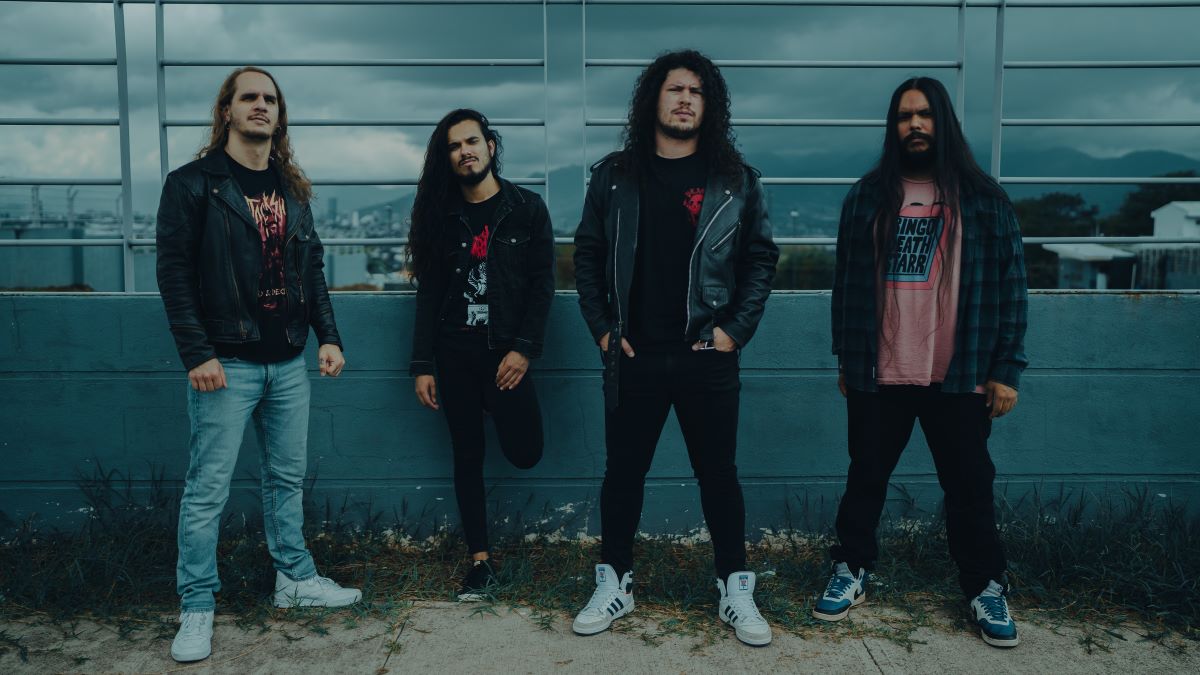
With ‘Violence Prevails’, Costa Rican thrashers Chemicide have entered a new phase in their evolution, complete with a record deal with Listenable Records and a new rhythm section. Vocalist and guitarist Frankie and drummer Chalo give us a glimpse into the production process of the album.
“While I wrote all the songs and lyrics, I always ask the other guys what they think of it”, Frankie explains. “This time, I did the pre-production with Chalo. Before we went on tour last year, I told Chalo: let’s start working on the album, let’s figure out what we want to do. When we have the skeleton of the song, we’ll send it to the other guys, and once they listen to it, we’ll start writing the bass lines and the solos.
Chalo and I started working on the first songs two weeks before going on tour. And that was great, because we had all these good ideas flowing, and when we were doing soundcheck or something, we could say: let’s try this out. And then we could actually put it in the songs once we got back.
We came back home on – let’s say – a Wednesday, and I said to Chalo: let’s just not see each other the rest of the week, and on Monday, we’ll get back to work. Then, in about a week and a half, we had the whole album done. It was a very fast process between the both of us. We knew I had to have knee surgery in August, so I couldn’t be going out or coming down the stairs once that had happened. And as soon as I was able to walk, we went back to the studio and recorded the album.”
“Not even!”, Chalo corrects him. “You were still using your crutches when I was recording drums.”
From the Same Tribe
“Chalo and I have a great connection”, Frankie says. “He understands what I want. And he also plays guitar, so he understands the riffs. When we work together, I think we feed off each other, and we understand each other’s ideas. For example: for the song ‘Chokehold’, there is a part where I told him, let’s do the riff like this, then we keep the riff going the same way, but how about we try a different thing on the drums?
He said: I’ve got it. I hadn’t even said anything, haha! But he knew what I meant. He just wrote it down, he tried it, and then when we went in to record the album, it was exactly how I had it in mind. He knew exactly what I wanted. That made it an easy process.”
“We met a couple of years ago when I was playing in another band”, Chalo recalls. “And our country being so tiny, everyone lives maybe ten or fifteen minutes away from each other. Frankie and I live in the same neighborhood. I think I played Frankie’s guitar about four years ago before a show with my other band, and I was like: dude, this is a great guitar.
Years go by, and now we’re working together. And I don’t know if it’s because we are from the same tribe, from the same neighborhood, we’ve had the same kind of upbringing, but there’s a connection. I’m 28 and Frankie is 35, so it’s not like we’re from the same generation. But for some reason, we connect. We have the same taste, and I think we have the same drive, and the same intentions why we do what we do.”
“We share the same hunger, I think”, Frankie nods. “We say this all the time: obsession beats talent. We are obsessed with what we want. So we try with all of our heart, and all of our effort. There are other musicians here in Costa Rica who are probably more talented and more proficient at their instruments than us. But they’re not willing to risk it all to achieve what they want. And we are, haha! It’s very difficult to find people like that, that can really connect at that level in a band.”
A Controlled Mess
“With Chemicide, I was finally able to accomplish a lot of my drumming dreams”, Chalo says. “The style of the previous bands I’ve played with was maybe not suited for my style of playing. I’m very inspired by classic thrash and death metal drummers, like Dave Lombardo and Pete Sandoval. I’ve been trying to recreate those sounds of that kind of old school style of playing, and the kind of gear they use.
A couple of weeks after I joined Chemicide, I was talking to Frankie, and I said: dude, I don’t know when we are going to begin the process of making a new record, but this is the sound I want. I don’t know the riffs that you have in your head, or the kind of style that you want, and Frankie said: dude, that’s exactly what I want as well! That classic Sepultura sound: big drums, big room, a sound that is not so controlled.
Nowadays, when it comes to recording metal drums especially, everything is too neat. Too perfect. Too controlled. I like mess. I like a controlled mess. If we understand our own mess, then it’s all good. And we achieved it. I think the band adapted to my style of playing and my sound. We mixed and mastered the album with Martín Furia from Destruction, and he said: guys, I have never mixed anything like this before. Everything he receives from bands is so neat, so controlled, and so computerized…”
A Sound That Has Been Forgotten
Furia was also the one who came up with the perfect reference for the sound that Chemicide was trying to achieve. “When we were talking about albums that inspired our sound, he mentioned ‘Dehumanizer’ by Black Sabbath”, Chalo explains. “That is not one of the seminal Black Sabbath albums, but it definitely captured that kind of sound that we were looking for. And when he mentioned it, I thought: yeah, you’re totally right!
It’s a sound that kind of has been forgotten. But Martín knows his shit. He actually brought that album back to my memory. It’s so weird that bands have abandoned that. I don’t know why. I understand the demand that record companies have with bands to sound a certain way, to have a certain recipe of sound. But to be honest with you, we thought: we’ll just do it the way we want.”
“Chalo had the idea of having that late eighties, early nineties power drum sound”, Frankie continues. “Really big drums, very powerful, but you can still hear everything. And I knew how I wanted the guitars and vocals to sound. I wanted the guitars to be sharp, but very modern, without losing that cutting edge. Just like the bass. And I wanted a lot of reverb on my voice, to give it that eighties sound, while the guitars and the bass have that modern twist.
Working with Martín was a dream come true. It’s a match made in heaven for us. We worked with him on the last record (‘Common Sense’, 2022), and I don’t know if it’s because he’s from Argentina and we come from Costa Rica, and we have the same background, but he had the same understanding of music. When we explained what we wanted to him, he said: I’ve got you boys, I can understand what you want, and we’ll work on it.”
Messing with the Songs
“When Martín was doing the mixes, we thought we were done with the recordings”, Frankie says. “And then he goes: dude, can you go back to the studio real quick and just do this bend here, get this sound here, could you do a couple more screams for me here and there? For the very first riff of ‘Prey of Failure’, he said: I’m sorry to tell you boys, but that guitar is out of tune. And I thought: what? It can’t be out of tune!
Chalo suggested taking a different part of the song and copy it there. We sent it back, and he said: it’s still out of tune, go re-record the whole thing. The funny thing is: it was out of tune by pretty much an imperceptible difference. But I think his ear is so developed that even though most people wouldn’t be able to catch it, he did.”
“When we re-recorded that part, we all thought: this sounds exactly the same”, Chalo smiles. “But Martín was happy with the outcome. That shows that he was really invested. After he mixed it, he said: I’m taking off my mixing hat, and I’m putting on my producer hat. So he really cared about the album.”
“Martín is a great producer”, Frankie nods. “He has so many great ideas. The last quarter or so of ‘Supremacy’ was all his idea. He said: go back to the studio and record this, I’m going to tell you exactly what you’re going to play. I’m not very keen on people messing with the songs that way, but Martín is different. I know what his intentions are, and I know that his ideas are great.
I think the way for bands to stay relevant would be to explore new sounds. If we don’t explore ideas from our producer that might work, then why would we work with a producer? That’s the thing about working with Martín: we listen to him. We have to have somebody who can bring us back to the ground and tell us: this doesn’t work, this might sound better with what you guys are trying to do.”
A Transformer Drum Set
“Some of the drums I used for this album are not high-end drums”, Chalo admits. “The kick drum is; that’s a very old Yamaha Custom kick drum. But the toms are from my cheap Ddrum set. Like I said, I wanted big toms, but stock drum sets no longer have those. When you see Charlie Benante on he ‘Oidivnikufesin’ DVD from the ‘Among the Living’ era, he is behind a wall of toms. You can’t even see his head.
So what I did was: I picked up 14″ and 16″ floor tomes, and I converted them to rack toms. Back then, you could have 12″, 14″, 16″, 18″ and 20″. Nowadays, 8″, 10″, 12″ and 14″ are the norm. Maybe a 16″. And they’re all shallow toms. Pancake drums. I can understand the necessity of short, fast, modern sounds, but I was trying to sound like my idols. When you listen to these classic death metal albums from the likes of Morbid Angel, Deicide, Suffocation and Incantation, you can hear low-pitched drums. That was the sound I wanted.
So yeah, it was like a Frankenstein or a Transformer drum set. I used a very tiny snare drum, but really deep, tuned low. And a very tiny ride cymbal with a huge bell on it. It’s not a traditional drum kit, but that is what brings me life.”
“Our engineer for recording the drums said: is that all you’re using?”, Frankie laughs. “We had a microphone inside of the toms, and the microphone for the snare drum had to go in between the rack for the toms, very tight, going straight down to the snare. He was worried that the toms might bleed into the snare drums. But once he listened to it, he said: I should record all my drums like this, they sound amazing, haha!”
“You’ve got to hit them hard”, Chalo emphasizes. “That’s the only thing. Those big toms don’t vibrate, they don’t react if you don’t hit them really hard. So if you want to do it, you have to put in the work.”
Intention and Mindset
The drums aren’t the only instruments on ‘Violence Prevails’ that were recorded in an unconventional way. “The studio was basically my house and Frankie’s house”, Chalo explains. “There’s even a song that if you listen very carefully to the intro, it has an acoustic guitar, and it was recorded in my bathroom, with one microphone inside the cistern of the toilet. All these kinds of things that maybe the band hasn’t tried before help give it this sound. It’s not always about gear; it’s the intention and the mindset.”
“That was my very first acoustic guitar that I bought for twenty bucks”, Frankie explains. “We didn’t even want to change the strings, to give it a rusty, old, beat-up sound. That’s the thing; Costa Rica is a very expensive country. A Jackson guitar that costs a thousand dollars in the stage will cost double here. We come from this background where it’s a struggle for us to get what we want. So we take advantage of what we have, and we make the most out of it.
My guitars are built by a friend of mine, it’s an FKS. They’re build with Costa Rican wood. We spent maybe three hundred bucks on making it, and it sounds like a five thousand dollar guitar. We are sponsored by Lace for the pickups, but the guitar itself was built by a friend of ours, in his back yard.
I recorded all the rhythm guitars on the album, and they’re both FKS guitars. One for the left side and one for the right side. They are made with different wood types, so they have slightly different tones. My white guitar is made out of mahogany. Usually a slab of mahogany will cost you three hundred bucks, but there was this dude who had a piece of wood just lying around. He said: you guys want to take it, take it. It cost us forty bucks. You can find real gems when you go look for them.”
Taking Away from the Composition
One of the more surprising tracks on ‘Violence Prevails’ is the band’s cover of Metallica’s ‘72 Seasons’, which has had a bit of a tempo upgrade. “Our bass player originally had the idea to record a Metallica song”, Frankie says. “But all their songs have been done so many times by other bands already. Chalo suggested: how about we do from the new record, and do it our way?
Chalo knew the song on guitar, so he taught me how to play it, and we decided to record it, but to play it faster. We cut the intro, the final part of the song, and some parts in the middle. We wanted to make it our style without losing the essence of Metallica. We’ve had interviews where people said: I didn’t even know it was a Metallica song until I saw the name of the song, haha!
The thing is: people tend to forget that Metallica still writes great songs, it’s just the production that’s different. People say they have gone soft, and they have, I mean: they’re 65 years old. But they still write great riffs. And we wanted people to see that, really. It’s a great song, and it’s just Metallica’s new production that is a bit cleaner, and maybe not as powerful as it used to be. But it becomes a whole different song with a different production.”
“And that is the exact reason why we recorded our album the way we did”, Chalo adds. “Because, again, production sometimes takes away from the composition. ‘Death Magnetic’, ‘Hardwires’ and ‘72 Seasons’ have great riffs, great songs, just a very polished production. If we would have polished the production of ‘Violence Prevails’, maybe it wouldn’t have sounded as raw and aggressive as it sounds.”
Like a Reality Show
The presence of a few spoken intros suggests that ‘Violence Prevails’ is a concept album, but according to Frankie, this is not entirely the case. “It’s not really a concept album”, he says. “But we always try to write our albums around a theme. We always try to write songs that people can relate to. We feel that a topic that is very constant worldwide is that people forget how to discuss things, how to solve things with words, and they just go straight to violence.
We see it more often now with different governments around the world running their governments like it’s a reality show. The way that this album is written is with a lot of frustration and anger with what’s happening around the world. So that tied in perfectly with what we wanted. And the sound of the album just relates very well to what we wanted to portray with the lyrics in the songs.”
On Top of Everything
Chemicide being based out of the Costa Rica comes with its own set of challenges. “Going everywhere to play is a nightmare for us”, Frankie admits. “If you want to play in the US, you’ve got to get artist visas, which cost 400 dollars each, with the possibility of getting denied. Then going to Europe is another nightmare in terms of money, because it’s very expensive. Once you’re there, it’s easier to travel, but just getting there is difficult.
Last year, we were in Europe with our tour manager Francisca, she’s from Germany, and she told us: you guys are on top of everything all at once, you have to let me do my job as a tour manager. We told her: we are like this because of our environment. We’ve got to control everything. When we travel anywhere, we need to be sure where we’re going and what we’re doing, so everything is done right. So we’re not very used to having a tour manager helping us out with stuff the whole time.
In America, we can tour everywhere by car. The problem is, in America we don’t have what you have in Europe, where you can just travel freely through the continent. Also, countries in South America are huge. And not only the size of the country; you’ve got to climb mountains and volcanoes. We drove from Belgium to Germany, and we were where we needed to be in three or four hours. You drive in Colombia for ten hours, and you haven’t even left one part of Bogotá yet; you still need another twenty hours to get out of the country.
That is the difficult part with our continent; it’s very messy when it comes to travel. We have to travel most of it by plane, and that’s hella expensive. There’s a part here from Panama to Colombia that you cannot drive; you have to take a flight. Same in South America: you cannot drive in part of the jungle, so you have to drive or take the boat. After that, you have the Andes, and Brazil, which is almost a whole continent by itself. It’s crazy.”
Cohesive and Supportive
“We’re a very small country, five million people”, Franky explains the local music scene. “Latin music is predominant here. You’ll see Karol G or Bad Bunny come here, and fill up our national stadium with 52 thousand people twice in a row. You can see Metallica coming here and filling it up just once.
Although our scene here is very small, it’s very cohesive and very supportive. At least for us. We have no complaints. We play shows in front of a hundred, two hundred people. People will say that doesn’t sound like a lot of people, but those people don’t consider that in a country where Latin music is predominant, a hundred people showing up to a show is a big audience.
Recently, there has been an oversaturation of international concerts here in our country. We’re right in the middle of the continent, so if artists have to fly down to South America from Mexico or the US, they always stop in Costa Rica for a gig. There will probably be between 2500 or 3000 people. That is a packed show for Lamb of God, Cannibal Corpse, Skeletal Remains, or bands like that. Bigger names. Three thousand people is not a lot of people, but it’s a huge amount for the size of the country.
When we have so many shows going on for international bands, it hurts our local scene. So we’ve got to plan very carefully if we want to play down here, so we can have as many people as we want coming to the shows. Having said that, the scene is very good, very healthy, but it’s not a big scene.”
How the Sound Was Achieved
“Most of the bands I listened to when I was younger were punk bands”, Frankie says. “One of the bands that inspired me to do this was actually a band that our bass player used to be in: Eternal. It was founded by another friend of mine, and Daniel later joined. When I saw them live in 2003 or 2004 – I was 14 years old at the time – it was very inspiring.
But the thing that inspired me the most, I think, was when I saw the Ramones in New York when I was 6 or 7 years old. That was back in 1995 or 1996. And then I saw Kreator here in 2003. I was 13 years old, and when I listened to them, I thought: this is what I want to do.”
“My musical upbringing was thanks to my dad”, Chalo says. “He played violin in a mariachi band. We have a lot of Mexican-styled mariachi things here in Costa Rica. He wanted me to play the violin, but I ended up playing drums. The first rock or metal band I heard was Stryper, because I grew up in a Christian household. The first time I heard ‘To Hell with the Devil’ was the first time I heard a distorted guitar. I had no idea what that was, how that sound was achieved, but it inspired me.
Years later, I discovered Mike Portnoy playing with Liquid Tension Experiment. Not even with Dream Theater. When I saw their ‘Live in 2008’ video, I knew I wanted to play drums the way he was playing them. I’ve told you before that I’ve been inspired by thrash and death metal drummers, but it all comes out of Mike Portnoy. That was the exact moment I knew I wanted to play rock and metal drums.”

 Kevy Metal
Leave a reply to Interview Martín Furia (Destruction, Bark): Adding New Nuances – Kevy Metal Cancel reply