
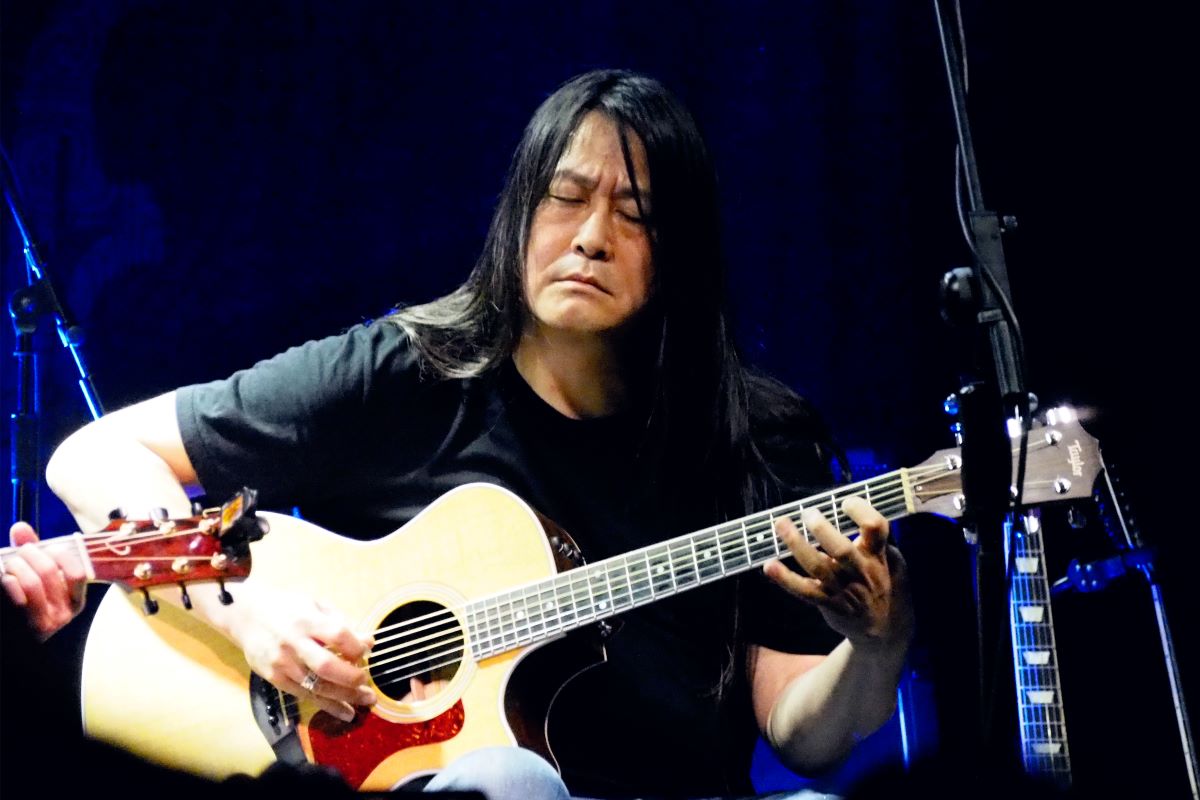
Traveling back and forth between his native United States and his parents’ homeland China many times throughout his adult life, Kaiser Kuo eventually played a pivotal role in the development of the Chinese hard rock and heavy metal scene. Initially with the highly influential Táng Cháo – Tang Dynasty for westerners – later as the guitarist for Chūn Qiū, or Spring and Autumn. And he comes bearing great news.
“The big news is that I’m moving back to China in April or May, reforming Chūn Qiū”, Kaiser says. “I was back there, bought a new Paul Reed Smith Custom 24 while I was there, and I’ve just been trying to get all the rust off my fingers, getting back into shape, learning some new techniques, and writing again.
I was playing a lot of drums, but I was never able to play at a level I was confident with. And I said to myself: why did I stop playing guitar? And I just started cleaning up all my guitars, changed my strings, and got one of my favorites fixed just now: a Jackson SL1. I’ve been building a new pedalboard, and doing all sorts of stuff. Playing like a maniac, six or seven hours a day for the last month or so.”
Keep Getting More Ambitious
“The original plan was just to do a reunion concert. And then it turned into a reunion tour. Then that turned into reforming the band and doing a new album. So we keep getting more ambitious. We had a lot of material that we never ended up putting on a second album. Some of that is still workable, I think, so we’re going to continue.
There will be a different drummer, but otherwise, the line-up is still the same. Our drummer moved to the US, but we have the drummer of Suffocated (Wú Gāng) who’s going to be playing for us. And he’s really great. Our guitarist Kòu Zhēngyǔ is also in Suffocated, so it’s going to be kind of a hybrid Suffocated, Spring and Autumn band.
Originally, we had another couple of guys trying out, because we weren’t sure whether Yáng Měng (singer) would be up for it. There are a lot of people who can sound just like him, who trained themselves to sound a lot like him, so we would have been okay.
Do you know the band Dream Spirit? Their singer, for example, really wanted to do this with us. The only problem is that he doesn’t really play guitar. And we need a singer who can also play some guitar. At least to do acoustic stuff, and play some of the clean parts.”
Almost Unrecognizable
“The very first time I went to China, I went for only a couple of months. That was in June of 1981, so I was fifteen years old. My parents brought us, but they left us for about a month at a university in Peking called Beijing Capital Normal University, where my aunt was teaching. It was summer, so there weren’t a lot of students around. I was in an underground room in a dormitory, trying to get my Chinese in good shape.
Then I went back again in 1986. By that time, I was in university, and China had changed so much in five years, it was almost unrecognizable. I just thought: why am I studying Eastern Europe and the Soviet Union? This is much more interesting. I already know the rudiments of the language; why don’t I switch my field of study to China? So when I went back to university, I started working more on China, taking more Chinese history and politics courses. And then in 1988, as soon as I graduated, I went to China and almost spent a year there.
When I was there in 1988, there was one band that I would say was a hard rock band, and that was Hēi Bào, or Black Panther. But at the time, they weren’t really a band. They were just sort of a confederation of musicians. There were like seventeen people, and their idea of a concert would be: they would play ten or twelve songs, but there were no two songs in a row with the same line-up of people.”

Different Configurations
Around those days, Kaiser played an important part in getting Tang Dynasty together. “Just to spell it all out really clearly: in about November of 1988, I had already talked Dīng Wǔ, who is the lead singer in Tang Dynasty, into leaving Black Panther and forming a band with me”, he explains. “So we started working on material, and we hadn’t come up with a name yet.
That winter, we actually were travelling quite a bit, playing shows in different configurations, mostly just in this expatriate band that I was playing in with two other North American guys doing songs of the likes of Boston, Aerosmith, Rush, Led Zeppelin, and Pink Floyd. We did ‘Godzilla’ by Blue Öyster Cult, we did ‘Purple Haze’ by Jimi Hendrix, we did ‘Crazy Train’ by Ozzy…
Anyway, when we came back from all of that, it was almost Chinese New Year, and so I decided to go home to the States, during which time I borrowed money from my father, and I would get a bunch of gear. We needed stuff that was very hard to get in China at the time. Everything from drum sticks to guitar picks to drum heads and good strings.”
Hand-Me-Downs
Kaiser’s gear trip was necessary, as China did not have much of a market for electric instruments at the time. “It was really tough”, he confirms. “There were people who had nice instruments. Mostly they had been imported by friends or family. Or, in case of one guy, he had actually won a song contest, and he had been given a number of guitars and gear by the Japanese sponsors of this contest. That guy’s name was Chang Kun, and he had guitars that everybody envied.
But most of the rest of them were hand-me-downs from American musicians who would come and brought their guitars and said: you know, you need this more than I do, I’ll leave it with you. A lot of them sort of had a pedigree like that. I met Dīng Wǔ at a music store, and they ended up sponsoring us initially. They fitted out a rehearsal room for us. They gave us amps. At the time, the best amps they had were like Peavey Bandits. It was just really, really crappy equipment.
It was really hard to get decent gear. There weren’t any Chinese luthiers either. People played acoustic guitars. So sometimes you would have to buy acoustic guitar strings and string them on an electric. They didn’t have nearly the magnetic properties, so you would often end up with one really quiet string among a couple of louder ones.”
The True Music of the Heart
“After I came back to China, as soon as Dīng Wǔ saw me, he had great news. He told me we had been asked to take part in a movie. We were going to star in it, we were going to be the band in this movie, and write the soundtrack for it. So not long after, it would have been February of 1989, we met with the director, the assistant directors, and the screenwriters to talk about this film, and to sign our contracts.
The film was really stupid. It was called ‘The Crazy Chick Who Played Rock ‘n’ Roll’. It was about this woman who was a singer in a nightclub, and her back-up band during her set just played schmaltzy Cantonese and Taiwan-style pop. But every night after everyone would go home, they would start rocking out, playing their own music. She gets involved with one of the guys, and ends up deciding that rock is really the true music of the heart, and becomes a rock aficionado.
One of the members dies in a car accident, which is really prescient, because it was actually the guy who would later die in a traffic accident: Zhāng Jǜ, the bass player. That was really strange. There’s a song on Tang Dynasty’s second album, ‘Your Vision’, that’s also on a tribute album for Zhāng Jǜ. That is actually the song that was playing in the scene where we learned the news of him dying in a car accident. That’s what I wrote that for. And then we repurposed it as a tribute to him later on.
My college roommate Andrew Szabo, who is still my best friend, was a fantastic drummer. He actually plays a lot of instruments. He came to China during that spring, because we needed a better drummer to record that soundtrack. Our drummer was good, but he wasn’t good enough for a studio recording. They decided the Chinese drummer was going to be in the movie, but the American guy was actually going to record the soundtrack.
Of course, in 1989, the massacre got in the way of all of that happening. But a lot of the music that Tang Dynasty was doing when it had formed originally wasn’t metal at all. A lot of it was pretty progressive stuff. A lot of what Drew and I had written, playing in a prog band in Berkeley, got repurposed for early Tang Dynasty stuff that was going to be for the album.”
A Real Cosmopolitan Spirit
“I did come up with the concept for the band. I understood that to appeal domestically in China, we would have to find a similar touchstone to those we see in hard rock and metal in the west. They have Tolkien and medieval fantasy in the west, we would have ‘Romance of the Three Kingdoms’ and the martial arts novels of Jin Yong that every kid has read. Instead of burly guys all wearing leather, you would have our hair tied in warrior knots, and we would have sword tassels, and evoke that kind of heroic tradition.
Everyone in the scene was a fan of ‘Romance of the Three Kingdoms’. It’s very metal. It’s an amazing story, and I think nothing teaches you more about the psychology of Chinese people – the good and the bad – than that novel. People talked about it a lot. It was a reference we made all the time. People would ask each other pretty regularly: which character in ‘Three Kingdoms’ do you think the lead singer in Overload is most like? And we would be like: oh, he’s like Zhou Yu, definitely. It was sort of like our ‘Lord of the Rings’.
Of course, the music was more important. We wanted to have music that had an organic, recognizably Chinese element to it, without it just being merely ornamental, sort of an afterthought tacked on to make it sound more Chinese. We wanted to include it from the writing stage, to have it have sort of pentatonic foundations. Not blues pentatonics, but Chinese string pentatonics.
This was 1988 and 1989. This was really the flowering of reform in China. There was a real cosmopolitan spirit in the land. People really wanted to absorb influences from all over the world. The Tang, historically, was known as the most cosmopolitan dynasty. It was when foreign religions came in. Buddhism especially, but also Judaism and Nestorian Christianity. They were all present in China at that time. Also, people almost fetishized exotic goods from Western Asia, and even from Byzantium.
So the name of the band was an idea that fit as well. We immediately all took to that name. So that’s what we went with. That was my real contribution.”
Getting Ready to Record
Despite not actually playing on Tang Dynasty’s 1991 debut album, Kaiser’s contributions extend to the songwriting. “When I left after 1989, only one of the songs that’s on the album had already been written”, he emphasizes. “When I came back in 1991, they had been signed, and they had been getting ready to record the album. The idea was that they would record in August of 1991. The problem was: I had to go back to graduate school in August that year.
So we were really, really hoping that I would be able to get into the studio with them before that. But the dates kept getting pushed back. And honestly, they weren’t ready to record. In fact, when they ended up going into the studio, much later that year – I think it was in October and November – I think they still weren’t ready. There was a lot that wasn’t held together.
Earlier that summer, though, I recorded the demos of four songs with them. Stuff that I had actually worked on. One of them was our version of ‘The Internationale’, which I arranged. Another one was ‘Don’t Go Hiding’, which is the song that I’m credited for. Another one’s called ‘9/4’, and it’s the most metal song on the album. The other was called ‘Soaring Bird’, I wrote a lot of that too. It’s very Rush-sounding.
So yeah, that was my contribution for the first album. And then I came back in 1992, and the album was already out. I did join them for the first tour, when we were promoting the album, which was a lot of fun.”
Standing the Test of Time
Given the circumstances, it is quite miraculous that the first Tang Dynasty album came out sounding as good as it does. “A lot of it had to do with the Taiwanese producers”, Kaiser points out. “There’s still a lot of it that I really don’t like the sounds of. A lot of the guitar sounds were played through something like a Tom Scholz Rockman, the little units you would clip onto your belt. It really does sound like that to me. But they did what they could, and I think it still sort of stands the test of time.
The Taiwanese people really had the recording expertise. The band signed to a company called Rock Records, which is a big record company in Taiwan. And they immediately created a new label that was only going to be for mainland rock music: Magic Stone. Magic Stone was led by a guy named Landy Chang. Landy is an anagram of Dylan; he was an old rock ‘n’ roller. His father and mother were actually from Beijing. He did a ton for these guys.
The producer and engineer that he brought over, Jiǎ Mǐnshù, was a really good studio guitar player himself. Later on, they told me that some of the solos were actually played by him. They also brought in lyricists. A friend of the band, Yáng Jūn, was a really good lyricist. He wrote a lot of the lyrics that really endured. The Taiwan people actually wrote a lot of the more schmaltzy stuff that I don’t really like. I have a feeling they have a lot to do with the production of ‘Paradise’, which is basically a pop song.”
Playing the Peacemaker
In the mid-nineties, Kaiser re-joined Tang Dynasty, though he was not planning to. “I thought I was done after 1992”, he nods. “I went back and got really serious about graduate school. I was really throwing myself into that work. I wasn’t playing at all. But I ended up going back really unexpectedly. There were a couple of reasons for that. I was pretty fed up with academia. I saw that it wasn’t going to go anywhere. It wasn’t going to give me the sort of life that I really wanted.
Then Zhāng Jǜ died in May of 1995. They called me right away to tell me. He had been the one person in the band who could keep Dīng Wǔ and the lead guitarist, Líu Yìjūn – or Lǎo Wǔ, as he is known – from killing each other. They didn’t get along at all, and hadn’t for a long time. But Zhāng Jǜ had been able to make peace. Once he was gone, after his funeral, they fell back to fighting, and Dīng Wǔ eventually kicked him out of the band, and asked me to rejoin.
I said: listen, as much as I would love to play this, I am not good enough. I’m nowhere near the guitarist that Lǎo Wǔ is. I will do my best to play peacemaker, and I’ll try to get you guys to get along. I will help you with arrangements, I’ll attend rehearsals, but I’m not going to play. I’m not good enough anymore. I still think I have a good ear, so I think I can tell you which ideas are worth pursuing.
We tried that for a little while. We had a couple of rehearsals, and they still couldn’t stand each other. So this time, Lǎo Wǔ was the one who said: I’m done. And I was handed the role. At first, it was sort of part-time, filling in. But then, it got more and more. And then, when the time came to write the album, I realized I was writing quite a bit of it.”
A Really Strong Will
“That is how I ended up re-joining full-time at the end of 1996. Another part of why I was back there was that there were drug issues in the band, to help sort that stuff out. Dīng Wǔ had actually been dating my sister for a while, and she was one of the people who really insisted that I came back to China and help him get clean.
I don’t think he needed my help. He has a really strong will. He was able to get clean, and he would have done it without me. I can’t take any credit for it. But man, it was hard to watch. Also, his voice wasn’t as strong as it had been. He couldn’t hit those really high notes. But I think he had gotten a kind of sensitivity, and some of that comes out on the writing of the second album. There was a little more mysticism on it.
There’s a lot that I’m proud of and that I really hate about the second album (‘Epic’, 1998). I really hate a lot of the production decisions that were made about how guitars were recorded especially. I grind my teeth at night thinking of how much I would have liked to have gone back and re-done all those tracks. Just plugging a guitar straight into a really overdriven Marshall, and just record all the rhythm and lead guitars that way, instead of through effects boxes. And not even good ones. The guitars we used also weren’t the best available.
We ran out of money for mastering. That’s why it’s so low-volume. What I did right away: I made lossless wave files out of it, and I basically just did my own mastering of it. That’s the only way I can listen to it.”
Not Committed to Market Success
“We had a falling-out in May 1999, and it had been a long time coming, which is why I ended up leaving in June of 1999. A lot of it was my fault, I would say. I was a guy who always knew I had another road I could go to. I always had another escape hatch: I’m educated, my family had money, I’m bilingual… There are other things I know how to do. Also, I always sort of knew I wasn’t a good enough guitarist to really do this.
So in the back of my mind, I was always thinking about other things. While I was playing music, I was not committed to market success in any way. I didn’t think it was even possible that we could have made a lot of money doing that. So what I focused on was just writing music that would satisfy us. And I really encouraged them not to compromise: so what if the song is nine minutes long? It wants to be nine minutes long! What would we cut?
Dīng Wǔ had a girlfriend at the time who he wanted to have manage the band. She was commercially sensible, but we didn’t get along at all. Part of the reason was that she thought I was the reason why we weren’t commercially successful. We had a small, loyal base of people who loved us exactly for what we did.
What she wanted to do was to basically make Dīng Wǔ leave the band, and become a solo artist. My friendship with him stood in the way of that, as well as my insistence that we don’t go commercial in any way. I think I was naïve.”
Read the Room
The rumors that political issues contributed to his departure are confirmed by Kaiser. “It was really only one thing”, he emphasizes. “And that was when the United States bombed the Chinese embassy in Belgrade, and killed three people, in May of 1999, during the Kosovo war. The United States apologized immediately and said it was a mistake. But no Chinese people would believe that.
They said the United States used these smart bombs. They only hit this one target, and it was the only target that the CIA had actually picked during that entire campaign, and they said it was because they had an out-of-date map, which showed that building to be an arms and munitions depot. Which it used to be, but then it had been acquired years ago, and it had become the Chinese embassy.
I immediately defended the US, and said: no, I think it was a mistake, why would the United States bomb the Chinese embassy in Belgrade? There was no reason for them to do that. But I was not sensitive at the time. I was in China, among Chinese people; I should have read the room better and kept my mouth shut. Instead, I decided to make an issue out of it. It only accentuated my foreign-ness, my differentness, and I think it was arrogant of me to do so. I really regret that.”
Slightly Painful
Tang Dynasty released two albums after Kaiser’s ultimate departure – 2008’s ‘Knight of Romantic’ and 2013’s ‘Mángcì’ – but Kaiser admits not having kept up with them. “I never listened fully through any of the other two albums”, he admits. “It’s slightly painful for me to listen to it. I listen to a lot of Dīng Wǔ’s solo stuff though, which is really, really good. His vocal style is death growls, but it’s got some tone in it. He sounds really convincing doing that. It’s pretty brutal.
I had a few musical projects after leaving Tang Dynasty. Mostly, I was helping out a band called Thin Man. They were kind of a funk rock band, and I was friends with a couple of guys in the band. I was helping them out here and there. Not playing with them or anything, but helping them get gigs. I helped sponsor them to go to Japan to play at Fuji Rock. Their guitarist is still a very good friend of mine.
Also, I did a very strange musical project. A local company wanted to do ‘The Good Person of Szechwan’ by the German playwright Bertolt Brecht. Brecht had written lyrics to the songs that had been translated into English, but there was no music, so I was asked to take the lyrics and write songs for them.
So I did that, and performed that live, with just a percussionist. Just me doing a very heavily effected guitar, just doing a lot of different sound effects for the performance. That was a lot of fun. I had a really good time doing that. Putting in hundreds of hours of work for just one performance.”
A Compelling Rawness
“Soon after that, Yáng Měng approached me. I had met him when I was with Tang Dynasty in 1998, when we were playing in his hometown of Kunming, in southwestern China. We had hung out all night one night, just jamming on a couple of acoustic guitars. I thought he had a great voice for that kind of acoustic folk rock. He had a really clear, high voice, almost sort of like a wild child. So untrained-sounding. No subtle vibrato or anything like that. It had a rawness to it that I thought was compelling.
I said: look me up when you come to Beijing, maybe we can do something together. And so he did. He had come up to Beijing with a band called The Seventh Day. I was just talking to my guitarist, in Beijing, and I asked him: did you ever see The Seventh Day perform? He rolled his eyes and said: yeah, it was just really an embarrassment, they didn’t know what they were. They were like a band that was just figuring out that there was this nu metal thing, and they were trying to do that. It was just an embarrassing catastrophe.
Some of the guys in that band, the ones who were really committed to that nu metal thing, ended up forming a band called AK-47, which went on to have some success. Yáng Měng and the drummer of that band, who were not so into the nu metal thing, formed Chūn Qiū with me. There’s nothing nu metal about us.
I never know what to call it. Some people classify us as folk metal, some as prog metal. There’s no odd time signatures, but apparently, it’s the arrangements and the instrumentation that makes us prog.”
More Traditional Songwriting
“From Yáng Měng’s voice, I knew that he wasn’t going to be the kind of person to be able to sing and cut through over the heavily distorted stuff with the really driving drums. So I knew that we would have to have pretty balls-out instrumental distorted guitar-driven passages, and quiet stuff that he could sing over and be heard. That was the idea for me. And I thought that would sort of be spring and autumn, that dualism.
What I really wanted from this band is to have more traditional songwriting. Not super, super long songs. Six or seven minutes tops. More strong melodies. Just good riffs and hooks. Solos that play over sixteen bars, not over sixty-four bars. And I wanted there to be a lot of guitar harmonies, because we had two guys who could play.
When I met Kòu Zhēngyǔ, we immediately bonded over guitar tones. We talked about guitar tones all the time. We showed each other the settings from our boards and stuff, and we were remarkably similar. To the point where on the Chūn Qiū album, you can’t tell who’s playing what if you isolate the left and right channel. So I was thinking: just like Glenn Tipton and K.K. Downing. Or just like Dave and Adrian in Maiden. I wanted it to sound like that and have lots of guitar harmonies. But I also wanted it to have that Chinese folk element in it.
Those were the ideas I presented to the rest of the band right away. The first song we wrote was ‘A Call from Afar’, which pretty much touches all the stuff I wanted to do. The strong melodic stuff. A lot of clean guitar, but then just more balls-out stuff as well.”
Head in the Clouds
The credits of the ‘Spring and Autumn’ album (2006) show the songwriting to be a more collaborative effort than it actually was. “The truth is that it’s all Yáng Měng and me”, Kaiser admits. “Except the very last one, the acoustic one (‘Between the Mountains and the Sea’); Yáng Měng wrote that whole thing. But every single song of ours, all the riffs and arrangements, it’s all both of us.
We work together very well when it comes to writing. He’s impossible in a lot of other ways. That’s the thing we always say about him: he drives you crazy, he’s always late, his head is in the clouds. He’s a dreamer. It’s weird, because he doesn’t drink and he doesn’t do drugs, but he’s just kind of spacey and kind of cooky. But boy, can he write good songs! His acoustic stuff is really good. He can write really good melodies on top of good chord progressions. That’s just what he knows how to do.
We got really lucky with that band, because there were no huge egos in it, and I think we all worked together pretty nicely. There were minor line-up changes. Our first drummer left because he had another project that he wanted to devote more time to. And he thought we were going to be a little more metal than he wanted. But I love that drummer so much! He is a really musical drummer. Lots of ghosts notes on his snare, and his hi-hat and ride work was so subtle. But it worked out in the end.”
Very Memorable
“We gigged a lot before the album came out, but it was a show a month, and usually in Beijing. It was just really low-key. I had a full-time job the whole time I was in that band. There was no way I could just take off. I would have to take vacation time to go on tour, so it was mostly playing in Beijing during weekends, and occasionally going out to a nearby city, or one city and then come back.
We only did one tour at the end of 2008. It was a ten or twelve-city tour. That was a lot of fun. The rest of the time, it was just a show a month, roughly. But it was very memorable stuff. We were pretty experimental. We would work out new material for a show, and just do new songs.
A lot of it ended up working better acoustically, which is something we kind of regret now, because we really should have been writing more for the next album. Because when we had a meeting, we sat down and said: okay, we have fifteen songs that we could put on the album, but all but one of them are acoustic. We can’t do that. Then we started thinking through the songs: could we do a rock version of this? Not really.
Another thing we realized, as we recorded our album, is that the tempos of almost every song on our first album is between 102 and 110 BPM. Very similar. We were conscious of not having two songs in the same key in a row on the album, and so I’m trying to do that again.
I’ve just been goofing off and coming up with new riffs, thinking about what will work. I’ve got some pretty cool stuff that is very Chūn Qiū, but it’s a little harder, a little proggier maybe. A little more kind of obviously proggy. That will really push us musically.”
Talk Big, Think Big
Despite Shanghai having a larger population, Kaiser insists that most of the scene is still in Beijing. “For rock and especially metal”, he clarifies. “Obviously, like anything else, the scene took a hit during Covid. It’s been really tough on a lot of the music scene, but everything is coming back to life now. I was back in Beijing this summer, and it was such a delight. There was just so much going on. I think there’s a lot of pent-up demand for live music.
Shanghai has a really good jazz scene, and there’s a lot of pop music. But it was never really big for hard rock and metal. There’s a very different kind of person that lives there. They’re very pragmatic and detail-oriented. Very business-minded. Beijingers, they talk big, they think big. Beijingers love politics, philosophy, literature, and poetry. Shanghaiers like nice clothes and refinement. They don’t drink hard like Beijingers do. It makes sense that you’d have less rock there.
There is also a lot of rock coming out of the post-industrial northeastern cities. A lot of black metal is coming out of there. And that makes a lot of sense, culturally. It’s the frozen north, very industrialized. They feel a lot of kinship with Scandinavians.
As across Europe and North America, I think, metal is a very earnest genre. It takes itself very seriously, people are serious, and people are pretty intellectual. When I go to metal shows, I always end up in long conversations with anthropologists, or people who are doing post-docs in cognitive science or something. I love the community so much. Almost more than the music. Metal people are my favorite people. They’re curious, open-minded, and thoughtful about music.”
Shaking Cabinets
Despite this interest, Kaiser hasn’t kept up with the Chinese metal scene as much as he would have liked. “I’m really looking forward to plunging back into it when I get back”, he assures. “I’m going to see a lot of bands, and try to meet a lot of kids. One day, before this all ends, I would love to try to produce a band.”
After all, he has had his fair share of learning experiences. “When Tang Dynasty recorded ‘Epic’, I paid close attention to what our producer did”, Kaiser says. “He made a lot of really good decisions, and a couple of really bad ones. But I learned from everything. Chūn Qiū had a really great producer, a guy named Jaime Welton, who is an American who had spent a lot of time in China. He is a really good musician – I played in an AC/DC tribute band that he’s the singer for – and studied audio engineering.
He was mostly a live engineer, but learned all these studio tricks along the way. He was very against us using any kinds of effects. Just straight into mic’ed amps, so loud the cabinets were shaking. That’s how you get it. He just knew what to do. I was really happy about all of it.”

 Kevy Metal
Leave a reply to Album of the Week 16-2022: Tang Dynasty – Epic – Kevy Metal Cancel reply