
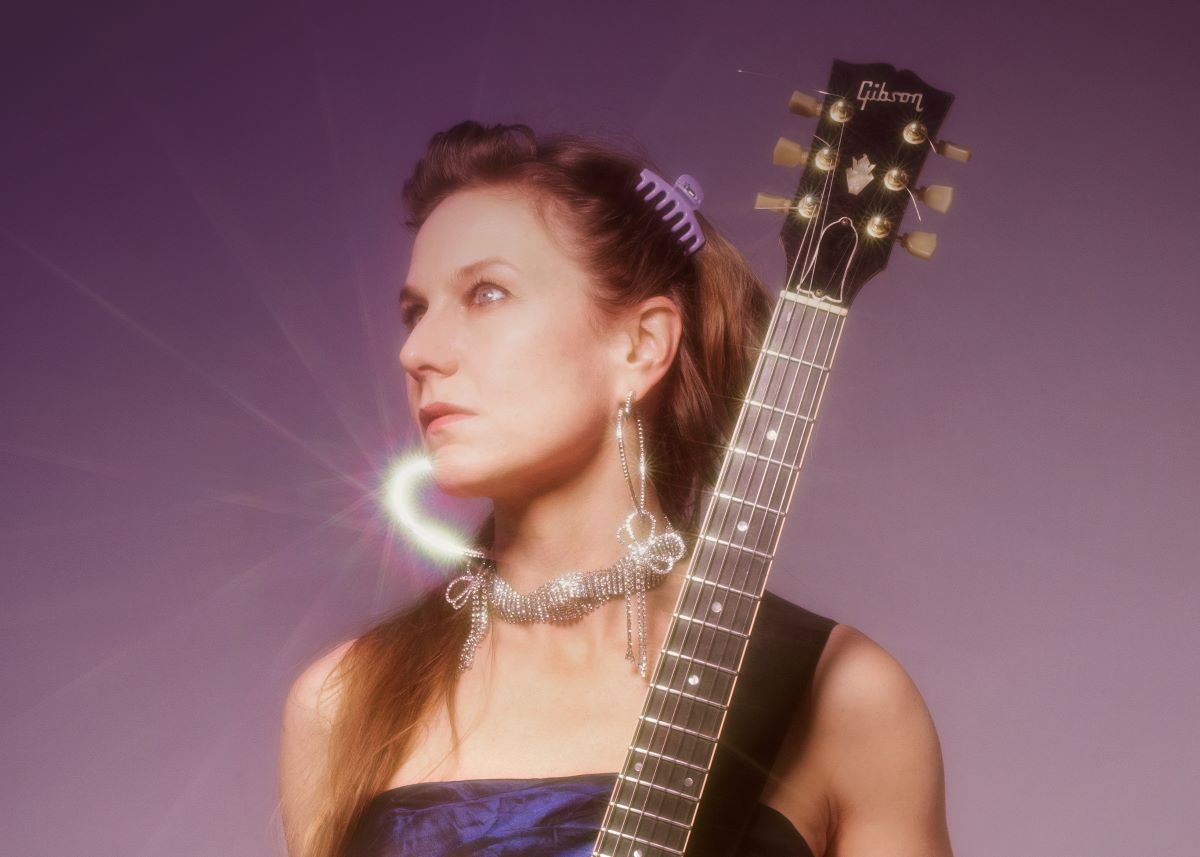
Few musicians are as good at combining the raw power of hard rock riffing with the improvisational character of jazz as Norwegian guitarist and composer Hedvig Mollestad Thomassen. Her Hedvig Mollestad Trio has been capturing the hearts of audiences from both sides of the spectrum for a decade and a half, while she is exploring other forms in different projects.
Hedvig’s journey to distorted guitar riffs and energetic rhythms is an unusual one. Where most guitarists playing a jazz-rock hybrid start out with rock and move to jazz later on, it was the other way around for her. “I didn’t even play in a band with bass and drums until I was in my twenties”, she explains. “When I started discovering the guitar, I was very focused on the songs and what the guitar was doing, but not necessarily on the band.
My father (Lars Martin Thomassen) was a flugelhorn player, so we had very little guitar music in the house. I was listening to Chet Baker, Art Farmer, Miles Davis, and John Coltrane. A lot of ballads. And I was listening to an old Norwegian singer/songwriter who was really good with chords and melodies. So I was listening to some guitar music, but not into the band thing. I was probably too scared, and it wasn’t available to me.”
Not a Lot of Noise
“When I had lessons with my guitar teacher, he never said: shouldn’t you start a band? At least, I can’t remember that he did. But I was playing with other people. I was playing with a very good vocalist, one of my best friends. She was singing, I was playing guitar. And I was playing with my father; he was asking if we could play jazz standards all the time. At the time, we were a trio with a bass player for a long time.
But without drums. That happens a lot in the jazz world, and I think my father likes it, because we could play anywhere, and it was very tidy; there was not a lot of noise, haha! It was very easy to play, because I could focus on the chords and the melody. But I didn’t start playing with bands until I moved to Oslo, and that was when I was twenty.
I think I was a very well-raised kid, and I think I didn’t want to bother anyone. You smile, you kind of do what you should, and then everything works out, in a way. That is not something I encourage my own children to do. I’d rather encourage them to ask questions, and follow something if they’re really interested in it.”
Secret Stuff
“As soon as I started playing with other people, it was in a soul band, the band of Jarle Bernhoft. It was very nice starting to play soul music with him. I was so lucky to play with the people in his band. One of the first drummers he played with was Torstein Lofthus, who was very famous at the time, playing with Shining.
Getting into playing with bands and rock music as late as I have is probably one of the reasons that I was able to get into what I’m doing the way I did. I was educated at the music academy in Oslo from 2005 to 2010. And to me, taking a jazz education playing rock guitar was kind of a thing you were not supposed to do.
At the time, I was checking out a lot of guitars, and I think I was testing a Gretsch guitar that was very silvery and sparkly. When I brought that to school, and I was playing it, one of the teachers said to me: honestly, what kind of music do you think you’re actually going to play with that guitar? He thought: in jazz, you’re supposed to be a little toned-down, focused on the music, not be too flashy.
To me, being able to do something that the others didn’t do was easier for me, because that way, I didn’t have to measure myself against the others. So it felt like a relief to have this kind of other secret stuff going on.”
Gift to the World
“I think it was 2005 when I was introduced to Black Sabbath. That was late; I was 23 at the time. But this music grabbed me exactly the same way as the music that I loved when I was 12 years old. I fell in love with this music. Ozzy’s voice was so full of meaning to me. And when I started listening to Led Zeppelin, I thought: what is this gift to the world?
My expectation was that rock guitar wasn’t advanced at all, and that it wouldn’t speak to me. I had listened to Pearl Jam, and that was good too, but this was on another level. Hearing ‘Achilles Last Stand’ was amazing. Both the harmonies and the ideas. Or ‘The Ocean’, which would just build layer upon layer. So much interesting stuff! Also, the tone of Tony Iommi’s guitar in Black Sabbath… I was absolutely captured. A boyfriend introduced me to all of this stuff, and he also introduced me to Rush, and to Melvins.
For a long time, I was still trying to play jazz, and it just didn’t work out. I was just not cut out for that. It took a long time before I kind of gave up the jazz side, just by bringing in material that I had written. And when I wasn’t playing the jazz idiom-ish stuff that I was apparently supposed to be playing, I suddenly played very, very differently. There suddenly were no rules about how you were supposed to sound.
For me, that was a lot better than trying to sound like something that has already been made, even though I still love the history of jazz and contemporary mainstream jazz. And I really admire the people who play it.”
On the Opposite Side
“Around the time I was getting into those rock bands, someone came to me at a concert that I played, with Ivar (Loe Bjørnstad, Hedvig Mollestad Trio’s drummer) actually, and said: you must have listened to Terje Rypdal a lot. At the time, I didn’t know who he was, so I started checking out his material from the beginning. So I checked out ‘Bleak House’, which is not at all what he’s known for today.
And I didn’t really get it. He played with this large ensemble with flutes and sax, more traditionally jazzy. Then I didn’t check him out until sometime later, when I heard the ‘Chaser’ record for the first time. That’s when I could hear that what I was playing was reminiscent of what he had done. So I had to be careful that I wasn’t doing something that he had already done. I think Terje Rypdal and I have listened to a lot of the same music, because there was so much that I could recognize in what he was doing.
A similar thing happened with John Abercrombie. I was given the recordings that he did in the nineties: ‘November’ and a couple of other ECM albums, on which he plays beautifully, but it’s very mellow stuff. Likewise, ‘Quiet’ was my first John Scofield record. I don’t know why people gave that to me. I kind of ended up on the opposite side, and it took me years before I kind of realized that these people have done extraordinary guitaristic work.”
Not About the Rules
“Also, the stuff John McLaughlin does today doesn’t remind me at all of the fury and the sound of the amplifier that you hear on the early Mahavishnu Orchestra records. ‘Visions of the Emerald Beyond’ is still my favorite Mahavishnu album. The way the guitar sounds there is more like a light than an instrument.
There is a track called ‘Lungs’ on the first record that John Abercrombie did with Jan Hammer. It’s extreme. Compare that to a record like ‘November’; it’s two very different kinds of music. Those early records of John Abercrombie and Gateway are mind-blowing stuff that I guess is jazz, but it’s just very, very free. It’s not about the rules, it’s about the energy and the interaction between the musicians.
On some of Jeff Beck’s later stuff, it’s hard to get into what he really means. But on a lot of the early stuff, like ‘Led Boots’ and ‘Wired’, there is just so much cool guitar stuff. Great playing, and it’s in the middle of some kind of jazz-rock fusion.”
A Fun Game
“To me, it has always been more fascinating to hear the interaction between musicians than just kind of playing the stuff that you find harder to play, or jazzier. That is not interesting to me at all. It can be fascinating, but what is really gripping my brain is the interaction between musicians. It’s no use to play in a band if you’re just going to do your own thing.
The thing with reacting to what you hear in the moment, that is such a fun game. It’s nice to be in the studio, but it’s so much more fun to play music live. There don’t even have to be many people for it to be very, very fun to play music. Or exciting at least.
At the same time, my soul is not resting properly until I have recorded stuff. I wish I could do more with the band that recorded ‘Ekhidna’ (2020), because it was very fun. So I’m thinking about if there is another way to make that kind of music. When I was doing ‘Ekhidna’, I was very focused on us having to be in the studio at the same time. The music had to be performed then and there.
But as time moved on, I’m now thinking that rather than not doing it at all, it might be possible to do stuff with just three of us, and having people come in to do their parts on top of it. Maybe Susana (Santos Silva, trumpeter), for example, can record her parts later, and we can work around that.”
Two Different Worlds
“When I made the music for ‘Ekhidna’, I wanted it to sound different to the trio because of the musicians involved. Nearly all the music could have been played by the trio, but it just sounds different with the other people. I could work differently within the music, because the spaces were taken up differently than when I would be playing with Ivar and Ellen (Brekken, Hedvig Mollestad Trio’s bassist), not in the last place with two keyboard players who were kind of all over the place. The sound and the shaping is different from the trio, but I really think it’s the same string of life.
It was fantastic for me to have another melody instrument to play with. It’s a different way of working, which was very refreshing. But of course, I will continue to work with the trio. They are my closest friends. The trio is my family. That’s where I live; the other projects are just visits, haha! One is not better or worse, it’s just two different worlds. That’s why I’m really inspired to keep working on different projects.
A lot of the music for ‘Maternity Beat’ (2022) was written in the first part of 2020. Everything was up in the air back then, because nobody knew what was going to happen because of covid. ‘All Flights Cancelled’ came rather late in the process. ‘Maternity Beat’ had all these complex arrangements, and I thought it needed something that wasn’t quite as arranged, but would still fit into the project.
I didn’t meet the musicians for ‘Maternity Beat’ until one week before the performance, so I was testing a lot of stuff with Ellen and Ivar. When I played ‘All Flights Cancelled’ with them, it felt very natural to use it in both places. I think it was really nice, because they treat it very differently. Ståle (Storløkken, keyboard player) plays the solo on the ‘Maternity Beat’ version, and the tempo and the vibe are different. So it was ridiculous to use such a nice song only for a project that plays live once every four years.”
Eight Shows in Six Days
Many of the projects aside from the Hedvig Mollestad Trio have started as commissioned works. “This is the way a lot of Norwegian festivals are structured”, Hedvig explains. “They ask a lot of Norwegian artists. There are several reasons for that. They have been taking a little bit more care of their own artists after the pandemic, and the euro is so expensive at the moment that it’s cheaper for the festivals to buy Norwegian music. Or at least to build the program around that rather than expensive international headliners.
‘Ekhidna’ was a commissioned work for Vossajazz. Weejuns was a project for Kongsberg Jazzfestival. When that was realized, I was offered to be artist-in-residence at Molde Jazz Festival last summer. That meant I could put together a series of concerts with myself, a mix of old and new projects. I had eight shows in six days, all different projects.
I did a whole new opening concert with strings, horns and a bigger band, called Liquid Borders. That was an interesting project, but there were so many people involved that the touring aspect would be hard because it would be difficult to get around with so many people. So that was just for that occasion. I don’t know if I will pick that up again, but I’m using some of the material for teaching my students.
I took up this old record that my father was a part of in 1974, 1975 called ‘Østerdalsmusikk’, which is a jazz record that digs into Norwegian folk music from the eastern part of the country, with Jan Garbarek and several others appearing. I rearranged that record for a band with horns and Trevor Dunn on bass. Then there was the Weejuns gig, with Trevor Dunn as a guest.
I was also playing with an avant-garde jazz quartet called Cortex. We played with the trio, with Motorpsycho’s guitarist Hans Magnus Ryan and Nels Cline from Wilco guesting, and I was guesting in Snarky Puppy myself. On the last day, I did a solo concert in a church.”
A Very Pleasant Accident
“It was a crazy week. It was a lot of hard work and a lot of fun. After that, we released the Weejuns record. Last year I made some music for a silent movie called ‘Limite’, which is a Brazilian movie from 1931, together with Ståle Storløkken from Weejuns and Elephant9.
At the moment, I’m working on two very different kinds of projects. One of them is the trio. We are going into the studio in October. We were actually not planning on going into the studio until January, but then something occurred, and we had to pull it forward. That was a great thing. I always plan far in advance; I hate to put stuff too close on the calendar, because I get frightened that I won’t be able to do everything in time. So this was a very pleasant accident. That will probably be the new record to come sometime next year. Probably before the summer.
In the autumn, I’m going to do a strange thing at a more classical-oriented festival, together with one of the great guitarists in Norway, Eivind Aarset, and another Norwegian guitarist called Frode Alnæs, together with a string quartet. We are playing in a church. Merging strings and guitars without drums or bass in a church, but still trying to maintain some sort of identity is really difficult.”
Showcase Model
If you have seen Hedvig play, you have probably seen her play her Gibson ES-335. “That’s my favorite guitar, and I got it when I first started playing seriously”, she says. “I tested a lot of Gibsons before that. I was just looking for the right one. And the one that I stuck to, and that I always use, is a 335, but it’s a showcase model. It didn’t come with the Bigsby; it came with EMG pick-ups and black hardware, so I modified it quite a bit.
But of course, I need to have back-ups that are as similar as possible, so I have another 335 in a walnut finish, from the seventies. However, the neck is very, very different, so I only use it if it’s not for heavy playing. I can’t use it with the trio, because I pull the strings so hard that I kind of bend them over the edge of the neck. So I only use it in more jazzy settings. I also have a 345 as a back-up.
The people I played with around the time I got the 335 had Gibson mania, I think. But it wasn’t like I didn’t like anything else. I think I played these kinds of necks so long that I really should get a guitar with a thinner neck, just to make sure that I don’t get locked into one kind of playing. Maybe it’s too late already.
I have had other guitars. They just haven’t been used. I have this beautiful Gibson LP-295, but I never got the kind of tone I wanted from it. What I have may not be perfect, but I’m very used to working with it. And I’m interested in how far the two of us can go: how much we can get from each other, although neither of us is perfect, haha!”
A Cool Combination
“I have been less satisfied with the amplifiers that I’ve had. But I just bought a Fender Dual Showman Reverb with a large 2×15″ cabinet and a master volume, and it is the best one I’ve ever had. Every time I turn it on, I can’t believe that I have this amplifier. I’m in heaven. And I can’t believe I haven’t checked it out before. I wish life has more surprises like that in store for me. The only issue with it is that it’s too big to travel with it.
I started out with Fender Super Reverbs, and I still play those, especially in combinations of two different ones. Especially with these vintage models, they often sound very different. I used to have this Lehle pedal that I used to have two signals, but it always made a sound if you hit the switch. Then I tried some more boxes, and now I’m just going in on the one channel and out from the second, into the next. Really the dullest way, but it’s working fine. It’s very convenient actually.
I used to play a Bassman 50-watt head and a 2×15″ cabinet, combined with a Vibro-King 3×10″ and a 2×12″ cabinet. That was all Fender, but then I added a white Marshall Bluesbreaker. And those three were kind of a cool combination. The Bassman is kind of heavy and sludgy, the Vibro-King was much more tough, and then the Marshall was a lot cleaner and kind of to-the-point, direct. The mix of those three was very nice to play with, but I couldn’t bring all of those. Also, the 2×15″ cabinets started to get really, really worn.”
Guilty Pleasure
Despite Hedvig’s immense skills as a composer, she has taken a liking to covering her idols in recent years. “I had never done covers, because I thought the joy of playing those things we all love would never outweigh the fact that it will never sound as good as the original”, she explains. “Maybe it’s because I never played in bands when I was a teenager, but playing the work of other rock bands is a guilty pleasure of mine. At first, I thought you should always play your own music. Very judgmental. And then I started loving playing these songs so much.
With the trio, we are now covering Zeppelin, Sabbath and Melvins. What happens to me when we’re going to do one of these covers that I love so much is that I get so extremely happy. The joy! I cannot keep a straight face. I think you have to kind of keep the covers if they fit the rest of your set. You can’t have this kind of sudden identity shift at the end or in the middle of your set.
The last gigs with ‘Ekhidna’, we played two cover songs at the end of the set. One of them was ‘Led Boots’ by Jeff Beck, and the other was ‘Red’ by King Crimson. It was fun. One thing I love about ‘Red’ is that they didn’t put vocals on it. To me, instrumental music is more than enough information most of the time. It’s more than enough sound to delve into and to spend time with. I love vocal music too. King Crimson has a lot of great songs. But I love it when the instruments can be the most significant part of the song.”
This interview is part of Kevy Metal’s Gateway to Jazz series.

 Kevy Metal
Leave a reply to Album of the Week 19-2025: Hedvig Mollestad Trio – Bees in the Bonnet – Kevy Metal Cancel reply