
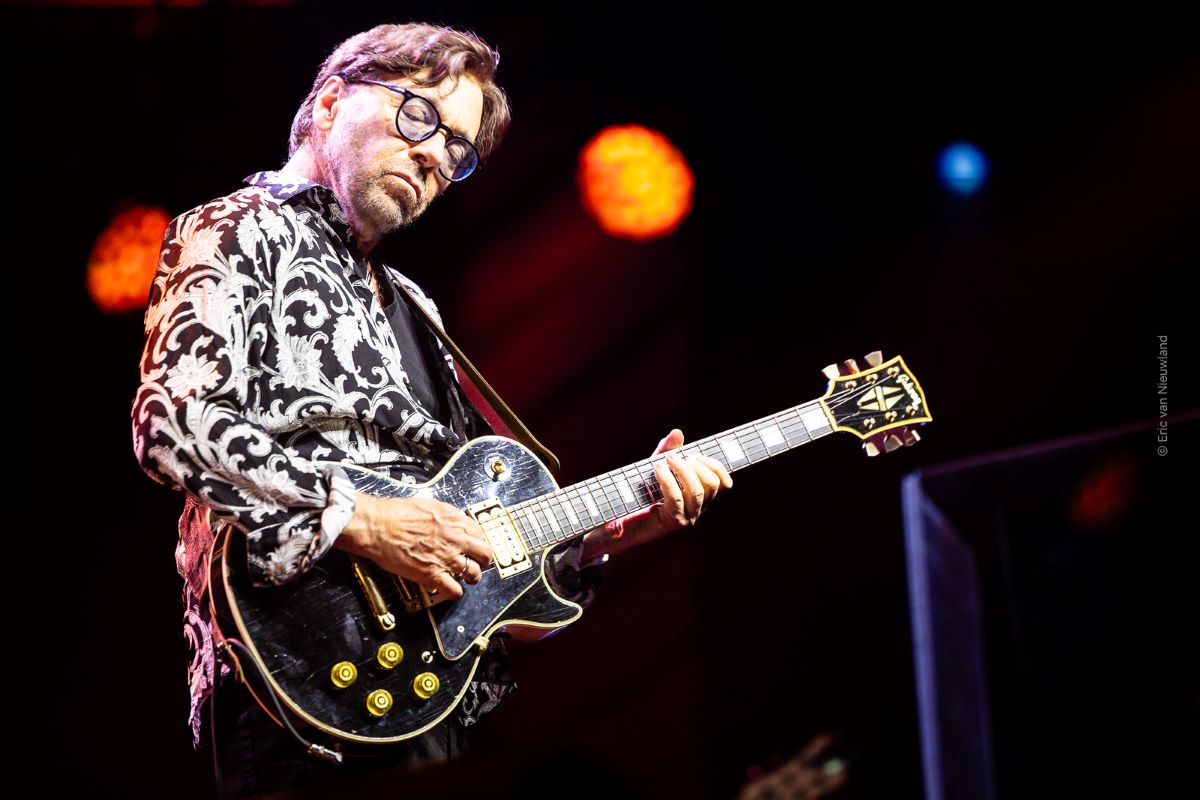
What better way to start my Gateway to Jazz interview series than with a musician who made such gateways in different directions? First, a gateway between jazz and rock, on the albums with Return to Forever and his first few solo albums. Then, a gateway to instrumental acoustic guitar music. His brand new album ‘Twentyfour’ moves in multiple directions, featuring multiple tracks with electric lead guitar over an acoustic foundation.
We are lucky to be speaking to Di Meola, as he suffered a heart attack on stage in the Romanian capital of Bucharest less than a year prior. “I recovered very quickly from that”, he assures. “It was a serious heart attack, but I didn’t need to have open heart surgery. It’s just stents. Because I was in very good physical shape, I didn’t suffer any heart damage or scarring on the heart. I’m operating at 100 percent, and I’m monitored really well by doctors.”
This also means his ability to play guitar isn’t affected. “In fact, my playing is better”, he states. “Because during the time of recuperation, I had hand surgery. I had a pretty big scar from carpal tunnel. It looked like Frankenstein’s monster. It was really bad. Painful. The surgery was not as quick to heal as I thought, but now, it has completely healed, and it enables me to play better.”
Increasing the Production
Back to more current matters then. Despite being quite an elaborate production, ‘Twentyfour’ was originally intended to be a fully acoustic album. “Solo, without overdubs”, Di Meola clarifies. “I thought it would be appropriate to do a solo record at that time, because I thought with covid and everything, it would be very difficult to fly in my band members from different cities. I had to be able to play solo concerts with some new music.
That was the original intention. But then, as the time grew longer, I got the urge to increase the production much further on a lot of the music. Not all of it; some of it is still in a solo format. Some of it is solo guitar with percussion. But more than half of it has a bit more production on it. Some of it even has a lot of production, including an orchestra that I recorded in Italy.
Now, it’s a year later, and I wish I had more electric on the record, because I’m playing electric so much live. But that’s the way it goes. Maybe we’ll do a live album.”
Going Deeper with the Writing
“A solo double album is a lot to ask of the listener. But it’s already a lot to ask of the listener, because of everyone’s attention span diminishing over the last twenty years due to cell phone activity, constantly checking it, and moving from one thing to another. We’re not at the same mindset for a longer attention span like we had in the seventies. So I went completely against what may be more popular: much shorter pieces, hit and run.
There are a lot of more involved pieces. Like ‘The Immeasurable’, all three parts. They’re all lengthy pieces of music. This is a composing record. Having most of the time uninterrupted by airports, packing, and travelling all over the world allowed me to go deeper with the writing, and go to places I haven’t visited before. It’s quite a different record, in a way.
The first two years after my last record, you could say I was working on it most of the time. And the third and the fourth year, we were kind of back on the road again. Whenever I was off, I would go back to recording. So in those two years, I was more interrupted. But it took the duration of four years to complete the record that turned out to be a double record, because everything was surpassing what would be the time limit for one vinyl record. Or even one cd.”
A Thrill Within the Compositions
“The style in which I wrote the music involved me using a hybrid picking technique. I’m used to plectrum-style picking, but now I’m using the pick on the lower strings, and my fingers on the upper strings. On a lot of it, at least. It depends on what I wrote. Because I wrote a lot of two-part harmonies which require me to play two notes at the same time. Or sometimes three.
But I don’t use my fingers so much in a very fast-velocity type of technique, like some of the newer players or flamenco guys have been doing. When we started in the seventies, we weren’t only known for this fast velocity. Yeah, we were popular because that was a big thing in the mid-seventies. Our chops were important. But the compositions were equally important.
These new guys, their playing is fantastic, but against what? Fast playing for the sake of playing fast is going to bore the hell out of the audience. Playing fast is quite boring to everyone other than guitar players that like fast. That segment of the audience is pretty small. You’ve got to have a balanced night.
The composition is what keeps the attention of the audience throughout a two-hour show. Not the speed-playing. Speed-playing is like a thrill within the composition. But if the compositions are weak, it won’t work.”
Exactly What They Remember
“The primary acoustic guitar on ‘Twentyfour’ is a Felipe Conde Al Di Meola model. I have several, but the one I use is an older one that I favor. It has an RMC pick-up in the bridge that connects to my AER acoustic guitar amp. That amplifier is available in two sizes, and this smaller one I favor. It’s the same one I use on stage. And I also use two up-close Schoeps microphones that cross. The sound is great, I think, and it works good in my studio.
If you hear an electric guitar on the record, it’s mostly my ’71 Les Paul. I think I used a PRS on one or two places. But that ’71… I kind of pulled it out of the closet, and I haven’t used it since 1978. For some reason, I thought all these beautiful-looking PRS guitars are the way to go. But when I A/B’ed them recently, I could not believe how big that Les Paul sounded. The Les Paul has the old DiMarzio Super Distortion pick-ups, and they are amazing. They don’t make them like that anymore.
That was the signature sound of my early years. The tour I am doing now was promoted as the early years. Most of my fans know that music very well, and they haven’t heard it in forty years. The response live was unbelievable. Normally I would go out with a new record, and I would naturally want to play new music. And audiences are very respectful, but this was like: aaaaaah! They just know all these songs: every bar, every fill.
So I told the band: I want to recreate exactly what was played on the records. Not even find new versions to play, which is normally my intention; I always want to make it even more modern. No, I want to play exactly what they remember.”
Superior Sounds
It’s not all old equipment that Di Meola brings on his current electric tour, however. “I did have a 50 watt Marshall that on the record was working well”, he explains. “But someone tried to repair it, and for some reason, it doesn’t sound the same. It’s too bad, because it’s a great-sounding amp from the seventies. Very hard to find. On the record, I used a Mad Professor, which is also a great amp.
Then I found this amp that is just so great, from a brand called Two-Rock. Boy, they’re really good. I discovered it during the rehearsals for the tour. And I just called up Two-Rock, and the main guy there was a huge fan. He said: oh my god, we’ll send you an amp when we get back from NAMM. I said: we’re in the middle of rehearsals now, what can I do to get it right now? Eventually they managed to send me one immediately. Now they’re building me another one. A different model, called a Bloomfield.
So my sound on this electric tour, compared to the last two electric tours we did – I think we did one in 2014 and one in 2018… I was using different amps at the time, but the Two-Rock is really superior. It’s in-your-face, punchy and sustainy. A really good sustain. Not too fuzzy. And it’s loud as hell.”
For the Enjoyment of the Audience
“I shied away from electric because of so much ear damage over the course of my career, early on especially, and also a head injury I had. These days, I just turn the speakers in the opposite direction. I don’t have any monitors aimed at me; they’re aimed away from me. And I hear the sound ambiently. Sometimes, if it’s a low ceiling, and the walls are close, it can be very loud, even with ambient sound, so I put ear protection in. And then some nights, when you’re in a big theater, and the ceiling is fifty feet or more up, then sometimes I take them out.
The rehearsals are hard work. In this case, the musicians really had to stick to the chart, and maybe enhance here and there. But mostly, I wanted to recreate those pieces for the enjoyment of the audience. And I wanted to introduce a couple of pieces from the new album within a whole evening of my most popular pieces.
What I’m doing on tour now is the complete opposite of the record. A lot of the time, things I do don’t make sense. But it keeps people in suspense. I do play a couple of new pieces with the electric band. One of them is ‘Ava’s Dance in the Moonlight’. And we also channel the whole orchestra through the PA. That’s coming through, we’re playing with it. It’s a full-blown sound. It’s quite nice.”
Take It to the Next Level
Despite the electric tour taking up most of Di Meola’s schedule, there is still time for acoustic performances. “I have an acoustic trio, with another guitarist from Italy, and a percussionist from Valencia, Spain”, he explains. “We play none of the repertoire of the early records. Our focus is more on the new record, and also acoustic pieces from the previous record, ‘Opus’, maybe one or two from my Beatles tribute records, and one or two Astor Piazzola pieces.
What we do with that is take it to the next level. Live, you get so used to playing it that, usually, the tempos increase. So then, when I go back to listening to the record, I tend to think: oh my god, that’s so slow, I should have sped that up. But to the listener, they’re hearing that for the first time, and they don’t think that’s the case.
I sometimes think that a record that’s too fast becomes very monotonous for the listener. And it’s okay that a record is more evenly paced, and not chaotic and fast. But live, it works great. Plus, with the other guitarist, I get to add some harmonies that I didn’t put on the record, that I always wanted to do, but didn’t get the chance. We have our live versions, slightly different from the record, but you definitely know that it’s from the record.”
No Interruptions
“If you really want to make a modern-day ‘Casino’, or a modern-day ‘Elegant Gypsy’, then your thought process is going to be different. If you hear ‘The Immeasurable Part 1’ from the new record: there is no way that would have started on an electric guitar. I was thinking acoustic pretty much throughout the record. And then the adding of the electric guitar was more of a solo instrument, or a lyrical melody instrument in various places, or at the end of songs to take it to another level.
I’m already thinking of the next record being electric, but making a studio record is so much harder today than thirty, forty years ago, because everyone has a cell phone, and everybody’s constantly looking at it. The attention span and the focus is not there. Not like it was.
Before cell phones, we would go into the studio, with any group of players – even if they were famous sidemen like Steve Gadd, Anthony Jackson, or Jan Hammer – and we would be totally focused on the music, because there were no interruptions of a phone. In fact, the one phone in the control room, we would tell the receptionist to block any calls coming in. Just take messages.
That doesn’t happen anymore. The last time I made a studio album with a full band live in the studio was ‘Pursuit of Radical Rhapsody’, maybe five records ago. Everybody would record together in the room, but the minute we were done, they would go out in the hallway to check their phones. We used to run into the control room so we could hear the playback. But things have changed. And I don’t know if I’ll ever do something like that again. But we’ll see!”
An edited version of this interview appeared in Gitarist 400 (July 2024)
This interview is part of Kevy Metal’s Gateway to Jazz series.

 Kevy Metal
Leave a reply to Kevy Metal’s Gateway to Jazz – Part I: Origins – Kevy Metal Cancel reply