
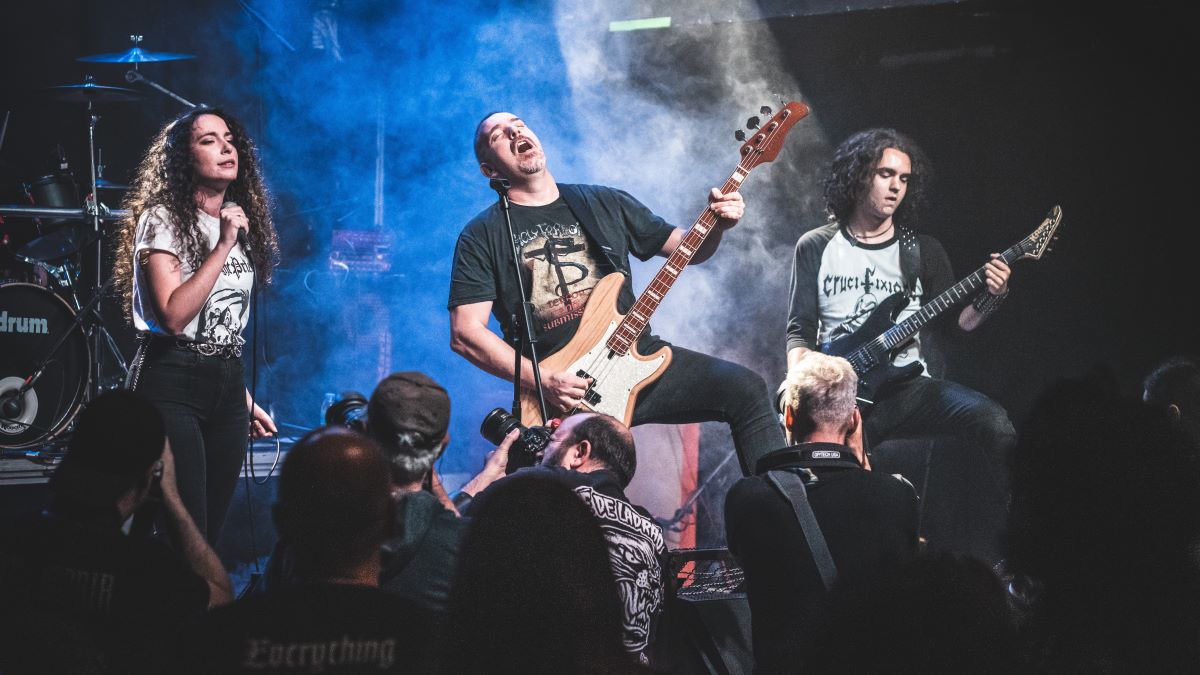
With its combination of epic heavy metal compositions, almost ethereal vocals and a sound that is both old school and timeless, Dolmen Gate’s ‘Gateways of Eternity’ is one of the most impressive debut albums of the year so far. Bassist Nuno sheds some light on how the Portuguese band was formed and how their sound has developed into what it is now.
Despite his current enthusiasm, it wasn’t always a given that Nuno would be playing with Dolmen Gate. “The band started with Alex (drummer) and Kiko (guitarist)”, he explains. “After I finished playing with Ravensire, I didn’t want to commit to any other band. The two of them knew each other quite well, and they were already playing together in a metal/punk outfit called Nagasaki Sunrise. But Alex always loved playing epic heavy metal and knew that Kiko was also a fanatic of the genre.
Alex got together with Kiko and another guy called Fred on bass, who is another long-time friend. But Alex always liked working with me, so he kept begging me, and I kept refusing. Then one day, he sent me a recording of a song they were working on and something clicked – it was ‘Retribution’, by the way. Moreover, I knew that the other guys were cool and easygoing, so I ended up relenting. It was the best decision I ever made, because they were really great, not only as bandmates, but as mates in general.”
More Varied Expression
“Unfortunately, Fred had other commitments and had to leave. Then came the question about who to get on board as a vocalist. One day, I was scrolling through Facebook, and I saw a video of the girlfriend of yet another one of our mates – Faias, the bassist of Midnight Priest and Nagasaki Sunrise – singing ‘Burn’ by Deep Purple. You can check that video on Dolmen Gate’s Facebook reels. That was it. She was the one!
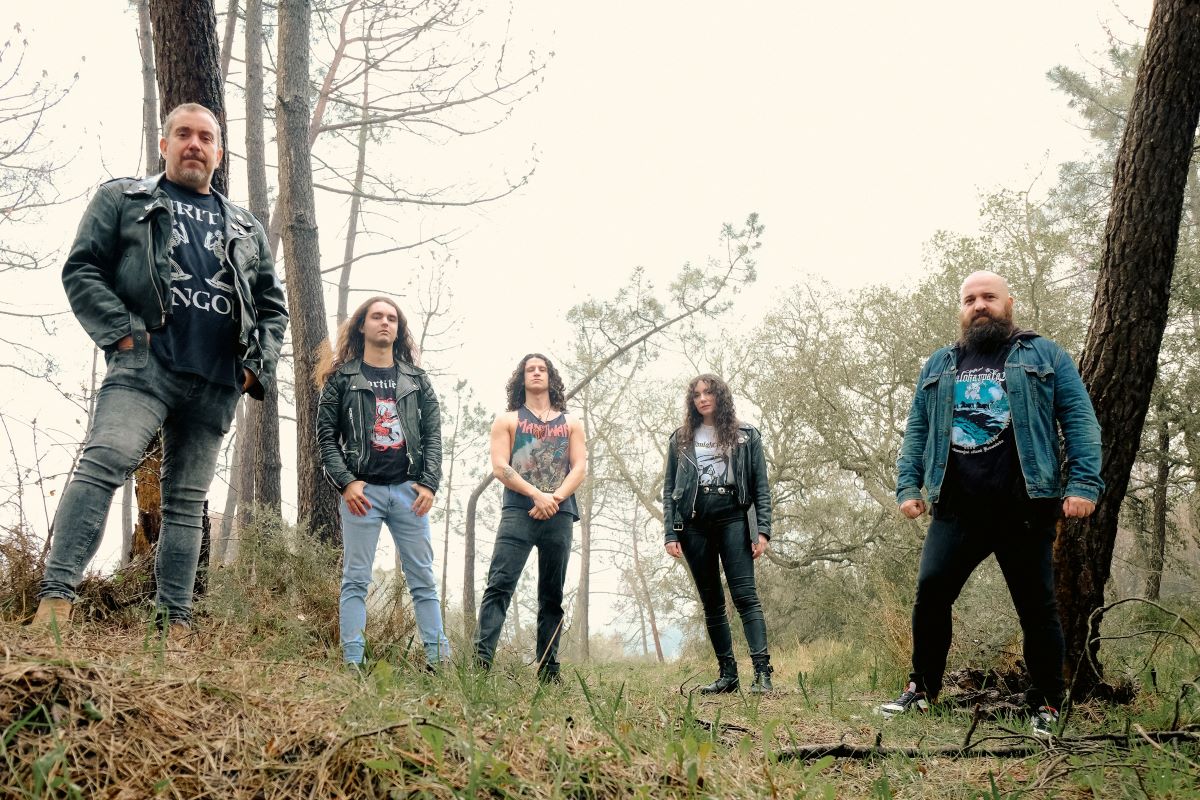
So you see, there is a trend in all this: we all share the same background, we know each other from the scene and from some nights out, and we have more or less the same outlook on life and music, although we are from different generations. This band has three different generations on board: musicians in their twenties, forties, and fifties. That is why all of us are the right people for this band: we understand each other.
Dolmen Gate and Ravensire are two very distinct entities. In Ravensire, I’d write 90 percent of the music, whereas in Dolmen Gate, there is much more input from everyone else. Although both bands have the same epic heavy metal outline, I feel that the expression in Dolmen Gate is much more varied than Ravensire ever was, thanks in no small part to Ana’s different approach to singing in a heavy metal band.
Only one song came directly from Ravensire. ‘The Oath’ was originally written for Ravensire as ‘Damocles’ or something like that. For Dolmen Gate, we changed the arrangement a bit, changed the lyrics, and Ana did her own vocal interpretation. We ended up with a completely different feel. Not better, or worse, simply different. And it worked out great together with the other compositions.”
Breaking Out of a Template
Nuno already referred to it: Ana’s incredible vocals are quite unconventional for a heavy metal band. However, it was not difficult to make her voice work with the music. “Having a completely different, atypical voice for this style was one of the main reasons we always felt it would work”, Nuno assures. “That is also why we didn’t change anything in the compositional style of our songs.
The way I see it, bands end up following a template set by others, intentionally or not. They can do it very well, and I love a lot of bands who do that, but in the end, they don’t bring anything different to the table. We love traditional heavy metal, but if we can play it with a little twist and – more importantly – with our own identity, we will feel accomplished.
Of course, breaking out of a template will always bring divisive opinions. Some will love it, others not so much. But for me, I prefer it that way. We have a musical base that is very epic and ‘martial’, but on top of that, you have the quasi-ethereal vocals of Ana singing about epic deeds from the past or the imaginary.
I think it’s a killer combination that, together will all the imagery and lyrical content, works perfectly for me as a metal fan. Her vocal influences come from classic rock and hard rock from the seventies – remember ‘Burn’? – which coupled with music that is inspired by the likes of Manowar and Bathory makes for a killer combination!”
Merging Influences and Identity
“When you don’t close the songwriting off to different ideas, it’s very easy to get musicians from different backgrounds moving in the same direction. Dolmen Gate gets inspiration from Boston – yes, the rock band – to Immortal – yes, the black metal band – and everything in between. It’s just a matter of taking those influences and merging them with our own identity, and let everyone chip in their ideas. In the end, everything sounds like Dolmen Gate and not like a mishmash.
Generally speaking, the process starts with someone having an idea. Usually, at the very least, it’s already a somewhat complex structure – like a verse and a chorus – or a more or less complete song. That idea is sent to everyone to get a feel for it. Then, we start working on the ideas in our rehearsal room and work out the arrangements, and, if necessary, the missing parts.
Everyone will have a say, either on their individual parts, or on their idea of how the song can develop. Ana, in the meantime, starts thinking about vocal melodies, and when the lyrics are written – could be by anyone, but Alex is the resident poet, contributing more lyrics than the others – it’s time to work on the vocals and see if the song needs a different structure, more or fewer parts, and things like that. We only consider a song to be complete after finishing this round.
Artur (lead guitarist) approaches the guitar solos as a mix of composition and improvisation. First, he starts to improvise over the solo parts. After he nails an interesting idea, he’ll start developing it and working around that. Then, when the structure is decided, he’ll polish the parts and work on some flourishes and embellishments. Sometimes, during the recordings, we can also throw in some ideas, like harmonizing a part, or making some minor changes.”
A New Outlook
Speaking of guitar solos: Nuno was originally going to be the guitarist in Dolmen Gate. “After recording the demo, and the solos, I kept thinking that my guitar playing was not on par with how I wanted it to be”, he admits. “I was never a lead player, but somehow ended up recording four Ravensire albums filled with solos.
Not having a lot of lead chops, nor having that obsessive mentality to play better and faster – I prefer to write songs, honestly – I started feeling that if I was to continue playing solos for Dolmen Gate, they would start sounding a lot like the Ravensire ones, and pretty average to my ears. Also, I felt that some new blood was needed to make it all refreshing. So when we recorded the demo, I told the other guys I’d switch to bass, and we should get a young guitarist with a new outlook and approach.
Me changing to bass and Artur joining as a guitarist is the most important development since the demo. He has been handling most of the solos in a great way, with his own style, and great licks and ideas. That has elevated our songs yet another step! The live experience we have gathered, especially after playing Up the Hammers in Athens and Keep It True in Germany, has been an important development as well. Both were great and rewarding experiences that injected us with the confidence to look for a bright future.”
No Studio Mathematicians
Sonically, ‘Gateways of Eternity’ feels very old school, almost like portions of it have been recorded live in the studio. “It wasn’t”, Nuno points out. “Nowadays it’s very difficult and costly to find a decent studio with decent recording gear to record that way. Nevertheless, the fact that we rehearse our songs a lot when we go to the studio means that we are more than prepared to lay down the tracks.
Also, our producer and ourselves are not studio mathematicians, which means that if there are some minor flaws or fluctuations, we won’t be playing 110 takes to make them sound perfect, or put a grid on top of the recordings, and edit around that to make every note sound perfectly on top of every beat. We like our music organic, and these minor fluctuations or flaws add to the charm, and to the feeling, avoiding the robotic, mechanical standardized sound we hear on so many big-label releases these days.
None of us is very gear-oriented. The most important thing is that we can have our sound with an easily portable set-up, so we can travel with it to foreign gigs, and not be unpleasantly surprised with weird or exotic amps. Having a decent multi-fx unit with carefully crafted pre-sets will help in that regard. Then connecting it to the power amp, or the clean channel if you can’t connect it directly to the power amp, will normally avoid nasty surprises.
Of course, it would be cool to play with valve amps and big 4×12″ stacks, but that’s not realistic when you can’t travel with your own gear. Having said that, when we are in the studio, we know very well how we want to sound, and we will talk to the producer to get exactly that.”
The Conquered vs. the Conqueror
One interesting thing about Dolmen Gate lyrically is that they don’t seem to be as inspired by high fantasy novels as most epic heavy metal bands. “Most of our ideas come from both historical and metaphorical themes, with a few fantasy splashes here and there”, Nuno explains. “Ales likes to write about historical empires, but with a twist. He always writes his lyrics from the point of view of the conquered and not the conqueror, showing the struggle and defiance to the powerful foes that impose their way of living onto the weaker, but resourceful, free people. The mythical David vs. Goliath dichotomy, if you will.
Even the lyrics that weren’t written by Alex have this common folk theme. Like in ‘Betrayal’, written by Ana from the point of the view of the Mozarabs, who were a Hispano-Visigoth Christian sect who, during the Muslim rule of Iberia, were second class citizens. But after the Muslims were defeated by the traditional Christians, their lives were even worse; they were persecuted and practically brought to extinction.
‘Horizon’s Call’ was written by me, and they are the musings of a sailor as he is about to engage on the voyage of a lifetime. Actually, now that I think of it, my lyrical ideas on ‘Horizon’s Call’ and ‘The Oath’ have similar themes, as they both talk about life’s journey towards death in a metaphorical way.”
Some of the songs, most prominently opening track ‘Rest in Flames’ and the aforementioned ‘Betrayal’, are about the history of Portugal and the Iberian peninsula. “More than focusing on any culture, even our own, we like to tell stories”, Nuno says. “We can grab anything from everywhere if there is an interesting tale behind it. That is why we called our album ‘Gateways of Eternity’. Step through our dolmen gate and let yourself be transported to anywhere in eternity.”
That remark suggests that it’s not just the album title, but also the band name that carries some significance. “Kiko came up with the name, believe it or not, after playing Magic: The Gathering”, Nuno smiles. “He knew of a card with this name, and it was just perfect, because it combined the mythical and mystical aspects of our lyrics, but also the image we wanted to project with our covers and titles. There have been so many ideas lifted from literature, from Dungeons and Dragons, so why not a fantasy card game? Haha!”

Sharing Music and Experiences
While much of southern Europe has a healthy epic heavy metal scene, Dolmen Gate is one of only a few in Portugal. “Although there aren’t many epic heavy metal bands around, there is a metal scene that always greets us with open arms”, Nuno emphasizes. “Ranging from the more traditional stuff to the more extreme bands; as long as the spirit of heavy metal reigns, we will be open to play with them!
The bands we normally hang out with or play with more often are speed metal band Wanderer, metal/punk band Nagasaki Sunrise, speed/thrash metal band Speedemon, black/thrash metal band Gallows Rites, epic heavy metal band Rage and Fire, which was formed by the other two former Ravensire members, and heavy metal band Dark Pearl – new kids just starting out, sounding very good – among others. We also did a couple of gigs in Portugal and Spain with our Spanish friends Frenzy.
The international response to Dolmen Gate has been great. During our performance at Up the Hammers, when the album hadn’t even been released yet, so most songs were new to the audience, we had people singing along choruses they had been listening to for the first time. In Germany we had a big audience banging their heads together with us.
Lots of people talk to us after the concerts, or contact us from all over the world, buying our merch or, like you, doing interviews and reviews. We couldn’t ask for more right now! We hope this momentum brings us gigs everywhere, because that’s the reason why we do this: sharing our music and experiences with everyone.
At the moment, we are composing our next album, which hopefully will be out next year. We already have a few songs completed and others being worked on. We’re also working on getting more gigs around Europe. So far, we have been confirmed for Skulls of Metal Fest in Jaen, in southern Spain, in October. Next year, in March, we will be in Warsaw, Poland, for the Helicon Metal Festival. In Portugal, we will play in Lisbon in October, and in Pindelo in December. There are other things being talked about, which we will disclose in due time.”

 Kevy Metal
Leave a reply to Best of 2024: The Albums – Kevy Metal Cancel reply