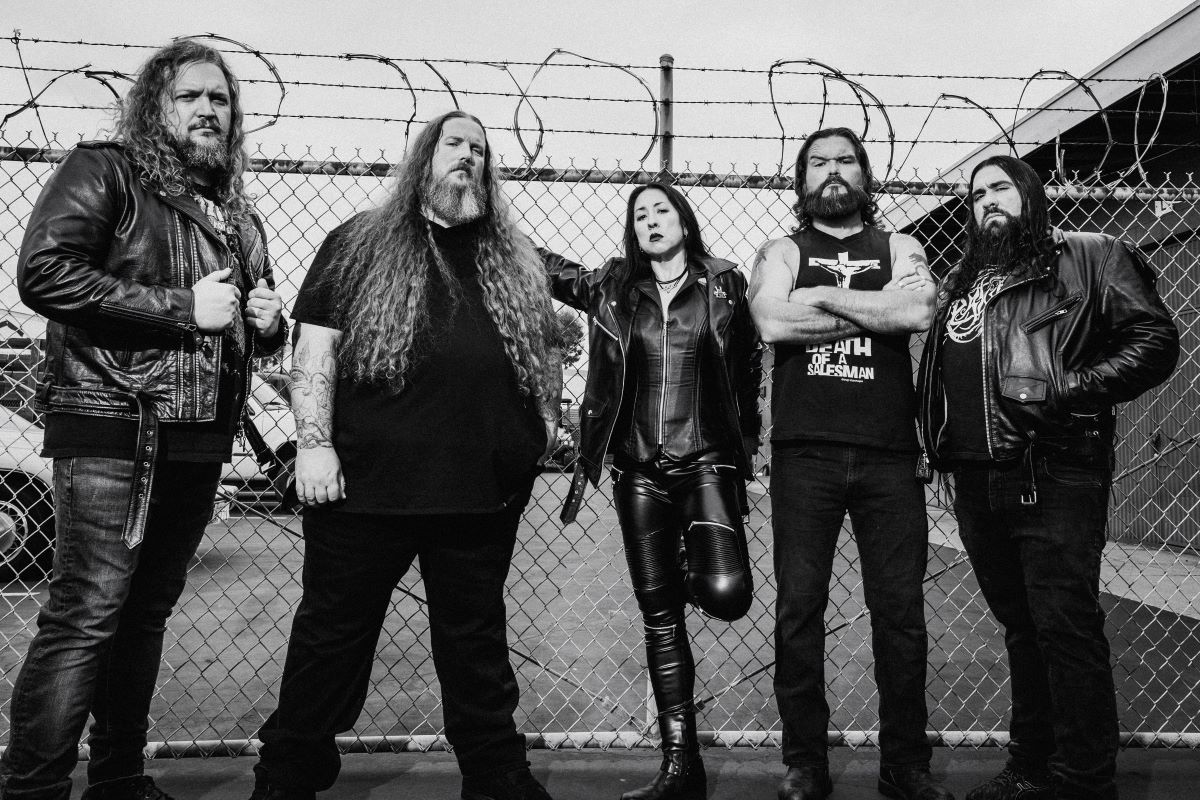
Stygian Crown has carved an interesting niche for themselves, with doom/death overtones adding a particularly crushing character to their epic doom metal sound. The heaviness was dialed up even more for their sophomore album ‘Funeral for a King’. Singer Melissa Pinion and bassist Eric Bryan tell us more about the developments Stygian Crown went through in the four years since their self-titled debut was released.
“Certainly in terms of songwriting quality, all of the ingredients were already there on the first album”, Pinion says. “It was just a matter of adjusting things a little bit. One thing that I’m really proud of about this album is that the songs are a lot more concise, which was something that a lot of critics mentioned about the first album: that the songs tended to be on the long side. We made things a lot more concise, and I think we benefited from that.
The song ‘Flametongue’ is eight minutes long, and we got dinged a lot in the press about that song being too long. At the same time, a lot of them said that it’s their favorite song on the record. So you get this mixed messaging sometimes, and it’s kind of hard to navigate. But we still took it seriously, because I had moments where I went: well, maybe this could have been cut or maybe this could have been a bit shorter. So we were really mindful of that when we were going into this second record.”
“You know, that’s actually my favorite song from the first record”, Bryan smiles. “And I understand the criticisms, in playing and learning the song, but when you go through it, you learn the song, and it all makes sense to me. The structure makes sense; the way it takes time to build. One of those things where it is a useful critique, but I also wouldn’t change the song for anything.”
Doom Metal in a Different Way
“This band has one of the more unique writing processes I have ever been a part of”, Bryan says. “For some of it, Nelson (Tomas Miranda, guitarist) will do the classic demoing process, but then others… When Mel is writing, because a lot of writing is going to Mel first, it’s written on keyboards, and then we have to translate it.
There is one song on this record in particular, ‘Where the Candle Always Burns’, where Mel had written the basic structure of the song on keyboard, and then passed it on to me. It was actually really fun to go through the process of interpreting it, and deciding: how can I make that sound into a doom metal riff? I’ve never done that before, but it was pretty cool.
Some of that leads to unique results. Mel can speak more on this than me, but ‘Blood Red Eyes’ was basically a process where it was written on the keyboard, and then we couldn’t really find a way to keep the power of it while translating it into doom metal, so it became an entirely different sound. It really sticks out on the record through that process.”
“That idea came from Rhett (A. Davis, drummer) too, not from me”, Pinion emphasizes. “I fully intended the song to be fully electric, a true doom song. And then Rhett calls me up and says: hey, why don’t you do it this way? Completely stripped down: piano, violin, vocals, choirs… I thought that was a pretty wild idea. It gave us an opportunity to view the doom genre in a different way. I think it turned out pretty cool.”
Pure Emotional Translation
“It has been widely referred to that we took a long time to record this second album”, Pinion says. “But that gave us the time to really think things through. If we had an idea that wasn’t so awesome, we had the chance to kind of weed it out and approach it in a different way, or move on to something else. So what you’re hearing is the best of the best. At least we think so, haha!”
“Speaking to that: an entire run of the album was done where I play fingerstyle bass”, Bryan adds. “It came through okay, but it had a little too many of those Steve Harris clicks on it, where you’re hitting the pick-up. So when we were listening to it, we thought it sounded okay, but why go with ‘okay’ if you can go with your best? So we went through, and I played the entire thing over with a pick. And it really locked in more with that sound, I think. That was more what we were looking for.
The recording process was unique in a lot of ways, because we have the wizardry of Andy (Hicks) and Nelson on guitars. Nelson in particular meticulously designed the tones for this album. So there’s a lot of time and energy put into that process. And then as far as where the music actually came from… With other records that I’ve done in this time period with other bands, I think there was an overall increase in aggression and in darkness.
It was a hard time. I mean, it still is a hard time, let’s not be foolish, but that period especially: if you’re a guitar player, and you are locked in a room with that instrument, you’re going to get a really unique result out of that, I think. Because you have nothing but pure emotional translation for, what? A year straight? It’s probably going to yield some pretty dark results if you’re talking about heavy metal.”
A Clean Slate
“Lyrically, ‘Funeral for a King’ is kind of a continuation of the first album, where it revolves about ancient mythology and history a lot”, Pinion explains. “The good thing about the pandemic is that it gave us a lot of time to sit back and kind of consider things in different ways. So I did a lot of reading. That’s where a lot of these ideas came about. Particularly ‘Bushido’, about the World War II holdouts in the Philippine jungle. ‘Blood Red Eyes’ came from a Mexican myth. Although it was a dark time, it gave us a lot of time to focus on things and get some really good ideas.
We were messing around with some weird stuff during the pandemic as well. At one point, we had the idea to turn (Bolt Thrower’s) ‘The IVth Crusade’ into a song with clean vocals and put it out there during a live performance. We never ended up doing that, but it would have been really fun.”
An interesting idea, given the strong doom/death leanings in the riff work contrasting with Pinion’s clean alto. “To be honest, my knowledge of death metal is very, very limited”, she admits. “So I’m kind of coming into this with a clean slate. When I’m writing lyrics and vocal melodies, I don’t really think about wanting to make them sound like a particular artist. Sure, I’m always thinking about our heroes in the back of my mind. You know: Solitude Aeturnus and Candlemass, and there’s always Black Sabbath. But first and foremost, I’m always just writing what makes sense for the song.
There’s some genres that would be really hard to write vocal melodies to. Prog is one of them. I don’t know how people do that. But with doom metal, you have a lot of room atop some crazy riffs and stuff like that. It’s been really rewarding being in this band.”
Vital Part of Songwriting
When talking about the songwriting, Bryan is generally quick to point out that Pinion and Miranda are the ones with the initial ideas. “Nelson is a machine that takes in Dr. Pepper and puts out riffs”, he summarizes. “So we are very fortunate. He’ll just be going through warm-up, and I’m like: well, that’s three songs he just came up with really fast. It’s amazing!”
“I feel that the way a lot of the songs get started is either with Nelson or me”, Pinion nods. “Although when I joined this band, a lot of the songs were already done, so I don’t always know who is involved with the architecture of those songs. But since then, it’s pretty much been Nelson and I. But I also want to mention that Rhett is very instrumental in terms of song structure. He has this kind of sixth sense about where a song should go or when things should be cut. So he is a very vital part of the songwriting process. Every single member of this band is.”
“It all feels very community-driven”, Bryan continues. “The writer will have the idea and the riffs, and potentially the structure. Then he goes into the jam room and there is never a sense of: you didn’t write that, so you can’t have any ideas. It’s all about what’s best for the song. And that’s what we’re all coming there to talk about.
So coming into it as the newest guy – even as a session guy for a little while – I was just learning the songs and getting comfortable with them. But as we were going through them more and more, ideas started to come together: you trim this, add that, and you get to a final place where you’re ready to abandon the song and say it’s ready for the world.”
Up and Running
Stygian Crown has actually been around for longer than both Pinion and Bryan have been part of the band. “My understanding is that the concept and the idea of the band was Rhett’s, somewhere around 2015”, says Pinion. “In the years that followed, they started recruiting players and writing a demo. When the demo was done, that’s when the idea of bringing me in came.
Then, after the first release, a couple of months went by, and our original bass player Jason (Thomas) had some family obligations and decided to step down. That’s when we decided to bring Eric in. He is a longtime friend of all the members of the band, so it was a natural fit. And he’s been a great addition ever since.”
“This is the most fun I’ve ever had in a band”, Bryan smiles. “In 2020, just prior to covid, there was a gig in Chicago that Stygian was booked before, and Jason was having issues with his family, so I got the call to come in and do it. Then covid happened, and there was no need to go on anything. But then a few years go by, things got a little bit better, and I got their call again, and we’ve been up and running ever since. I’ve been having a blast.”
More Listening Time
During current live performances, Stygian Crown is essentially promoting two albums. “The thing that people don’t realize is that a lot of bands who put out releases in 2020 kind of got screwed”, Pinion states. “Because we didn’t get the chance to promote it right away, since nothing was going on. There were no shows, there were no festivals, there was nothing. We could only promote it online. So right now is the chance to finally show the fans: hey, this was our first record, you were there for it, when we were all locked down, here’s your chance to finally see it live.
We’ve been playing shows in both Europe and North America. This last year has been really busy for us. We played Up the Hammers in Athens, we played Hell’s Heroes over in Texas, the year before we did quite a few interesting shows as well. But I think our favorite experiences have all been overseas.”
“Yeah, I mean: I live here, my stuff’s here, but there’s just no comparison”, Bryan adds. “Or, I shouldn’t say that there’s no comparison, but thus far, the experiences overseas have just been so much more spectacular. The crowds have been more locked in. They come to the show… I don’t know, with a little more listening time under their belts, maybe?
That being said, Hell’s Heroes is one of my favorite shows I have ever played in twenty years of playing shows. Crazy. It was so good! Well-run, they treated us great, the fans sounded great: couldn’t have asked for more. So it depends what you put into it.”
“When we played in Athens, our record had only been out for three weeks”, Pinion continues. “And then we got there, and they were singing the guitar riff melodies note-for-note. I actually stopped for a second there, because I couldn’t believe it. I’m pretty sure my bandmates felt the same way. Afterwards, I talked to a guy and asked: how the hell did you guys do that? And they’re like: we study! Haha!”
Engagement and Excitement
The band’s home turf in California is not exactly the doom metal hotspot of the world. “But you know, when we were in Würzburg in Germany, we met (Saint Vitus singer) Scott Reagers”, Pinion corrects. “And I actually found out he was sleeping on the bus on our way from the airport. Turns out he lives in a town about 45 minutes from were I live. So there’s doom metal here, you just have to look for it, haha!”
“Especially for more traditional styles of metal, there’s still more going for it in Europe”, Bryan puts it into perspective. “We’ve had a wave of that here in the US, but the bands aren’t reaching the same heights here that they are there. So there’s just more engagement and more excitement. So naturally, I think the fans are more into it, more present, and more studied.”
So what’s next for Stygian Crown? “Right now, we’re basically just taking a little bit of a breather, because we just came back from our first tour”, Pinion says. “But I think we’re eventually going to start talking about some writing sessions, and starting on either an EP, a split, or a full-length. I’m not really sure. All of those things have been discussed.
Writing is definitely central to our future plans. And then also some more tours in the US, and we have also expressed our interest in multiple overseas festivals. Hopefully we will have some interesting things to do in 2025.”

 Kevy Metal
Leave a reply to Best of 2024: The Albums – Kevy Metal Cancel reply