
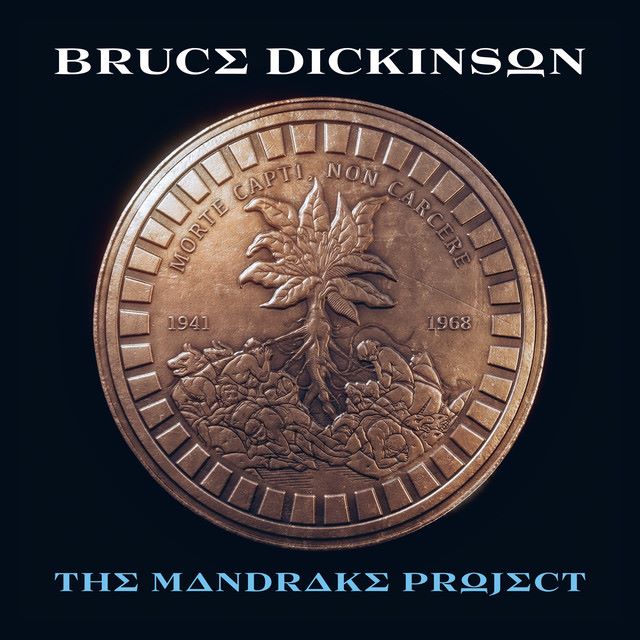
It has gotten to the point where I am looking forward to a Bruce Dickinson solo album more than a new Iron Maiden album. ‘The Mandrake Project’ is his first in nearly twenty years, although he reportedly started working on it fourteen years ago. While Dickinson probably never will be able to top his 1998 masterpiece ‘The Chemical Wedding’, ‘The Mandrake Project’ is the sound of him playing things notably less safe than on its predecessor ‘Tyranny of Souls’, and it certainly manages to avoid the formulaic pitfalls of latter-day Maiden stuff, or at least the songs that Steve Harris contributes to.
Where Dickinson’s last three solo albums felt like an open letter to anyone who thought he had said farewell to heavy metal, ‘The Mandrake Project’ shows the singer broadening his scope a little more. Hard rock and heavy metal still make up the bulk of the album, but the song material simply covers more ground. Nowhere is that more obvious than on ‘Resurrection Men’, which feels like film noir soundtrack rock with a stoner rock middle section, but the album also ends surprisingly low-key with three semi-ballads; one dull and two excellent. There is plenty of seventies-inspired hard rock on here as well.
Yes, ‘Eternity Has Failed’ is the exact same song as Maiden’s ‘If Eternity Should Fail’. And while I prefer Maiden’s version on account of the guitar leads being better, it is still an excellent song. Those who prefer to hear Dickinson as metallic as possible are probably pleased by the powerful opening track ‘Afterglow of Ragnarok’, which highlights the strengths of Dickinson’s lower-ranged vocal theatrics. The same can be said for ‘Fingers in the Wounds’, which starts out sounding like a power ballad, but quickly turns into a theatrical rocker with a middle section that has clear Middle-Eastern inspirations.
But what makes ‘The Mandrake Project’ better than most of Dickinson’s solo efforts are the less metallic moments. The aformentioned ‘Resurrection Men’ is hands down my favorite song here, but the two calmer tracks that close out the album are successful experiments as well. ‘Shadow of the Gods’ is probably the least experimental, as it features a surprisingly heavy Roy Z riff in the middle of the song. The borderline psychedelic closing track ‘Sonata (Immortal Beloved)’ is a different affair altogether. It’s almost ten minutes long, but Dickinson largely resists the temptation to go for bombast or his highest registers. Roy Z’s bluesy leads near the end are incredible as well.
Flaws exist on ‘The Mandrake Project’ – ‘Face in the Mirror’ is possibly the most boring ballad Dickinson ever recorded and ‘Mistress of Mercy’ is kind of a one-dimensional rocker – but by its very nature, those are bound to be there. The simple fact that Dickinson and Roy Z take so many more risks here than on ‘Tyranny of Souls’ is exactly what makes ‘The Mandrake Project’ the far more satisfying listen. It also plays to Dickinson’s vocal strengths far more than Maiden’s “can you go one higher, Bruce” approach. Definitely worth the wait and highly recommended to fans of adventurous, yet accessible hard rock.
Recommended tracks: ‘Resurrection Men’, ‘Afterglow of Ragnarok’, ‘Fingers in the Wounds’


 Kevy Metal
Leave a reply to Kevin Cancel reply