
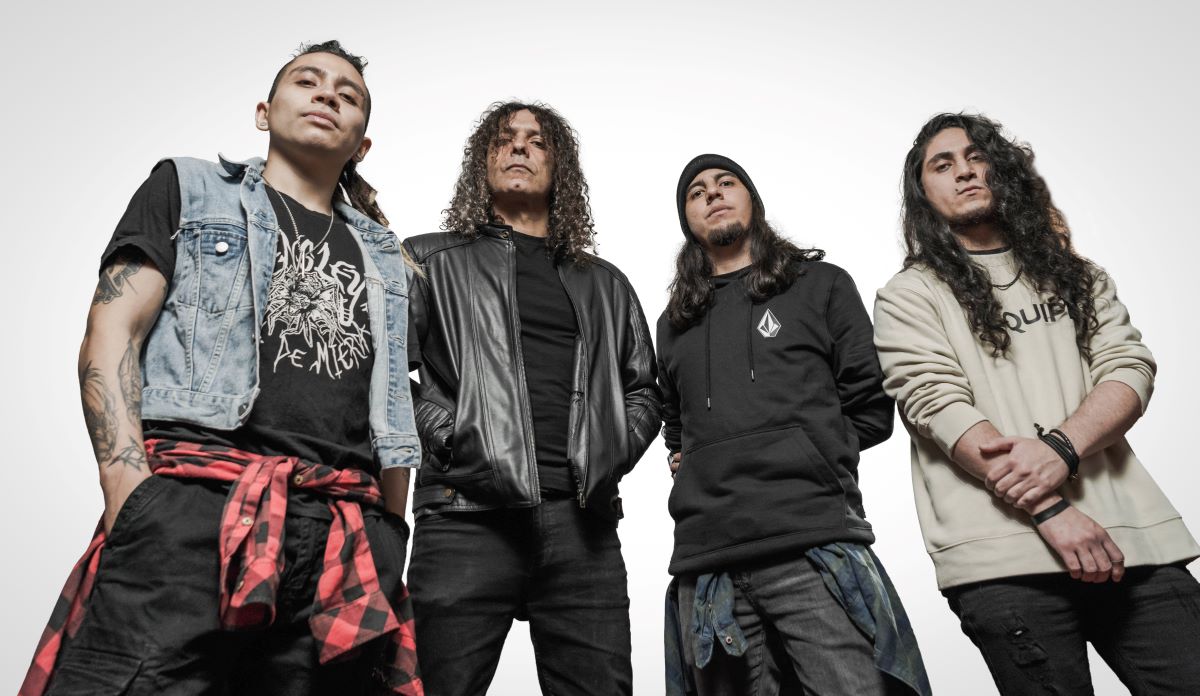
With three albums under their belt in just over six years – and a fourth one on the way – thrash metal band Miserable is remarkably prolific by Peruvian standards. When talking to their singer and bassist Adrián Del Aguila, it immediately becomes clear why: he is a man of many ideas, with a clear hunger to turn them into something tangible.
Del Aguila first rose to prominence with one of Peru’s premier heavy metal bands. “I was playing with M.A.S.A.C.R.E, but I had the feeling that I had to do something else”, he explains. “However, I couldn’t find any band members with enough time and a similar taste in music. So before Miserable started, I had actually already been working on it for a long time.
Then came the day when I just said: fuck it, I’m going to do it on my own, and let’s just see what happens. I started working on what would become ‘Gran Náusea’ with Giovanni Lama (co-producer and Epilepsia’s singer/guitarist). At the time, it was only the two of us. We did the pre-production: I went to his studio with all the ideas I had in my head, and we started working on all the riffs.
There was no band at the time. I did the recording of ‘Gran Náusea’. The whole thing except for the drums. There were midi drums just to get a feel for what the parts should be. When the day came to record it properly, the second member joined the band: our drummer Diego Porturas. Giovanni told me to approach him to record the drums. He did it, and when he finished, I asked him if he wanted to be a part of the band. He said yes immediately. That was in 2017, and then there were two of us.”
Generational Gap
Porturas was not the only Miserable member Del Aguila found by chance after temporarily putting his idea of forming a proper band on hold: “Suddenly, I found a guy on the metro: Jonathan Bustinza, one of our guitarists. We started talking, there was some magic, and I asked him: do you want to join the project? He said: yes, let’s do it!
It kind of went the same with our other guitarist at the time, Marcelo Vasquez. We met somewhere and I asked him to join. That’s how the band formed properly. I started alone, by myself, trying to see what was going to happen. I was waiting for a long time to find my bandmates because I was trying to search for people. And only when I stopped searching, I found the right people. I’m a lucky guy: I found a bunch of good fellows and good musicians.
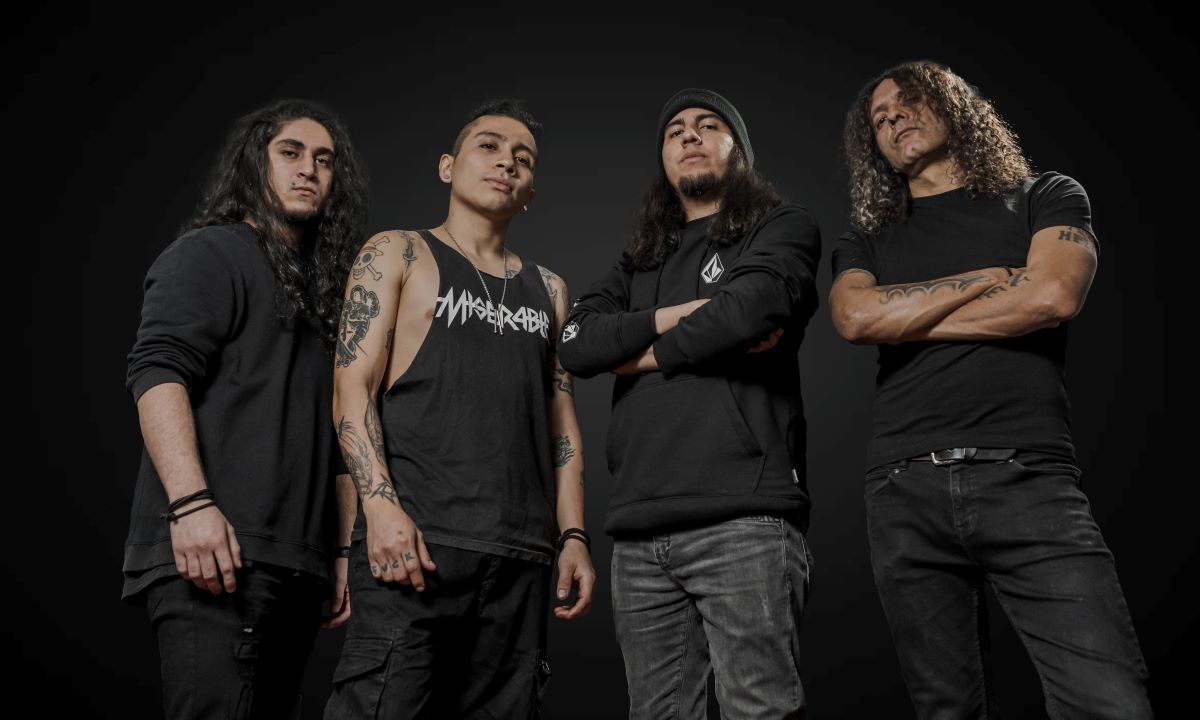
I am 49 years old, and these guys are now 23, 24 years old. So when I found them, they were 18 or 19. There is a huge generational gap, but despite that, we found out that we connected very easily. When we started the rehearsals for ‘Gran Náusea’, the ideas for what would become our second album ‘Esclavo Miserable’ started forming immediately. That was a kind of magic to me. And since we are recording our third album right now, the magic is still there.”
Fight to Be Ourselves
While Miserable essentially started as a solo project for Del Aguila, he greatly values the input his young bandmates have these days. “It starts with a riff from any of us, then we all cook the final dish”, he describes the situation. “We all work on the compositions and the arrangements together. On my laptop, I have plenty of material for further productions. Not completed songs, but ideas, riffs, halves of songs, all waiting to be worked on.
Miserable has a lot of work to do for the next few years. We have to find the time to work on it, because we can’t live from metal. But we like getting together and trying out different sounds. Eighties Metallica and Death’s material from ‘Spiritual Healing’ onward are big influences, but we try to do it our own way. We have different hands, we have different souls. We don’t want to copy anyone. It should start with the influences and then go wherever it has to go.”
The fact that there are no possibilities to make a living wage playing metal in Peru was never a reason for Del Aguila to give up. “On the contrary”, he says “We want to do it despite the problems there are. Life is what it is; it’s passion, and passion never dies. To tell you the truth, we are a fucked-up country with a lot of economic, political and social problems. I grew up listening to the bombs of terrorists throughout the city. I see it as a fight to be ourselves. We do this because there is no other way to live.”
It is a theme that is surely reflected in Del Aguila’s writing, both as a lyricist and as an author, who published the novels ‘Necio’ (2012), ‘Sistema Perfecto’ (2018) and ‘Peste, Odio y Voluntad’ (2021). “Lyrically, the albums deal with a main theme: the submission of people, of their will, of their spirit”, he explains. “Submission either to necessity or duty. Anything that crushes passion must be destroyed. That is my fight. That is my war.
In that sense, the previous albums have more to do with criticism, but our upcoming album touches on the theme of jumping into the abyss of freedom, where freedom is surrendering to your passion, with all its consequences. All this also has to do with the literary works that I have done, which based on telling stories deal with the same topic, but in prose or aphorisms.”
All the Fury
“Since we have Spanish lyrics, I didn’t expect to be heard by people in countries that don’t speak Spanish. I would like it to happen, but I didn’t expect it. Maybe I’m wrong, because music is universal. When we started Miserable, I was absolutely certain that the language was going to be a barrier. But I see now, after having come into contact with people from Europe – Greece, France, the Netherlands – as well as places like Indonesia and Japan in the last few years, that I was wrong, that there isn’t that much of a barrier. People like you can hear us, enjoy it, and we can talk about it.
However, Miserable is never going to sing in English. The lyrics will always be in Spanish. That’s for sure. There is no way I can write in anything other than Spanish. I can speak English, I can sing in English, but my mother tongue makes it possible for me to express myself with all the fury that I need. And it’s just different in a different language. It could be good in English, but it would not express what I would want to express.
The idea was always: let’s do Peru first, and then other countries in South America and Latin America that speak Spanish. And Spain, maybe. But now we are seeing that maybe we can play in other countries. We are going to work on that, starting with the new album. If it is possible, we are going to expand our vision.”
Capturing Rehearsals
At the time of writing, Miserable’s most recent release is 2022’s ‘Náusea Celebre’, which was recorded live at the band’s rehearsal studio. “We work with a guy who organizes events”, Del Aguila explains. “Then the pandemic came around, but he had some budget left. So he asked us: do you have any ideas what we could do with it? We could not play any concerts at all, but there was an opportunity to do something. So we thought it would be interesting to do a live session of nearly all our songs.
We thought: let’s do it organically. Let’s capture the way we sound in rehearsal. Let’s try to demonstrate ourselves, and we can record that sound with no processing at all. Raw. Let’s show the audience how the band really sounds. On our studio albums, we used to do two rhythm guitar tracks per side. On ‘Náusea Celebre’, there is one rhythm guitar on each side. And if there is a solo, you hear just one rhythm guitar. Our plan for the new studio album is also to do it as organically as we can.
I really don’t like the sound of bands that use too much processing. If it’s too clean, I don’t like it at all. You know what I hate the most? When you hear a snare drum that always sounds the same. That’s not natural. I have had a couple of experiences in other musical projects outside of metal with processed or electronic drums, trying to make it an option, but the truth is that it sucks. It doesn’t express anything. The good news is that I’m seeing new bands out there that are trying not to lose themselves to processing too much.
With Miserable, we have found a way to sound as natural as we can. There was some processing on ‘Gran Náusea’, less on ‘Esclavo Miserable’, and now we try to be as natural as possible. In the eighties, it could be rough, or it could be raw, but it moved your heart.”
Hungry Kid
The eighties are not a random mention, as it is the decade Del Aguila started playing music. “Keep in mind: people here mostly like reggaeton and cumbia; tropical music”, he describes the musical climate in Lima. “A little rock and pop maybe, but metal is very underground. When I started playing guitar, I was about eight years old. I started by playing some folk music, which I didn’t like at the time. I like it now, but at that time, I was a very hungry kid who just wanted to play rock ‘n’ roll.
I joined my first band when I was 14 years old, but that was a rock band. I didn’t listen to metal at all until I was 15, I think. I had a friend whose older brother played in Hastur, which nowadays is recognized as the first ever black metal band in Peru. So that friend said: you play guitar, right? Can you play this? And he gave me a TDK cassette – a white cassette, I remember it very well. That cassette had ‘Fight Fire with Fire’, ‘The Trooper’, ‘The Call of Ktulu’ and a recording from Hastur.
At the time, that recording from Hastur – something very satanic – was too much for me. These days I like it a lot, but the first song I heard I listened to was ‘The Call of Ktulu’. And what I liked the most that there were no vocals, but it was still very interesting. That’s how I got started with metal.”
Step By Step
“In terms of audiences, Peru is a very small country. Here in Peru, most metal bands are extreme metal bands. In terms of local concerts in Lima, no more than 300 people generally show up. When there are 500, that would be a resounding success. In other provinces, the audiences are smaller, of course. But professional international mainstream metal bands may draw crowds of 1500 to 2000 people.
When Slayer came here for the first time, there were no more than 3500 of us there. When Iron Maiden came here for the first time – when I had the opportunity to open for them with M.A.S.A.C.R.E – there were 30,000 people, but the second time, there were no more than 10,000 people. So there were a lot of tourists the first time around. And Maiden is the most mainstream metal band that I know!
That’s the reality. We all know that. That’s why we try first of all to play in all the cities in Peru we can play. Lima is the biggest place in terms of bands and population, of course, but a lot has been happening outside of Lima. There is a number of concerts in the south, north and east. Add to that the wonder of playing in different geographies, sometimes in front of the sea, sometimes at 4000 meters above sea level. After that, we can move to foreign places. Step by step, and it takes a lot of time, but that’s the idea.”
Creating Opportunities
“Many musicians in Peru have home studios where we can work on our own music. It’s cheaper, it’s possible, and the sound is good. There are no major labels here. They have gone a long time ago. So there are no opportunities here; we have to create our own opportunities. But in terms of the work being done, there are a lot of recording bands here. We do not stop, because we can do it. Despite the problems going on here, we still do a lot of work. There is a legacy for the future.
In terms of the infrastructure to play, we have grown up too. For example: nowadays, we’re using amplifier modeling for playing gigs. We don’t have to worry anymore about what equipment they will put in the venues for us to play. The backline is not an issue anymore. For me, that’s such an improvement, especially outside Lima.
I was one of the guys who said: no way, I don’t want that crap. But in 2022, we started to play in a lot of places outside of Lima again, for the first time since the pandemic: Ayacucho, Arequipa, Juliaca… There was no other way to do it if I want to keep my peace of mind. So I am a convert. All we need is a mixing console and drums, of course. If the sound engineer does his job, we can sound great everywhere.
However, there are not a lot of venues to play. That’s a problem. We have not evolved anything on that front, not a step. We still play in discotheques, with mirror balls hanging from the ceiling. There are no appropriate venues for playing rock and metal concerts. There are one or two, nothing more. We have a serious lack of that.”
Growing
The release of Miserable’s third studio album is on the horizon. “We have done the recording process at Giovanni Lama’s studio, the same studio as the previous albums”, Del Aguila explains. “This time, for a series of reasons, it has taken us a little longer than we had planned, but we are already finishing the final mix and hope to have the album released by March.
We are happy with the sound, because we are achieving what we want, which is to sound as natural as possible, avoiding that modern sound that sounds like super-processed plastic, especially when it comes to the drums. It’s not that it was like that on previous albums, but we are definitely getting closer to what Miserable sounds like in our heads.”
The album will be the recording debut with the band for guitarist Luis Sáenz, who replaced Marcelo Vasquez about two years prior. “Luis’ entry into the band has been important”, Del Aguila emphasizes. “And of course, like any family, a change of members influences what is done. Luis has contributed his vibe, his ideas and arrangements for the new material, and most importantly, his way of playing. We have really gotten better since he joined us, and everything has been growing more and more with him in the band.”

 Kevy Metal
Leave a reply to Coqui Tramontana (M.A.S.A.C.R.E): Great Expectations – Kevy Metal Cancel reply