
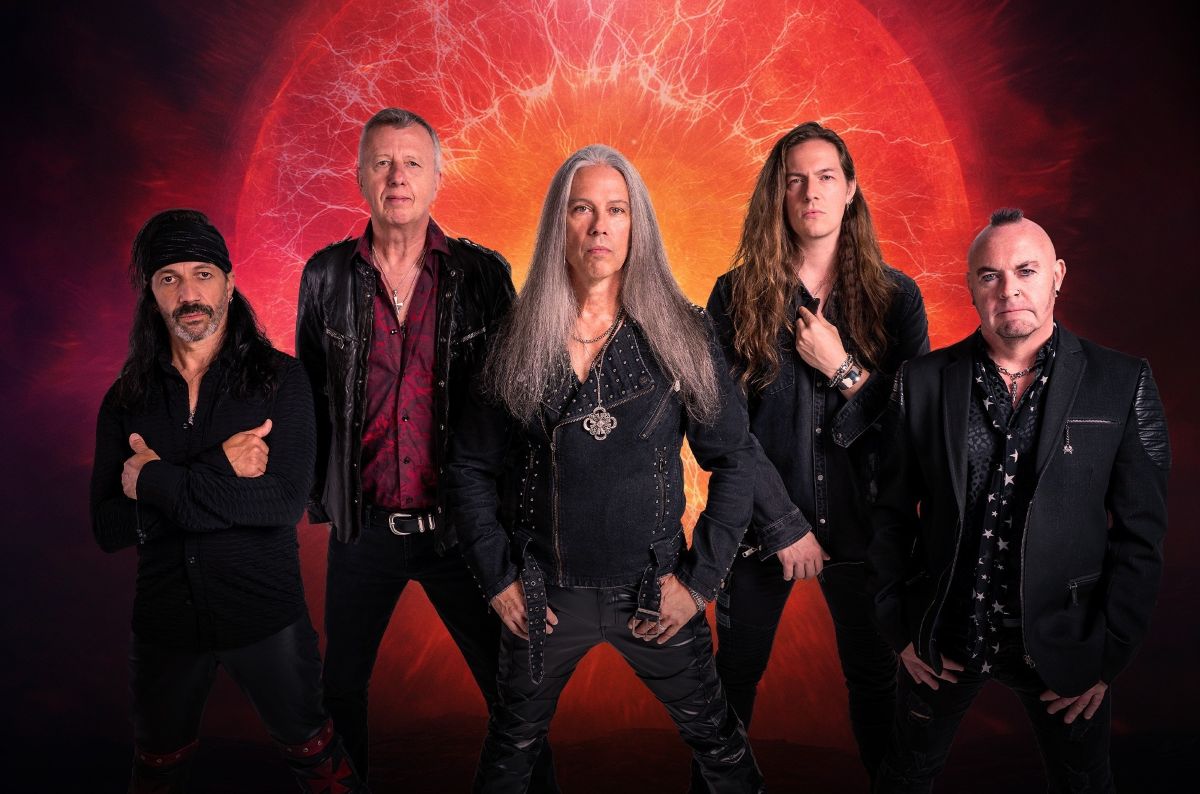
‘Closer to the Sun’ is the first new studio album in a decade from American – or technically British-American at this point – melodic hard rockers Tyketto. It’s also their first album with singer Danny Vaughn as the sole remaining original band member. Vaughn shares his experiences getting the current line-up together, keeping his voice in shape, and playing cheap twelve-string guitars.
“It was not difficult at all to work on the album with this line-up”, Vaughn says. “Because the line-up that’s on the album started two years ago. When we came out of covid, I was kind of surprised by the fact that two key members wanted to retire. Michael Arbeeny (original drummer) and Chris Green (former guitarist) spent the last two years at home, and they said they kind of liked it there, haha!
There was no drama, nothing like that, it just took me a while to decide whether or not Tyketto should go on. Some people have something to say about one original member and all that sort of thing, but I thought we would try it and see how the audience would respond. So we got Johnny Dee (drummer) and Harry Scott Elliott (guitarist) in, and we had two years of touring around before it was time to make a record.
If you have the chance to do that, it’s the best way. Because everybody got to know each other quite well, and how to work together, how to play together, and all that. And I think that contributed to the sound of the record.”
Approaching Music from a Slightly Different Angle
“There were more different collaborations this time around. On previous albums, it was always collaborations between band members. But for instance, we have a song called ‘Starts with a Feeling’, and that was co-written by Jim Peterik of Survivor. You know, that’s a nice guy to have write a song with you if you can get him.
There are a couple of other songs that were co-written with my friend Ruben DeMello from Boston, who has co-written two other songs I have put out in the past. One was on Tyketto’s ‘Dig In Deep’ album (2012), which is called ‘Monday’, and then the second was on my ‘Myths, Legends & Lies’ solo album (2019), which is called ‘Time Out of Mind’. The demos were just sitting there, and I went through the files when I was looking to write new songs, and these things just jumped out to me. Then all of a sudden, I had two more songs for this record.
Both Chris (Childs, bassist) and Harry have contributed ‘Bad for Good’ and ‘Higher than High’. It’s a really nice kind of mix. And I prefer collaborating. I have never been someone to say: look, I’m running this, I’m doing all of it. Even for my solo records: I write 99 percent of it, but sometimes, you just get into a good thing with somebody, and it will always make it better, in my opinion, because each of us approach music from a slightly different angle.
It’s one of the things that I think made the original Tyketto so interesting. Because Michael Arbeeny was all about Led Zeppelin. I was into blues rock, whether it was Bad Company, the Rolling Stones, Aerosmith… And Brooke (St. James, guitarist) was into things like Dokken and Eddie Van Halen. And somehow, you smush all of that together, and you get ‘Don’t Come Eeasy’ (1991), haha!”
The Courtesy of a Call
Back in the mid-eighties, Vaughn was a member of Waysted along with new Tyketto drummer Johnny Dee, so it stands to reason that Dee was the first drummer Vaughn thought of after Arbeeny’s departure. “He wasn’t”, Vaughn says. “And only because I just thought he was too busy. He has been playing with Doro for thirty years, and she’s always on tour. I actually started putting a list together, and there was a voice in my head that said: if I don’t at least give Johnny the courtesy of a call, I’m going to get a call from him going: yo, dude, you’re auditioning drummers and you don’t call me?
So I thought: alright, let’s get that over with. I’ll call Johnny, he’ll say no, and I’ll move on. But he said yes immediately. Oh, okay, I guess I won’t have to make these calls then, haha! That was just a wonderful surprise. Johnny is one of my favorite human beings on the planet. We supported each other all through Waysted, which had its highs and lows, but we were the new kids, we were the Americans, we were the outsiders, so we hung together and kept each other sane.
We just always stayed friends ever since. You don’t see each other that often – more than anything, we would run into each other on the Monsters of Rock Cruise, and it would always be such a big, warm thing for us. Also, our families would meet and all that. So now, I have him as my traveling companion, and he is a human jukebox. You can hum any line from a song, and he’ll tell you who wrote it, who performed it, what year it came out, haha! A never-ending source of information.
He can also learn a set quickly. There’s a short list of players both renowned and not so well-known, and that’s what they’re good at. Greg Smith on bass is one of those guys as well. If you hand him twelve songs for your set, and he’s getting on the plane for the first gig, he will know them better than you by the time he gets there. It’s a skill. It really is.”
A Kind and Generous Energy
The search for a new guitarist resulted in an equally limited number of phone calls. “I had three guitarists in mind”, Vaughn says. “And I wasn’t sure if any were going to fit. It would have to be quite a conversation. Harry had come into our spectrum because he was playing guitar for Kane’d, which had Chez Kane and her sisters fronting that. We liked that band, and Kane’d ended up opening for Tyketto on a tour, and on several other shows.
Then Tyketto did this very odd thing. It’s a DVD called ‘We’ve Got Tomorrow, We’ve Got Tonight’, where we took our songs and stripped them down and re-thought them. There are string sections, horn sections, and the Kane sisters were our backing vocalists. Also, they opened up for us, so Harry was there, and Harry and Chris Green really got on, immediately. That’s when I learned that Harry was a big fan of Tyketto as well, and there’s just such a kind and generous energy about him.
So when I had that conversation with Chris, where he said: I don’t want to travel anymore, I want to stay home… Chris, to me, is the best of every guitar player I have ever seen. Just a remarkable guitar player. I thought: how am I going to replace this guy? Then he and I talked about it, and it just popped into my head. I said: you get on with him really well, what do you think of Harry Scott Elliott? And he went: that’s the guy! So that was one phone call again, haha!
It’s amazing to me that when I meet people, they will say: I’ve been listening to Brooke St. James since ‘Don ‘t Come Easy’ came out, and he’s one of my most influential guitar players. I don’t think Brooke has any idea, haha! And that includes Harry Scott Elliott. He was in the band for about six months before he admitted to me that his parents gave him ‘Don’t Come Easy’ when he was 6 years old.
Harry plays Caparison Guitars. He’s a big Engl amp guy. And I kind of worried about that when he joined the band, because Engl is known as much more of a hardcore shredder sound. But he managed to really warm it up, and make it work with our band as well. They sound great. I love them.”
One Minute of Electric Guitar
Additionally, Vaughn plays more guitar on Tyketto albums than people might realize. “I tend to do most of the acoustic work”, he nods. “That’s where I’m the strongest. You wouldn’t want me in your band as an electric guitar player. I’m not good enough. But I will occasionally throw in a bit or thing here or there. On some of my solo albums, I’ll venture out, because they’re not quite as guitar-centered. My solo stuff isn’t big riff stuff. I might play a little slide guitar and this or that.
But overall, I tend to leave the lead guitar playing to the professionals. That little credit of me on electric guitar, that’s pretty much pure ego. I think I might have played about one minute of electric guitar on the record, haha! Ged (Rylands, keyboard player) plays loads of guitar live as well. He’s the Paul Raymond of the band.
If I have access to the acoustic guitars I have at home, I’ve got easily a good half-dozen to choose from, as far as what sound really works. But to be honest with you: it’s 90 percent my Taylor at this point. Once I got the Taylor… It seems to have the best of all worlds, sound-wise. Both the brightness and the wood quality.”
A Sound Like No Other Twelve-String
“Playing live, I have these two Gibson Chet Atkins SST twelve-string solidbodies, for thirty-something years. They’re on the record as well. On the record, twelve-strings quite often are these electric twelve-strings. And they are just remarkable instruments, still. They stopped making the Chet Atkins SST twelve-strings years ago. They still make SST’s, but I don’t think they do the twelve-strings anymore.
And I got both of them at a time when Chet Atkins himself was overseeing. He would go down to the factory in Nashville every week and oversee the construction. How in the world I got two from Gibson, I’ll never know. They’re not renowned for giving guitars to guitar-playing singers. And they have been through it; they have been broken, battered, I’ve had one neck snapped… But the pickup they designed for those things at the time, a single brass pickup, is just gorgeous.
Every time I plug it in, the signal is incredibly hot. But also, the sound is just gorgeous on them. It’s brass at the bridge. I might have had to repair it once, but I’ve never had to replace it. And they produce a sound like no other twelve-string that I’ve heard that’s electrified. The other thing about it is that because they’re solidbodies, you have no regeneration or no feedback.”
Never Needed an Adjustment
“I developed an obsession for twelve-string guitars a long time ago. I have five of them at the moment, and that’s because I had to sell a couple in my life, haha! I have these enormous Guilds, the jumbo-body Guild twelve-strings, and that’s a whole other sound. But then I’ve also got the guitar that I recorded most of ‘Don’t Come Easy’ with, that I still have, and I still use, but it doesn’t leave the house anymore.
That was a very inexpensive twelve-string I bought while tripping my brains out on LSD-25 when I was 16 years old, haha! I wrote most of ‘Don’t Come Easy’ on it, recorded all of the acoustics for ‘Don’t Come Easy’ with it, and then I brought it in when we did ‘Strength in Numbers’ (1994). Kevin Elson, the producer, had tons of great, very expensive instruments, and he brought his in, and we tried all of them out.
He just sat in the control room while I played two or three different twelve-strings, and he went: what’s that one? I said: that’s mine, that’s my 150-dollar Madeira. He said: that’s the one! It just had an unbelievably gorgeous sound. I bought it when I was 16, so… Oh boy, going on forty years. Longer than that. Never needed a neck adjustment. It’s the perfect instrument.
If I have my sights set on another one, it will be a Taylor. I’ve played some of the Taylor twelve-strings, and they’re gorgeous, but it’s a heavy price, haha!”
The Big Payoff Chorus
Vaughn’s voice is still in great shape. “The same way a footballer treats his knees is how I think of my voice”, he explains. “It’s not like I have another career to fall back on. So, you know, if that goes, I’m done. I’m pretty tough on myself about how to take care of it. There’s a lot of don‘t do this, don’t do that. On paper, I come across as pretty boring. But as long as I can deliver live, I don’t think anybody minds.
Sometimes you get offers you get offers you can’t help but do, but I try not to do more than four shows in a row, without a rest. If that goes on for three or four weeks, it starts to take its toll. My technique as far as going into the studio is: don’t think about having to do a song live later, because you’ll hold back.
I think it was Don Henley, who said that when he writes a song, he pitches it in a key that if he gets to the big payoff chorus, his voice is just pushing. Now, the problem with that is, you age, and that gets much harder to do, and then you’ve got an hour and a half, two hours of music more to do. So it may well be with some of the songs from the new album that I might have to drop one or two a key, just to make it so that I can do it night after night.
There are certain songs that I see in the set and go: okay, deep breath. One of the things where you have to bow your head to your age is: okay, maybe don’t run so much for a little bit here, just stand center and do your thing so that your singing is still strong.
The hard part about ‘Forever Young’ is that big last note. That was kind of my specialty: my breath control, that I can hold notes for quite a long time. So I made a rod for my own back there, where I have to do that all the time now, and of course I have to do it last, haha! It has to be the last song, so I have to figure out how to get my breath back at that point to hold it.“
Not Just Calisthenics
“There’s also the side of the argument to where people, I think, can be a bit rough on singers who may not have the strength they once had or the range they once had. I’ll get somebody saying: how come you can still sing, and Jon Bon Jovi can’t? Well, he can, but Jon Bon Jovi also did two to three hundred shows a year for decades. Hard shows. And hard travel. The human voice isn’t made to sustain that. Give him a break!
I listen to that Waysted album that I did (‘Save Your Prayers’, 1986), and I think: it was all balls, no brains. Because in the eighties, guys like Steve Perry, Geoff Tate, Miljenko Matijevic and Tony Harnell came along, and we thought: we’ve got to keep up with that? These guys had ridiculous vocal ranges, and you can feel unconfident around them. And it takes years before you mature into that.
Singing isn’t just that. It isn’t just calisthenics. The same way that guitar playing isn’t just thirty-second-note arpeggios. We had Bad Company on the other day, just listening to Mick Ralphs playing the simplest shit and thinking: how great is that? It’s in the fingers! That’s the thing that’s beautiful about guitar playing: you can learn everybody’s thing and study and study and study, but in the end, particularly your vibrato is in your fingers.
I’ve heard that a guitar player’s vibrato is the same as a singer’s vibrato, whether they realize it or not. I didn’t know that. But I can never not recognize Robin Trower. He’s got a fantastic slow wobble on his. Stevie Ray Vaughan had his. It’s in the fingers for sure.”
Only a Two-Year Stint
“If you’re in front of a wall of guitars, you’re going to have to project loudly. I remember with Waysted, Paul Chapman (guitarist) had at least two Marshall stacks, sometimes three, depending on the tour, and this is how he would set his amp: he would plug in, and he would turn everything all the way up with his flat hand. Everything! It would actually blow my hair forward into my face. So I couldn’t go on that side of the stage.
But the problem was: he did it, so Pete (Way, bassist) did it. Pete had Marshall Stacks for bass. Ugh… And these were pre-in-ears days, which is why I have tinnitus now. I’m probably lucky it was only a two-year stint, because I don’t know how much longer my ear drums could have taken it, haha!
That said, the most dangerous thing you can do to your voice is all the talking to fans before and after the gig. You have to pitch it way out there in order to be heard, and you don’t realize the damage that you’re doing. I cut back a lot on doing meet and greets and things. It’s not that I don’t enjoy doing them, or that I don’t want to meet people, but again, I have to bow to my years and think: I really have to be good on stage every night, so nobody walks away disappointed.”
 Kevy Metal
Leave a comment