
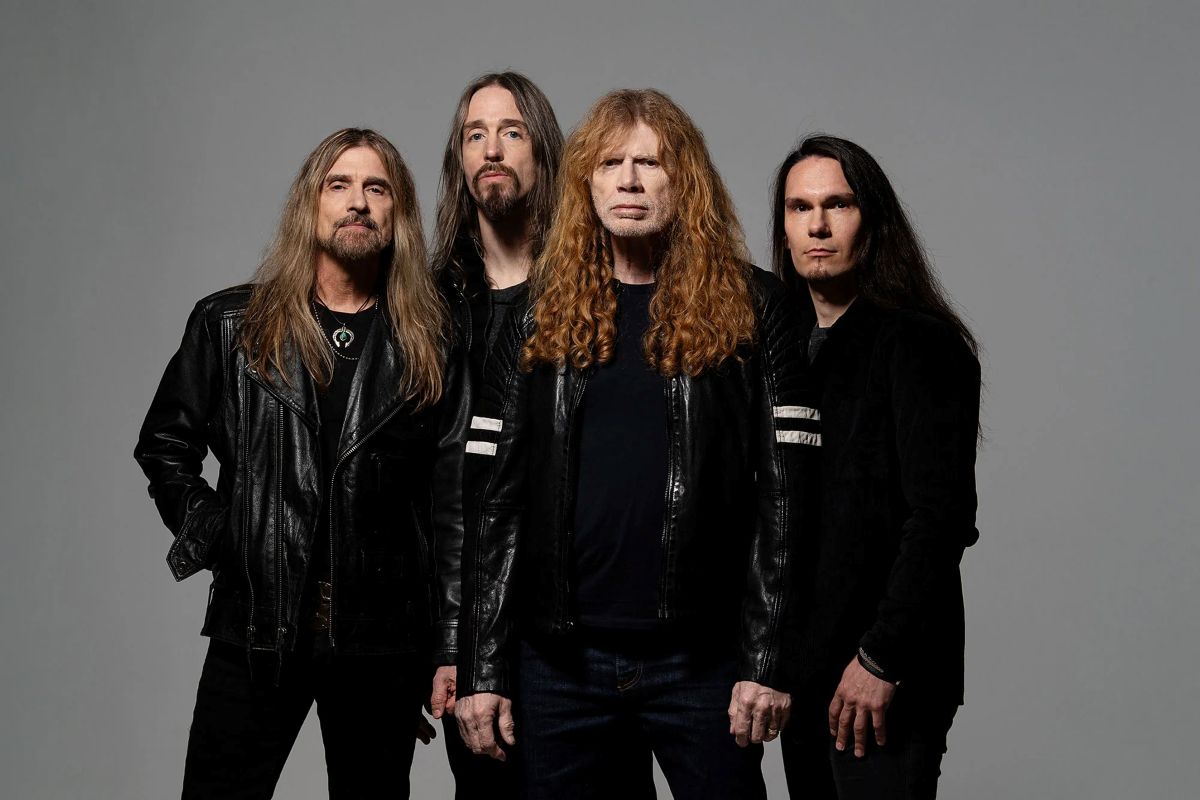
With their self-titled seventeenth album, the album recording days of American thrash metal titans Megadeth have come to an end. Singer, guitarist and band leader Dave Mustaine sheds his light on the circumstances surrounding their farewell album and what we can still expect from Megadeth in the next few years.
“We were already writing the record before we made the decision that it would be our last one”, Mustaine clarifies. “We didn’t go into the record thinking this was going to be our last record. We were at the halfway point of the record when I started talking to management that it felt like I was feeling kind of run-down, a little tired. We were thinking of how great the record was turning out, and I have always said that I want to go out on top. I don’t want to be playing if I can’t play anymore.
We knew we had a great fucking album, it’s just… Partway through the recordings, I was talking to my management, and I just said: I don’t know how much longer I can do this. Because we were doing really long days. And that was it! It’s kind of hard to put into words, because I don’t really know. I don’t really have an explanation that’s going to make sense to anybody. I just kind of felt like it was time, you know?
However, we’ve got a lot of dates wat we’ve got scheduled, and the last tour we just did, we were playing our asses off, so I don’t think that anybody needs to worry about us not being able to play a hundred percent. Because that’s one thing I know for a fact: when we play live, we are like caged animals that get released before we go on stage.”
Two Guitar Players Playing Off of Each Other
Fellow guitarist Teemy Mäntysaari, who only joined the band in 2023, contributed significantly to the songwriting on ‘Megadeth’. “Working with Teemu was really fun”, Mustaine says. “It was kind of like back in the day with Marty (Friedman, Megadeth’s guitarist from 1990 to 2000), when we could play off each other. We would have a song, and one of us would play a solo in the beginning, and then we would get to what the official solo section of the song is. And then when the time came to finish the song, we would go back and forth a little bit.
That was something that was really fun to be able to do, because a lot of records that we have done in the past were great records, but the dynamic of two guitar players playing off of each other to the degree that we did on this record, we haven’t done that for a really long time. And I know that the fans are going to be fucking thrilled when they see that, because the structures of the songs are a lot like our old school stuff, and the sound and the technique is very much kerned with all of the wonderful technology that’s out there.
When we had a lot of parts in the songs, Teemu and I would talk about the development and the structure, and I would kind of listen to what my heart was telling me about the song, then I would decide: is this a song where it would be better for Teemu to take some of the solos in some of the areas, or would it be better for me? That’s kind of how we go through the division of the work.”
Not Regretting a Single Guitar Player
“Sometimes we’ll take a guitar part and we’ll both play it together, do a harmony part, or we’ll have a section that we’ll go back and forth on it, instead of just one person playing that section from beginning to end. But that’s all stuff that we kind of come to while we’re doing it, when we’re writing it. I’m not necessarily thinking: okay, this is where the solo part is, and then we’re going to go: Dave, Teemu, Dave Teemu, Dave.
Teemu and I both play rhythm guitar on the record. I have always looked at it like this: with Megadeth, with as much rhythm guitar there is getting played, both guitar players always will play rhythm during every song. And then we would jump off the rhythm guitar parts to do harmonies or guitar layerings, apart from the solos, obviously. Sometimes these parts were electric, sometimes they were acoustic.
All the guitar players we have worked with have been so great. Honestly, I have not regretted a single guitar player that we have played with. Some of them things didn’t end very well with, but I think that the music I have made, and the contributions that all of them have done were all perfect for the songs. I look back and appreciate everything that everybody did.”
A Little Techy Guy
Mustaine played guitars built by various manufacturers through the years. About five years ago, he switched to Gibson, which has built most of the guitars heard on ‘Megadeth’. “The acoustics might not have been”, he says. “I might have played a Kramer or an Epiphone while I was doing the album. The different guitars sound a little different, and they play a little different too. So we were going back and forth between several guitars. We also had a guitar that was not a signature guitar. It was a normal Gibson Flying V that was just a superb guitar that I happened to have.
We use a lot of different things in the studio. For amplification, I primarily use all my wonderful Marshalls, and Teemu uses the amps that he likes. And then, our producer who produced the record with me, Chris Rakestraw, is like a little techy guy who likes to collect every single pedal in the world. And I don’t know how the fuck he knows how it works, but he does, haha!
The album still has the classic Megadeth sounds and the songwriting stuff for sure. You know, I think that beauty is in the eye of the beholder, and it’s what’s in our hands that matters.”
Special Little Goodies
“The Neural DSP Quad Cortex is an amp modeler, and the Neural helps us take all of those special little goodies that we use on the albums on the road with us. The Neural is a beast. I love that device. I love the company.
It’s a very complex unit, so if you’re a guitarist that’s just starting out, I would recommend that you’re going to find somebody who has one and knows how to use it, or to find a guitar store, and hopefully somebody who works there knows how to work on it. If not, you can find a lot of stuff online. In the beginning, it’s a bit complex. But you know, after a little bit of time, you’re going to fall in love with it. Because it truly is one of the greatest things I have ever played through.
We have had a blessing with the people who have worked for us. We take really good care of our guys. They are professionals at what they do, so they keep up with all the new technology. They are friends with all of the guitar technicians out on the road with other bands, because that’s just what people at their level do.
My guy, his name is Preston Petit, is inheriting my rig. Because I had another tech that I switched at the beginning of the album. It was someone named Bryan Jones, and he knew a lot about all of the Neural stuff. It’s really good to have techs as well as record producers who know all that stuff.
We do use speakers on stage with the Neurals. We just need to hear what we’re doing on stage, so that the surrounding sound feels right. Because the drums are putting up so much volume that if we don’t use some kind of speakers, when we walk by the drums, it’s going to need to be balanced out. There’s no way around it. How can you have in-ears in your ears and walk away from something very loud, unless the engineer is mixing constantly?
I don’t think that would work. So we just put some cabinets up there. Because the people who are in front of the barricades want to hear the music too. If they’re not standing in front of the PA cabinets, or for some reason, the sound man doesn’t have speaker cabinets all across the front of the stage that sound like guitar cabinets, the people in the middle aren’t going to hear the guitars. What good does that do?”
It’s a Feeling
“I try to do my solos the same as how I recorded them on the albums, because it’s a feeling. I grew up on UFO, and I thought Michael Schenker was one of the greatest guitar players in the world. Very interesting and talented guy. In fact, I was at a party and one of our neighborhood kids, who was a guitar shredder, did the solo for ‘Rock Bottom’ exactly like on the record, because there wasn’t a live version out yet. The only thing we had to learn was the studio version.
And that’s the one that I learned! So when I heard a live version of that song, and the solo wasn’t the same as the studio version, I thought: oh wow man, that’s a lot of free-forming. I’m not sure if I like that. And that’s because it wasn’t Schenker, it was Paul Chapman.
My solos are important to me. I try to make them matter. Because the rhythm is a melody, so I want the solo to be a melody too. I just think the whole thing should be a composition that if you come to a part in the song, and it’s time to do a solo, and you just jerk off, then you’ve ruined the song. Why do a solo if you’re not going to make it as good as the rest of the song?”
A Lot of Territory to Cover
The fact that Mustaine is still able to play guitar at all is something of a miracle. He already disbanded Megadeth for a little while in 2002 because nerve damage left him barely able to move his left arm. Doctors told him he would not be able to play guitar anymore, but intensive physical therapy helped him make his way back to the stage barely a year and a half later.
“It doesn’t function the same”, Mustaine admits. “Because my pinky finger on my left hand is numb, and the one next to it, that my wedding ring is on, that one is numb on half of it. So it’s not functioning at 100 percent, and it never will. But I’m happy, because it’s better than it was when it got injured, and I learned how to work around it. I didn’t rely on my middle finger all that much when I was playing anyway.”
So what are Mustaine’s plans for when Megadeth finally retires? “We don’t really have an official date”, he emphasizes. “We’re an American band, and we don’t just play in America. We play everywhere. So we’ve got a lot of territory we need to cover. And, you know, we’re not going to stop until we do things right. What we said about not making another studio album: that was important. But as far as the live performances, we will be coming to where you’re at. Don’t you worry about that.”
An edited version of this interview appeared in Gitarist 419 (February 2026)
 Kevy Metal
Leave a comment