
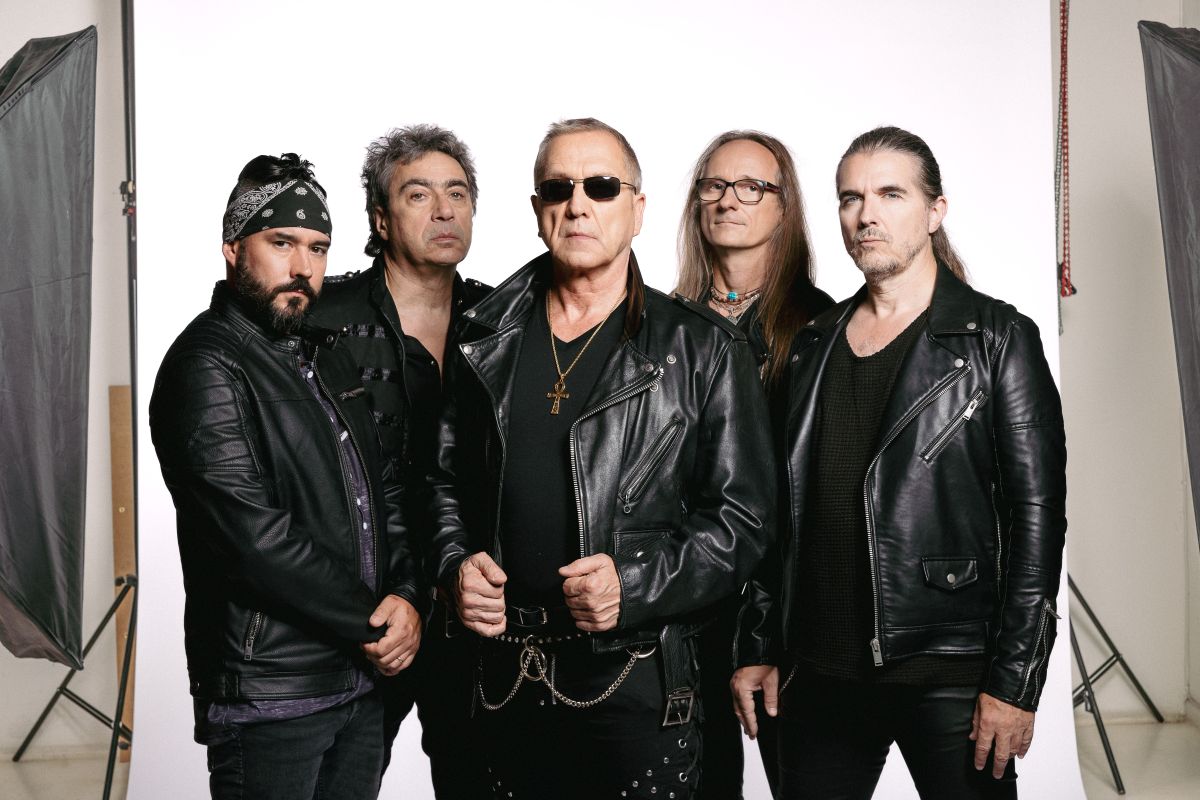
Ever since moving on without the rest of the classic Sortilège line-up, singer Christian ‘Zouille’ Augustin has been releasing quality heavy metal albums, the latest of which being last year’s excellent ‘Le Poids de l’Âme’. Augustin and guitarist, fellow songwriter and producer Olivier Spitzer shine a light on the developments in Sortilège’s songwriting process, as well as replacing the late Bruno Ramos, and why they think they sound best singing in French.
“Creating a new album is always a headache for us”, Spitzer admits. “Most of the time, the beginning of the work is done by Christian and myself. We are merging a lot of different ideas before we get to the final thing that may become a song. There are many, many steps, and it’s very tough. It’s like we are giving birth to a newborn every time, even though we have a clear idea of the core of what we are doing.
Inside that core, there are many different possibilities, depending on the tempo and the mood we are going for with the song. Fortunately, we have our own studio, which is a great laboratory to work on different ideas. But from the maybe thirty or forty songs that we start with, there are only a maximum of ten that will end up on the album. Those aren’t complete songs, though. They are ongoing works.
In the beginning, I come up with riffs, and Christian will bring in the melodies and write the lyrics. That’s the common way things go. But there are other ways, where I may bring some riffs, which can then be subjected to light or heavy corrections when we do the riffs with Zouille, because he has some ideas of melodies, but some of the chords are not the way he wants them to be.
So we work on different customizations of the primitive ideas to eventually get to the final ideas. And this takes quite a while sometimes. We can have five to ten attempts before we get the right structure and the right chords for what we are going for.”
Without Hard Feelings
“Zouille and I have known each other for the last twenty-five years”, Spitzer says. “We have been working together on demos for other projects since the early 2000s already. The fact is that now, working actively with Sortilège since 2020 – six years now – it’s an ongoing experience, where we can be open-minded to many different ideas to add to what we have built together.
It’s not as straightforward as just having a riff and writing vocal parts to that. Sometimes Zouille comes to me and says: I have been listening to Sorcerer, for example, and there’s a doom song on their album, can we do something like that for Sortilège? This is what our song ‘Apocalypso’ went through, from an original idea that came from Zouille listening to Sorcerer. I would say I come with riffs only half the time. The other ideas come out of discussions, listening to other things, and so on.”
“Since Olivier and I are friends, there is no comparison to working with other people that you only work with for two or three weeks”, Augustin adds. “That was the situation for a long time before these last twenty-five years. The more we work together, the better we get to know each other, the easier working together becomes. It becomes fluid. Sometimes, a situation does not need to be talked about; the only thing you need is a little facial expression to know that something isn’t exactly the way it should be. We’re still improving this situation every day.”
“We put the complexity in the art itself”, Spitzer smiles. “That’s the only right way to do it. We can have disagreements in trying to find a good way to compose the songs, new arrangements, new structures… This will lead to discussions sometimes, but without hard feelings, always with the goal of making the songs better in mind. And sometimes we spend twenty to forty hours working on a song that will not be a song at the end of the day, haha!”
A Layout of the Possibilities
“I have never been a lead guitarist”, Spitzer admits. “Always a riffer. And always a producer. So I have had some steps ahead in that regard, because I have been doing that for the last forty years. I’m never practicing any guitar techniques. Instead, I’m always composing in my studio. So there will always be bits of riffs, waiting to be a part of a new song, or to be abandoned.
But there is always a kind of pull of ongoing ideas. This is the way I work. I’m not counting anything, but each time I’ve got an idea, I go into a studio, and I produce it well, with drums, bass, and two or three guitars. That gives us a layout of the possibilities. Or not. It doesn’t matter that much for me if it turns into a song that gets used later. At the moment I’ve got an idea, I’ll make sure I’ll record it. And once it is produced, we’ll find out if it is a good idea or a medium idea, haha!
The only issue is that days don’t last longer than twenty-four hours. It’s a great benefit for us to be able to work on different things at the same time, opening all the folders we have, without being able to close them properly sometimes, haha!”
“It’s not even a question of ease, it’s a question of practicality”, Augustin emphasizes. “Simply because we can take more time to properly work on our songs. We can take all the time we need. If we want to record for two or three hours before putting down our instruments, we can decide to do that. But if we want to record for twelve hours without stopping, we can also go ahead and do it. The fact that the studio is free to access at all times gives us a lot of flexibility.”
“Sometimes we start a new recording, and maybe after about ten minutes, we will say: it’s not the right day”, Spitzer nods. “And then we can just stop, because we are not on the clock.”
Metalization of the Guitar
“As you may know, we lost our lead guitarist Bruno Ramos”, Spitzer says. “He passed away in 2025. Mentally, it was a very difficult thing to replace him. But we knew Mike Zurita from the past. We have had plenty of experience with him. I myself had been playing with Mike in Satan Jokers in 2009. Zouille, Mike and I have been on stage together during the Satan Jokers days, playing some Sortilège stuff on Keep It True in 2009.
So we knew Mike well. But we had been having so many good experiences with Bruno in the last six years that trying to find a replacement for him was really painful. Musically, things came very naturally with Mike, but it was just a very tough situation.
Mike is a bit less rock ‘n’ roll than Bruno was. He is more classical in the real sense of the word: classical music. He’s got the know-how and he is trained in classical music. He’s more of a pure shredder than Bruno was. Bruno was, first of all, a punk, a punk-addicted guitarist. So he had this rock ‘n’ roll strength inside him. That’s not exactly the case with Mike. He is a more technical player, I would say.
We have been modifying things since Mike’s arrival. We began with the sound of the guitars. We had to evaluate what Bruno brought, which was really rock ‘n’ roll. Mid-frequencies, while Mike brings brightness, which brought some metalization of the guitar. I don’t know if you can hear it, but the sound of the guitars is a little different between ‘Apocalypso’ (2023) and ‘Le Poids de l’Âme’. That’s what makes the difference: Bruno was more rock ‘n’ roll with a sound in the mid-frequencies, Mike is heavier, with higher frequencies.
Both Mike and I are playing EVH heads now. I’ve got the EL34 and Mike plays the 6L6. That makes a difference. Mike plays with the black Stealth, the new one, which is very, very heavy. And the one I play is a bit smoother.
No material from ‘Le Poids de l’Âme’ was finished before Bruno passed away. There was a song we had been working on which was called ‘Le Monde de l’Oubli’, which was composed by Bruno and finalized by myself and Christian. But this is the only one we really worked on with Bruno. We did do some attempts at songs, but nothing in terms of composition, just additional guitars. Unfortunately, we were forced to carry on without him quite quickly.”
A Mix of Nothing Sounds
“It’s always the music that influences the lyrics”, Augustin explains. “I have never created the music from a big of text or vocals. The music always inspires a certain theme to which I can write lyrics.”
“For example: ‘Medusa’ is a heavy, speedy song, and we thought about the two words ‘oh, Medusa’, and that gave us the idea of writing lyrics about Medusa”, Spitzer delves deeper. “Christian will bring the first melodies in a pseudo-yowl. It’s not English or French; it’s a mix of nothing sounds. Going by the first sound of the melody, that will give him some ideas to fill it in with French words. It does give us the musicality of what it will sound like in French.
We feel like French lyrics are more suitable for the music that we make than English lyrics. It gives us the musicality that is linked to the Sortilège sound. We have been comparing the French versions with the English ones, and I think there’s a real different sound coming from Zouille. Our specialty is to go abroad, and to sing in French on a bill with English-speaking bands. That gives Sortilège its originality. Without that, we would maybe just be like any other band.”
Bringing Back the Training
Augustin’s voice is in better shape than that of many of his peers. “That comes from the fact that he did not sing in touring bands for forty years”, Spitzer smiles. “That brought some health to his voice, compared to someone who has been shouting and screaming everywhere all this time. Also, he has been practicing at a lower profile singing gospel for twenty years. So the training was still there, and he could bring that back to life in Sortilège.”
“I still practice for four to six hours for four to six hours per week”, Augustin explains. “In a live situation, with a PA and everything, on a Sortilège playback, doing at least two gigs a week. At my age, when I stop working on my voice, it will go away, and it won’t be at the right level to perform.”
“Christian sings at a very high level for these four to six hours per week”, Spitzer emphasizes. “That’s the minimum. Him working on this so seriously benefits the band every day now. And I think he’s still getting better.”
Less Flexibility, More Efficiency
“If you listen to ‘Phoenix’ (2021), which is the album of re-recordings of our eighties songs: this is the way we play the songs live these days”, Spitzer says. “This is the way we recorded them, because that’s exactly how we play them. There were different things to be addressed at the time when we were updating the old songs.
First, the sound was different. The sound of Christian’s voice was different from how it was forty years ago. In some respects, that was an advantage, and in some, maybe it was a disadvantage. His voice is not quite as high as it was before anymore, But it also became more powerful, and there is a more natural roughness to his voice nowadays. So we had to adapt to a few things. Tuning half a step down was one thing. That brought some thickness to the sound.
Also, we decided to change the sound of the guitars as a result of the sound of Christian’s voice being tougher than it used to be. We decided to add more bass and more mid-range, as you can hear on ‘Phoenix’. Also, we had to fix the way that the songs were played. Because at the time it was recorded, it was done without click, without metronome. It was really live, but we had to fix it by tightening it up, to sound like a more modern band playing this material nowadays.
So now, everything has been fixed with the correct patterns. Our drummer has got a click, and everything has been tightened up considerably. That does bring us slightly less flexibility, but on the other hand, it also brings us more efficiency.”
A Special Eighties Set
“We have wonderful year planned for 2026”, Spitzer says. “With a lot of wonderful gigs that will happen around the same time. We are playing with Saxon in France, we are playing at Hellfest… You can imagine that we have to prepare ourselves for these events, thoroughly working on the sets that we are going to prepare. That takes a lot of work.”
“Putting together the setlist is a difficult thing to do in itself”, Augustin admits. “We prefer to do only new material, but of course, there is old material that we have to do. For our fans, and because it simply has to be that way, because we have been around for forty years.”
“There are five to ten songs that we have to play at every show”, Spitzer nods. “The amount of new material that we played during the show that ended up on ‘Coram Populo’ (2023) is exactly how Christian would like to see it, with a lot of new things. But sometimes festivals will ask us to play some old material exclusively, which is most often the case in Germany. They want to have some old material for one special show, a special eighties set or something like that.
In such a case, there may be one or two new songs, but most of the set will consist of old material. In 1986, the band released ‘Larmes de Héros’, so this year, we will play a few shows that will celebrate the fortieth anniversary of ‘Larmes de Héros’. There will be at least two of those shows in July: one in Germany and one in France.”
 Kevy Metal
Leave a comment