
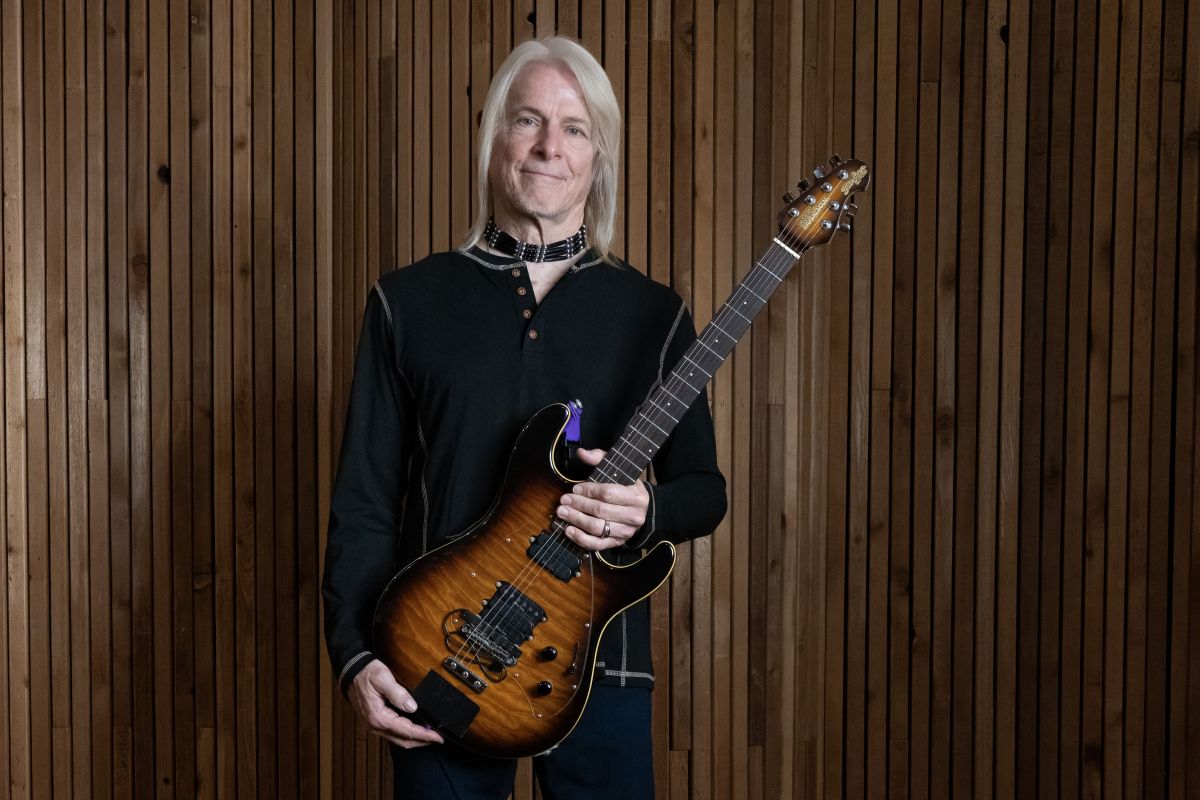
‘Triangulation’ is the first album featuring Steve Morse after his departure from Deep Purple in 2022. On the album, Morse puts his most melodic side front and center. The 71-year-old guitarist shares some insights into the writing and recording of ‘Triangulation’, his new Engl signature amplifier, stainless steel frets and playing with arthritis.
“I feel like the compositions have become more mature, and I have reached the point where I want everything to have melodic content”, Morse explains. “Even if there are fast parts in it. Those parts need to make sense and go somewhere. They have to be musical and not just energetic.
The band on the album consists of Dave LaRue on bass and Van Romaine on drums. I have been playing with these guys off and on for about forty years now. Dave can play in a very straightforward manner, and that’s exactly what he does for some people who hire him. But he is also able to play complex arpeggios, almost like a classical guitarist would do, with melody, vibrato, effects and an exceptional phrasing. Him being so versatile allows us to do much more than you would normally be able to do with a trio.
Van has mastered many different feels. He loves Latin, funk and jazz, and he has incorporated those influences into a rock feel. ‘Break Through’, the opening track on ‘Triangulation’, has a very catchy swing. It’s played with double bass drums, but there is a consistent swing on it. That’s Van’s doing. This way, the three of us really are a band, a partnership that the three of us share.”
Very Quickly and Efficiently
“When we work on music, things will always keep changing. Dave lives in the same town as me, so it’s easy for him to drop by my studio to put pieces of music together, apply spontaneous changes, and record them, simply to keep track of everything we have done.
Once that part is done, we send everything to Van, and we will continue to work on things as a band. Dave and Van played together on more occasions than just in this band. Because of that, they have learned to communicate really well, which allows them to adjust drum parts very quickly and efficiently when the three of us play together.
As soon as we have something that feels right, we will make a recording in the room to remember all the parts and ideas, especially when it comes to the drums. From there, a template is created, which everyone can use as a starting point to work on, which allows us to sound like a band, even if we record our parts separately.
Then there are the guest spots from Eric Johnson on ‘TexUS’ and John Petrucci on ‘Triangulation’. I gave both of them a recording on which I play all the parts, as a concept. Then, they will get a recording on which I play my parts on the left, and their parts on the right, plus a recording on which I play my parts, and there’s a silence where their parts are supposed to be. I send the stems of those to their engineers, so they can choose to record however they prefer to do it.
To be honest, I don’t like asking for favors. Because when you ask a friend for a favor, they sometimes end up saying yes only because they feel like their friendship forces them to do so. But I will say that their guest spots have truly become fantastic.”
Part of the Composition
“What I usually do when recording solos is improvise a few tracks and record those. When I finish doing that, I take a little break, and after that, I collect the good parts. If there aren’t any, I will just record a couple more improvisations. But usually, I am able to put together a solo out of maybe the three tracks I think are best. The only thing I have to do sometimes is record a few short pieces to connect some of the parts.
If the solo is very melodic, or I simply like the shape, it may end up becoming the permanent solo. When we record video clips, I have to learn how to play the recorded solos anyway. It’s a lot of work to go back and learn a solo you once improvised, but after you played it for maybe forty or fifty times, I will end up sticking with you eventually.
Once you have gotten to that point, you will automatically end up playing what you did on the album when you play the songs live, and that improvised bit suddenly becomes part of the composition. Because of the video clips we recorded for all the projects I was involved with, there are improvised solos I have seriously rehearsed more often than the songs we recorded.“
Spending More Time Practicing
The guitar Morse used to record ‘Triangulation’ is his old, trusted Music Man signature guitar. “Serial number one”, he clarifies. “That’s the guitar I have been playing for nearly forty years. Back in 1986, Music Man wanted to build me a guitar, and the only limitation was that they wouldn’t stop until I thought it was ready
I gave them my Frankenstein guitar, which is the Telecaster with a Strat neck that I had been playing since the seventies, and discussed what was good about it and what could be improved with them. They came up with some great suggestions of their own as well.
After three prototypes, they finished it, and it immediately felt natural to me. Since then, I have brought it with me to every show I played. And I’m still changing things about it every now and then. Sometimes it gets a new bridge, or I put a pickup that I took out a while ago back in.
But I don’t use it for practice. Right before we go on tour, I switch to that guitar. Guitars can feel a fraction of a millimeter different due to how they have been set up, or how much the neck has been worn down. That is why I prefer to spend some time with that guitar right before going on tour. But I don’t want to wear out another set of frets.
At the moment, I am playing with my eleventh set of frets, and it’s the first time I’m playing stainless steel frets. Not because they sound better, but because of their wear resistance. To be completely honest, I’m not sure if they actually sound better than nickel frets, but those do wear out completely after two years, and the neck is sanded down every time the guitar is refretted.
On tour, I spend more time practicing than I do playing live. When that happens, I practice over the entire neck. Plus, I play with a lot of vibrato and I bend a lot, so the frets tend to wear fairly evenly after I have played them for a while. Every song I play tends to have a bit of vibrato on every string.”
A Transportable Amp to Fly With
For recordings as well as live shows, Morse has been using his signature Engl E656 for many years, but that has recently changed. “There is a new signature Engl”, he explains. “The Engl E658 is a 20-watt head. It weighs a lot less. There are different valves in it in order to make it smaller and lighter. It sounds really good, and it has built-in effects. Also, it has a five-way switch for impedance, and an XLR with IR simulators.
The direct sound of that 20-watt head is what I used to double a couple of the parts I recorded with the 100-watt head. That will give you two different approaches. It makes the sound bigger, to my ears at least, because it isn’t the same part with the exact same sound twice.
Dave and I did a couple of shows at Andy Wood’s guitar camp and John Petrucci’s Guitar Universe, and I was able to take that guitar with me in my suitcase, along with a bunch of clothes and toiletries, and I didn’t even have to pay any additional fees for my luggage. It’s very easy to carry. If I take that amp with me on a tour where we don’t have a backline, all I have to do is rent a cabinet and borrow some cables. It’s a nice luxury. It’s something I always wanted to have: a transportable amp that I can fly with. Especially since it fits in my suitcase.
There have been some shows where I didn’t even have to bring my pedalboard. Just go straight into the amp and have a clip-on tuner on the headstock. The only thing that I would want in such a case is a little more control over my delay. A British friend of mine is building me a midi pedal to do just that. I have never really delved into the world of midi before; I always had effects you can turn on and off. But I do have a preference for fading in effects, which creates the illusion that it’s seamless.”
Ten Thousand Notes a Day
Through the years, Morse has had to learn play guitar differently due to his arthritis. “Rehearsing is what you do most”, he says. “More than actually playing live. Many people think that you recover if you take a couple of hours off, but it’s not like that: every time I try to do something, it hurts. That’s why I created a mute that kind of functions the same way as having a scrunchy near the nut.
However, my mute is a little stronger. It pushes down a bit more, and it’s easy to remove it from the strings. Back in the day, I used to twist my wrist in an awkward position to be able to mute the strings I didn’t play and only let the string I played ring. One of the reasons why my joints are as worn as they do is the fact that I played ten thousand notes a day for over fifty years.
At the moment, I’m working with three different ways to hold my pick, and I alternate between them the whole time. There’s only so long I can play any single one of them before it starts to hurt so much that I need to switch positions. So I have taught myself to switch between three different ways, otherwise I won’t be able to keep up for the entirety of the show.
But let’s be honest: that’s what everyone does in their daily life. If you spend your entire life making driveways, your back is worn out by the time you’re fifty, the muscles in your shoulder are torn, and your knees are shot. Your entire body hurts, but you still need to work, so you need to find a way to be able to do that. If your foot hurts, you still need to walk. Everyone my age has physical issues. I can still play every note; I just need to hit them differently.”
Giving himself some more rest than in the days when he still frequently toured with Deep Purple and Flying Colors might help his joints as well. “Scheduling problems have always characterized Flying Colors”, Morse smiles. “It’s almost impossible to get together before a live show. Back in December 2019, I finished the Eastern-European Deep Purple tour, then got off the plane, and drove to the first show of the Flying Colors tour. It’s something you get used to, really.”
Skilled, Energetic and Versatile
Since ‘Triangulation’ was recorded as a Trio, Morse is fairly confident that the material will be easy to translate to the live environment: “But since we have two songs that are duets, and I do tend to overdub a few things here and there, we have welcomed a new touring member into the band: Angel Vivaldi.
I worked with him on one of his projects, and he is very skilled, energetic, and versatile. A fantastic musician. That’s going to make a difference for us. Things just sound bigger when he plays with us. At his suggestion, we have also added the Dixie Dregs song ‘Attila the Hun’ to our live set.”
An edited version of this interview appeared in Gitarist 417 (December 2025)
 Kevy Metal
Leave a comment