
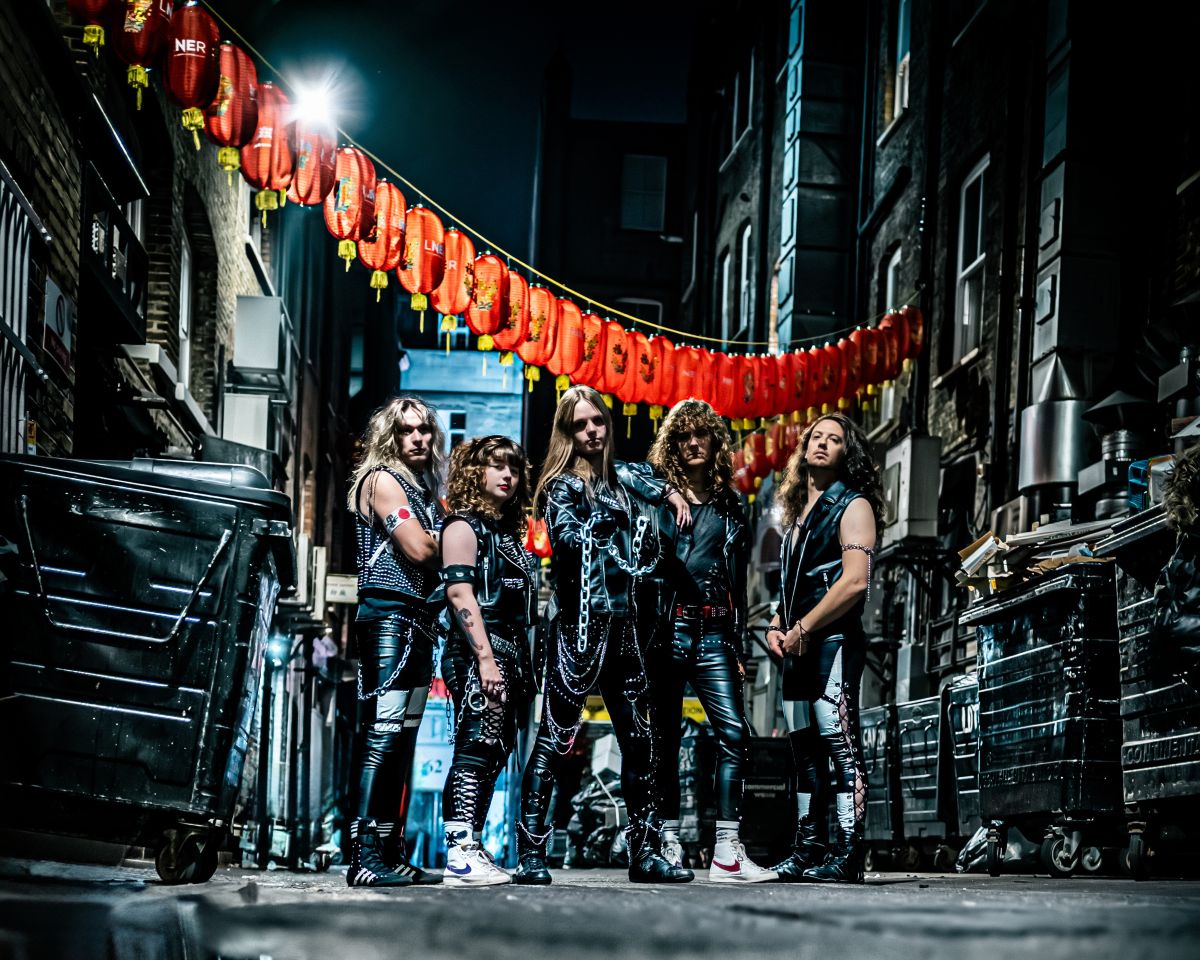
While 2023’s ‘Guns for Hire’ was a very promising debut album, it wasn’t until Tailgunner toured with that material that it really came to life. That excitement and experience was brought into the recordings of ‘Midnight Blitz’ with spectacular results. Bassist Thomas ‘Bones’ Hewson and guitarist Rhea Thompson, who debuts on the album, dig into the evolution the British quintet went through over the last few years.
“Most of the debut album, I wrote myself before the band ever existed”, Hewson explains. “I had never written any songs before, I had never planned to be a songwriter, but I had to have something to show to people: this is the type of music I want to be able to play with the band. Really, it came together almost by accident.
With this record, we had the full line-up, we’ve been out on the road, played over a hundred shows, and shared the stages with so many amazing, influential bands. I think it’s very difficult not to be inspired when that’s the life you live. So, thankfully, it was very easy to put this new record together.
We recorded the debut over a year before we ever played a single live show. We did it for no money, with no actual studio. It was recorded in an Airbnb in ten days. So we had no experience with playing live. And definitely, being out on the road so much, it is something that we carried forward into making this new record. And I think you can really hear how much alive the songs sound.”
The Table of Iconic Guitar Players
“Having Rhea on this album, and just in the band in general, dramatically improved things”, Hewson emphasizes. “For me, I’m constantly blown away by her and Zach (Salvini) as a lead guitar duo. It’s extremely pleasing to have two lead guitar players like them in the band. Also, for me, Rhea is one of the most exciting new guitar players in the entire world.
As the years go by, and as we put out more music, I think she will really earn a place at the table of iconic guitar players. It’s always a pleasure for us to have her in the band. I really enjoy it when we write music, and seeing the solos that Rhea comes up with, and sharing the stage with her as well. On a personal level, being on the road together is really fun. It’s a huge difference how it was before, and I’m really thrilled to have her there.”
“The tricky part of joining the band was learning the set in three days”, Thompson smiles. “I had three days to learn the set because I had to stand in for a festival they were playing. And it was alright. The guitar work on the first album was nowhere near as technically challenging as it is now, so I would definitely need more than three days if I was to learn the second album now.
The first gig I played with the guys was the first proper gig I ever played for more than a hundred people. So, I was afraid I was going to forget things, but it went very well, actually. And now I look back on those gigs, and I think: christ, we’ve come on worlds from that.
Tom does most of the songwriting. But I have complete freedom to write my own lead parts, my own solos, harmony sections, et cetera. Live, I try to play then as accurately as possible, until I get to the point that I think: okay, I want to play something a bit different. But the solos on the second album are so technically demanding that it isn’t really the sort of solo you would improvise on like – let’s say – Slash does on loads of the Guns N’ Roses solos. There’s no time for that.”
Piecing Together the Intricate Details
‘Midnight Blitz’ was produced by Judas Priest guitarist K.K. Downing. “We needed a producer on this album”, Hewson says. “Because the first one was self-produced, and we wanted someone with that level of experience. Obviously, K. K. co-produced all of those classic Priest records, alongside Rob Halford, Glenn Tipton, and Tom Allom. It was awesome for us to work with someone with that level of experience. Not just for the sake of this record, but as something that we will take forward with us for the rest of our careers.”
“He never actually had any input on the solos”, Thompson says. “What he inputted more was the little extra parts that I wouldn’t think to add, like the dive bombs and whammy bar stuff in the verses. It was really refreshing to have him input that. What he did have in terms of input on the solos: on ‘Eulogy’, we have a sweeping section at the end. Originally, it was just me playing that. But after I tracked it, he said: what do you guys think about adding a harmony sweep thing? So Zach went and he did a harmony section.”
“We don’t do a lot of pre-production in terms of playing together as a band”, Hewson admits. “That’s probably something that will change going forward, because as I said, on the first album, we did do a lot of rehearsing, but we had never played live. Whereas with this new album, it was a lot of individual rehearsing, but not a lot of playing together as a band. We had some line-up changes as well, which affects schedules as well.
We definitely learned the hard way, because we would be recording, and someone would come around and say: that guitar part you’re playing doesn’t match the guitar part I’m playing, or it doesn’t match this bass fill. It’s because we haven’t had the opportunity to go into a room and really play it together. So we had to piece the intricate details and the tiny little runs together as we were in the studio.”
A Knock-On Effect
“You learn so much by playing live as a band”, Hewson continues. “We just really kept that experience in mind when it came to recording this new album. You don’t always think about what’s going to work live. Sometimes, it’s great to create for the studio, and then learn how to do it live. But you just learn so much as a band from being out on the road as much as we have. It affects your writing, and when you’re in the studio, it has a knock-on effect, which I think is a huge positive.
With ‘Guns for Hire’, we didn’t know how fast we would play live. I remember the first show we ever did. We filmed it, and we watched it back, and we thought: fuck, is that how fast we play? Haha! The studio stuff felt so slow comparatively. But we learned so many lessons on the debut album. Maybe at some point, we will re-record a few tracks. Or certainly, there will be some live versions at some point.”
“It’s just about pushing yourself as much as you can”, Thompson adds. “When it came to the solos, what I thought was fine, would make me think: no, I could do better. Getting the live feel is really important. When I was writing the solos, I didn’t want to write something that would have been impossible to play live. And even if I did, I would just sit with it until I could play it live. What I wanted to write was something I would actually be comfortable with playing live, so I don’t just have to keep my head down and focus while playing live.”
Not Cheapening the Fan Experience
“When we record, I’m always of the mind of: don’t worry about the live show, just make the record as great as possible, put as many layers in as you like, do whatever the hell you like, then figure out how to play it live”, Hewson says. “In terms of how it sounds live, we try and stay pretty close, but we do choose to do some different things in terms of structures.
As a live band, I think it’s all about that experience of how a band comes across live. You don’t need to play the songs exactly the same as on the record. Sometimes we’ll play some things faster. Certainly the stuff from the debut album. Sometimes we’ll extend songs, have different endings… It’s all about the show.
Having said that, you don’t want to cheapen the fan experience. If there’s a really great solo on the song, and someone doesn’t play as technical of a solo live, as a fan myself, I would come away disappointed. If I go see a band, say I see Helloween or something, and there are some crazy high notes that I’m looking to hearing Michael Kiske sing… He always sings them, but if he didn’t, I would feel a bit short-changed. So we always try to make sure that the standout moments of our songs are played as true to the recordings as possible.”
“Before we went into the studio, I made sure that I knew the parts like the back of my hand”, Thompson continues. “I wouldn’t have to spend too long on one take. But that was mainly for the solos, to be honest, because I always record solos in one take. I don’t like chopping them up and stuff, because I’m not going to do that live either. That is the live feel I want to get across in the recording.”
“If you have to piece something together from a million takes to get it right, it’s never going to feel live”, Hewson nods. “You have got to know your parts and be ready to nail them. I think that’s the key. If you’ve played something twenty times, it’s going to sound robotic by the twentieth time, and it’s going to sound stale, because there’s no excitement in playing it. Whereas if you know your stuff really well, and you go in and hit record, and you nail it, the excitement is within that take. That’s how we get that authentic feel to the stuff.”
Extremely Particular
“The guitars went through a DAW”, Thompson explains. “We used the Neural DSP Quad Cortex. In fact, we used the same presets that we do live. We put that straight into the computer. I only really use Jackson guitars, though I use an Aria Pro Series at the moment. I will be getting a Jackson Randy Rhoads, though. The white and gold one.
The effects I use are all in the Quad Cortex. In terms of my sound, I have always just used these amp sims that you get in pedalboards. I have never massively been one for having specific pedals. I just find that as long as I have got a good distortion and a bit of delay, and the tone is good, it will always work for me.”
“I am extremely particular with my bass sound”, Hewson admits. “I have a Gallien-Krueger bass amp, and I played through amp simulations that are based on the Gallien-Krueger, but it’s not quite the same. It’s close, but it’s not the same. For live, I think you can get away with that. But when it comes to making the record, it has to be the sound that I want it to be.
It’s funny, I know what I like with my gear, and I have never been someone to experiment. I feel quite lucky that I know what I like. I know my sound, and I don’t need to buy a million pieces of gear. But at the same time, I’m very particular that I have to use the stuff that I like as well.”
Not Quite How You’re Supposed to Record Music
“There was a particular demo that I made when writing that I showed to K.K., and he really loved the bass tone on that demo. He said: that’s the sound we have to get on the album. We tried a lot of different things. We tried doing it the proper way. And in the end, I said to him: look, this is how I set up at home when I record demos. Which was literally just to have my bass amp, with a compressor, and feed it straight into the DAW. No loadbox, no Torpedo Captor or anything, just straight in, really raw, and probably not quite how you’re supposed to technically record music, haha!
On the record, I played a black Fender Aerodyne Jazz Bass from Japan. That is my number one bass. I think it’s from 2002 or 2004, something like that. That model has been discontinued. It’s still my favorite bass. It’s still what I would probably use on all the records, but I mainly play a P-Bass live these days.
I never wanted a new bass after the Aerodyne Jazz Bass for years and years, until I saw the Aerodyne P-Bass. And as soon as they released a P-Bass version of the Aerodyne, I had to get one. And of course, we do the all-white guitar thing live, and so it fits really well into that. It’s a really stunning-looking bass, so I’m very pleased to have it.”
 Kevy Metal
Leave a comment