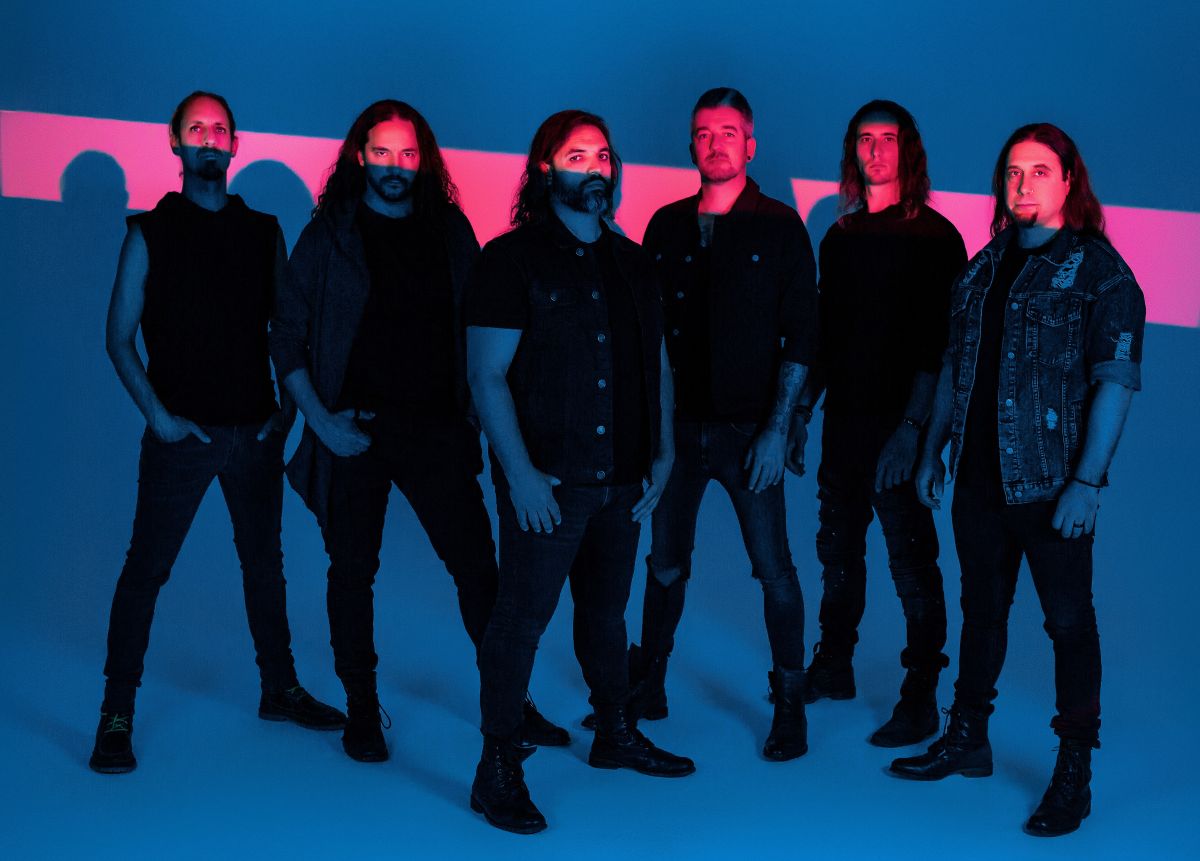
A decade after originally splitting up, the influential Dutch progressive metal band Textures is back with their new album ‘Genotype’. The album sounds familiar, but at the same time notably more modern than its 2016 predecessor ‘Phenotype’. Founding guitarist and producer Bart Hennephof shares his insights into Textures’ split and reunion, as well as the band’s new approach.
‘Genotype’ was also the title of the album that Textures had been working on before splitting up in 2017. Hennephof emphasizes that it wasn’t the music written for that album that split up the band. “As far as I’m concerned, that didn’t have much to do with the music”, he says. “It was rather something practical: are we still on the same page? Is it even practical, planning-wise, with everyone having a family, to tour full-time?
Obviously, the album didn’t come together all that well either. It was a really cool concept, but it was difficult to realize as well, and we noticed that immediately. There were lots of ideas, and that has pretty much always been the case with Textures: we have loads of ideas, lots of options, and after a while, you enter a certain momentum, and all those ideas coalesce into an album. But it became quite difficult to find that momentum.”
A Hundred Ideas per Rehearsal
“Precious few of the original ‘Genotype’ ideas actually ended up on the album. We have actually tried to use some of those ideas. There were a few that we thought still had a great deal of potential. On the other hand, we had been inactive for seven years. We thought we had quit altogether. The idea wasn’t to take a break and to make a comeback. We have had a drink or a barbecue every year, and talked about it at each of them, and every year, our conclusion was that it felt good that we had quit.
However, after seven years, we had another one of those barbecues, and all of us said that we were starting to itch again. We had a completely different mindset, and everything felt better. For me, the idea of starting again was quite an unexpected one. And then the idea came to start rehearsing again. Stef (Broks, drummer) and I rehearsed a couple of times, with the idea being: let’s give it a shot and see what happens. And if nothing happens, we won’t reunite the band.
When Stef and I started jamming again, that spark was of course still there. A lot of ideas came up during those rehearsals, like a hundred per rehearsal. We did consider doing something with the old ideas we still had lying around, but at some point, we decided: let’s start from scratch. There are even some new ideas we have shelved. It just felt like the right decision to go for fresh ideas and a new concept.”
Transparency and Directness
“On the first few singles, you can already hear that we have chosen to let the music lean on the synths a lot more than in the past. That was the approach we were going for: a very heavy sound with a lot of synths. The drums a bit more forward as well. Everyone was behind that idea. It sounds fresh, but all the trademark Textures elements are still there. The idea was: let’s start building from there. After that, things started happening fairly quickly.
A lot of the album was recorded in my studio. It was really nice to do that. It was the first time that we have outsourced mixing the album. Jochem (Jacobs, former guitarist) did that for all five our previous albums, but we thought: we’re going for a new sound, why not ask someone else to mix the album and see if it still sounds like Textures? We feel like it still does, despite that new sound.
Forrester Savell also worked with Karnivool. Obviously, we don’t really sound like Karnivool, but I like that general transparency and the rock vibe. Everything is nicely layered, everything can be heard clearly, but it’s not too in-your-face. On the other hand, he also mixed an album for Twelve Foot Ninja. Which is completely unlike Textures, but that directness and heaviness appealed to me. It felt like a cool idea to see if we could try and do something like with Textures. That directness is something completely different than we have done up until this point.”
As Analog as Possible
“Our first five albums were all recorded with actual tube amps, cabinets, dozens of microphones in front of those cabinets, stompboxes, and effects. All analog. For this album, I took everything from my Neural DSP Quad Cortex. Nothing else. The only additional thing I used was a Strymon BigSky for less conventional, bigger reverbs.
It was a bit of a challenge for myself as well. I could have brought out all the amps I used back in the day, as well as a handful of pedals that always worked on those earlier albums as well. But it was fun to see if I could practically get everything from that little box, all digital, and see if I can make it sound as natural, as analog as possible, with clean arpeggios and effects. Just dive head-first into that sound world and try and make it sound like Textures as much as possible.
Obviously, you can make everything sound very unnatural and industrial with a Quad Cortex. But I wanted to keep my approach. I have been using that Quad Cortex live for a few years now, and the possibilities are still endless. It’s been very cool to use it to record an album this time around, which is becoming increasingly common.”
A Very Free Flow
“I still play Mayones guitars myself. Joe (Tal, guitarist) brought a couple of his Ibanez guitars to the recordings as well. He managed to borrow a couple of cool guitars from the Ibanez factory. We used those for a couple of sections. But one of my older Mayones guitars has become the main guitar for a lot of the riffs.
For every album, everyone will try to borrow a bunch of guitars or buy a new one for the recordings, so that we have a wide range of guitars to choose from. I think we’ve had about eight for these recordings. We have tried out all of them for the most important parts of the album. The riffs, high gain, low gain, the clean parts…
We have played those parts on all eight guitars, recording a bit, and then we listened to how it sounds in the bigger picture. That way, we knew: this part will be like that, let’s pick up that guitar, because it sounds best on that one. The clean parts were all done with one of Joe’s Ibanez guitars.
When we are in the studio, Joe will come in during the morning, and we start working on guitars together. Joe starts, and I’m engineering. Joe will play a riff, or maybe something I have written of which I want to know how it sounds when he plays it, and sometimes he will simply record it.
Sometimes, I will take on a riff because it just sounds a bit better when I do it, or because I have a cool idea to add to it. That way, a very free flow is created in which both of us can play on anything. But always with the idea that whoever plays it best will record it.
However, Joe is truly our solo master. And Joe has been able to let himself go on the new album. A couple of songs have plenty of space for guitar solos. He really was able to reach his… Well, I wouldn’t know if it’s his limit. I’m not sure if Joe even has a limit. But he has definitely tried to take his solo skills as far as he possibly could.”
A Much Better Fit
“When recording the album, I always have the live situation in mind, as a producer. Especially when it comes to the vocals. Things like: is that high note safe? Daniël (de Jongh, singer) can just about make it in the studio, will he be able to do it live as well? That is something I already have in mind during the writing process.
There was one song which we had demoed, and after a couple of weeks or months, we said: there are some extremely high parts for Daniël in it, what if we transpose the song down a full step? We made a new demo recording, Daniël sang over it, and it just felt a lot better. It sounded fuller, and it was a much better fit for his timbre. The original was just a bit too high.
It’s always a good thing to stay vigilant for things like that during the writing process, so that you can reach every note while recording, and hopefully live as well. Doing something you can just about do might be very difficult live, playing for an hour and a half and headbanging, which would be a shame.
When it comes to guitars as well. Sometimes a riff ends with a run high up on the neck, and the next riff starts much lower on the neck. That doesn’t work in a natural way. There have been instances where we decided to just end them in a slide. That sounds much more organic, and you can play it on stage as it was recorded. A much simpler solution. It shouldn’t sound like we copied and pasted the album together from loose parts. It makes the whole thing sound more human, which I think maximizes its impact.”
How Far to Take Complexity
“When writing albums for Textures, we always think: we could come up with crazy ideas that are technically impossible to play, but we should focus on writing something that is physically attainable, because that way, you can make it sound as powerful as possible. That is the balance you have to find as a musician. On the one hand, you want to show what you can do, but on the other, it doesn’t have to be difficult. It just has to be special.
For me, it has to be something that triggers me with something unusual or cool. That’s not in sweeping or scales or lightning-fast solos for me. I find that in what Textures is about: complex rhythms and exploring how far you can take that complexity. You can make it mega-complex, but then nobody wants to listen to it anymore. It can sound difficult, but it does need to have a nice groove as well. You have to be able to move your head along to it.
There is a lot of space in our music to do all kinds of things. If you are technically gifted, you can show that. I like it when a Steve Vai, a Satriani or a Tim Henson can create a guitar spectacle. But if you play music with vocals, you have to take a different approach.
I tend to see myself as more of a producer than a guitarist. I love brainstorming with people about the form of a song: what if the vocal melody becomes a guitar melody there? Or what if the singer sings the guitar melody? I really like thinking about things like that. That is why I always keep a producer’s mind and try to translate that to the guitar, rather than randomly pushing my guitar skills to the foreground.”
An edited version of this interview appeared in Gitarist 418 (January 2026)
 Kevy Metal
Leave a comment