
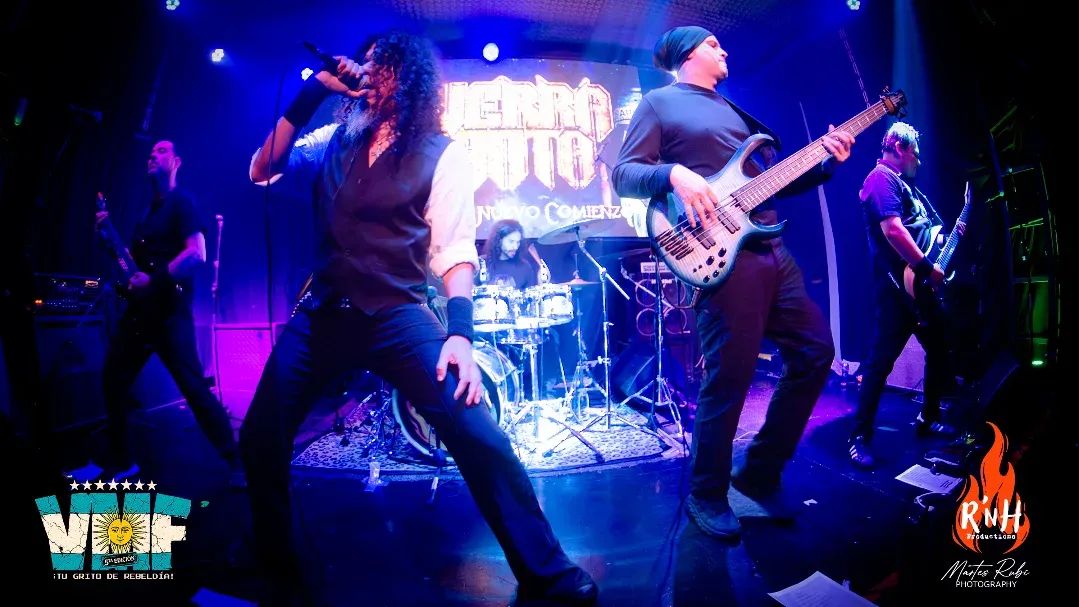
For over thirty years, Marino Vásquez has been the voice and the face of heavy/power metal band Guerra Santa, which from the western town of San Cristóbal grew into a force to be reckoned with in all of Venezuela, and later all over Latin America. The band has relocated to the Argentinian capital of Buenos Aires about a decade ago, but Vásquez remains close to the Venezuelan metal scene, organizing Venezuela Metal Fest since 2020.
“Since I was a child, I always sang with friends and at family gatherings”, Vásquez says. “It’s worth noting that Venezuela is a tropical country where the popular music played on the radio had nothing to do with rock music, especially not in the city where I was born and raised: San Cristóbal in Táchira, in the Venezuelan Andes.
My first great influence was my father. He was a tango and bolero singer – ironically, he never came to Argentina. He used to sing in tango clubs in Caracas. My grandfather was a multi-instrumentalist, and he was part of an orchestra. The fact is: I remember my father singing, and the expression on his face, his gestures, and the way he conveyed those feelings with his voice has left a lasting expression on me.
At the age of 9, I had my first encounter with rock music, thanks to an uncle who left a box at my home with a lot of records in different genres. But the covers of two of them in particular caught my attention. One had several people with their eyes covered, and the other one had a cannon on it. When I first put on the first song ‘Dirty Deeds Done Dirt Cheap’ by AC/DC, I understood there was another way to song, and I entered a new world that I never left, nor do I intend to leave, haha!”
Freedom and Rebellion
“Soon after, I began to understand that it was a genre that expressed freedom and rebellion. When I saw a video of Queen, and saw Freddie Mercury sing live, it was clear that I wanted to be a singer. And of course, in Venezuela, although rock music was not very popular, there was an audience, there were media, and there were rock concerts to go to. At the time, they did not let me in, though, because of my age.
At 16, I joined my first band Skirla. We only played covers of heavy metal classics, but I did play my first concert with them, and then several dates got added to that for about three years, until we formed Guerra Santa at the end of 1991. Our first show was in San Cristóbal at the Circulo Militar with Tiempo Zero and Zapato 3. Since then, the band has not stopped, and although I am the only one left from those early days, we continue to be great friends, brothers for life with thirty-five years of history.
The first big show that I went to that made me understand that I could go further with my band than the land where I was born, I travelled nineteen hours by bus to Caracas to see Iron Maiden on their ‘Fear of the Dark’ tour in 1992. There, I also saw Gillman play live for the first time, with a guitarist who today has become my brother Facundo Coral. From there, I had a different perspective on music and what I could do with it.”
Long Hair, Tattoos, and Earrings
“In the eighties, the new wave of British heavy metal boom also invaded Venezuela. In our city, there were heavy metal fans, and a record store where you could buy the records of those bands that were all the rage. There was a radio program that played those songs in the early morning, and we used to record the songs on cassettes.
It was a very underground movement though. And we, with the long hair, the tattoos, and the earrings, were considered weirdos in our city, frowned upon by both the people and the police. Those were very nice times, but with few options and resources to record in a professional way. So it was the time to develop ideas, to sow and then later reap the fruits.
Táchira is a province far from the country’s capital, and the options for playing and recording were very limited. Almost all of the heavy rock scene was concentrated in cities such as Maracaibo, Barquisimeto, Valencia, Maracay, and Caracas.
Furthermore, San Cristóbal is a very conservative city, and a man with long hair, tattoos and earrings was not well-regarded, especially if we were talking about rock music. Little or nothing was heard, and what reached us was through records that friends brought from the more heavy rock-oriented cities. But little by little, things it became more normalized, haha!”
An Odyssey to Move Them
“Since our first show in 1992, Guerra Santa never stopped playing live. Even during the pandemic lockdowns, because we did a live streaming session at the time. We were always on the lookout for dates and veneus where we would have the minimum equipment required to sound good live, and feel comfortable playing a show.
I remember one show in particular. It was the first time we travelled to the center of the country, specifically from San Cristóbal to Valencia, and we took our equipment and instruments with us. We had to disassemble the drums and store them inside the bass drum. It was an odyssey to move them. On many occasions, we travelled with our own equipment either with the car of one of the guys or in a long-distance bus. We never stopped, and as the years went by, the equipment was a vital requirement to play live.
Even though before we did our first show in 1992, we already had six songs composed, we had a tendency to do things backwards. The first years, we dedicated ourselves to playing. We did many shows in Venezuela and Colombia. In 1994, we recorded a live EP with Hender Contreras, and also recorded live with bassist Fendando Macero, and these were the first recordings that reached the public and were played on the radio.”
Limited Resources and Few Options
“Our first formal recording was our first live show in 1998, for which we once again worked with Hender Contreras. Then, in 1999 and 2000, we recorded in a more formal way in Mérida, a city five hours away from San Cristóbal, in Leonardo Rodríguez’s studio. They were one-take recordings with very low-budget and low-production, but they served to leave a reference of those years of the band.
Although our repertoire consisted of our own songs from the very beginning, it wasn’t until four years later that we finally managed to record a live demo. It was not easy for us to record, due to a lack of resources, knowledge, and recording studios. In fact, our first official production was a live acoustic show. But we did manage to play live a lot.
And that prepared us, because then came the studio recordings that we did live. Without a doubt, all those early years were a learning experience with the limited resources and few options that we had at the time.
The same goes for my singing voice. It has all been a learning process over the years. Singing live is not the same as recording in the studio. Recording and getting to know your own resources gives you the vocal range and the technique that was very empirical in those early years. You never stop learning, and studying is without a doubt essential for that.”
Drawing the Attention
“Guerra Santa had the opportunity to win several festivals in the late nineties and early 2000’s. The first one was in Mérida, a city five hours away from our hometown of San Cristóbal, and where the recording studio of Leo Rodríguez was located, which is where we made our first albums. The Festival Underground allowed us to draw the attention from the media andthe public, both in our homeland of Táchira and in Mérida, and then in Caracas, nineteen hours away by land.
The Festival de las Bandas Disconocidas was a festival organized by Amnesty International where bands from different rock genres came from all over Venezuela to participate, and we had the honor of winning it. Thanks to that, we were able to perform at the Poliedro in Caracas.
It was the first time we performed in the capital, and since we won, we were able to position the band nationally in the Venezuelan metal scene, participating on TV shows on public networks for the whole country. Having interviews in the most important radio programs of the genre certainly helped us to continue to grow, and emerge from the province to other parts of the country.”
Understandable and Relatable to Everyone
“Since before Guerra Santa started, I used to write songs on the walls of my bedroom. Some time later, I took them to a notebook, and that’s where you could find our first songs ‘Hechizo’, ‘Arlequín’, and ‘Paraíso Perdido’, among others. The themes have always been my own history in song form. Love and heartbreak, social justice issues, the environment, messages of awareness to humanity, brotherhood, strength, struggle, unity and hope.
I usually write lyrics based on my experiences and everyday life. And of course, each song carries a message that I try to make understandable and relatable to everyone in one way or another. You will always get a positive message in every song. And on our latest album ‘Éxodo: Un Nuevo Comienzo’ (2023), there are multiple songs that speak about the experiences of leaving your country and your people behind, in order to start anew.
When composing, most of the time, I come up with ideas that the guitarists then shape. Over the years, I have worked with great musicians who have known how to turn these lyrics and melodies into songs with a life of their own. There have also been cases where the guitarists already have a riff or an idea for a song in mind, and I adapt to the melodies, and write the lyrics to it.
Nowadays, the way we compose is very different than before. In the early days, we spent many hours rehearsing. Luckily, we didn’t have to pay for a rehearsal room, as we rehearsed at my house or Danny’s (original drummer Dany Alba Coelho, who died in 2019) house. Today, thanks to virtual technology, we can compose and record any time we want remotely, which is something the pandemic has left us with.”
Vásquez is also responsible for the visual design of every thing Guerra Santa. “I have always drawn, and I always enjoyed the graphic aspect of it”, he explains. “My evolution of a designer has also been reflected in our work, through years of learning, my studies and eventually graduating in computer science and graphic design.
These days, the entire visual side of the band – our CD’s, our advertising, our social networks, video clips, website and visuals on LED screens during our concerts – passes through my hands. One of the many things that motivated me was that in the early days of the band, we were rarely included on posters, because we didn’t have a logo in the required resolution and size.”
Knocked on a Few Doors
“Unfortunately, Guerra Santa arrived too late to experience record labels that would pay you to record, managed the band image, printed copies of your albums and distributed them, got you on tours, and paid you for your musical work. To be fair, it was never like that in the city where we grew up, where none of that existed anyway.
We knocked on a few doors, and none opened. So we decided to do it alone all of these years. Of course, everything has changed now. The vast majority of bands these days are self-managed and try to do the best they can with their time and resources.
Fortunately, we have been able to move forward and produce and record our albums, our videos, make our merch, market it, organize tours, and keep going. We have never waited for anyone, and we are always grateful to those who have supported us in all the different facets of our musical process.
Like everything else, it was very difficult at first to try and make ourselves known from the provinces of a Caribbean country where rock music was not at all the music of the youth. Leaving San Cristóbal to go to the center of the country in order to bring the band closer to the reality we were seeking, and then making the decision to leave Venezuela, leaving everything behind and starting from scratch, the pandemic in Argentina, with all the fear it brought, and then rebuilding the band… They were all difficult times.
Of course, most of those moments and many more are anecdotes we can laugh about today. On the road, you live and learn a lot. Very difficult and sad moments were the deaths of Gregory (Delgado, original guitarist) and then Danny.”
The Best Decision for the Band
“The first time we came to Argentina was in 2009. We played some shows in the province and the capital, and we recorded our fourth album, ‘La Sombra de un Bufón’ (2011), at La Nave de Oseberg in Buenos Aires. Thanks to Facundo, we met Martín Toledo, the owner and sound engineer of La Nave, where the biggest metal bands in Argentina and Latin America have recorded.
We released the album through a digital record label, Don’t Pay Music, then won a South American band contest paying tribute to Dio, and in 2013, we returned and toured Patagonia, the province, and the capital. The response from the audience was incredible.
In 2015, we returned to La Nave to record our fifth album, ‘La Guerra Apenas Empieza..!’. We already had a clear formula for composing and recording. Then, in 2017, we had to leave our country, and Argentina welcomed us with open arms. It has been the best decision for the band, and for me personally. Argentina is our home, and we are forever grateful.
Every country we have had the opportunity to play has been a wonderful experience: Colombia, Uruguay, Brazil, and here in Argentina, we have made many friends who are part of our history, and whom we are always eager to see again, and play for them, and sing with them. The audience and our fans are what keep us going. Hopefully, we will be able to play for our people in Venezuela again soon.
Little by little, we have made a place for ourselves in the difficult, demanding, and competetive Argentine scene. It has been quite a challenge, but hey, that’s what it’s all about.”
A Result of the Diaspora
“Together with Néstor Fernández and Facundo Coral, we started Venezuela Metal Fest in 2020. A great adventure, which, for reasons of availability and work, fell largely on my shoulders. The idea initially arose from a desire to introduce the audience in Buenos Aires to the musicians and bands living in the city. After all, there is a large Venezuelan community in Argentina as a result of the diaspora.
The first edition was a great success. When we were in the process of producing the second edition, the pandemic it, and we had to redefine everything. That’s how three streaming editions came about, allowing Venezuelan musicians from many countries around the world to participate. Including, of course, Venezuela. When the pandemic ended, the streaming edition was already part of the festival, and we have continued to do both formats every year.
We have also extended the invitation not only to Venezuelan bands, but also to Argentine bands, and then to Latin American bands. And so, in 2024, the festival became a travelling music festival, with editions in Montevideo, Uruguay and São Paulo, Brazil, with the participation of a German band in addition to bands from Argentina and Brazil.
In 2025, we celebrated five years of the festival and, in addition to the live show in Buenos Aires, we broadcast it live via streaming for the whole world. Each year there is a new challenge that will bring new surprises. For 2026, the slogan will be ‘our cry of rebellion’.”
Through Effort and Unity
“I have always tried to manage things myself as much as possible, and that is how the idea for Concierto por una Sonrisa came about. It was held eight times in Venezuela, and the aim was to collect toys to give to children in unfavorable socio-economic conditions, in orphanages, pediatiric emergency wards, and childcare homes.
Other important bands from Venezuela also performed at the festival, which began in San Cristóbal, and later took place in cities such as Barquisimeto and Caracas, collecting more than five thousand toys that brought smiles to children’s faces during Christmas. It was a beautiful experience that taught me the blessing of giving to those who need it most, and of valuing my own work, and the common goals we achieve through effort and unity.
I am proud of how we managed to stay on our feet for so many years, always being open to learning, and knowing that it’s never enough when it comes to the band, as a singer, as a songwriter, and as a founding member of the band. Every goal, every objective will always be a challenge, and it means so much more knowing that you have bandmates who are there, who are strong and determined.”
 Kevy Metal
Leave a comment