
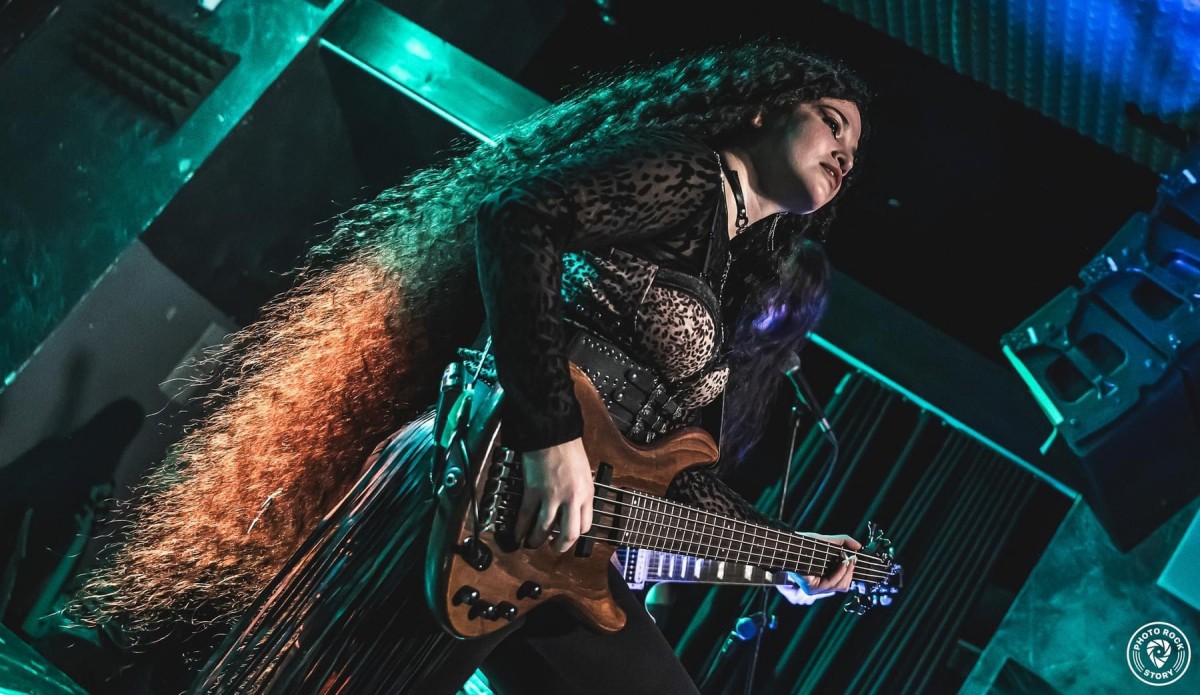
Ever since relocating to Spain, bassist Roxana Herrera has become an increasingly familiar name within the European metal scene. Back in her native of Venezuela, however, she was already involved with highly influential bands like Gillman and Arastral from a very young age. Herrera gives us a glimpse into her lengthy and varied journey in a music scene on multiple continents.
“My interest in music began at a very early age”, Herrera says. “My main influences come from blues and classic rock from the sixties, seventies and eighties, as well as contemporary music. At the age of 10, I began studying guitar in Venezuela, with the support of my parents and a local musician from the city where I grew up named Alcidez, who introduced me to the fundamentals of the instrument. Later, at age 14, I studied electric guitar at the Valencia Music Technology Institute under the guidance of Yaser Núñez, an outstanding Venezuelan guitarist.
That was also the moment when I can confidently say the bass guitar truly called to me. While studying electric guitar at the Valencia Music Technology Institute, I became familiar with the work of a Venezuelan power metal band called Arastral. I was deeply drawn to their arrangements and compositions, and eventually got to know the band members personally. They told me their bassist was about to leave the band, and offered met the opportunity to audition.
I managed to borrow a bass guitar, and two weeks later, I attended the audition and joined as their bassist. From that point on, I began exploring the instrument, inspired by musicians such as Steve Harris, Billy Sheehan, and Cliff Burton. That experience made me realize that the bass had chosen me, and I committed myself to fully following the path of this great instrument, along with the responsibility it demands.”
Significant Musical Growth
“My introduction to the bass was initially self-taught, driven by strong motivation. I felt the need to progress quickly with the instrument, so I searched for methods online, and studied influential bass players within the genre. I listened extensively to rock and metal bands, focusing on improving my technique and sound, while also analyzing gear and instruments. During that period, my technique was focused exclusively on the use of a pick.
My start on the electric bass I got with a six-string Washburn bass, a six-string instrument which I started playing in Arastral. After I joined Gillman, I had the opportunity to become familiar with Ibanez, as the band wanted a fresher image with a classic four-string bass. From that moment, I started playing Ibanez, and later, I had the chance to use a four-string Music Man bass, which I personally chose for some tours with Gillman.
Eventually, I returned to playing Ibanez, which I continue to use to this day. I feel very comfortable with the fretboard layout, the way the instrument can be EQ’ed, and, above all, its versatility. It allows me to work across many musical genres.
In 2014, I pursued formal studies at the National University of the Arts – UNEARTE in Caracas – where I studied music, specializing in jazz bass performance under the guidance of master Carlos Sanoja. This was a period of significant musical growth for me. Additionally, I had the opportunity to learn from renowned Venezuelan musicians, such as Álvaro Falcón, Gonzalo Micó, an Manuel Barrios, which greatly enriched my training and artistic perspective.”
Without Any Limitations
“The first band I formed was formed when I was 17 years old, and it was called Armoni. That’s where I had my first experience as a guitarist. But it wasn’t until I joined Arastral as a bassist that I really began performing at festivals and taking my first steps in the live music scene.
When I joined Arastral, the band was in the process of relaunching after a period of inactivity, which marked a stage of increased activity and momentum for the group, and proved to be a very enriching experience. The songs were composed by Víctor Castillo, the band’s lead guitarist, but I was given complete freedom to contribute my own bass lines, without any limitations.
That period allowed me to grow as a musician, develop discipline, and gain valuable experience through direct contact with audiences, strengthening both my technical development and my stage experience.
In terms of live experiences, however, the most active band I was involved with was Gillman, with whom I had the opportunity to play different regions of Venezuela, as well as perform concerts across Latin America and Europe. On the recording side, however, I was more involved with Arastral, a band with which I also toured several cities throughout the country, further strengthening my experience with the Venezuelan scene.”
Drawn to the Challenge
“While being part of the music scene in Venezuela, I learned through an open call that the band Gillman was holding auditions to select their new bassist. Even more than joining the band itself, I was drawn to the challenge of performing with a group that had such a well-established musical career. At the time, I was only 21 years old, and decided to contact the production team to participate in the audition. They sent me eight songs they considered essential from a musical and technical standpoint.
The audition took place about a week later. I remember being alongside highly experienced musicians from different cities across the country, which made the experience an even more stimulating challenge. When it was my turn, I felt ready to demonstrate my full potential, both in instrumental performance and stage presence. It is worth noting that I was the only woman present at the audition, which made the whole thing even more meaningful for me. One week later, through the band’s social media platforms, it was announced that I had been selected as the bassist for Gillman.
Being part of a rock and metal band composed entirely of men was a continuous learning experience for me, both musically and personally. I always sought to maintain my authenticity as an artist, without losing my feminine identity, demonstrating that our place in the scene does not have to be limited to a specific role: we can contribute from any instrument or creative space.
It is worth noting that at the time, there were also bands with female instrumentalists, though perhaps they were not as visible. At my early concerts, I noticed a mix of surprise, excitement, and focused attention from the audience on my performance. Over time, those reactions have persisted with new audiences discovering me. But with my regular followers, I perceive something different: they now feel more confident, connect with me in a closer way, and enjoy my performances with greater freedom.”
An Indelible Mark
“Being able to play with these bands presented me with a valuable opportunity to share experiences with musicians of outstanding and well-established careers, as well as to acquire in-depth knowledge about music as a discipline, professional training as an instrumentalist, and continuous improvement in stage performance, along with other essential aspects of being a musician.
It has been highly rewarding for me to enjoy meaningful moments with both bands. In Gillman, I had the honor of performing alongside musicians of exceptional caliber, such as Ernesto Ferro, Rubén Limas, who now plays with Tetrarch, and Trino Mora, an iconic figure in Venezuelan pop/rock. Additionally, performing a legendary song with Elkin Ramírez from Kraken at the Siembra y Lucha Festival in Costa Rica has left an indelible mark on my artistic career.
There were great opportunities to collaborate with these highly experienced musicians, and to gain knowledge in areas such as musical discipline, the consolidation of my skills as an instrumentalist, and the continuous improvement of my stage performance. It has been incredibly rewarding for me to have shared memorable moments with both Gillman and Arastral.”
Very Receptive to Emerging and Established Bands
“I can say that during my concerts in cities and states across Venezuela, such as Caracas, Aragua, Carabobo, Falcón, Mérida, Zulia, Lara, Anzoátegui, and Apure, the infrastructure was, in many cases, quite adequate. The sound equipment and the stages were generally well-suited to the concert venues, and the overall production was usually well-organized.
As for audiences, it is important to highlight that Venezuelans have always been very receptive to musical proposals, both from emerging and from established bands. Venezuelan audiences are passionate about live music, and they consistently show enthusiasm and a strong connection to the music during each performance.”
A Cordial and Productive Working Environment
During her time in Venezuela, Herrera was part of a few fairly high-profile projects in addition to her band activity as well. “Km Blues is a musical project led by master Gonzalo Micó”, she explains. “A highly respected musician in Venezuela with significant international recognition. In addition to his work in jazz, he decided to take on a musical project centered on blues and rock ‘n’ roll.
At the end of 2014, I was contacted by him to discuss my availability to join the project. I immediately said yes and had the opportunity to perform several concerts in Caracas with the band, as well as record a couple of tracks for Km Blues’ first album.
In 2016, while studying at the National University of the Arts, I was contacted by Daniel Hurtado, who was the director of the Simón Bolívar Rock Symphony Orchestra at the time, to join the orchestra. They were working on a very ambitious project: the Symphonic Tribute to Queen. It was exciting to be part of it. The dynamic with the director was extremely positive; as a bassist himself, he created a very pleasant, cordial, and productive working environment.
The Symphony Tribute to Queen eventually took place in 2017 at Venezuela’s most important theater: the Teatro Teresa Carreño, in the Ríos Reyna Hall. The event was so highly anticipated that tickets for the first show sold out the day it was announced, leading to the addition of a second and a third performance. The hall has a capacity of 2,367 people, and over two hundred artists participated on stage.
During this incredible tribute, we performed songs that were especially moving for me, such as ‘Innuendo’, ‘Somebody to Love’, and ‘We Are the Champions’. It was an unforgettable experience for all of us involved, and a DVD of the concert was scheduled for release.”
Something to Embrace with Great Gratitude
“Without a doubt, the most complex part of starting a new chapter of my musical career in Spain was the migration process: arriving in another country and starting from scratch. Since my arrival in Spain, I have worked consistently to continue my artistic career, and remaining active as a musician has been a demanding challenge, but also an experience that has strengthened me. Arriving in a country that opens its doors to you is something we must embrace in its proper dimension, with great gratitude.
Living and working in Spain has been a very enriching experience. The proximity to the rest of the countries in the European region has allowed me to travel between different countries with great ease. When participating in a band, it is much easier to move around to play at a festival in Europe, or to work with a band that does not necessarily have its base in Spain.
Among my most important collaborations, I had the opportunity to work with David Readman, participating in his 2021 recording production of the single ‘Madame Medusa’, for which there is a music video. Likewise, I played with the Madrid-based band Endernity in 2022, performing concerts with them in Vigo, Murcia, and Fuenlabrada. From April 2023 to December 2024, I was the bassist for the band Cobra Spell.
Currently, I am involved with several musical projects as a session bassist, while at the same time developing my own personal project, in which I not only handle bass duties, but am also exploring singing. Additionally, I am responsible for the compositional structure and the entire conceptualization of the project. It is a great challenge, and I am truly enjoying every part of this process.
Within the metal scene, I am part of Darktemis, a symphonic gothic metal band that I recently joined as their bassist, and with whom I have just recorded the music video for the title track of their first album ‘Asylum’.”
 Kevy Metal
Leave a comment