
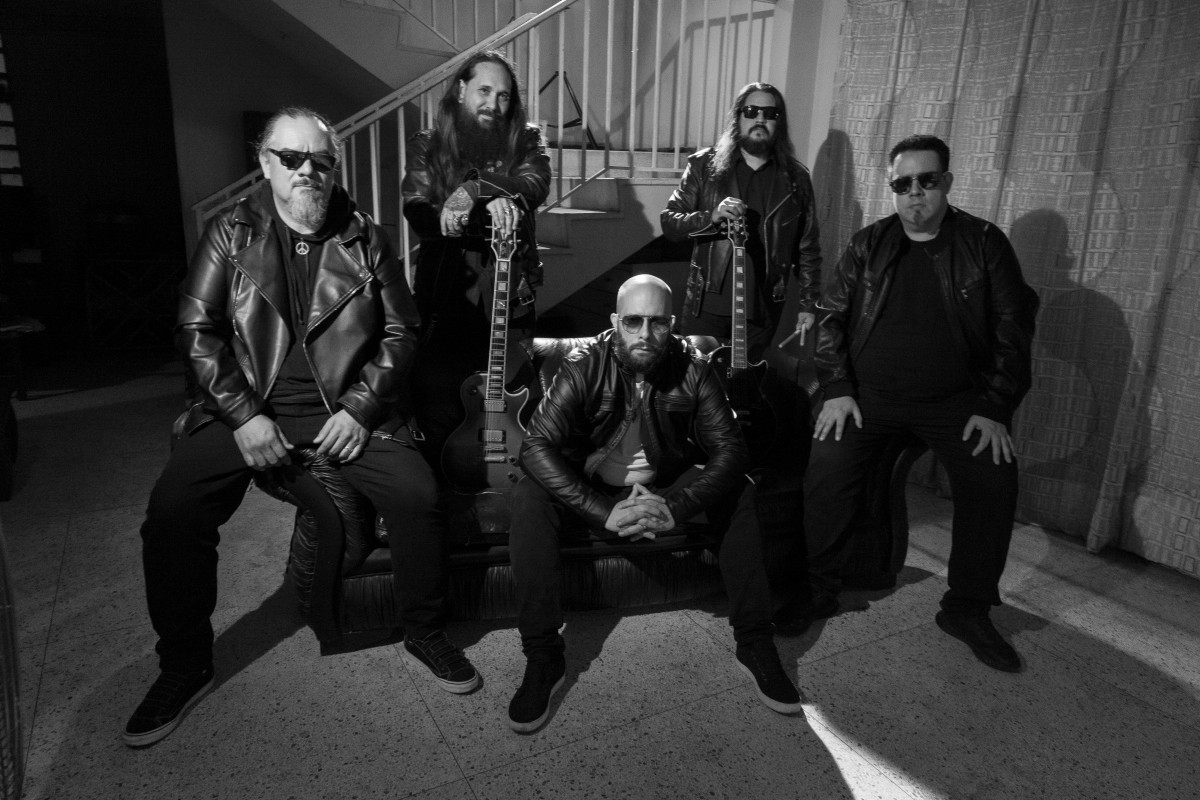
Vettor n’ The Insurrectos is a relative newcomer in the Venezuelan scene, releasing their debut album ‘For Everyone But Not’ in late 2024. Make no mistake, however, the members of the band are all veterans of the scene. Singer/guitarist Giancarlo Vettor, guitarist César Barrios and keyboard player Angel Paredes introduce the idiosyncratic band.
“Angel and Johnny (González), our drummer, used to play together in a band called Sabotaje”, Vettor explains. “And then Eykell (Ramírez), our bass player, joined Sabotaje in 2014. Angel didn’t play keyboards back then. He played guitar in Sabotaje. I founded Overhate in 2003, and I only played in Overhate until 2015, which was when everyone left the country. And that was hard, because we were just pre-producing what would become our third record ‘New Beginnings Are Met’ (2020).
By the time I was doing the ‘New Beginnings Are Met’ record, I recorded a bunch of acoustic demos, and those weren’t demos you could play with a band like Overhate. It would maybe have been interesting if a band like Opeth did it. But that’s when I went to Facebook – when I still used that – and said that I had some songs that didn’t sound like Overhate, and I was looking for people to play them with.
That’s when Eykell and Johnny told me they would do it. They came to my house, we started jamming, and Johnny said: those demos, I hear some keyboards there. But my keyboard ability sucks. So Johnny said: I have a friend who plays keyboards, I will tell him. And it happened to be Angel. Angel sent a recording of the first song we did together, which is ‘To the Devil His Due’, and I was blown away. It was excellent!”
Not Doing Anything
“After that, Angel came to my house, we started jamming, and we became a four-piece until César came into the band, which was in September 2023. That’s how we prepared a whole record, our first one, recorded it, and then some stuff happened. Johnny was dealing with a lot of familial issues, because his oldest daughter had cancer. So that was a very difficult time.”
“Around the same time that Johnny was dealing with his daughter’s cancer, my father passed away”, Paredes adds. “And an uncle that I lived with passed away as well. I just got fired from my job, and around the same time, Eykell’s father passed away as well. It was quite a difficult time for all of us. Those were four years that we were a band, but we weren’t actually doing anything, simply because we couldn’t.”
“The economical situation when we had just started out was very tough as well”, Vettor emphasizes. “One day we were rehearsing, and we wanted something to drink, so we went to the liquor store to buy a bottle of cheap rum, and we had to pay for it using four credit cards, haha! You should have seen the clerk’s face. She asked: why are you paying like that? Are you broke? The four of us looked at each other and said: do you even care that we’re broke? Thankfully, we’re not that broke anymore. It was just that the situation was dreadful.”
Three Bands on the Same Record
Although the band carries his name, Vettor is the first one to point out that Vettor n’ The Insurrectos is a proper band that values collaboration. “As soon as Angel adds the keyboards, things change”, he says. “Angel doesn’t like to do the same pattern over and over again. Plus: there’s a couple of songs on the first record that came together because he sent me a keyboard line. ‘Nuestra Canción’ is one of those songs.
He sent me the keyboard line of the main melody, I grabbed my acoustic guitar and sent him back a very rough demo. He couldn’t understand what I did there, so I said: give me a couple of days, so I can just get home with some time to sit down and record it. When I got all the guitars and the programmed done, everybody was excited.
We ended up having most of the songs coming about like that: a keyboard line and I add stuff on it, or I sent a demo and Angel added keyboards on it. Then Johnny and Eykell worked on their drum and bass parts, and we ended up having, I don’t know, nineteen songs. Too many songs. We were trying to agree which songs were going to be on the record. It sometimes sounds like there were three bands playing on the same record.
In the case of ‘Nuestra Canción’: that is one of the songs that is tuned down to B, heavy, distorted, and Angel playing that acid keyboard line. That’s one band. Then, if you play in E, with a heavy organ or piano, that’s another band. Even though it’s the same four guys playing. The songs we eventually went for had a certain vibe, and we put the other demos to the side for a different occasion.”
The Most Outspoken Opinions
“When I joined the band in 2023, the whole record had already been finished”, Barrios adds. “But now that we’re creating new songs, I think fitting in with the band has become very natural. If Giancarlo or Angel has an idea, they show it to us, so we can start working on the structure and the main parts of the songs. Giancarlo could say: César, I want you to play a solo in this section. The process is very natural, very collaborative, very sincere, very honest. If we don’t like something, it’s no problem for us to say: why don’t you try this or that?”
“Johnny is the one with the most outspoken opinions, I should say”, Vettor smiles. “He’s got that vision where he says: maybe this part shouldn’t be that bloated, we should simplify the drums, and maybe instead of that beat, we’ll do this beat, and when we do this beat, maybe we can do the vocals like that. It’s really a 180-degree turn sometimes.
That happened on a couple of tracks from the first record. There’s a track like ‘Obscure’. Johnny came up with the idea that the drums shouldn’t be that bloated. I’m really proud of that song. It had that input, and we did the video for that song as a starter. It didn’t sound like that when it was first done. It had little bits of other things going on there.
There are also songs that ended up way shorter than they were on the demos. And there were songs like ‘Between Their Lines’, which were originally much mellower, and ended up being much heavier.”
Not in English Class
“Our first record is titled ‘For Everyone But Not’, and that is because of remarks we got from people”, Vettor explains. “We played live one time, and people said: your band sounds like the Foo Fighters, but not. Or here in Caracas, there is a park, it’s called Parque del Este. It’s located in eastern Caracas, and it’s got a beautiful view of Ávila Mountain. We were fortunate enough to play in that park, with that view, in front of six thousand people, and that was like our third show, haha!
We did the show, had a great time, and then a lot of friends said: hey, that band sounded like Type O Negative, but not quite so. And then like five minutes later, someone else said: well, that band sounded like Opeth, but not Opeth. There was even someone who compared us to The Allman Brothers Band. I remember looking to Eykell and saying: do you even know who The Allman Brothers are?
That’s when we said: let’s call the record ‘For Everyone But Not’, because everybody says we sound like someone, but not, haha! There is a woman named Coromoto, who helps us with a lot of things, like making pictures. She’s not a roadie, but almost, and we all really appreciate her help. She told us: ‘for everyone but not’ is incorrect in English. But we’re not in English class. The record is called that and we do not care, haha!”
The Fat One and the Professor
“I always had it in mind that the lyrics for this band were going to be in English. Because I can sing in Spanish, and I do it well enough, but people make fun of me, because there was a time when we wrote some rock lyrics in Spanish, and for some reason, I was pronouncing it like Eros Ramazzotti at the time. So for this record, we did our songs only in English.
An exception is ‘La Balada del Gordo y el Profe’, which translates to ‘the ballad of the fat one and the professor’, the fat one being Angel, and the professor is Eykell. When we started rehearsing, these two would start giving shit to each other, and Johnny and I would look at each other: do you know what’s going on here? They weren’t exactly fighting, but they always had something for each other every day.
There was this demo we were working on, and Angel just finished the keyboards for it, and I said: you’re going to love the lyrics to this one. When we listened to it the first time, Angel just looked at me and said: why did you write those lyrics? I wrote these lyrics because you two won’t stop giving shit to each other, haha! Eykell loved the lyrics, and suggested to leave it like that. When we play it live, everybody wonders why we play it, haha! If you know some Spanish, give it a try.”
A Special Experience
“My father gave me Metallica’s black album”, Vettor says about his main inspiration. “And I remember being blown away just listening to ‘Enter Sandman’. You can say whatever you want about ‘Enter Sandman’, but that song kicks ass, and kicks it badly. I heard it when I was only 11 years old. I guess I didn’t even speak English. We were kids. I started buying magazines and stuff, and I guess I bought one that had Metallica in it with a photo of James Hetfield playing guitar that made me think: I’ll be the frontman in a band.”
“My mother always wanted us to learn some extra activities”, Barrios says. “And in my house, there was always a Venezuelan instrument called the cuatro. It’s like a ukulele, but not. So I took some classes, but I didn’t really practice on the cuatro so much. But I did at some point start listening to The Beatles, and I took interest in the guitar from hearing those records.
Then in 1983, when Van Halen came to Venezuela, I had the chance to go to the concert, and it really blew my mind. So I went home with the idea that I wanted an electric guitar. When I finally got it, I began to study it seriously. Looking at Eddie Van Halen playing in front of me was a special experience. After that, I started to learn more and more rock music from the eighties, like Saxon and Iron Maiden.
When I was 14 years old, I was in a band called Concreto, and our rehearsal room was next to Resistencia’s. Last May, I met mr. César Somoza, their singer, and told him about that, which he actually remembered. It was incredible.”
“My first contact with music was through the keyboardist Yanni”, Paredes follows. “At the moment, my role model is Jordan Rudess from Dream Theater. I didn’t properly learn to play the keyboards until I heard Jordan Rudess.”
“Angel has big heroes”, Barrios smiles. “He has a very good sense of hearing as well. When we rehearse, he hears it immediately when we’re out of tune, or when the chord phrasing doesn’t sound quite right. He is gifted, I have to say!”
Always Attracted to Extremes
“When we started playing, I would say the scene in Caracas was a lot bigger”, Vettor says. “When we grew up in the nineties, that was when nu-metal was thriving. It’s funny, because Venezuela was always attracted to extremes. If you were into metal, you either played in a nu-metal band, a new wave of British heavy metal-styled band, or you played death metal, grindcore or black metal. So if you went to a show, there would be one heavy metal band, one nu-metal band, and maybe five extreme metal bands.
Overhate toured the most after we did our second record, ‘Relentless Is Our Strength’ (2011). We did a lot of shows in Venezuela and abroad: we played in Ecuador, we played in India, we played in Canada, and there were a lot of plans. By that time, we had to make a decision. It was a bit tough back then, but we could have maybe managed to spend one year doing a very decent tour in Europe or maybe America. The United States was always the hardest, because of the visa stuff and taxes and everything.
As of now, the most difficult thing is finding a good enough place to play. There are cafés and restaurants where shows are organized, but they are small venues with a capacity of maybe sixty people. But that would be enough to go and have a good time, and start spreading the word.”
Violent Crowds in General
“When I was in Overhate, it was good for extreme metal bands to play in the rest of the country rather than Caracas. We played on Margarita Island, and the crowd there was violent. For extreme metal, that was heaven. Eastern Venezuela in general has violent crowds, haha! The eastern part of Venezuela was very well-known for death metal and grindcore. Vhill, the band who represented Venezuela at Wacken Open Air last year, is from a city in eastern Venezuela called Puerto Ordaz.
Valencia is considered Venezuela’s rock capital, and that’s where some of the best-known artists are from, like Gillman and Arkangel. Maracay recently rebuilt or rescued the Concha Acustica, or the acoustic shell, and held a festival there. Machine Head played there when they toured Latin America, and it was a great concert. There are also festivals like Oriente Extremo in Puerto La Cruz or Extreme Gore Fest in Maracay.
But putting together a show that, let’s say, two thousand people will attend just isn’t possible right now. You can get the venue, you could rent equipment and get your sound going, but good luck with the ticket sales and seeing if people actually show up. Here in Caracas, we played three concerts in another park, Arístides Rojas, this one in western Caracas. It was a free-admission show with eight bands or something, and about four hundred people showed up. We also did a small show here in Caracas in a small bar called La Pared.”
An Active Scene
“In the 2000’s, there were a lot of mainstream bands coming here. Metallica came and played in Venezuela for the second time, Motörhead, Deftones, Nine Inch Nails, Incubus… And on the extreme level, a lot of tours came through here: Tankard, Destruction, Dimmu Borgir, Cannibal Corpse came a few times, Kreator and Exodus came on the same tour – go figure how happy I was about that show!
When that was happening, we had an active scene, and you were able to play and travel as a band. There would still be small shows. If you went to cities outside of Caracas, and you played in front of 150 people, you could call it a decent show. But that was okay. There were also cities where you could play a show, and maybe six bands were on the bill, and around three hundred people showed up. Great show!
You still didn’t get that much out of it of selling merchandise, but there was an active scene. Right now, there are a few concerts, but it’s nothing like it was. Back in the day, you had to choose, and you also had to choose whether you wanted to go to a show from a local band rather than an international one. You don’t have that right now.
If you were to put up a show in Caracas, but an international band also plays, whoever is playing, people are more likely to go for the international act, because we don’t have that many shows these days.”
Many thanks to Ariah Records for their help setting up this interview.
 Kevy Metal
Leave a comment