
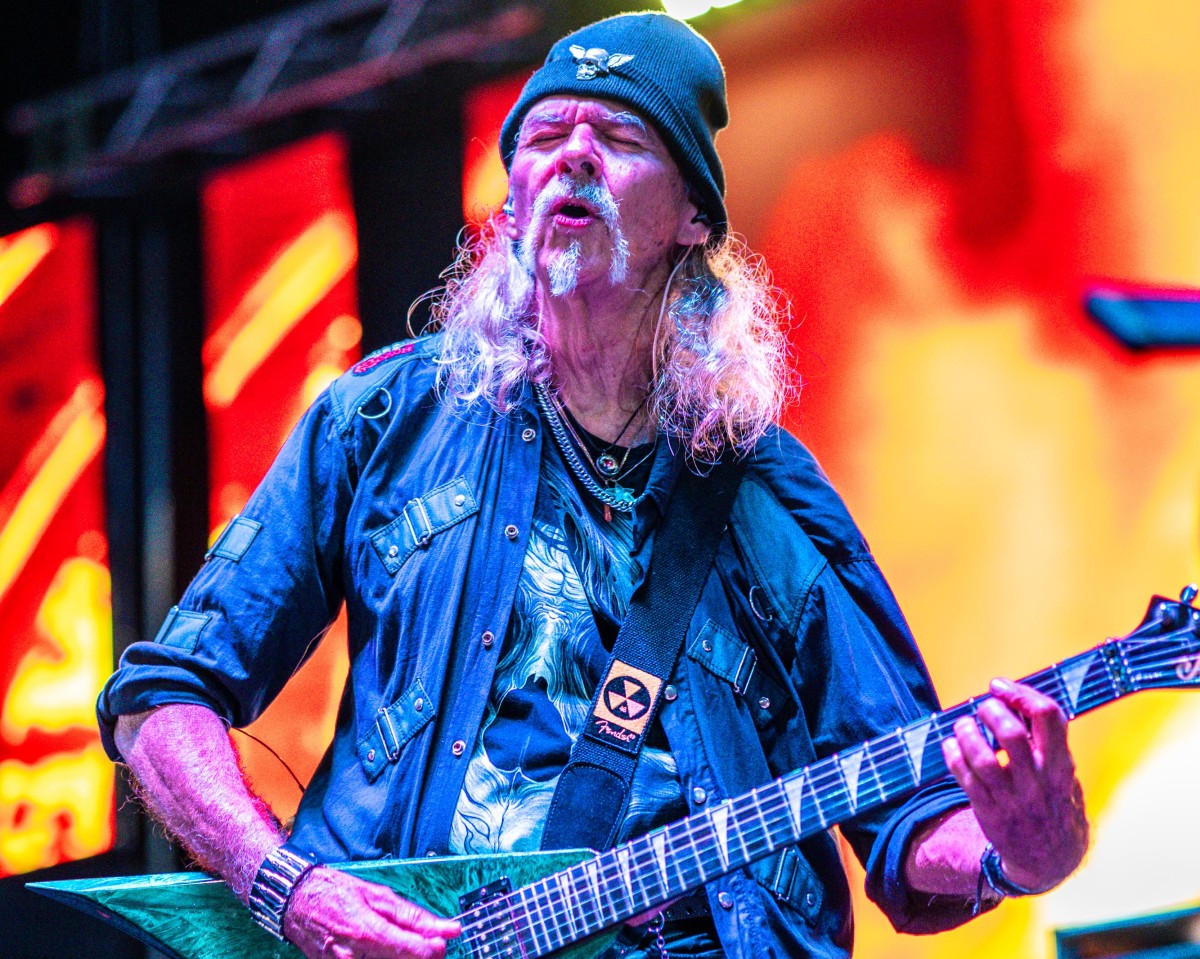
Along with his drumming brother Giorgio, Arkangel guitarist Giancarlo Picozzi was part of the first generation of Venezuelan heavy metal musicians, establishing the band under the name Power Age as early as 1978. These days, the Picozzi brothers are still the core of Arkangel. Giancarlo looks back on nearly forty years and seven albums of Venezuelan heavy metal history.
“When Paul Gillman (original Arkangel singer) and I were students, we were in the same class”, Picozzi reminisces. “Back in 1975, I told him about a song I had heard, which was ‘War of the Gods’, by a singer named Billy Paul. It was soul music, with notable synthesizer sounds, and it lasted about ten minutes. It drew my attention, because it had a unique atmosphere. Paul told me that it was nothing compared to the bands that he was listening to, and he invited me to visit his home to listen to those bands.
When I entered his room, I was impressed by the large number of posters of rock bands he had on his wall. His room was foll of posters of Black Sabbath, UFO, Grand Funk, and lots of other bands. Once I wore my headphones, I heard Pink Floyd, Genesis and yes for the first time. I loved all of them, and asked him if he could record a cassette of them for me. He answered that he could record a cassette with one specific band, and if I liked it, I would probably enjoy the rest as well.
That first cassette was a Black Sabbath compilation album. Obviously, I was in shock. I never thought that music like that could even exist. But it wasn’t until we saw the cover of Kiss’ ‘Alive’ double album that everything changed for us. We ended up so addicted to Kiss that we came up with the idea of dressing up like Kiss and pretend to play a concert, since none of us played any instruments.”
A Guitar That Truly Existed
“That went really well, but after that, we were left with a certain sense of emptiness, and while in the dressing room, we wondered: okay, so now what? What will we do now? So we decided then and there that we had to learn to actually play the instruments we pretended to play, and form a rock band. That happened in February of 1978.
My brother Giorgio was Peter Criss, and I was Ace Frehley, and they became our alter egos. Paul couldn’t play bass, so he decided to become the singer. Our classmate Miguel Sánchez, who ended up playing Paul Stanley, would be our second guitarist. Our bassist would not come until a little bit later. His name is Rogelio Gutiérrez, the son of Mexican immigrants, and a big Kiss fan as well, so we were all on the same wavelength.
In Valencia, where we lived, there weren’t many music shops. The best of them were the Yamaha stores, which I still think are excellent instruments. They just had a very limited stock. When a friend of ours who was also a musician told us about a shop that sold copies of Fender and Gibson guitars, he told us that they had the type of guitar that I had fallen in love with: the Flying V.
At first, I thought he was messing with us, but I could not resist taking a look, and much to my surprise, he had been telling me the truth! That guitar truly existed! It was a Gibson copy from a Japanese manufacturer called Maya. It cost me about 280 dollars. I still own it, and it still is my favorite guitar to this day.”
The Message Should Appeal to People
“Power Age was our first band. Up until we started that band, I could not play a single note. After that, though, everything went fairly quickly, and within a short amount of time, I was able to play a couple of riffs on my guitar. I was completely self-taught, because there weren’t any rock academies around yet at the time. I learned to play some classical music on a Spanish guitar, after which I listened to bands like AC/DC, Black Sabbath, Mott the Hoople, and Bad Company a lot. Those were the bands I enjoyed the most, besides Kiss of course.
In the beginning, we played a lot of covers from bands that, at the time, weren’t very well-known in Venezuela yet, such as Aerosmith, The Babys, AC/DC, The Dictators, and Black Sabbath. The first few songs we wrote ourselves had English lyrics as well. Later on, we translated them into Spanish. At first, Freddy (Marshall, guitarist) refused to have us sing in Spanish. But at some point, he changed his mind, and he agreed that it wasn’t just the music that should appeal to people, but the message as well.
Personally, I didn’t bother with the lyrics very much. Instead, my focus was on coming up with riffs and making the structures of the songs. Just like Freddy. After that, Gillman wrote the lyrics based on the feelings that the music evoked in him. That worked very well.
Alfredo Escalante was a key figure in making the band as well-known as we eventually became. He was the host of a television program, and he had a lot of knowledge about the contemporary music scene of the time. He managed to convince a promoter of the record label Color to attend one of our rehearsals, which resulted in an offer for a record deal for four albums. Three of these albums were for Arkangel, and the fourth ended up being given to Paul Gillman.”
Enjoying a Real Rock Concert
“There was a fledging rock scene in Venezuela at the time, and there were some differences in how the other bands treated us. Bands like La Misma Gente treated us as brothers. Others were a bit more suspicious of us, maybe because we came from outside the capital to show people what we could do: making the audience enjoy a real rock concert.
We weren’t like some other bands, who mostly just enjoyed showing off how good they were at playing their instruments, and completely lost sight of the people who paid for tickets to come and see them. They were cool and apathetic, and that’s what distinguished them from us: we were celebrating enthusiastically. Maybe it bothered them that this happened in their own cities, like Caracas.
Like some other cities, Valencia did not offer a lot of options for concert locations. They generally don’t have the necessary facilities. There are often underground bars that aren’t properly equipped for concerts. Many of them don’t even have a proper stage. And yet, they manage to organize something. This is still the case today, but the audience has changed. There aren’t many bands who play their own material anymore. Instead, they play covers of bands like Metallica, AC/DC and Nirvana. Often, they end up stagnating and disappearing, which I think is a pity.
In the early eighties, however, I think Valencia was made into an attractive place to play rock music, because there weren’t many bands who played that style of music in Caracas. Most of the bands there were focused on fusion, mixing jazz with Latin-American rhythms and trying to be progressive. Valencia offered hard rock, which was more expressive and rebellious.”
Paying the Price for Inexperience
“The recording studio where we recorded our first album (‘Arkangel’, 1981) had all the facilities necessary to record a proper album, but the person who manned the console was not very familiar with rock music as we knew it. We brought in some examples of how we wanted the music to sound, but unfortunately, that did not help.
The guitars were recorded without any microphones. They went straight from the distortion pedals to the mixing console. We did complain that it did not sound like the examples that we had presented to him in the slightest. He told us that that was something that would be worked out during the mix, which of course did not actually happen. We have paid the price for our lack of experience.
We were offered just three days to record that first album. We did all the basic tracks on day one, then did all the solos and other overdubs on day two, and on day three, we recorded all the vocals. The final mix was also done on that third day. For the second album (‘Rock Nacional’, 1982), we were given more time, and we made sure that we could actually use our amplifiers.
For the third album (‘Represión Latinoamericana’, 1983), we changed studios and recorded in Valencia, where we were able to get better results. The sound engineer at the console understood our music much better, as he was a musician himself and understood rock music. We were able to spend a week in that studio to record things and experiment a little.”
During those days, Arkangel’s music was even featured in the fairly well-known movie ‘Cangrejo’ (1982). “Alfredo Escalante had good connections”, Picozzi smiles. “Among whom film maker Román Chalbaud. When Román told Alfredo about the movie he was making, Alfredo made sure that multiple Arkangel songs would end up on the soundtrack. We also had a cameo in the film, and Alfredo also appears in the film. We were honored to be part of the film, and it presented us to a completely different audience than before.”
Adapting to Various Singers and Styles
Gillman left Arkangel shortly after the released of ‘Represión Latinoamericana’. “To be honest, the whole thing hasn’t been all that dramatic at all”, Picozzi assures. “We have always kept believing in ourselves, and we were never afraid to experiment with our music. With every member that left or joined the band, we learned something new. And really, that’s the sort of thing that makes you a better musician.
After Gillman left, we just kept on recording, but then without a record deal. We became a self-produced band, and we released various works, such as ‘No Más Apariencias’ (1991), ‘Inmortal’ (1993), ‘El Ángel de la Muerte’ (2000), and ‘MMVII’ (2008). Before ‘MMVII’, Freddy also left the band. Freddy is irreplaceable. He is a true character, with an exceptional sense of musical insight. The guitarists who came after him really only took his place on the guitar. Personally, I tried to stay as close to his way of composing and arranging songs as possible. I truly hope I succeeded in that.
Our most recent work, which I would really recommend anyone to listen to, is our album ‘Theātrum Timorem’ (2019). I think it’s our best work, and in Deibys Artigas, it features an amazing singer, truly excellent. We have also released various compilations in the meantime.
I think it is essential to write to the strengths of the singers you work with, especially if they also happen to write music or play any instruments. We have been able to adapt to them and their various styles, which has resulted in a discography in which no two records are alike. They all have something unique and distinctive.”
Seven More Doors
“With the exception of our first album, I think we managed to really find our own sound. But more than that, we have managed to develop our own voice, without having to follow any trends or changes in the musical landscape. When we create new songs, they are only subject to our souls, and how we want the songs to sound at that particular moment.
The most important method to reach that, I think, is to not let one band member create all the music, as that will generally result in a body of work in which every song sounds similar, and that’s simply incredibly boring. There is nothing better than allowing everyone to let their imaginations run wild collectively during the songwriting process.
Through the years, I think I have built up a certain amount of musical knowledge, and I am always trying to get better one way or another. As my beloved guitar teacher once told me: in the world of music, if you open one door, you will find seven more, all of which you also have to open.”
A Point of Reference
“In the rest of South America, we have grown into somewhat of a point of reference. Especially in Colombia, where they love us a lot. Just a couple of months ago, we toured through Colombia and Ecuador. We spent about a month there, and we came back in November to headlinethe Rock al Rio festival in Rio Negro in the Antioquia Department.
We have been traveling to Colombia fairly frequently since around the year 2000. Once, we toured there with the Spanish band Barón Rojo for a couple of weeks. I think that was in 2014 or 2015.
No matter where we play, my brother Giorgio is always in charge of creating our set lists. They usually turn out perfect. He has a good sense of how to connect the songs, and where there needs to be paused. We have a couple of variations which we can alternate between performances based on the audience we will be playing for.”
Many thanks to Ariah Records and Joad Manuel Jiménez for their help setting up this interview.

 Kevy Metal
Leave a comment