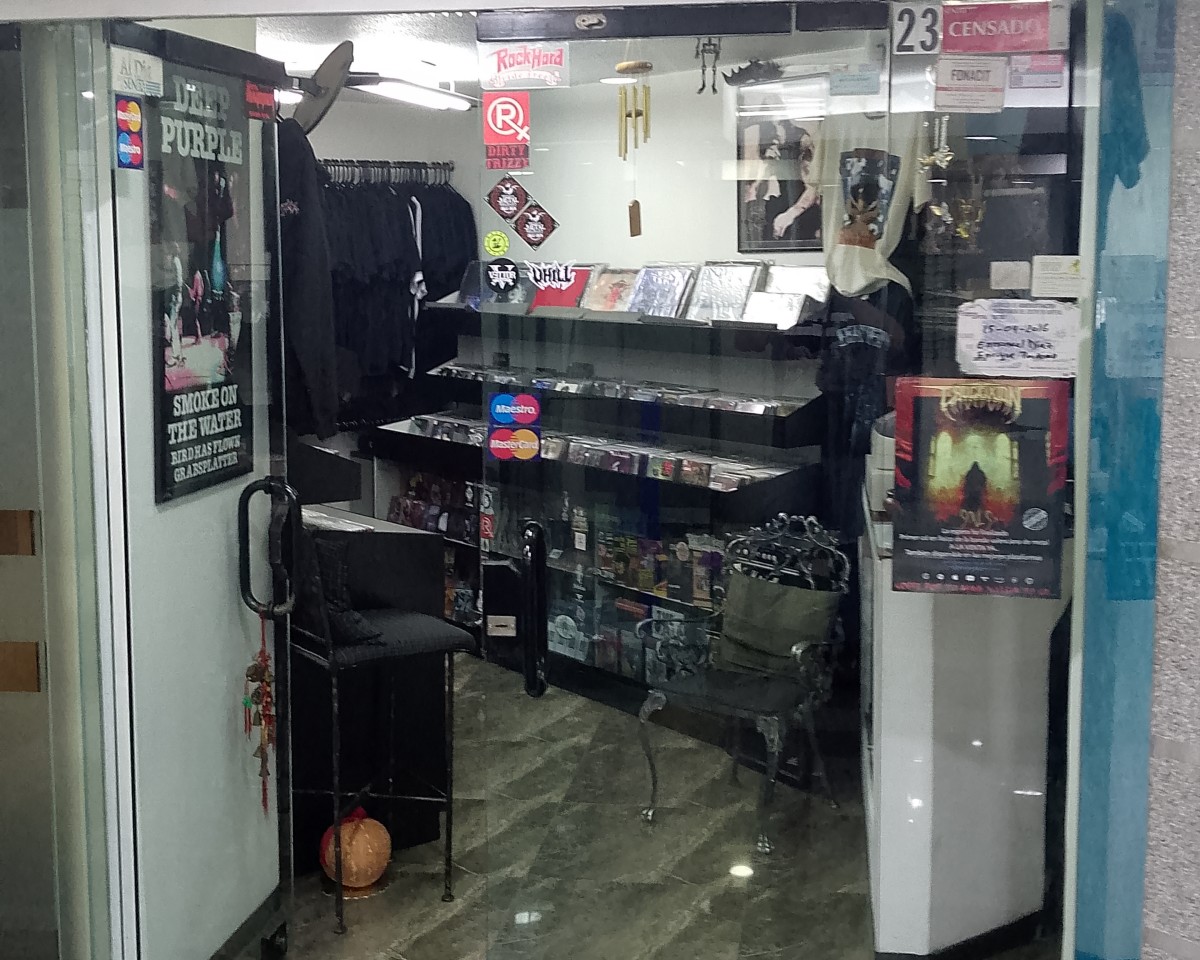
Record store, label and concert promoter Ariah Records is at the heart of the Venezuelan Metal Scene, and has been for about 25 years. Co-founder and co-owner Riccardo Musci gives us a glimpse into his motivations behind starting Ariah Records, and how the Venezuelan metal music industry has changed over time.
“My passion for rock and metal music started in the early eighties”, Musci says. “When I was 10 or 11 years old. At first, I liked to look at the covers of rock albums in record stores. I watched commercials on TV for various albums of that time, and for concerts that were held in the country in those years, with bands like Queen, Van Halen, Barón Rojo, and others. However, when I heard rock records for the first time, it was with two older cousins of mine.
One of them lived in Maracay, and passed away a few years ago. With him, I discovered my true love for rock music, and especially the heavy side of rock music. Band like Uriah Heep, Deep Purple, Grand Funk Railroad, The Guess who, Procol Harum, The Beatles and Rare Earth. His best friend was also a rocker, and with him I got to listen to bands like AC/DC, Def Leppard, Scorpions and The Police. He gave me my first cassette, which was Pink Floyd’s ‘The Final Cut’ album.
With my other cousin, who lived in Caracas, I listened to more progressive rock bands, like Genesis, Premiata Forneria Marconi, and Van Der Graaf Generator. But I also discovered some hard rock bands with him, such as Triumph and Rush, and the first Venezuelan metal bands, like Resistencia and Arkangel.”
Selling CD’s from Home
“When I was 8 or 9 years old, I began to play guitar. My aunt and my late godmother paid for my music teacher. I started reading notes and playing guitar, but I quickly stopped, because I wasn’t really interested in music at that age, and I didn’t even know that rock music existed, as I didn’t discover it until a few years later. Nowadays, I can’t play guitar anymore. I forgot all of it.
I am a graduate in industrial engineering, with a postgraduate degree in marketing. So I learned management and business skills in my university, but I had never thought of applying them to my hobby, which was listening to rock and metal music. It really all started with being a simple fan of this style of music.
In the eighties and nineties, there were quite a few record stores specializing in rock music, but they didn’t last very long. And the good ones gradually disappeared. Another issue was the very high prices of imported records. One day in 1999 or 2000, while talking to my brother José Musci, who is also a rock and metal fan, I suggested bringing in CD’s and selling them ourselves. He thought it was a good idea, but my mother wasn’t too keen on the idea. I mentioned this idea to two other friends, and they thought it was a good idea to partner up with us.
In 2000, we decided to go to Europe to attend Wacken Open Air and concerts of Iron Maiden and Deep Purple. We also decided to contact several European distributors and record labels. We introduced ourselves in person, and they sold us their products. My brother and I began selling them in our home for good prices after returning home from our jobs.
Word started to spread, and there came a time when we no longer had privacy in our home due to the number of customers coming in, so we decided to rent a space. That is how Ariah Records as it is known today came into being, as a record store, event promoter and record label.”
Focus on High-Quality Releases
“The idea of starting a record label begin with another company that we had with other partners to organize concerts when we began selling CD’s at our house. The company was called South Metal Productions. With this company, we organized the first concert of the Argentinian band Rata Blanca in our country, in the year 2002. The band’s manager offered us the chance to launch their album ‘El Camino del Fuego’ and a Rata Blanca tribute.
Those were our first albums. ‘Cuauhtemoc’ from Gillman was also going to be a South Metal Productions release, but Paul Gillman, who is a friend of ours, didn’t know the other partners of South Metal, and preferred to launch it with our brand Ariah Records. And the catalog number became ARIAH 001.
Since then, Ariah Records has released a few albums, and our policy has always been to ensure that the bands are professional, and their releases are high-quality releases. Musically, we focused on heavy metal, thrash metal, and well-crafted death metal. Bands that we worked with are Gillman, Pablo Mendoza, Torre de Marfil, Grand Bite and Haboryn, of which multiple members now play with the Venezuelan/Spanish band ancient Settlers.
We received offers from foreign bands to release their albums, but Venezuela is a small market. That market became even smaller with the arrival of piracy and the beginning of digital streaming, YouTube, and things like that. The record label is now on hold.”
Awards for Heavy Rock
“As I mentioned, organizing concerts started with our parallel company South Metal Productions, with which we organized events for national bands and international events like the Rata Blanca concert. With Ariah Records, we organized events like Ariah Fest in 2006. My brother founded the Premios Metal Hecho en Venezuela, the most recent edition of which was in 2023, and a series of events called Ariah de Conciertos Acústicos, where new rock music talent of all styles is showcased, playing in an electro-acoustic format.
The idea for Premios Metal Hecho en Venezuela came about in 2003. At the time, there were several awards for pop and rock music, but none for heavy rock. My brother and I agreed to organize an award ceremony jointly with another well-known record store and label at the time called Melomaniac, and the members of some well-known websites that also covered music at that time.
The goal was to recognize talent in all styles of heavy rock and metal. Awards were given to bands, musicians, engineers, albums, concerts, and so on. This event would be biannual. The winners are chosen directly by the public. The public nominates the artists, then the top five with the most votes are chosen – after a jury has reviewed the nominees and evaluated their merits, also to ensure that they have not been nominated with false votes – then the five nominees are published by category, and the public directly gets to vote.”
More People Left Outside
“The first edition of Premios Metal Hecho en Venezuela was scheduled to take place in November 2003. At that time, the bands Shaman from Brazil, Kraken from Colombia, and Tren Loco from Argentina were in the country for the Primer Festival de Música Urbana, which was organized by the Venezuelan government, and where I was part of booking the heavy rock bands. They were also invited to the event. However, due to local issues with the electricity company, the date had to be postponed to January 2004.
This edition of the awards ceremony featured live talent represented by Gillman, Resistencia, Pablo Mendoza, Nada, Pig Farm on the Moon, Luna Tenebra, Krueger, Penumbra Leal and Elefreak, who did not perform in the end. The second edition was held in early 2006 at a larger location, as more people were left outside the event than entered the venue at the first edition. This time, the bands that performed were Stratuz, La Misma Gente, Grand Bite, Metempsicosis, Subconsciente?, Ghost Machine, Yaguar, Lignum Crucis and Landsemk.
Initially, the bands Arkangel, Guaica, Dirty Trizzy, N.O.D.S., Ravenous Feast, Alto Pana Power Trio, and Scape participated. At the last minute, Stratuz’ guitarist suffered tinnitus and was placed on medical leave for several months. Scape’s singer came down with the flu, and one of the Alto Pana Power Trio musicians, who also plays in other bands, had a commitment in another city, and the band was unable to perform. The remaining musicians from Stratuz and Scape were present as members of the audience, and were nominated in various categories. Grand Bite made up for these absences.
The next edition is expected to take place in late 2026, depending on the heavy rock scene in Venezuela. You can check the Premios Metal Hecho en Venezuela Instagram, where a great number of musicians from the hard rock and metal movement of Venezuela from the seventies until today send us a greeting and invite people to the event.”
Generational Shift
“Caracas is the biggest city of our country with six to seven million inhabitants, and the majority of concerts are in this city. But other cities exist where gigs are offered with good production and equipment, just with slightly smaller audiences than in Caracas, like Valencia, Maracay, Barquisimeto, Puerto La Cruz and Puerto Ordaz. The vast majority of musicians and rock and metal producers in Venezuela know each other and know who’s who in terms of event quality. Sometimes, some ghosts appear who put on low-quality events, but that happens in every country.
However, things have changed quite a bit in Venezuela. The best time for rock and metal events was from the end of 2001 until 2013 or 2014. After that, the economic situation became very severe, causing a decline in purchasing power, the migration of many Venezuelans seeking economic improvements, the pandemic and the generational shift; the so-called crystal generation listens to pseudo-musical genres like trap and reggaeton. This has meant that metal events have decreased considerably due to private promoters, and there are now only a small number of concerts in other styles of rock.
Currently, the scene is very small compared to the 2000s and the 2010s. No one can predict how it will be in a couple of years. A few years ago, there was much more interest in the work of Venezuelan bands than there is today. With digital platforms, people don’t consume as many CD’s and LP’s, but there are more people interested in the work of foreign bands. Unfortunately, we are now experiencing the invasion of cover bands, and there is very little new talent emerging.”
Recommendations from Ariah Records
Upon request, Musci is happy to give us a list of albums that should be in any serious collection of Venezuelan hard rock and metal. Bandcamp links are added wherever available. “As a rock and metal collector, I can recommend the following albums, though it is possible that I have forgotten some bands”, he says.
Ladies WC – Ladies WC (1969) (psychedelic and maybe proto-metal)
Tsee Mud / Bacro / LSD – (split of Venezuelan psychedelic and proto metal bands) (2012)
Resistencia – Hecho en Venezuela (1981)
Resistencia – Estrategia Contra el Movimiento (1982)
Arkangel – Rock Nacional (1982)
Arkangel – El Angel de la Muerte (2000)
Arkangel – Theatrum Timorem (2019)
Gillman – Levántate y Pelea (1984)
Gillman – Escalofrío (1994)
Gillman – Cuauhtemoc (2003)
Grand Bite – Al Borde del Precipicio (1985)
Grand Bite – La Sombra (2010)
Stratuz / Noxious – In Nomine / Grotesque Death (split, 1993)
Stratuz – Osculum Pacis (2022)
Cosmical – Fractal Emptiness (2025)
Krueger – Venezuela: Cuentos Grotescos de Amor y Muerte (2013)
Dischord – The Constant Fear (2013)
Nocturnal Hollow – A Whisper of an Horrendous Soul (2019)
Stormthrash – Systematic Annihilation (2018)
La Misma Gente – Por Fin! (1983)
Baphometh – In the Beginning (demo compilation) (2003)
Ravenous Feast – Song of Heroes (2023)
Vettor n’ the Insurrectos – For Everyone But Not (2024)
Landsemk – Horizontes Oscuros (2012)

 Kevy Metal
Leave a comment