

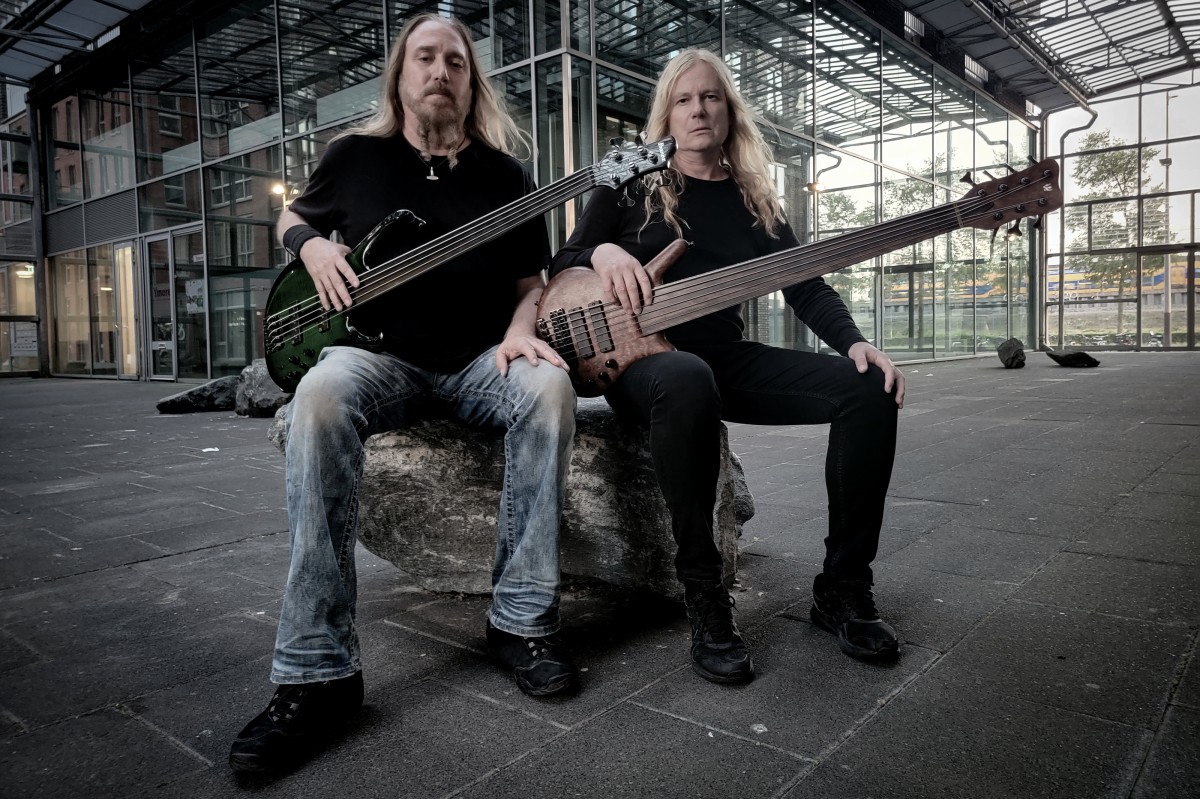
Quadvium’s debut album ‘Tetradōm’ is one of the most remarkable metal releases of the year. Not only does it feature two fretless bass pioneers in Jeroen Paul Thesseling and Steve Di Giorgio; the fact that the songs are centered about featuring two fretless electric basses makes the album sound unlike anything else released this year.
“This idea had been going on for a while”, Thesseling says. “We met quite frequently, while Steve was visiting Europe or when I was traveling to the US. But we had this in mind for a long, long time. It was an idea that just popped up every time. And we had ideas. We just didn’t have a main composer. That was a long journey: to find the last addition to the line-up. Somebody who would not only play impressively, convincingly, but who would also bring in material. Because we don’t consider ourselves main composers.”
“We are more like decorators”, Di Giorgio laughs. “We knew so much about what we wanted to do with two bass guitars, except for the main idea of how to do it, haha! We had all these grand ideas of how we would combine our styles, a lot of conversation about counterpoint, harmony, melody… All these great ideas, but none of them were tangible, because we realized we didn’t have it in us. We had many discussions about what we wanted, but they never included how to get there.
To use a comparison: I’m a really good painter and Jeroen is a great electrician, Yuma (van Eekelen, drummer) is a great plumber, but we were sitting there not knowing how to build a house to put it all in. So we found our carpenter, finally, and then once the framing was up, then we came in with what we knew how to do what we know how to do well for the songs.”
No Contribution by Subtraction
“Our search was on for someone to give us that foundation to then be contributors”, Di Giorgio explains. “Because we definitely have all contributed to the music on different levels, in our own way. But we realized, even with the addition of a third person, with Yuma, we are all just contributors. And we needed a composer.
There were brief moments when we thought we had found someone, and it would work for a while, but then it just didn’t suit what we were looking for, so we had to move on and find someone else. It was actually Jeroen who discovered this amazing musician just by going through internet reels.
When he sent me the link and said: should we ask this person? I think my first reaction was: oh, this is too good, it’s not going to happen. But then Jeroen said: they wrote back, and they’re completely excited to join us in this idea. We thought: holy crap, is this real? Was it the moment? By the end of the first thing Eve (guitarist) sent us, we all thought: it’s done. We didn’t even have a single suggestion except for maybe repeating a couple of phrases, because they were so awesome, haha!
There was never any contribution by subtraction. It was always: this is so good, we just need more of it. So we found our composer, and once that happened, our years and years and years of discussion became this working formula. And poof! Now the album’s out!”
Much Better Left Than Right
“During the very first stage, where we basically told each other ‘let’s do this, let’s go for this’, we had discussions during early mornings about how to have those basses interact”, says Thesseling. “It started with us thinking in two lines, totally different lines, and I tried to visualize it also for Steve: probably sort of a counterpoint-based method. But actually, that grew into so much more than only counter point.
At some point, it just became clear to us that left-right was the best way to go. And funnily enough, Steve sounded so much better left than right. It kind of felt natural like that. So that’s how I started to compose the guide. But Steve never told me: no, I want to be on the right!”
“That’s a little precursor to how a lot of different aspects of putting down the basses came to be”, Di Giorgio continues. “We didn’t really have to tell each other where to play, what octave, what to do in terms of panning and EQ… Every came so surprisingly naturally! We would end the session, listen to the music, and just laugh: dude, this is so much better than we thought!
It was something we knew was a very unique idea, a very different thing. So we were prepared to put in this much work, and we were prepared to face things that were completely out of the ordinary. We knew there was no template. There was nothing where we could say: so and so did it this way. But when we got to that point, we just kind of put it where we thought it should be, and when we listened back, it was just: it sounds perfect! Problem solved! Next!”
Across the Stereo Field
“The hard panning I guess started out fundamentally in a way to where we just didn’t step on each other’s feet”, Di Giorgio expleins. “But the blessing of it was: you can find out who’s who when you’re listening to it at all times. It’s like two people having a conversation. Instead of them both being on the same side of the table, you’re sitting in the middle, and your attention goes to whichever side is the person talking. It worked out musically in a cool logistic way, because these basses are playing a call-and-response type of thing.
I don’t know if I want to divulge too much of our so-called secret, but the basses are not technically hard-panned. We both recorded in stereo, but my tracks tend towards the left, and Jeroen’s tracks tend towards the right. But we are definitely spreading both bass signals past one speaker. So it’s a cool little combination of hard-panning and keeping things in stereo.
We knew that other things were going to be in this big stereo field. We had toms going across the stereo field, we had cymbals on the left, we had cymbals on the right, we’ve got guitar… So we had to make sure that we left room for other things as well as just focusing on the bass.
The purpose the band was to highlight two bass players, but the mission was to create a strong quartet. We wanted this to be a band. We wanted everybody to be heard, and to contribute, and within our little niche style make a good song. But we never wanted to stray from the fact that we started the band because we wanted two bass players to play stuff in a harmonious way instead of a leader-follower type of thing.”
Brutally Precise
“When I plugged into Jeroen’s equipment, and he found where my sound goes, he was just so astonished by the tone”, Di Giorgio says. “And I have always loved Jeroen’s tone. I always told him that he sounds like midi bass, and I don’t mean that in any kind of way of how midi is fake, but it’s just so brutally precise, and the sound waves are so pure, that when he plays, there’s not all these artifacts. It’s just pure note, precision, and this unadulterated bass tone.
That is how I recognize his tone. So that kind of salt-and-pepper, yin-yang, whatever kind of contrarian cliché you want to put in there, benefited us. Because when we put those two tones together, the identities shine through. Within seconds, you will know who’s who.”
“I think we have been lucky that both instruments sound very different”, Thesseling adds. “And our playing styles are very different. Even though we have similar musical tastes, and the same musical interests, our playing styles are different. And that also makes it very unique that these basses don’t clash. They complement each other. That’s basically what we figured out during these recordings.”
“I think we were both ready to make whatever adjustments were necessary to make this project work”, says Di Giorgio. “The way you dial the bass in for, let’s say, a normal metal band with two guitarists and relentless double bass, to come into a project like that, with two tones of that going on, might sound a little muddy. So we were prepared to alter whatever we needed to; sacrifice fifty percent of my low tone, sacrifice fifty percent of his low tone, so that cumulatively, it’s giving you about what one bass would.
But it was crazy; because the brand of bass he plays, the brand of bass I play, the way he attacks, the way I attack, just the quality of the equipment he has: all that stuff enabled us to really not make adjustments. Engineers like to use the term shelving, where they try to put things in different layers of frequency so they can go together. I think that all of our parts just magically occupied enough of a different frequency that it just went together.”
The Green One and the Brown One
“There are some parts on the album where we are both playing super low-register”, Di Giorgio continues. “Whether it’s the same note, of maybe a fifth away or whatever. Those were the parts where we were afraid we’d become two basses. But instead, it made things sound heavier. It sounded cool. There’s obvious upper-register stuff where we are getting away from any kind of mushing together too much, and that was easy. But the low stuff came out great. It’s two basses that really agree with each other; the green one and the brown one.”
“Most of what Eve composed, we took as a pre-production”, Thesseling says. “The first thing we did was making a guide. I recorded two basses with just my instrument, just to see how to divide the parts, arrangement-wise, before Steve would arrive to track here. Where do we go double? Where is his turn? Where can I add something? It was really a process that was carefully put together.
So the interaction was already sort of roughly created, but with only my bass. I had no clue how this was going to sound when everything came together. After one night of recording, it became clear that it was such a natural process. We didn’t need to force ourselves, we didn’t have to say: oh, if I play this, then you maybe can play this. I think we have been lucky with that.
Part of it was also pure improv. Also from Steve, tracking here. There were some gaps that were just empty, and I left them empty because I didn’t know what to do there. At some point, if I’m not sure about things, I prefer to just keep it open. And Steve also had ideas. He came up with stuff I never would have expected. So it was a very fruitful, very productive two weeks when he came to work on the album here.”
Refining the Interaction
“What Jeroen just described was a more intentional finalizing of splitting and distributing the bass”, Di Giorgio clarifies. “But there was so much prep before that even. Eve would put a guide bass in the composition, then the four of us would get together on an amazing Zoom call. Eve and Yuma are very studio-proficient, so they would put our Zoom call into a Pro Tools session, and we would look at the grid, and we could solo things up, and pick things out: hey, go back to bar 53, I think I heard something there, maybe this.
So there were bass lines already growing, and we would hear something, like: that little thing you did there, let’s expand on that. Or Jeroen and I would picture maybe harmonizing the existing bass line, or maybe instead of two basses playing constantly at the same time, maybe one guy lays out for a few bar and the other guy plays, and then we switch. So the early ideas were so well-prepped by the four of us. In theory.
Like Jeroen said: then we got to the point where we got a hold of those tracks, and he singled out the bass, and that’s when his genius came in. He would double himself and refine this kind of interaction, and give it the bass player treatment. Which is funny to say, because Eve is our guitar player, she plays a lot of guitar demos and covers and whatever on Instagram and stuff, but getting her own bass guitar gave her another tool to compose these songs.
She talked to Jeroen, bought a Warwick, and just said: wow, now I have a bass, let me try and record some ideas. Since then, her bass playing went from ‘oh, maybe I should buy a bass’ to playing Animals as Leaders-type tapping stuff while reading a book at the same time, haha! She really wants us to emphasize that her association with the bass guitar and her appreciation of how to play fretless came from us. Not in the past, but as a necessity to write this record.”
Fountain of Substance
“Before we started working with Eve, she said: could you perhaps send me some architectural designs, some images that would match with the music you have in mind”, Thesseling says. “So I went on the internet for a couple of days with that, and tried to figure out: how could we translate that to our music? Then when I sent them, the answer was: thank you very much, this is very helpful to me.
She is somebody who comes up with a totally unique thing. We have been so lucky with that. A lot of the bass lines are based on arrangements that were already in the compositions. So when you hear a piano in the background, it’s often that I cover the melody. Basically, it’s a unisolo melody line, but it was there already, because Eve added the piano melody. There’s a lot of things from her on this album.”
“Without a doubt”, Di Giorgio confirms. “That’s our fountain of substance there. Because, as we said earlier, we are all great support musicians. But when it comes to pulling something out of thin air that never existed, and turning it into something you can build upon… We were not able to do that until Eve entered the picture. We are eternally grateful for the mind of this person.
Like Jeroen pointed out: you never know where people get their ideas. It’s amazing that she can look at the shape of a building, and then in three days send us a demo of a song, and have us go like: holy shit, this is awesome music! It’s a unique thing. A very unique thing.”
Not Much Action
“I think the album has the progressive ingredients that were already there when we were both in our early twenties”, Thesseling says. “Steve was recording his stuff with Death, putting very different stamps and signature sounds on those albums, and I think I tried to do the same. It was this progressive period in which we kind of grew up. I think this is still in our veins. This is still what we like to do.
Though we are a few decades ahead now, I still think this is one of the main things. If you find people who are on the same page as you with this kind of music, it really is a blessing. Because it really isn’t all that easy to get things together. You need to feel it and know from each other: this is what we are looking for.”
“We are both huge fans of fusion, jazz, world music, flamenco, and we both come from a very obvious and strong metal background”, Di Giorgio nods. “So these early discussions were mainly about: how can we mix all this in a bowl and make it something interesting to listen to. This is probably why we didn’t know how to start. Because if you put a flamenco bass with metal drums and djent guitar, and try to make a progressive fusion song out of it… We had no idea.
We knew we wanted to do that, we just didn’t know how. So the discussions were always like trying to find that way to mix these things in a bowl. We started off with shared folders with little tiny passages. Anything from scales to just an odd rhythm, even little clips of songs that we’d find, some world music, some Charles Benavent, some Gipsy Kings, some Marcus Miller… Any little thing where we would go: look at this!
We had this ideas folder that was building, but the folder didn’t get much action. This is another thing that Eve took from us. She would open a song folder that had maybe a couple of scales, or maybe a little melody passage, and then: boom! All of a sudden, it’s a five-minute intricate piece. It took us forever to come up with nine, ten, eleven notes in this passage, and you give the kid the folder, and it turns into this complicated, technical journey, haha!”
A Fundamental Training in Positional Intonation
Both Di Giorgio and Thesseling broke through with fretless bass playing in extreme metal in a time when that was far less common as it is now. “There’s never that epiphany moment where you can say: I just woke up one moment and I decided to”, Di Giorgio emphasizes. “We both come from preadolescent rock ‘n’ roll discovery periods, and we both come from different types of orchestral music. Jeroen was a very good violinist, and I took a short time in school to learn the upright bass.
The point being: both of these instruments are naturally without frets. So we both had a fundamental training in positional intonation and not only relying on frets. We both still play fretted basses as well – me more so – but as far as what attracted us to the fretless bass, I think it was a vary natural and gradual process, because of our training as wee lads.
In a rock ‘n’ roll and metal context, every guitar and bass had frets. So people who have grown up with only this division, it’s a mystery to them. But when you look at everything from cello to viola to oud to sarod… There’s certain lutes too. There are so many instruments that go back hundreds of years without frets, so within the human history of music, there is absolutely nothing new about it, haha!”
“I think that playing without frets is a process that many bass players fear”, Thesseling nods. “But for me, it was just a matter of really putting myself to it, during a period where I played a lot of flamenco. I figured out it was the right spot for me to say: okay, I’ll go a hundred percent fretless. And from then on, I basically did. But that was also a process where I consciously put my fretted basses apart, and really focused on playing fretless. Because that’s when you have go get over that fear and go: my god, I’m actually playing without frets!
It’s like when you start to live in England, and you need to drive on the left side of the road. Then you’re not saying: you know what, tomorrow I’ll drive on the right side, but today I will try to drive on the left side. At some point, you’ve got to make it happen. So this is how I forced myself into fretless playing.”
A Lot of Deaths Involved
“It’s funny that Jeroen brings up this left-right example”, Di Giorgio smiles. “Because I didn’t realize this for a very long time. I don’t know if we were writing something down, maybe a shopping list one night, and I looked over, and my right-hand bass-playing buddy is writing with his left hand. I said: what are you doing? And he goes: oh, I’m left-handed.
That’s amazing! He’s playing a right-handed bass, and he’s a completely left-handed guy! If I picked up a left-handed bass as a right-handed bass player, if I try to make my hands opposite, it would be exactly like driving on the right side of the road in England. It would be a head-on collision, and there would be a lot of deaths involved.
That’s another amazing aspect about that guy over there. His dominant hand in life is his left, but he plays right-handed style, and plays pretty damn well. So that in itself is a major feat. He doesn’t really let on to that. I think I blew his cover.”
“I think it has to do with violin playing”, Thesseling downplays Di Giorgio’s praise. “Once you get used to having the bow in your right hand and playing the fingerboard with your left hand, you cannot get that out of your system. There’s no reason to go back to a left-handed bass. So I’ve been doing that for so many years that it basically feels normal. Although I’m still curious to what would have happened if I would play left-handed. Maybe I would have been ten times faster. I don’t know.”
“Quadvium would have looked like Black Sabbath on stage”, Di Giorgio laughs. “That would be cool!”
A Very Mid-Frequency-Oriented Character
“I seem to have moved around brands a little more frequently”, Di Giorgio says. “I went through phases of going through different companies. I ended up with Ibanez in 2016. We’re creeping up on ten years, which is a good amount. But Jeroen has been with Warwick forever. So I think he had a better grasp of what worked for him at a much earlier point in his career than me.”
“I remember that there were these trade shows, with all these instruments and brands”, Thesseling reminisces. “I was in my early twenties, and I noticed Warwick, but these basses were very expensive. Hard wood, exotic wood… I fell in love with those instruments. But I figured out later that this specific bass, this Thumb Bass, had this very mid-frequency-oriented character.
When I started working with Pestilence, I also noticed that it penetrated the guitar sound really well. It was the perfect instrument for articulation, for the sound, the way it reacted to my fingers, everything. So I have been playing them for more than thirty years now. I have never looked for another instrument that could sound better or play better. It has really just been luck.”
Made for a Big Caveman
“ESP treated me perfectly well”, Di Giorgio points out. “Not a single bad word to say about ESP. But I was also looking for something a little different, and I found a very small boutique-style luthier who averaged one, maybe two basses a year. He was very methodical. He had a full-time job, and work on his basses in his spare time. That luthier’s name is Karl Thorkildsen. He is of Norwegian descent. His company is called Thor Bass.
Every little aspect of the instrument, tonally or feel or weight, even the radical appearance of the shape, all that stuff was discussed between us. Having that very low-key one-on-one connection was really cool. But the thing about these home-shop boutique instruments with the demand I was putting on them… They were getting beat up. If anything fell apart, or something happened, it was difficult to get the replacement parts to keep up with the abuse I put these beautiful instruments through.
So when I was introduced to Ibanez through Linus Klausenitzer, who followed Jeroen in Obscura. He kind of showed me his Ibanez, and everyone liked the way I sounded on it. I have always loved the Gary Willis signature model. Even when I was jamming with Sean Reinert (former Death and Cynic drummer, who died in 2020), that’s the bass I wanted to have. I wanted that fretless sound.
Unfortunately, I’m kind of a tall guy, and that bass is built for a small person. I could never play it. So when Linus showed me his BTB model: that’s got a nice big body on it, with an extra long scale, it’s a little bit longer than a normal bass. It’s made for a big caveman like me. It fit very well. Linus introduced me to his contacts at the place, and then boom: it took off.
And once again, being with a bigger company, if a bridge saddle fell off or a knob broke, anything that these basses get exposed to on the road, the replacements were instantaneous. They’re all over the place. There’s Ibanez anywhere, and I can get replacement parts sent to the next club overnight. Their artist support is amazing.
We’re really excited to have companies like Warwick and Ibanez that put individual attention into the player, and support unique ideas. They’re both involved kind of helping showcase this new Quadvium project with a little bit of shred going on there. We’re happy with it.”
A Company That Would Have Our Backs
“I’m with EBS”, Di Giorgio explains his amplifier set-up. “They’re out of Sweden. They make great amps. We were all pretty much Ampeg SVT guys in the past. You really couldn’t get a better amp than an SVT. But the company went through changes. And if you still have your old Ampeg stuff, you’re fine. But when the time came to get anything new, the Ampeg products went through a weird change. And it seems like all their big-name artists who represented them went in search of a company that would have our backs.
I think (Cannibal Corpse bassist) Alex Webster went to Aguilar. A lot of people went to Hartke, some to Gallien-Krueger, some to Markbass. Everybody’s trying to find their sound. At one of these trade shows called Bass Player Live, it’s like a mini-NAMM, we stumbled upon this brand called EBS. And wow! The products are very powerful, and it’s a very friendly company. Their support is very unique, very personal. I love their amps, and I actually also use their speakers.”
“For amplification, I have actually also been with Warwick”, Thesseling says. “But at the moment, my focus is mostly on outboard gear for studios; these microphone pre-amps to record albums with. They are gold for us. They deliver that bright sound, that full sound. EBS is very powerful on stage as well. You basically blow everything from the stage if you want to.
When it comes to playing live, I can play with in-ears, but I need real speakers on stage to have a really good experience. I have a hard time with only an in-ear system and nothing else. Steve is very much used to whatever happens during a show, he will survive with his in-ear system. But I also had less fortunate live performances, where nothing was functioning, time codes didn’t work, and then you have to rely on in-ears, there is no stage sound. That’s when I get into difficulties.”
An edited version of this interview appeared in De Bassist 74 (October-December 2025)
 Kevy Metal
Leave a comment