
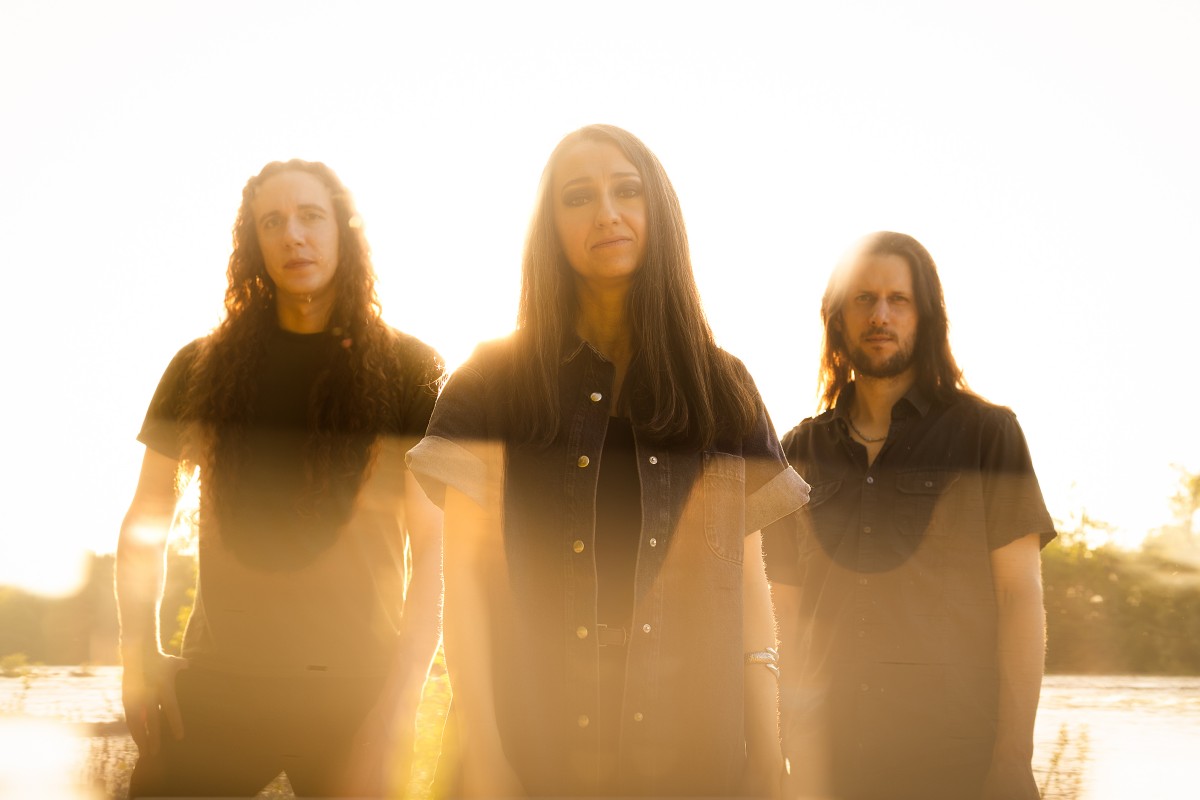
On their new album ‘Utopie’, Aephanemer take symphonic melodic death metal to what might just be its logical extreme. If you have ever wondered what an orchestra sounds like if blasting drums, electric guitars and aggressive growls are part of the instrumentation, ‘Utopie’ will answer that question. How these ambitious compositions come together is explained to us by guitarist and main songwriter Martin Hamiche, as well as vocalist, rhythm guitarist and lyricist Marion Bascoul.
“Most of the times, I write music just on the computer”, Hamiche explains. “I am a guitarist, but I very rarely compose with a guitar in my hands. Often, I’m doing something on my computer, I’m working, and I just think about a melody. So I compose that melody in my software, and I add different ideas, and build the songs that way.
I always try to have some kind of melodic line in each song, which means that when I’m writing the songs, I will make a very simple draft of the entire song with all the melodies of the song, one after the other. When that is done, when I have a more precise idea for the emotions that I’m going to put in the song, then I add depth the the songs, and I add all the other instruments.
Basically, when I write music on my computer, I don’t even write for a specific instrument. They are written more or less as piano pieces, and at first, I don’t even know which instrument will play what. That doesn’t come until much later.”
Something Much More Guttural
Another notable change on ‘Utopie’ is the shift to French lyrics. “We have been thinking of switching to French for a long time”, says Bascoul. “On our previous album, we tried it out for one song. It was a French version of ‘La Radeau de la Méduse’. We did that just to try it out, we weren’t sure how it would be received, but I liked it very much. Fortunately, the reactions were mostly positive. So this time, I decided to write a full album in French, my mother tongue.
I used some inspiration from French culture, French books, and French movies. For example: ‘Le Cimetière Marin’ is inspired by a French poem. Also, the title of the other single, ‘La Règle du Jeu’ comes from a classic French movie. So the album has some mixed inspirations: literature, history, and also French philosophy, which are mixed into the concept of ‘Utopie’.
The specific sounds of a language really change the singing a lot. In French, we also have very different intonation than in English. The specific air in French turns every growl into something much more guttural. Also, I tend to sing higher in French than in English. It’s really strange. It sounds much more black metal. The growling is more aggressive, with a higher pitch. But also, it’s really guttural because of the rolling R.
I have to remind myself to really project my voice, because the voice is not naturally projecting in French as it is in English. I would love to do that a lot more. But maybe that’s just because I’m not used to it yet.”
Not Lying to People
Aephanemer is about to go on a European tour to promote ‘Utopie’. Their dense arrangements pose quite a challenge for the stage. “If you really want to recreate the album live, we would need an orchestra”, Hamiche states. “Even having a keyboard player would not be enough for the orchestrations. Often, strings, brass and woodwinds are playing completely different parts. Just one keyboard player would not be able to do that.
We could do it like most bands do, which is to have a keyboard player who plays some parts of the arrangements, and the other parts are on tapes. For now, there is just the four of us. So basically, I write different versions of the songs for live. Specifically, I change some of the guitar parts, so it sounds good even if there are only two guitars, and not three or four like I often put in our songs.
One of our main ideas is that we don’t want backing tracks of instruments that are present on stage. Because then, you don’t know if you hear the musician or the backing track. So we have backing tracks for the orchestrations, as we have no musicians playing them on stage. But we never have backing tracks for the bass, guitars, drums, and vocals. This way, we don’t lie to people, and it’s clear.”
Complementary Leads
“When I prepare the live versions of the songs, what typically happens is that I give guitar lessons to Marion”, Hamiche says. “My day job is being a guitar teacher, so I help her to play specific parts. She’s extremely good in a lot of aspects of playing the guitar, especially rhythm guitar.
However, I am asking her to play more and more lead parts. This is not something she is necessarily used to, so I coach her a bit. On this album specifically, there are a lot of complementary leads. So two lead guitars, who are not playing in harmony. Instead, they are playing different things rhythmically. This is probably harder than what we did before, but she learns very fast!”
“I don’t know if I’m a fast learner”, Bascoul responds. “But I’m making progress with the leads. I have been working on that a lot. Maybe someday, I will also play solos, haha!”
Difficulties with the guitar parts not lining up with Bascoul’s vocals are non-existent. “Because Martin composes all the songs, and after that, I write lyrics to the music”, she explains. “So when I write the lyrics, I make sure that there are no problems for me playing the guitar while singing them. Sometimes that’s a bit difficult, because sometimes I want to do something special, and I don’t want to follow the rhythm guitar patterns or something. So I have to work on that.
But I make sure that everything can be played on stage. It’s very important to us that we are playing and singing everything on stage as it is on the album. It’s something a lot of people around us discuss. The use of backing tracks is increasing, and sometimes you can’t do without them. We have to rely on them for the orchestrations. But that’s what it’s for: nothing else is on the backing tracks.
With time, we will hopefully have a keyboard player, and maybe some other instruments. We would love to go with less and less instrumentation on the backing tracks. Even for the orchestrations.”
Reproducing the Sound of an Album
“We only use virtual amplifiers on the album”, Hamiche shares. “We have been working with Dan Swanö as our mixing engineer for many years. And I remember that back in 2017, during the first contact we had with him, I asked him: do you re-amp? He replied: no, I stopped doing that a long time ago, but software works great. I thought: okay, we’ll see. But we are satisfied. Since we don’t have a huge budget, it works very well for us.”
“Also, it’s the same as with the backing tracks: with that, we can reproduce the sound of the album on stage”, Bascoul adds. “Because we use the same sounds. It’s a way to bring the sounds from the album to the stage. Also, it’s easier to take with us on planes, haha! You just have a small rack with everything, and you don’t have to carry multiple cases with heavy amplifiers anymore.”
“Live, we have been using Axe-Fx II for many years”, Hamiche clarifies. “We learned how to set up and configure those many years ago. It was a bit annoying at first, because there is a hard learning curve on those, as there are so many things you can tweak. We like our sounds. We use a Peavey 6505 simulation for the rhythm guitar sound, and a Mesa Rectifier sound that’s been altered a bit for the lead sounds. We don’t experiment much with gear like that.”
“The Peavey was the amplified I used before switching to simulation”, Bascoul smiles.
No Left-Handed Violins
“I have been using the same guitar since 2010”, Hamiche says. “So before Aephanemer even existed. It’s a Jackson Warrior, an old model that isn’t on sale anymore. It wasn’t the most expensive one; it was 700 or 800 euros when it was new. It was my second guitar ever. It has EMG 81 pickups. It has its limitations, but it works well for us. The access to the higher frets is not great. When I have to play something on the 24th fret, it’s very complicated to play it live. But other than that, it works fine.
I’m actually left-handed, but I play on right-handed guitars. Back when I started playing guitar, about twenty years ago, people used to say: there are no left-handed violins, so you can learn to play guitar right-handed. It’s very common for left-handed people to play right-handed guitars, because honestly, it doesn’t change that much. When you have just started playing guitar, you suck no matter which way you will play guitar. Right-handed guitars are much more common, easy to find, and they’re cheaper.”
“For many years, I played on an LTD Explorer”, says Bascoul. “But it was a very old guitar, so it was time for a change. So I bought a Solar Explorer. It wasn’t a very expensive guitar, but I’ve been impressed with it. If you have a guitar for such a long time, it’s really hard to change. I know there are many people who like to try out many different guitars, but for me, I just want to find one that suits me and keep playing it.”
A Precise Rhythm Section
Although ‘Utopie’ was recorded as a three-piece, with Hamiche playing the bass, Aephanemer has recently found a new bassist in Florian Ménard. “We are really glad to have found him”, Bascoul exclaims. “Because he is the perfect person for us. We found him on the other side of France. He does live really far away from us. Martin, our drummer Mickaël (Bonnevialle) and myself are from the south of France, and he lives in the north of France. But we got along very well, and he is a really good player.”
“He has been in a lot of smaller bands through the years, so he has a lot of experience with live shows”, Hamiche adds. “Also, he is very serious. He practices the songs and plays them flawlessly live. This is exactly the kind of person we need in the band. Especially as a bass player. It’s very important to have a bass player and a drummer who are perfectionists, who will make a real effort to play their parts as well as possible. Because if the rhythm section of the band is not very precise, the sound will become muddy.
We only play six-string guitars, but I generally write our music with a five-string bass, so the bass can play the lowest octave. And that changes everything. It’s nice to have a bass player who understands that. Each instrument has a very specific place in our arrangements, and the bass is a very important instrument.”
As Much Clarity as Possible
“We considered switching to seven strings for this album to play the lower notes that Martin composed in the songs”, Bascoul explains. “But we just decided to stay with six strings, and to use the bass a lot more to cover those frequencies.”
“My unpopular opinion is that the lowest notes on a seven-string guitar don’t sound very good on a guitar”, Hamiche says. “Of course, there are many, many bands who use seven-string and eight-string guitars, but for the kind of music we play, we can’t use them like we would like to use them. For acoustic reasons, a low chord on a guitar will sound muddy. You can’t fight it. So the best thing to do is to have a bass that will play the lowest notes with a very pure sound. So without distortion, most of the time, to retain as much clarity as possible.
There are many things we just can’t do, because they won’t work. For this album, for example, I initially wrote some guitar parts that were going to be played on seven-string guitars that would play low chords. But I did a lot of tests, and it just doesn’t work for the kind of music we play. It’s impossible. Or we would need guitars with very, very long necks to avoid additional distortion.”
 Kevy Metal
Leave a comment