
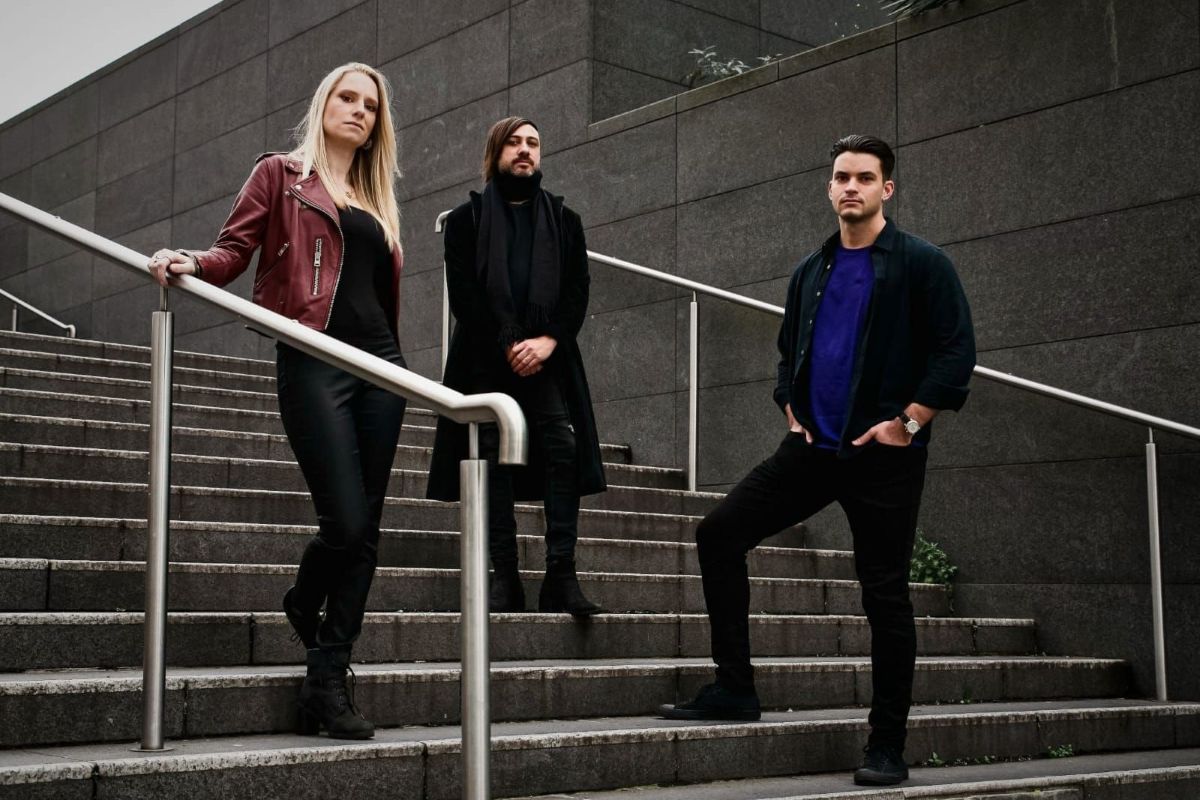
On their debut EP ‘Descent’, British-Belgian trio Exometry explores the possibilities of progressive rock and metal without losing itself in virtuosic stunts or impenetrable song structures. The result is a highly dynamic album with some great rhythmic variety. But why do the introductions if drummer Anna Mylee and guitarist Alen Fomichev can do it themselves?
“The whole point of Exometry was to create music exactly as we wanted it to be”, Mylee explains. “No specific vision to fulfill or to follow, or trying to sound like someone else, or whatever. We wanted to create music just for us, as we want it to be. Complete freedom to do whatever we want to do, and not trying to fit into some kind of genre. Which is refreshing.”
“I think it sounds different because it’s a mixture of influences”, Fomichev adds. “We come from similar, but very different backgrounds. Anna is more into rock. She grew up listening to rock and old school stuff a little bit more than I did. I grew up listening to old school metal, things like Rainbow and Metallica. Then I went into thrash metal, death metal, technical death metal like Necrophagist, and had a Dream Theater era. So definitely more on the heavy side. And there was some jazz fusion. So we kind of found a middle ground there.”
“Although I started playing music with a rock background – heavy rock, grunge music, which I can’t seem to get out of my sound – my dad is a prog rock guitarist”, Mylee says. “So I was listening to progressive rock from a very early age, whether I liked it or not, haha! At first, I was a little allergic to it. I didn’t really want to go down that route. But it’s there. It’s always natural for me to play odd time signatures.
Also, like most people, I was a little bored at some point, and I decided to explore some harder concepts on drums, and I got quite addicted. The more you work on harder ideas, the more you understand them when you hear them as well. That was a rabbit hole, really, haha!”
Fascinated by Simplicity
“I actually think it’s kind of interesting to come from one thing and then evolve into something quite different, quite far from it”, Mylee says. “Because you will always have that little touch that comes from where you’re coming from. Last year, I was touring with Crimson Veil supporting Lordi, and Lordi’s drummer said: you like grunge, right? And I thought: I’m playing progressive metal every night, where the hell did you get that from? He said he could hear it in my playing. I had no idea it was still there.
But that’s great, because that means you’re probably playing different things than someone else who plays that genre, but went straight into it. I come from a very simple genre, and I love simplicity. Also, I’ve had tendonitis. So as a drummer, I could not really focus on speed and showing off. And that’s what a lot of young players do: they go straight to the technical, fast show-off bits. And when they start to appreciate simplicity, they go back.
It was the other way around for me. I was fascinated by simplicity, and I wanted to perfect that first. Not in a lazy way, because it’s really hard to play slowly. And my tendonitis kept me from working on my speed, so I thought: let’s learn to play slow really, really well. Only after that, I went to technicality.”
More Real Estate to Build a Story
Obviously, there is enough of an overlap in Mylee’s and Fomichev’s preferences to have a stable foundation for working together. Most explicitly, their love for classical music may have had an influence on Exometry’s song structures. “Just today, we were listening to ‘The Hut of Baba Yaga’ by Mussorgsky”. Fomichev says. “If you put a guitar in it, it’s a riff. The composition and the dynamics are very similar to advanced metal.
The way composition is approached in classical music is very interesting, and very different from most popular genres. Basically, there is a story developing and unfolding. You have motifs developing throughout. You have more real estate to build a story.”
“And the development of a theme as well: every time it comes back, it’s different”, Mylee continues. “Which is interesting. It’s not just one part, like a chorus, that comes back exactly the same every time. It’s not that the four tracks that have been released so far have classical structures, but I think we just didn’t want to limit ourselves to regular forms.
There is always a subject, something we want to talk about, before we start writing the music, and then we write the music around that theme. But we still want to have a chorus idea and a verse idea that would come back every now and then, but not necessarily in a logical popular music form. There was a bit of freedom. It’s not necessarily a classically influenced concept. That’s coming though! That’s what we’re working on right now.”
A Better Balance
“Since this is our first project working together and learning off each other, there was no template”, Fomichev points out. “When you play with the same guys for twenty years, you know what everyone’s job is. There is a process that we’re still kind of discovering. I think the first songs we have written were a little bit more metally and more my kind of influence. After that, it kind of evolved to where Anna took more space as well, and I believe that’s when we reached a better balance. That’s where the most interesting songs are, at least for me.”
“You need a bad pancake before you can make a good one”, Mylee laughs. “Our first song was ‘Event Horizon’. Which is still a good song, but it’s the only one that’s kind of 4/4 all the way through, except the outro. That’s when we started going mad, I think. That’s when it started happening. The last one was ‘Amathia’, which was the quickest we have ever written. So we can see now that when we start writing, everything comes out much faster.
Usually, we discuss the concept first, and then Alen usually comes up with a riff, and then we try different rhythmic ideas on it, to see which one serves it better. We don’t want to be stuck in one way of playing a riff. When we pick the atmosphere we want, we see what comes next. And then, we like to put things together in a really linear way.”
On the Receiving End
There is one other important piece of the Exometry puzzle, however: singer Jude Benjamin, who joined relatively late in the process of writing ‘Descent’, when many of the arrangements had already been worked out. “There were some little bits here and there where I moved guitar lines to leave some space for him”, Fomichev admits. “We had all the instrumentals done ourselves, and then Jude came along, we told him the themes of the songs and see what he would come up with.
Then we would have a few back-and-forths, and we would sometimes say: please, don’t sing here, because this is a part we would like to leave instrumental. But there were also times when he would have come up with a vocal melody on such a part, and we would think: damn, that’s really good! And we didn’t think about it. If it’s cool, we will keep it.”
“We like to be clear about the concepts”, Mylee states. “Because the writing behind it makes sense with the theme, musically as well. So usually, we would give him the song, the form, and the concept, and he would write lyrics inspired by the concept. We weren’t involved in the wording of it. He is the English one who can probably be much more poetic than we could ever be.”
“He’s actually very good at that”, Fomichev nods. “The thing is: when we write, even coming from the riffs, we always think about dynamics. For example, ‘Foxes & Lions’ is about propaganda. There are some bits where the intensity is very high, and the line is being repeated: you can picture a hammer hitting down. The purpose is always: how would it feel to be on the receiving end of this? We try to put ourselves in that zone.”
Losing Half of the Groove
Mylee’s highly dynamic drumming, with big volume differences and lots of ghost notes, poses a challenge when it comes to sonic choices. “To be honest, it can be an issue live with some sound engineers”, Mylee admits. “Because they gate my snare, and I’m losing half of what I’m playing on my snare. Half of my groove is based on the ghost notes that I play. So I tell them: I would rather you don’t put gates on my snare, and they’ll say: no, because it sounds awful.
I feel like the ghost notes make my groove completely full. Sometimes it’s hearing those ghost notes between those other notes that makes it so satisfying. So when you delete those, you lose half of what was meant to be there, and what we’re basing the whole groove on. It’s not easy to find a sound engineer who can deal with that nowadays, because everyone plays really, really loud and triggered and very compressed. That’s what they do.”
“A lot of people are not comfortable hearing the natural sound of an instrument”, Fomichev laments. “They have an instrument, and they just want it to sound a certain way, so they never learn what that particular instrument actually sounds like. They want it for something that it’s not.
But you have to learn to play with that particular instrument in a way that everything is aligned and gives you the best outcome possible. If you hit a cymbal too hard, it starts to distort, and you get this very thin sound. But if you give it some room, it would have a much more pleasant and full sound.”
The Overuse of Compression
“We had to have a different style of mixing as well”, Mylee emphasizes. “That’s just because of the dynamics we use. I hate using triggers, always have things sound exactly the same and them being over-edited. I like having drums that actually sound like drums. That might be the old school rock side in me talking, but I enjoy using dynamics very much.
I always say: nothing is loud if everything is loud. That’s also what happens with the overuse of compression in mixes nowadays, I think. Because they just want everything to be loud. Yeah, that’s cool, but if everything is at the same level, nothing is actually loud. So that’s why we wanted to go back to a more old school mixing style a little more.”
“Compression is like ketchup on a plate”, Fomichev analogizes. “A little bit is nice, but too much covers everything around it, and you end up not tasting anything, potentially. That’s also going back to classical music. Dynamics are everything there, especially on the more Russian style of compositions. You get these absolutely huge contrast between massive-sounding parts going into subtle, harmonic violin bits. And I think those sorts of little things make a big difference. King Crimson does that very well.”
Devaluating the Live Experience
Playing live is going to be difficult with just the trio of musicians that recorded ‘Descent’, but the ambitions to expand the line-up are there. “The less backing tracks we can use, the better”, Mylee emphasizes. “For creation, the trio works great. But for playing, we definitely want a bassist, and ideally another guitarist, and there would be just some little bits and pieces on the backing track, just for atmosphere and sound design and stuff like that. But nothing else.”
“And even then, if we can make it work without backing tracks, that would be perfect”, Fomichev adds.
“If everything can be live, we’ll take it”, Mylee nods. “And it can be. We just have to find the right people. There have been a few bassists showing interest in playing these parts with us, so that’s a good start. So for the next live show, we will at least have a bassist with us for sure.”
“It just doesn’t look good if you have the bass playing by itself and nothing happens on stage”, Fomichev explains. “Also, it’s a big part of the dynamics. The bass on the backing tracks is never the same as the bass being there and clicking with the band.”
“Also, I think the backing track world is going a bit too far”, Mylee says. “I think a lot of people are getting fed up that when they see a band, half of it is not played live. On the other hand, it’s very expensive, and many bands can’t afford people to go on stage with them. But I do feel like the audience is turning away from the backing tracks. They like a show, and not just one person or two people playing with tracks.”
“There’s also a different type of energy compared to when you record a song”, Fomichev continues. “You’re in a room, isolated from everything, so you’re going to play with a certain good energy, but a different energy from when you would be there, facing the people, the drive, the adrenaline. So it would not be as unique to this event, or this audience, as a live performance. It would not capture the same magic.”
“That is why a live show is so valuable”, Mylee emphasizes. “It’s a unique experience every night. If there is a full band playing, it’s never going to sound the same way twice. If you see that band the next day, there’s definitely a difference. But if you have less and less people playing live, and more backing tracks, it’s going to end up sounding more and more similar every night. Which is safe for the musicians, but I feel it’s kind of devaluating the live experience.”
 Kevy Metal
Leave a comment