
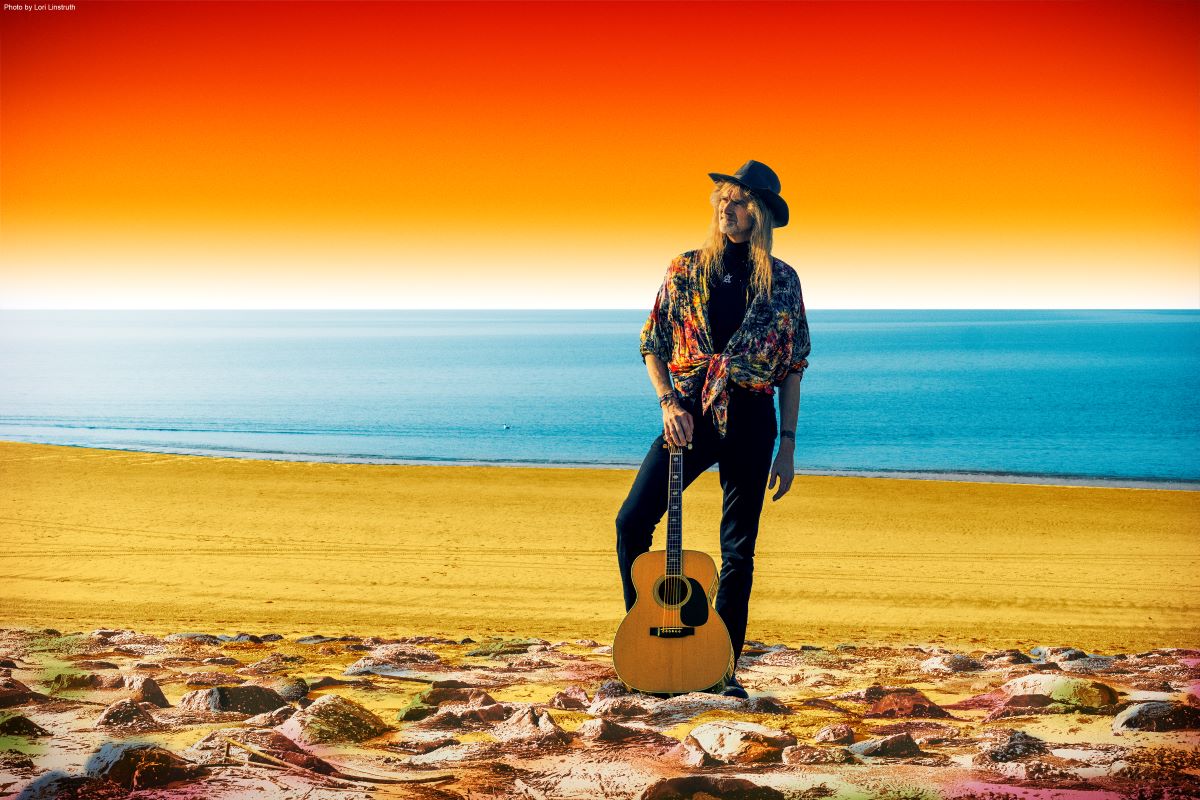
When Arjen Lucassen takes a break from his massive rock operas in Ayreon, his heavier work with Star One and working for other people, he writes solo albums. ‘Songs No One Will Hear’ is his first one in thirteen years. And like 2012’s ‘Lost in the New Real’, it is another concept album. It makes one wonder whether Lucassen is even able to create music without a grand concept in mind.
“That’s actually what I do about ninety percent of the time”, he emphasizes. “There is always a guitar or a phone nearby, and whenever I have an idea, I can just make a quick recording that way. Ninety percent of the time, I won’t know what that idea will turn into, or even what project I will end up using it for. That will not come until I go into my studio and upload all those fifty-odd ideas to my computer. That’s when I decide which project they are the best fit for.
The concept always comes later. That was no different with this album. I basically compile an instrumental album from all those little bits of music, and then I turn them into songs. By that time, I do know that it will be a solo album, but I don’t know what the concept will be at all. What happens then is that I hope the music inspires me for a story or a concept.
After all, once I have those – let’s say – fifteen songs, and I start writing a story, the order has to make sense, so I have to organize them in some way. By then, I have no idea what the songs are going to be about, because I don’t have any lyrics yet. So I have to put the songs in an order that makes sense to me. Usually, that ends up being: heavy song, softer song, heavy song, softer song, et cetera. Longest song at the end, catchiest songs in the beginning. Only then will I start working on the story and the lyrics.”
All for Other People
“Once I have started working on a certain project, I will only be working on that project. So it’s not like: I’ve got a song, I wonder what I will use this for? When working on ‘Songs No One Will Hear’, I was certain it was going to be a solo album from the beginning. So those songs have all been written with that specific idea in mind.
Since the most recent Ayreon album (‘Transitus’, 2020), I have done a lot of side projects, and they were all for other people. There was the album for Simone Simons, ‘Vermillion’ (2024), which I write specifically for her. Then there was Plan Nine, which was a project from 35 years ago, songs I had written with Robert Soeterboek. Robert really wanted to go back to playing live, and that’s what he’s doing right now, so it’s been a success as far as I’m concerned.
But that was another case of making an album for someone else. Since my last solo album had been released thirteen years ago, so I thought the time had come again to make a nice, egomaniacal solo album, haha!
One thing I had to keep in mind was the fact that I was going to sing on it, so I had to hold back a little. But it’s nice to have limits. When I’m doing an Ayreon record, I basically don’t limit myself in any way. Then I just let everything happen, everything is possible, all these different singers… But when I do a side project, I do put limitations on myself.
When I do a Star One album, I limit myself to metal. When I do The Gentle Storm, I limit myself to folky stuff. When I do Guilt Machine, I limit myself to atmospheric stuff. And when I do a solo album, I limit myself to knowing that I’m a limited singer.”
Nice and Bright
One of the things that stands out on ‘Songs No One Will Hear’ is the acoustic foundation that many of the songs have. “On this album, it’s often a combination of an acoustic and a clean electric guitar”, Lucassen points out. “That is something I did while working on the first song, and I liked that so much, that I ended up doing that a lot on the album. Except for ‘Just Not Today’. That one is an acoustic song with cello, violin and flute, so it had to remain entirely acoustic.
The acoustic guitars are recorded purely acoustic. That’s my Martin with a microphone in front of it. I have tried recording with two microphones a couple of times. Then I compare them, and the one that’s about 15 centimeters below the sound hole is always the one that ends up sounding best.
One thing I always try is to get as few low frequencies as possible. That’s the issue with an acoustic guitar: there is so much low-end, and what I actually want is for it to sound nice and bright. That’s something I tried to achieve with a second microphone, but I always end up switching that one off. Maybe I haven’t found the right way yet.
There’s also a difference in the parts I’m playing. When I play acoustic rhythm guitar, it has more low-end by definition, so that’s when I need the microphone to be 15 centimeters below the sound hole. When I’m picking notes, the microphone is right in front of the sound hole, because such parts don’t have quite as many low frequencies to begin with.
When recording the acoustic parts, I already take the low frequencies out of the microphone. There’s always a setting you can use to cut everything below 90 Hz. And then when I’m EQ’ing acoustic guitar tracks, it’s always a matter of adding a ton of high frequencies and taking out much of the low frequencies.”
Perfectly Complementary
“The acoustic guitar doesn’t have a lot of mid-frequencies. It’s a lot of low-end and a lot of treble. And then the clean guitar, which I always send through a real amplifier, with real speakers, and real microphones, are mostly just mid-frequencies. So those are perfectly complementary.
I don’t always do it, because there is a certain specific sound to just playing one guitar. Once you start doubling that, you take that solistic feel out of it a little. But if it’s a chord progression that supports the vocals, it doesn’t matter that it’s doubled. In fact, it makes the whole thing sound fuller and better.
The Bogner Uberschall I play is perfect for both clean settings and distorted settings. Its clean channel sounds nice and warm. I have compared it with everything else I have; I have maybe seven or eight different amplifiers, and every time I record an album, I will end up comparing them. Then I’ll go to Sandlane Recording Facilities, where they have so many different amplifiers, so I can A/B all of them.
Really, I bought an EVH, because I thought: I need to get with the times a little, I can’t let myself get stuck in the same sound forever. Also, the brown sound on the first Van Halen album is the best guitar sound of all time for me, so I’ve been hoping I could recreate that with the EVH. Of course, I don’t play as Eddie, so that may be a part of it, but I end up not using it except for once or twice.
There is also no layering on ‘Songs No One Will Hear’. It’s one left and one right. When I record a Star One album, I put six guitars on top of each other, to overwhelm the listener. But that’s not what I want to do here. There’s one big Black Sabbath-style riff in ‘Our Final Song’ that I double, because it needs to be nice and bombastic, though an octave higher.”
Piece by Piece
There is one aspect about the guitar work on ‘Songs No One Will Hear’ that stands out to Lucassen himself. “I have played a ton of solos”, he says. “That did surprise me a bit, because that wasn’t the intention at all. But then I thought: damn it, it’s a solo album, no Steve Vai or Joe Satriani this time around, I need to do it myself. So I started practicing a little bit, and little by little, I started adding more solos. And before I knew it, I was having fun again.
The real fast work is something I gave up doing when I heard Yngwie Malmsteen for the first time. That’s when I simply thought: no. What Ritchie Blackmore played was something I could just about get close to, but when the Yngwies and the Steve Vais came around, it was clear for me that I needed to start composing, as that is something I may be better at.
Technically, the solos are one hundred percent spontaneous, because I haven’t composed them. I just turn on the song, I haven’t practiced anything, my fingers are even refusing to do what I want them to do. But that’s a good thing, because it’s always about the melody for me. This way, you have to focus on that. You can’t impress people with shredding and technical stuff. You have to come up with good melodies.
After that, it’s almost a matter of recording it note for note. Because what I start with is: what should the first note be? There’s three options: the root note, the third or the fifth. Okay, now I have the first note, what will the next one be? And of course, sometimes I play five or ten notes, but the solos are really compiled piece by piece.
That also means I wouldn’t be able to play them live. It can be frustrating if I see someone on YouTube play a solo that I put together painstakingly in one go. Ah man, if only you knew… But it’s a massive compliment of course. Those guys are ten times as good as I am.”
The Weirdest Knobs
On ‘Golden Age of Music’, last year’s fantastic debut album by Arjen Lucassen’s Supersonic Revolution, Lucassen was only playing bass. He picked up the instrument again for ‘Songs No One Will Hear’. “I love playing bass”, Lucassen exclaims. “Ever since I got that Dingwall five-string, I love playing it. That’s something I do old school as well: through an amplifier with a speaker and a microphone in front of it. That’s always the safest option to me.
My bass amplifier is an old Trace Elliot. That one has a graphic equalizer, and I love that thing! I can just add a little bit of this or that, and there are all kinds of knobs on it for additional low-end and additional mid-frequencies. There are so many options on it, and they’re all options that I love. It’s kind of similar to the SansAmp for the guitar, if I’m looking for that Rammstein effect. It’s not just treble, mid, and bass, it’s got the weirdest knobs, and they do whatever I want them to do, haha!
For both the guitars as well as the bass, I use a Beyer M88 microphone. And then a Royer ribbon mic for the lower frequencies. That ribbon mic is outside of the cone, and the M88 is right in the middle of the cone, especially when it comes to recording the bass.”
The Bigger Picture
“When I have an amplifier, a speaker, and a microphone, it just sounds the most honest. It may not be the best or the fullest sound, but it always sits well in the mix. My strength is in the bigger picture, I think. Not everything has to sound perfect, because it has to add up well. That bigger picture is so important! And I think that’s where my strength lies.
Everything is about sound for me. The same goes for keyboard parts. It doesn’t matter how fast or technical they are; if the sounds are shit, it doesn’t move me. When I hear a Keith Emerson or a Rick Wright – I know those are two cliché examples – they just had a great ear for sounds. Rick Wright especially is a great example; he was quite a limited keyboard player, but his sounds were always awesome.
Or even a David Gilmour with his four favorite notes in ‘Shine On You Crazy Diamond’: he wasn’t working on sweeping arpeggios, he was just messing around a bit and ended up with those four strings, two of them open. That’s kind of why I’m happy I’m not a natural talent on any instrument. It forces me to focus on other things.”
 Kevy Metal
Leave a comment