
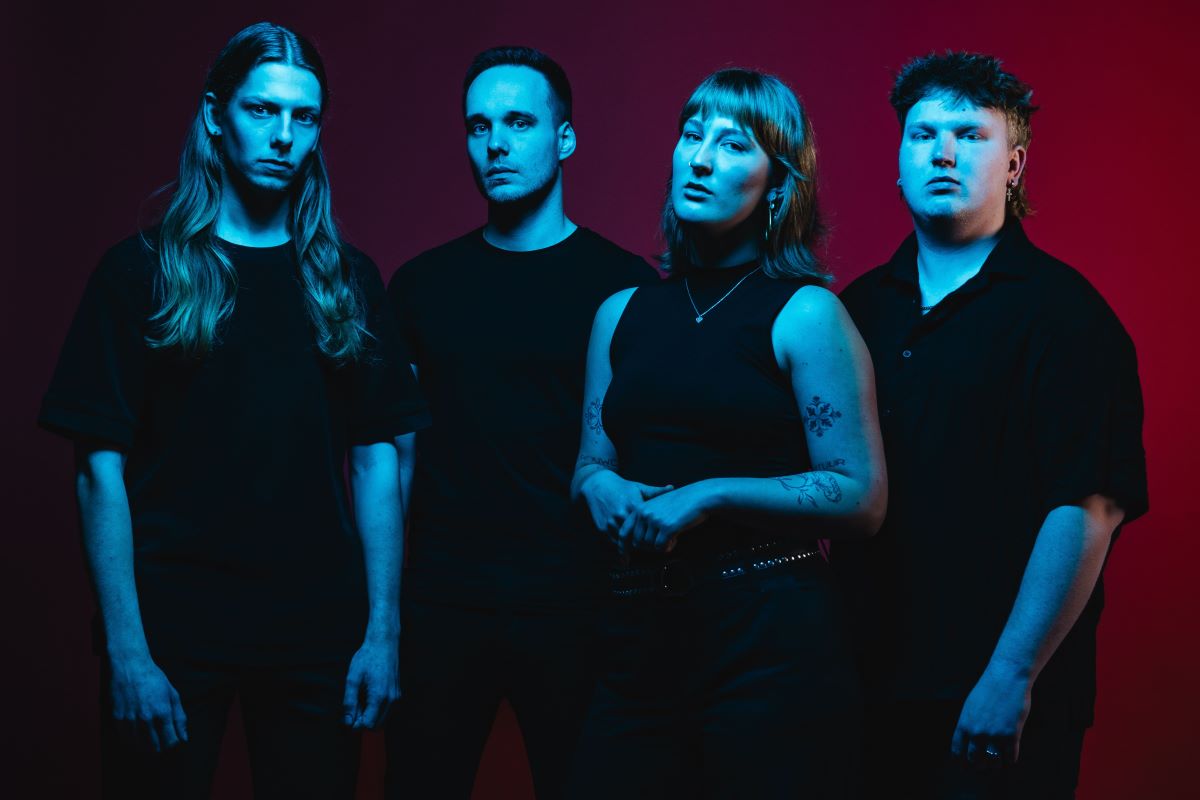
While their 2023 debut EP ‘The Only Way Is Through’ introduced Traversus as one of the most promising young bands in the European hard rock and metal scene, their new EP ‘Navigate’ really sees them branching out and exploring the extremes of their sound, simultaneously becoming more complex and more accessible in the process. Guitarist Joey Wessels shines some light on the developments the Dutch quartet went through in recent years.
“For ‘The Only Way Is Through’, most of the basic ideas were mine”, Wessels explains. “I would have written the entire structure of a song on my own, and we would further work that into a full arrangement in the rehearsal room. For ‘Navigate’, most of the initial ideas were mine as well, but we would start working on them as a band much earlier in the process.
So instead of me writing an entire song, Liam (de Groot, drummer), Madelief (de Groot, singer/guitarist) and Diko (Eleveld, bassist) would also come to the writing sessions with their own ideas. Because of that, I feel like the new songs sound a bit more cohesive than they did on ‘The Only Way Is Through’. It was a development I was hoping would happen. This way, we could all collectively think about the music we really wanted to write, and the sound Traversus should have.
For what it’s worth, I think we have found a much clearer direction in which we want to push the band. All of us have become a bit more serious, and that has been a very important development towards this new chapter of the Traversus story.”
Not Thinking as a Metal Bassist
“‘Maybe in Another Life’ was the first song we wrote after the recording sessions for ‘The Only Way Is Through’, and we have started playing that one live almost immediately afterward. So that one was properly road-tested before we started recording ‘Navigate’. We have played ‘Dead Hands’, ‘When the World Goes to Waste’, and ‘No Way to Silence Me’ fairly frequently since.
We played ‘Eye to Eye’ maybe five times, and ‘Headline Anxiety’ not at all. That was on purpose, so that we would at least have something truly new to present at our release show. These days, I do think that testing the songs live prior to recording them doesn’t have as much of an impact as it used to have. That is simply a result of us feeling more confident about our songs.”
Another change Traversus went through was a change of bassist, something that could have an impact on the rhythm guitars. “I wouldn’t say it impacted my playing, but it definitely had an impact on Traversus’ overall sound”, Wessels emphasizes. “Diko has played in multiple bands prior to Traversus, and he his musical taste is very broad. Because of that, he doesn’t think like a metal bassist, and I like that a lot. That adds a lot of depth to our music, in my opinion.”
More Time to Record Guitar Parts
“We switched up the recording process a little bit this time around. The drums and vocals were once again recorded at Sandlane Recording Facilities, and Joost van den Broek once gain produced the EP. Also, it has been mastered in-house.
However, the guitar and bass tracks were recorded at the Rockacademie in Tilburg in cooperation with Ian Groeneweg from Ian G Sound Endeavors. These guitar and bass tracks have later been re-amped with Jos Driessen at Sandlane. The reason we chose to do so was twofold. First off, it saved us a bit of money. Secondly, Ian and I both studied at the Rockacademie at the time, so we could make studio reservations and start recording very easily.
Because of that, I had considerably more time to record my guitar parts. As a result, we took a lot more time to record overdubs compared to the previous EP.”
Incorporating Melody into Lead and Rhythm Guitar
“I try to write the guitar parts in a way that there is kind of a clear lead part, and Madelief has a part that will enhance my parts. What often ends up happening is that I play a lead line under which Madelief will lay down a few chords, and the next moment we will be playing a melody together. That way, the parts weave through each other quite well.
It just seems like a waste to me to purely view a rhythm guitars as a bunch of power chords or something like that. By incorporating melody into both the lead and rhythm guitar parts, they both can end up much more powerful. And of course, Madelief has to be able to play the parts live without them getting in the way of her vocals. That is why I usually try to keep them relatively simple, so that Madelief can focus on singing entirely rather than being distracted by intricate guitar parts.
For my own guitar parts, I used my Music Man JP6 from 2001. That one has DiMarzio Crunch Lab and LiquiFire pick-ups. Then, for Madelief’s rhythm guitar parts, I used her Schecter BlackJack SLS, which has Seymour Duncan Blackouts in it, so active pick-ups. For all leads and overdubs, I used my Sterling JP160 from 2019. That one has Sterling’s own brand of pick-ups in it, but they sound absolutely fantastic.
For all the softer parts, I used the JP6 with the toggle switch in the middle position. That way, both humbuckers are split, and you use the outer coil of both your neck pick-up and your bridge pick-up. This creates a nice, thin sound that I think works very well when combined with a slight crunch sound. You can hear that very prominently on the song ‘Dead Hands’.”
Extensively Experimenting
“The recordings of the guitar and bass tracks were all done with my Neural DSP Quad Cortex. We didn’t really do anything special with that, because we already knew that the tracks would later be re-amped at Sandlane. For re-amping all rhythm guitar sounds, we used an EVH 5150 III with a Bogner 2×12″ cabinet. The amplifier used for all lead parts is a Bogner Ecstasy 20th Anniversary, which sounds truly awesome.
When recording the overdubs, we extensively experimented with effects pedals, which is something I had never really done before during recordings. Some of the pedals we used were a 68pedals King of Clone, a Dunlop Audio Electronics MC-404 Wah, a Klon KTR Centaur, a Keeley D7M Drive and a bunch of other pedals.”
 Kevy Metal
Leave a comment