

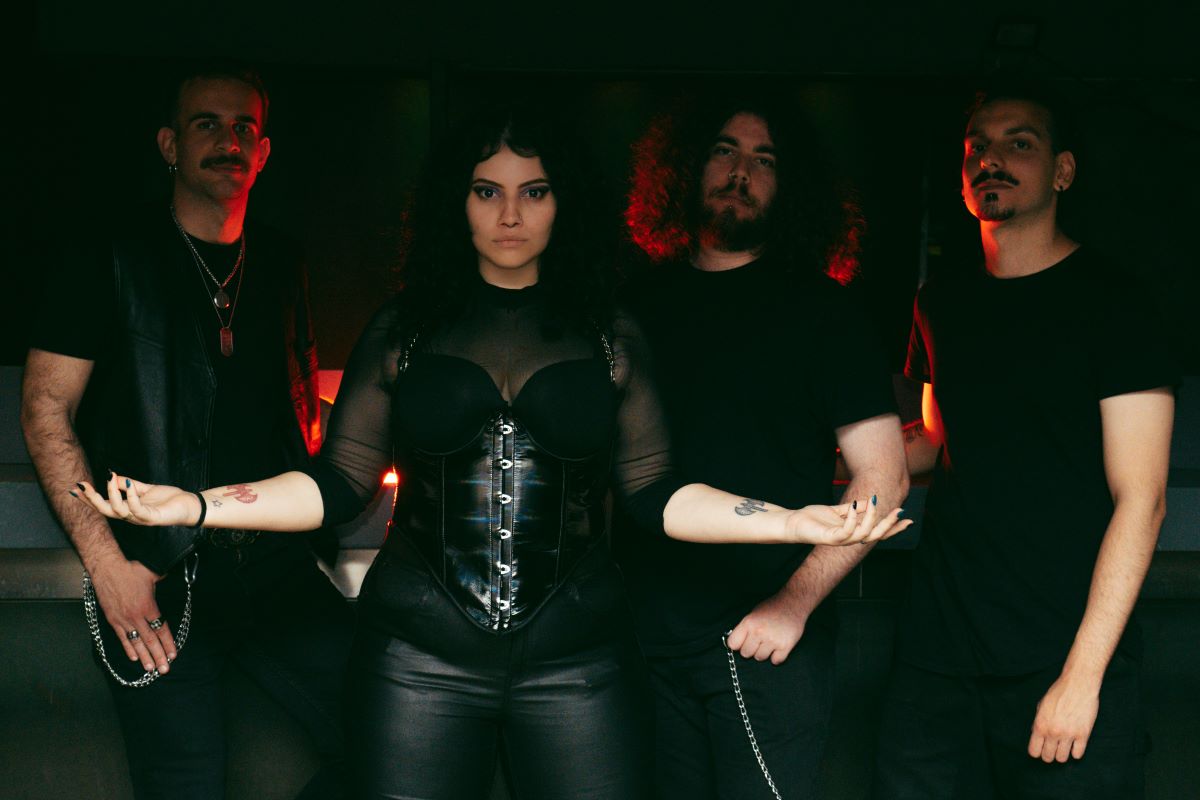
Debut album ‘Alchemists’ by Greek quartet This I Owe shows an interesting and unpredictable mix of various darker rock and metal styles, to the point where describing them is quite a difficult task. Fortunately, the entire band was more than happy to share their experiences around forming their band’s sound and creating the concept behind ‘Alchemists’.
“We have very different musical backgrounds”, singer Maria Kanellaki says. “Which was kind of a problem in the beginning, because we didn’t really know each other yet. The guys were already a band before I joined; I was the last member to join the band. Then when we started rehearsing, we didn’t have any songs of our own to play, so we thought we had to choose some covers to play. We just couldn’t decide which ones to do.”
“This was ultimately a good thing”, bassist Thodoris Grigoroudis emphasizes. “It was so difficult to choose songs to cover that we resorted to writing music. We never planned to be a cover band, but usually, in the beginning, you cover some songs to get a feel for the other musicians. But even that was hard for us. That forced us to start writing essentially from day one.”
“We had a pretty good connection too”, Kanellaki asserts. “We wrote ‘Nightmare’ in the first three rehearsals together. That was the first song we all wrote together. ‘Equinox’ and ‘Queen of Hearts’ were ready before I joined, so I had to learn them. But it was great to start writing music right off the bat.”
A Streamlined Listening Experience
“We didn’t really have a plan musically”, Grigoroudis says. “Most of the songs started as jams during band rehearsals. Between rehearsing songs, we would play some riffs, some licks here and there, and if we thought something was good enough, we would take it home, kind of build on it, and bring it to the next rehearsal. Of course, by the time we started to record the album, even more changes had to occur so everything would fit the album format, so they would sound like a collection of music rather than random songs.”
“Some songs we wrote and then recorded almost immediately”, Kanellaki adds. “So those have not changed a bit. But there are songs like ‘Nightmare’, which has been recorded and released twice, and it has different lyrics in each version. And then there are songs like ‘Isobel’. That song went through so many changes. We were so excited about ‘Isobel’, so we started building, and adding more and more stuff, and it got to a point where there were just too many ideas. We had to fix stuff in order to make it cohesive.
The last two songs we wrote for the album, we kind of had a hard time finishing them. The ideas were there, but the last steps – mostly their form, their structures – we weren’t really sure about. We put the finishing touches on those right before we went into the studio.”
“In the beginning, we basically had two or three songs ready, and there was a loose connection between the themes and the music”, Grigoroudis explains. “So we basically built on that foundation until we had a complete album in our hands. The album is an exploration of the stages of grief, going through loss. We didn’t really begin with that in mind, but it felt appropriate as we moved on to really turning the songs into a streamlined listening experience.”
Everyone Needs to Be on Board
“What happened a lot during the writing of the first album is that the three of us would play something, then I would see Maria looking at the lyrics she had written, trying to find something that fits the song”, says Grigoroudis. “We don’t really have a standard process for writing the songs, but as I said: we usually jam something first and then try to complete it.
But even that is not something that happens with every song on the album. ‘Equinox’ and ‘Queen of Hearts’ were mostly written outside of rehearsal. I think it was during the corona period that we wrote those two songs, so they were ready by the time we first played them together. Usually, one of us kind of starts the process with an idea, and the rest fills in their parts. Sometimes, maybe one of us will try to push the others in some direction they feel fits the song, but it’s a really cooperative writing process, I would say.”
“It’s because we are a team”, Kanellaki exclaims enthusiastically. “It’s not like there are two main composers and the others are just hired guns. We have built things together.”
“There is only one drawback to this”, Grigoroudis admits. “And that is that we really need to be in sync when we want to write something. When you write songs like this, you don’t really write other people’s parts. Everyone needs to be on board with what’s on the table. However, I would say that it didn’t really pose too much of a problem on the first album. We wrote it really quickly.”
Considered Fully Finished
“Recording ‘Alchemists’ was actually our first time recording an album”, Grigoroudis explains. “We had recorded two singles before, but recording an album is a very different experience. More time-consuming. We really spent a lot of time there, trying to figure out how we wanted to sound, changing things, even in songs that we considered to be fully finished. By the time we tried to record them, we still made some tweaks.”
“Our producer Jon Soti helped us so much with this”, Kanellaki emphasizes. “He’s an angel. We got into the studio and he asked us what we wanted our sound to be like. And we had no idea. No idea at all. We were a live band. We didn’t know how to record an album from start to finish. He put so much time and effort into helping us build our sound.”
“In our minds, we just thought: we will go there, we will record the songs, he will make it sound good, and that’s it”, Grigoroudis smiles. “But he was much more invested into making this record a good album. A great album even.”
“We knew what kind of a person he is”, Kanellaki says. “That’s why we chose him. He’s also a metal singer, and we knew that he is a very artistic person, and that he wants to make whatever he touches sound great. Whatever the case, we knew he would put his heart into it. But we didn’t expect all of this to happen, and him being so helpful.”
Not a Dragger, Not a Rusher
“We tried to build an album that would be doable to perform live”, Kanellaki explains. “We didn’t want to make an album that was larger-than-life, full of backing tracks and whatever, and then have the people who listened to it be disappointed when we play it live. We are a four-member band, there is only one guitar, but the album has tons of layers, tons of backing vocals.”
“That is why we brought some extra hands for our release show”, Grigoroudis nods. “Some guests from the scene here, to really help us celebrate the album. It’s okay for a band to sound bigger or grander on an album, but we still want to be able to play the songs live nearly identically. Or at least as much as we can. It’s okay to have multiple guitar tracks, double tracking, quadruple tracking, playing the same thing essentially. Most of the songs are not really affected by it, because they were originally written for just one guitar.”
“Also, we’re not used to playing with backing tracks at all”, Kanellaki admits. “In order to do that, we had to be comfortable with it, and we weren’t at the time. So we wanted to record an album that’s based on our live playing, without needing to add tons of stuff in order to reach that sound. Of course, we will be trying to experiment more on the second album, which we have started writing music for already. But we want to be able to create that experience in a live setting, without the listeners feeling that something is missing.”
Playing with backing tracks does require a different skill set, particularly from a drummer. “I have to keep up, but I can’t do everything”, drummer Gerasimos Avgeris laughs. “We are trying to find a way to make it work. I will try to remain open to different stuff.”
“For now, we are lucky that he is so on the beat”, Kanellaki smiles. “He’s not a dagger, and he’s not a rusher.”
“We have one song, ‘Feelings to Dust’, that we can’t play at the tempo we recorded it at”, Avgeris says. “It’s always at least 10 BPM faster.”
“That’s my fault”, Grigoroudis confesses. “The bass starts the song.”
“He’s full of energy”, Kanellaki laughs. “So he starts playing it much faster. And it sounds amazing. But you know what, I can’t catch my breath!”
More Freedom to Move Around
“For the live sessions we did after recording the album, I had a lot of work to do”, guitarist Christos Kalentzos says. “Because I recorded a lot of tracks. I mostly had to do rhythmic stuff, some melodic stuff mostly on the clean channel, and the solo parts, I had to rearrange all of that into one guitar part. Where do I play the basic rhythmic stuff? Where do I incorporate the clean parts with a bit of distortion, so it would fit the feeling? Where do I leave the rhythm section and go to the solo?
The good thing is that Thod, Gerry and I have been playing together since 2020, and we were already playing with one bass and one guitar. So Thod is used to not just playing the root notes. He experiments, he goes below the low frequencies sometimes, other times, he kind of covers some of the frequencies the guitar would ordinarily cover. It works well for us.”
“Personally, I prefer working with one guitarist instead of two”, Grigoroudis adds. “It gives you more freedom to move around, more freedom to create a larger sound. I’m not saying that having two guitars is bad or anything, but the extra guitar needs extra management to fit in. We didn’t really think we needed it that much. And we probably still don’t.
At live performances, we really have to fill a lot of space with sound. So essentially, the guitar sounds pretty massive live, and the bass also has to cover a bit of the spectrum that a rhythm guitar would normally cover. And I think that also kind of affected my playing. We kind of emulated that sound when we recorded the album. Maybe the bass was toned down a bit so that more guitar tracks could fit in the mix. But in order for it to sound similar to what we play live, there still needed to be space for the bass to come up.”
Honoring the Partnership
This I Owe released ‘Alchemists’ independently earlier this year, but now that the band has been signed by WormHoleDeath, the album will actually get a general release. “When we finished the whole album, we were very inexperienced with how things work in terms of being in a band, releasing an album, and finding a label”, Kanellaki says. “So when we got the album in our hands, we were so excited to release it, that we released it independently, and then started searching for a label. Which is not the right way, from what we have learned.
When we started talking with WormHoleDeath, they immediately wanted to re-release the album. It’s been an amazing collaboration so far. We didn’t know what to expect, but I think it surpassed our expectations by far. So yeah, we want to honor that partnership. We will try to make the most out of this album before we settle down and try to release a second one. That means playing live, showcasing it, going on tours…”
“Self-releasing the album really has limited its reach thus far”, Grigoroudis states. “No matter how successful you are in your own city, there is only so much you can do. Despite the WormHoleDeath release of ‘Alchemists’ being a re-release, I think for most people, it will be their first contact with the band. Even at this point, where one video of it has been released, it has attracted more traffic than we expected. People outside of Greece especially, which is something that we don’t think we could have done when we first released the album in February.”
“WormHoleDeath gave us the opportunity to get out of our city, and out of Greece”, Kanellaki nods. “And we are so thankful for that. Also, they have worked with other Greek bands in the past. We know the guys in Sirius and Psyanide, so we texted them to ask them about their experiences with them. And they were so happy with their collaboration, they told us these guys are amazing and helped them so much. Even now, at this very early stage, things seem to go well for us.”
More of a Festival Experience
Since This I Owe has a style that is difficult to categorize, they are a potential opening act for a fairly wide range of bands. That is more or less how it goes in their native country as well. “Mostly the way that we organize our shows is through friendly communication with other bands”, Kalentzos says. “Bands that we admire, that we like, and that are either at the same stage as we are or more experienced.”
“For ninety percent of our shows, we don’t really have bookers”, Grigoroudis adds. “The concerts in the Athenian underground scene are mostly booked by the bands themselves. Usually, a band books a venue, and then calls other bands, usually friends, to complete the line-up. Sometimes you get bands that are similar in certain ways, sometimes not. That’s not necessarily a bad thing. I think that people nowadays are more open-minded about the music they hear. They could go to a show with three or four bands that are significantly different from one another, and still enjoy themselves.”
“It’s more of a festival experience when you get to hear three or four, even five bands with totally different sounds”, Kanellaki sums it up. “The underground scene here is pretty friendly. We played with black metal bands, we played with gothic metal bands, prog metal bands, prog rock… Just because we know these guys as friends. We like their company, their crowds, so we organize gigs. At the end of the day, it’s about having fun. And the people who come seem to enjoy it.”
 Kevy Metal
Leave a comment