
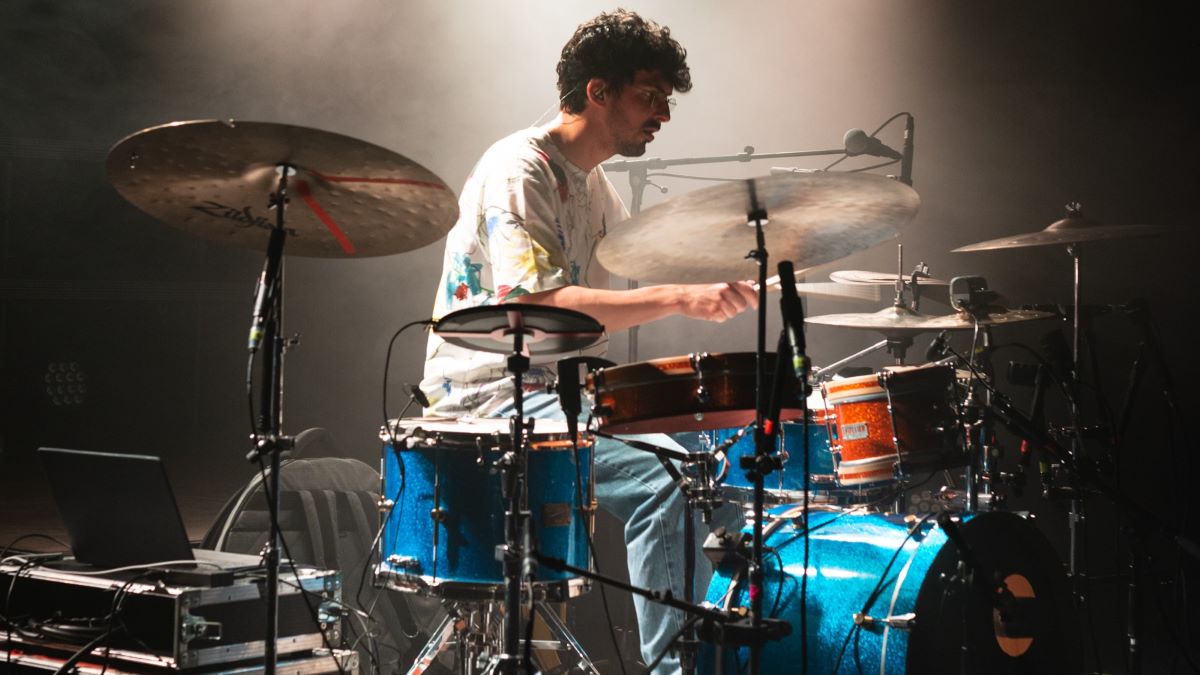
Antoine Pierre is one of the busiest jazz drummers in Belgium. But he also looks far beyond the boundaries of the genre for inspiration. So far, in fact, that he managed to surprise me with a question he asked me.
“You like metal, right? I have been a big fan of Slipknot since I was a teenager. It’s kind of funny, because I have never played that drumming style. I have never played with a double pedal. I have just never engaged into that kind of playing, but I just really love the energy, the rawness, and the technical ability of the drummers is just incredible. Same thing with guitarists, like James Root and Mick Thompson, these guys are incredible.
The other day, it was a full moon, and I had the craziest dream. I dreamt that we were in Liège, my hometown, and Slipknot was playing a show, but their drummer couldn’t show up, and they called me. But I never played with a double pedal in my life! Never! And they’re telling me: you have two hours to learn the whole repertoire.
I know most of the songs. I have never played them, but I could sing the drum parts and everything. I’m that fan: I know all the drum parts. But I would not be able to deliver. In my dream, I was so anxious. I had to learn everything, and they seem very intense people. It must be a real tough job, actually. I have always loved how they managed to bring the crazy aggression and a kind of pop approach together.”
Space for the Unknown
If that has not made it clear already: Antoine Pierre is not your average jazz drummer. He continues to explore several styles through his improvisational playing: jazz-rock with Urbex, triphop-inspired music with Next.Ape, a wide array of session jobs, and then there is his relatively new project Vaague, in which he plays live dance music by himself, armed with only a fairly unconventional drum kit. Vaague being more composed than the projects he is known for demands quite a different skill set.
“Sometimes I get a bit nervous”, he admits. “I tend to overthink the sticks. Because I’m alone on stage, trying to make it work as if there was a band. It’s very tight, and it requires a lot of concentration, a lot of focus. I see it as a choreography, in a way. The challenge in playing that music live with no click track, no pre-recorded loops, just playing exactly as if I was playing synth and drums at the same time, it requires a level of concentration to the point that all of my motion and movements are predetermined. Nothing is random. Everything has to be exactly where it is.
If I’m too mindful or too self-conscious about what’s happening, it could work, but then it doesn’t really groove. I need a little space for the unknown. The way I programmed everything makes it so that there are a few spots where I don’t know what’s going to happen. So I do program some random parameters. For example: there are samples that can be launched from different spaces, from different zones, but those zones don’t activate all the time. That’s a way for me to stay alert. I need to be 100 percent there.”
Reversing the Process
“I always wanted to do a solo thing, because I was jealous of guitar players, piano players, singer/songwriters, even harpists who could do solo shows. I wanted to do something with drums, but I didn’t want it to be just drums. I wanted something that would be a little more danceable. However, I’m really bad with Ableton, so I didn’t want to go into the realm of backing tracks. Playing drums to a track would feel like I was kind of karaoke-ing myself.
First, I tried playing with guitar pedals and contact mics. That was great, but very far-out. It was kind of scary to me. But then I saw a video from these guys from Sunhouse about the Sensory Percussion. It looked interesting, so I put fifty bucks into their crowdfunding campaign. They sent me the first trigger in November of 2019, and my idea was to do something about it in 2024 or something, when I had time, because I had projects planned with Next.Ape and Urbex.
Then covid happened, so I had a lot of time. I was in my room for a couple of hours every day, trying to decipher what was going on, checking the manual, trying every pre-set possible, and getting in touch with Sunhouse. They quickly saw I was very serious with it, because I was basically sending them a crash report every ten days.
Then one day, Tenoch Esparza, one of the creators, reached out to me and asked me if I would be interested in visiting their headquarters. I was planning to go to the States in 2022, so I went, and they introduced me to the new version of the Sensory Percussion, and they kind of made an endorsee.
They created a technology that’s not really like any other I know. I can just play drums, and it’s not like I have something separate from the kit. If you have an SPD, it feels like having a keyboard next to you. These triggers made me feel free about just playing the drums, and trying to reverse the process. Instead of having something melodic that I accompany with the drums, I’m playing the drums, and there’s something accompanying that through those triggers.”
Almost Recreational
“When I just started playing live with Vaague, I was not having fun. Which was weird, because I did have a lot of fun when I was alone in my room, trying out stuff, basically playing with all the parameters, and trying to figure out what was going on. You try something, and it’s totally not what you had expected, and then all of a sudden, you have created something that you didn’t know you were going to be able to. You get excited because you discover something new. I was kind of in the zone of trying to do that.
But then, when I got on stage, there were so many elements to think about. Before I could actually access that zone of improvisation, that bliss where you create stuff in the moment, I was not able to find that whatsoever. It required, first, a lot of practice. I did think about quitting, because I thought: why am I doing this to myself?
But then in the end, I found a way to see the computer more as a second musician. And now it’s fun! In the last year and a half, I haven’t had a single gig where I thought: oh shit, not this again. The reason why I think I’m very excited about this thing, and why I’m still doing it now, is that in the last four years that I’ve been doing this project, I still had jazz projects going on at the same time, where I could experience the joy of playing with other people, making things happen, living in the moment.
Going back on the road with jazz projects felt like vacation again. Because I was just bringing cymbals, tuning the drums, and playing. It felt like a playground again. It was almost recreational. Playing jazz drums is very demanding, but then Vaague was really demanding in a different way. That balance was what I needed.”
Only Snares
“Cymbal-wise, my set-up in Vaague is kind of close to what I use with Next.Ape: one ride, which is a flat ride that I use in my jazz projects, and a 22″ Zildjian K Custom crash, which I often use as a ride. In Vaague, I use it more as a crash ride, and it’s always on the far right. The one thing that makes the set-up different from the rest it’s that it’s only snares.
I have one classic 14″x6″ snare and one snare that I use more like a floor tom, with the snare mat off. Actually, I had that one made for Next.Ape, but then I kind of shifted it to Vaague as a tom. For some reason, it made more sense to use that snare as a tom because of the sound. The tension of the head is so low, so loose, that you have this really direct attack.
And then I have two custom-made snares by a great drum maker in Belgium called Latellier. He’s a drummer, and he learned from the guys of Noble & Cooley. One is a classic 12″x5.5″ side snare, kind of Dave Weckl-ish, that I use as a jungle kind of sound: really sharp and high, with a very tense head. And then I have a very special one, that’s the same depth, but it’s an 8″x5.5″. So it’s very, very small, very sharp, and when you put the snare up, it really sounds like percussion. When you pull it back, it sounds like my 14″ played at ten times the speed.
Usually, in my jazz projects, I use a classic 18″, 12″ and 14″ Coated Ambassador set-up. And then just rides that I love to use. But I have to say that I feel like I still haven’t found my ride. I really love that flat ride, but I wouldn’t mind trading it for something else.”
Taming the Drums
“Sometimes drummers come to me to talk about gear, and I have to tell them that I’m not really interested. Which sometimes I feel is a bit of a pity, because there’s a lot of fun to be had with that, but I don’t really care so much. I like good drums, but I have played so many shitty drum kits in my life, and I like that too. Like every other drummer, I went through a phase of experimentation with heights, angles and positioning, but at a certain point, I was playing so many different drum kits that I started to not care.
Admittedly, I’m a bit of a lazy person when it comes to tuning the drums. Pierre Hurty, who plays with Wajdi Riahi, is an incredible drummer; I’m in awe when I see him play. But we have such different approaches when it comes to taming the drums. If the drums sound good enough, I’m not even going to bother taking my tuning key off. Pierre is going to untune everything, then retune so it’s perfect, and he puts the moon gel at exactly a certain distance from the rim. I actually feel a bit jealous that he has the guts and drive to do that.
The one thing that did it for me was when I saw Marcus Gilmore play for the first time, and he was tuning his drums while playing, without even checking. I thought it was kind of genius, because then you have to make the sound out of the drums. I don’t want to sound braggy, because I don’t think I have reached the point where I know exactly how to play many drums and sound the same, but it’s kind of my goal: trying to deliver the same kind of sound without trying to make it too good.”
A Very Intricate Science
“Sometimes engineers do tell me, for instance, that my bass drum sounds like shit. I’m the worst bass drum tuner in the world. Except for Vaague, where it’s very easy. I just put something into the hole, and that’s it. There is not much where you can go wrong that way, because you just put the mic into it, and it’s kind of the sound engineer’s work to make it sound the way it has to be.
For that kind of stuff, size does probably matter. Because you can go in with a smaller bass drum, but you’re not going to get that very big push, that amount of air that really kicks in the mic. That’s something I don’t master. Bass drums in jazz is a very intricate science, and that’s probably the one thing where I kind of try to find something that works almost everywhere. You can have the same bass drum every night, but then the venues react differently, or the way it has to be amplified changes.
What I do though is trying to keep my toms tuned so that they have to be melodic, in a way. If I go to a place and the drums are not resonating at all, I’m going to tune them. But if the drummer the night before was a jazz drummer, they are usually tuned kind of high. At Bimhuis in Amsterdam, for instance, I almost never have to touch the toms. They probably had someone like Martijn Vink or Jaimy Peet play that Sonor kit they have there the night before, and I’m not going to change it.
Usually, I ask the sound engineer not to mic the toms, because I like it when the sound comes naturally from the overheads, and then you can just really be the master of your own dynamic. For Vaague, I like to have something more compressed. But for jazz, it’s better to have something with air and space.”
Collaborative Effort
“This year, I will be touring with Kit Downes a lot, on different projects. I have toured with his band Enemy, because James Maddren, who is normally in the band, became a father. That music is really difficult, but it’s very fun to play. We’re also going to play with another band with him, Ben van Gelder and Phil Donkin in October, called OddBloke. It’s kind of like a collaborative effort rather than a band. It’s mostly Kit’s initiative, but we’re all going to be composing for it.
And then, I have a new project with Jesse van Ruller, a flute player who lives in Amsterdam, Ketija Ringa Karahona – she’s from Latvia – and a saxophone player from Belgium, Bo Van der Werf, who is one of the legends of the baritones and serial music, in a way that even Godwin Louis, a giant in the world of saxophone playing from New York, studied this guy. We haven’t named the band yet, but the premier will be on the 19th of September at Théâtre Marni in Brussels.”
An edited version of this interview appeared in Slagwerkkrant 247 (May-June 2025)
This interview is part of Kevy Metal’s Gateway to Jazz series.
 Kevy Metal
Leave a comment