
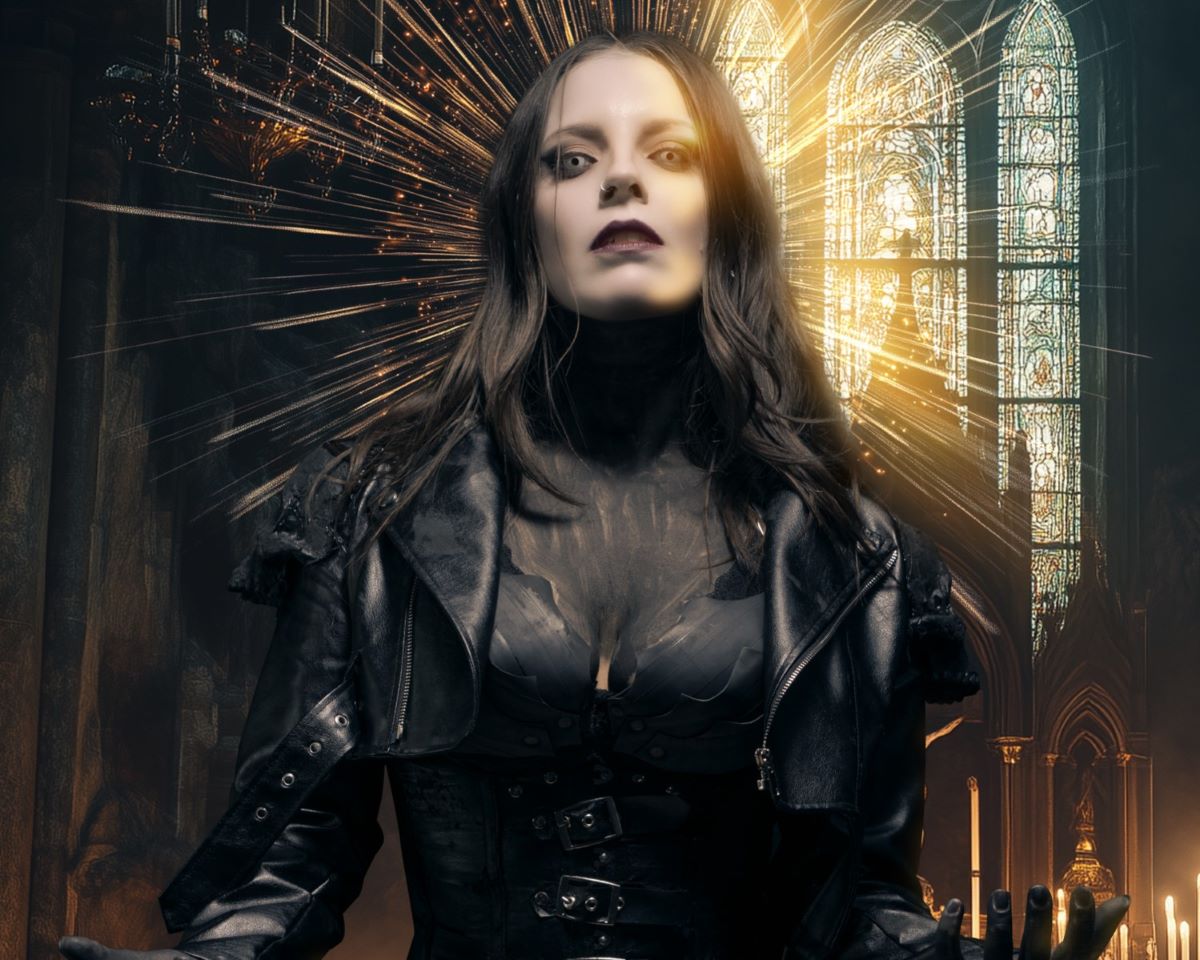
Horror theater and rock music have gone together for a long time, just rarely in as catchy a package as Italy’s Deathless Legacy offers. Fronting the band is Steva Deathless, whose husky, yet powerful voice is one of the more unique in the metal genre. She is also more than happy to share some insights into the recording of the new Deathless Legacy album ‘Damnatio Aeterna’, their theatrical live performances, and recent developments in her singing style.
“The album started with me and Frater Orion (drummer) in the car, coming back from a festival in Croatia in 2023”, Steva says. “It was about a six-hour drive, and we said: let’s think about the new album. We came up with the idea, the story behind ‘Damnation Aeterna’, and we managed to put together the main plot on that car ride.
Since ‘Rituals of Black Magic’ (2018), all our album have been concept albums, and we tend to take care of the story first. But this time, I think we took care of the story in a different way. We usually gather the ideas that everyone works on at home, and then meet in the studio to work on them to try and get the songs together for pre-pre-production.
The album being a story, there are chapters. Let’s say the chapter is a feeling we would like to express, or there is some kind of battle in the story, then the music has to be battle-oriented as well. That really helps us create the atmosphere that we want to get. And even, speaking for myself, it helps me find the way for the song to express what it is supposed to convey at that point.
So the process was this: we wrote the story, tried to split it up into chapters, and then we got into the studio with some riffs. We worked on them, got all the parts of the songs together, and then went on to record our pre-production, which is recorded a little better than the previous step, so we can listen if the song works.
One of my favorite songs on ‘Damnatio Aeterna’ is ‘Indulgentia Plenaria’. During the pre-production, which should be the last stage before going into the studio to record, we changed the chorus. And I think it improved a lot. It was so beautiful to be able to say: now it’s exactly how we want it to be.”
Combining Singing and Acting
There aren’t just chapters in the stories that Deathless Legacy writes; there are also characters that Steva has to embody and give their characteristics. “I think that’s the most fun part”, she smiles. “I love that part of the process. It’s like being an actor, but with my voice. One of my spiritual fathers, King Diamond, is one of the best singers when it comes to expressing all of these things.
I know my singing style and King Diamond’s are quite different, but I have always loved his voice. Even the way he writes songs and lyrics. I have always loved it. Since I was a teenager. I always got a lot of inspiration from his voice and the way he sang. I think it’s a great way of combining singing and a certain kind of acting.
Some albums ago, I was trying even harder to find different ways of singing for different characters. This time, I think I am a little more subtle with my style. Back then, it was much more obvious that I listened to King Diamond a lot. I still do, but at the time, I was young, and I was still shaping my way of expressing things. So let’s see what the future will bring.”
Exploring Different Approaches of Singing
It is interesting to hear the vocal development Steva went through recently, as ‘Damnatio Aeterna’ and its 2022 predecessor ‘Mater Larvarum’ showed her relying less on belting than she had in the past. “About six years ago, I have started taking singing lessons”, she explains. “I have been singing metal my whole life, doing harsh vocals and stuff, but I wanted to try and explore a different approach of singing. So I took pop singing lessons.
I think that really helped me explore my instrument more and find new ways of expressing myself. As for the pop aspect, it may have been strange that I don’t listen to the radio. My teacher suggested starting with a song I had never heard, and she said: how is it possible? It’s everywhere! And maybe I should have known: if you’re a musician, you should explore everything, because you don’t know where you can find something that will inspire you.
So I am happy I took that path. I had to quit because of covid, and I never went back to taking lessons. I would like to at some point, because it was fun. But in the end, she said: you can already sing, I don’t know what to teach you anymore. She was more used to people who want to learn how to sing, and I was already a singer. But she did help me manage my voice for a show a lot.”
Making Weird Noises
Steva admits to the vocal maintenance being an important improvement, as her unique, but reasonably throaty singing style tends to be at risk of fatigue and strain. “The most important thing I have learned from taking singing lessons was doing a lot of vocal warm-up”, she says. “I’m making weird noises and having everyone look at me in a funny way for about an hour before the show. That’s what helped me most.
I used to do a bit of warm-up, but I am taking it much more seriously now. Also, I try to drink a lot of water and I should avoid drinking beer, but that’s not always so easy, haha! I even started taking more care of what I eat before a show. Sometimes, it depends on where we play, you have to eat what is there, and there’s a lot of stuff that can ruin your voice, so I try to avoid that.
Also, I try to maintain my voice by working on the whole package. Even physically, because I move a lot on stage. I can’t run out of air while singing, so I try to be as healthy as possible. With this heat in Italy especially, it can be a challenge. The first gig we played this year was a struggle because of the heat. I don’t know how it’s going to be when we have some shows in July or August, but I’m very scared, haha! I hope I’m going to manage.”
Becoming One Brain
Another important part of Deathless Legacy’s live shows is the performance aspect, going so far that the band even has a designated performer in their line-up. These performances are as integral a part of the album production process as the actual music. “Usually when we have something going on, like a story that we’re thinking about, we already start to think about the performance side of Deathless Legacy”, Steva explains. “That’s when we meet with our performers to brainstorm ideas together.
Most of the work actually happens pretty much once the album is done. When everything is ready, we go to our rehearsal room, and we spend multiple days there thinking about things and trying stuff out. Of course, we all do some things at home individually, but the best things happens when we become one brain, when we all get together.
Usually, that is the last part of the process, because we need to know what the songs are going to sound like for real before we can start thinking about something so important for us. After all, each performance tells a story, so it’s important that the story we are telling is coherent with the album, the songs, and everything.”
No One Got Decapitated
However, that does not mean that the performances are always working out as intended, for example in very small venues. “Plan B is to get there, panic, and find a solution while we’re there”, Steva laughs. “We have been in situations like that. Like in ‘Miserere’: our performer has two big wings, some kind of bat wings that she has to open, and then dance like a bat. Sometimes the ceiling is too low, so she has to find ways to not kill anyone.
That’s another fun part of the whole process. Not the panic of course, but once it’s done, you can sit back and think: wow, it’s impressive that we found a way to make it work, even in a place like that. There have been instances where we were able to see pictures from some of these values, and we still wonder how we managed to play there with all our stuff, and the audience really close to us, and no one got decapitated! How is that possible? Haha!
Every time we play on stage, it remains a challenge. You never know what happens. I remember when I first started playing: if something didn’t go the way we wanted, it was the worst performance ever. Nowadays, it’s some sort of a challenge to make the best out of the situation. You have to always be prepared for anything. Anything could happen.
If I know after a gig that I didn’t perform the best way possible, I still don’t like it, but sometimes people don’t even realize that there were mistakes. Especially if I can listen back to it and realize that it wasn’t that bad at all. Sometimes the feeling you have on stage is ten times worse than how it really was. But that comes with experience, in my opinion: the more you fail, the more you understand that it’s not a failure.”
Like a Game
Deathless Legacy famously started as a tribute act to Italian shockrockers Death SS, though the truth is somewhat more nuanced. “We never played Death SS songs exclusively”, Steva emphasizes. “In fact, the first show we played was in 2009, and we already had a couple of our own songs. So we knew the Death SS tribute thing wasn’t forever. We were just some sixteen-to-twenty-year-olds who wanted to play together. It started like a game, for me at least. It was a way to spend some time out with my friends, and then it turned into Deathless Legacy.
We always have and always will consider Death SS our spiritual father. They are a big inspiration. For us, and I think for a lot of other Italian bands. For so many reasons, and for what they represent for Italian metal music especially. If you listen to our first album, you can still hear a lot of Death SS influences. There are always going to be, because they are part of our background.
But I think from our second album onward, we started to grow a bit more of our own personality. Since then, I think we have grown up a bit more. Personally, I am always going to be thankful to Death SS. Especially because we have had the chance to become friends. If I can speak to myself at sixteen years old, and say that one day, I’m going to speak to Steve Sylvester like he is one of my friends, my sixteen-year-old self would say: fuck off, no way, haha!”
Labeling Something That Doesn’t Exist
“When Alex Van Eden joined on keyboards, he was the big musician in the band. He was the keyboard player from Vision Divine, he had toured with Angra, he had been in a lot of different projects… As musicians, we have always been into different kinds of music, and I think Alex was the glue. He managed to glue everything together. If we ever had to choose another keyboard player, I wouldn’t even know who could do it.
After he joined, we won the Wacken Metal Battle in Italy with three new songs that we had written with Alex. That’s when we understood that we could do something different. We could explore new sounds and try out new things. I think that from then on, we grew into what we are today. And I’m so happy with the sound that we have.
A lot of people ask me what genre Deathless Legacy is. I have no idea. I don’t know what to answer. I truly don’t know. Apparently it’s a problem for some that you can’t label something that doesn’t exist. On the other hand, it’s pure chaos. And I love it. If you want to listen to something, but you don’t know what, Deathless Legacy will probably do.
Not labeling ourselves gave us a lot of room to explore. For example: a blues metal track like ‘Get on Your Knees’… If you present yourself as a very strict genre, and then you do something weird like that, people will say: what the fuck is that? To be fair, they probably say that in our case as well, but at least then it’s: what the fuck is that? Oh, it’s Deathless Legacy. I’m curious to see where we will go next.”
Breaking Up in the Best Way Possible
Although Steva and Frater Orion are the only ones who have been in Deathless Legacy since the band was founded in 2006, the band has had a fairly stable line-up over the last decade. “It took us a long time to get that stable”, Steva sighs. “We were so young when we started out… We were at that age where you have to pick your university, pick your job. Back then, I was quite angry with the situation, because we couldn’t find a stable line-up. But now I understand why, of course.
I was sixteen. The others were in their twenties. You can’t pretend you’re going to be something for life. Things change, especially at that age. Now, we’re all a bunch of old asses, we are all in our thirties and forties. We did have a change in our line-up last year. Our previous performer Revyla had to leave because of work reasons. She found another path. We broke up in the best way possible. We’re friends and still see each other.
But in the early days, it was a real struggle. To make our first album see the light of day was quite an ordeal. It took us forever. We couldn’t have anything stable. But I don’t regret anything.”
An Earthquake in Band Dynamics
Steva emphasizes that the fact that the performers don’t appear on the album does not mean that changing them has no impact. “Every break-up – because it feels like a break-up after you have lived through a lot of experiences together – is like an earthquake in the dynamics of the band”, she says. “It’s like losing someone from your family that moves to the other side of the world, and you don’t see them that often.
That’s the reason why the performers are important to us. We are so happy that our former performer The Red Witch is back. I went to high school with her. I’ve known her all my life. She left the band because she moved to the US, but I’m happy she came back. She doesn’t play any instruments, but we are great friends. It’s like welcoming back your uncle or your brother. Or your sister, in this case.
Our purpose is to give our audience different ways of experiencing our shows. The performers are an element that adds to that. We have only played one show without a performer. That was a bad break-up with someone, some years ago. And it was weird! The performer is really a member of the band that plays in a different way, but plays an equally important role.
Sometimes it happens that we play songs unexpectedly. Someone asks if we can play one more song, and we’ve run out of songs on our setlist, so we have to reach back into our past, and we don’t have the costumes. That’s when we have to improvise and I have to be the performer myself. You can really feel the difference compared to the performer actually being there.”
Raising the Bar
Despite Deathless Legacy’s sound being fairly clearly defined, the band tends to find new directions on every release. “We always try to raise the bar a bit”, Steva states. “That doesn’t necessarily mean that we have to play complicated stuff, but we do try to find new ways to express ourselves, and to tell a story in the best way possible for us. It’s always going to be a challenge, but that’s a good thing. That’s the fun part.
When we are in the studio, like when we recorded ‘Damnatio Aeterna’, I hated that time of the year, because there was so much stress. You live in the studio from 8 AM to midnight every day. But then when it ends, I always start to miss it. Maybe that’s why we have been doing so many albums in a row.
When we released ‘Mater Larvarum’, we realized it was something different in our career. We got a lot of opportunities. We got to do 70,000 Tons of Metal, we got to play a lot of different places, so we wanted to give ‘Mater Larvarum’ its chance to shine as much as possible. But as I said before, we already had the idea for ‘Damnatio Aeterna’ in the summer of the same year.”
Giving Each Album Its Time
Perhaps the most obvious example of Deathless Legacy raising the bar is the fantastic one-track release ‘Saturnalia’ from 2020. “Our twenty-four-minute-long rock opera suite”, Steva smiles. “For me, it is one of the best things we have ever done. The video is something we have all done by ourselves. Just us acting, directing and everything. Everything you see in that video is home-made.
Whenever I listen to ‘Saturnalia’ these days, I can’t help but think: how the fuck did we manage to do that? None of us remember how it was possible. Some kind of demon possessed us for sure, because we don’t know where else it would have come from, haha! But I’m very proud of it. We haven’t played ‘Saturnalia’ live too much, but who knows? Maybe one day…
‘Saturnalia’ came out when lockdowns started here in Italy. We had a lot of special events planned to present it. We had to cancel everything, and basically lost the chance to have a ‘Saturnalia’ tour. That is what made us realize that we have to give each album its time. We still have these ideas in the backs of our minds for the future, though.
We played it a few times at prog festivals. They like that kind of long stuff, haha! But when we have to add the rest of our normal setlist, it’s going to be a three-hour show…”
A Better Experience
“The problem in Italy is that we don’t have many places to play. If you are in the south, for example, you don’t have anything. There are some festivals, and some of them are actually really good. But for example: we are in the middle of Italy. Reaching Sicily or reaching Germany takes the same amount of time. Maybe reaching Germany is even a bit faster. So if you have the chance to travel a lot, you go to Germany, because that gives you the opportunity to present yourself to a bigger audience.
The south has great metal, by the way. All of Italy has. We have basically played everywhere, and people are really passionate about it. But as a band, it’s hard to reach some places. There may be a lot of bands in southern Italy that are the new big thing, but they are so far away from everything.
Also, after covid, we have lost a lot of places to play. Milan is constantly booked by big bands. It’s hard to play there, because everything is always booked. We don’t have clubs. We do have festivals, and I have visited them, but to be honest with you: you can go to Graspop and see all the bands that are going to be playing here, and you are probably going to have a better experience.
The sound is often awful, possibly because of some trouble with the local administration that doesn’t allow bands to play above a certain volume. So we don’t have the places, or maybe we don’t want to find the places to have great festivals. And then we cry if big bands don’t come to Italy.
Fortunately, the underground metal scene is so much better. There are stages, but of course, they are small. And because the venues are so small, the big bands can’t come there. But we have a lot of fans in the south who ask us to come there and play. We went to Puglia, which is like a 13-hour drive. We can go to Wacken in that time!”
Being Gross on Stage
So far, Steva has been pleasantly surprised by the reception of the singles from ‘Damnatio Aeterna’. “When we chose ‘Sanctified’ as a single, we were somewhat scared”, she admits. “Because it is a kind of ballad, and it was the first song we released after ‘Miserere’, which sounds more like people expect Deathless Legacy to sound. It’s heavier and more frantic. But apparently, people loved it. And I’m so happy, because that song is so meaningful for me, and for us.
‘Sanctified’ is a song about struggling with big traumas, big holes in your soul. The fact that people acknowledged that they can understand this and feel these feelings made me so happy. If people can understand the emotional side, that we put a lot of effort into – it took me a lot to sing that song – I love it.”
Steva’s initial expectations were created by earlier responses that weren’t quite as supportive. “I was expecting people to complain that we took the path of least resistance by having a woman in the band”, she says. “Some people say it’s the shortest way to reach people. That’s why I love being gross on stage. To everyone who had their picture taken with me after the show, I say: you’re going to remember how I smell after the show. I’m like a beast, haha!
If you go see a band because of a singer you think is good-looking, that’s fine, but it’s not the fault of that singer. If you scroll through the comment section of any YouTube video of a female-fronted metal band, the comments are all the same. Fortunately, things are getting a bit better now. But I remember a few years ago, it was like a jungle. Everything was like this. A lot of female singers that I’m friends with have had the same experiences.
Not seeing that kind of stuff is why I was so happy with how people reacted to ‘Sanctified’ and ‘Get on Your Knees’. I feel like basically everyone got to the point. Maybe people are starting to realize that it doesn’t matter what gender the musicians are.”
 Kevy Metal
Leave a comment