
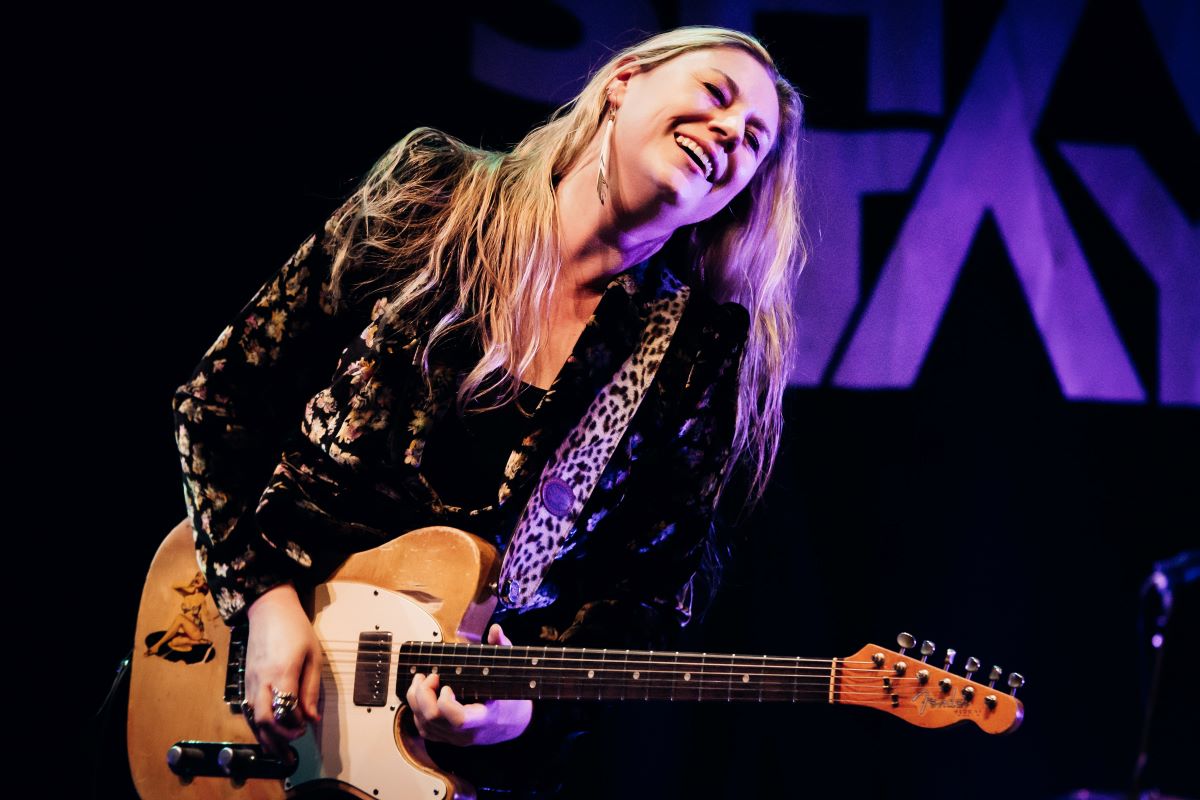
Few artists manage to combine the spontaneity of blues guitar playing with strong, memorable roots and soul songwriting as well as British singer and guitarist Joanne Shaw Taylor. Her strong new offering ‘Black & Gold’ was released one day shy of a year after its equally strong predecessor ‘Heavy Soul’, so she certainly isn’t stuck for inspiration.
“Touch wood, I hope it stays that way”, Taylor smiles. “I think a large part of it was just being locked down for so long, having to take two or three years off because of Covid. And then, I focused on doing a covers album (‘The Blues Album’, 2021) for the first time. I probably would have released this amount of music in that time, but instead of doing it over five years, I’ve done it over two. I’m sure I’ll run out of ideas at some point and start repeating myself. But maybe if I do, I’ll try something a bit different.”
Taylor might already be doing that, given how different ‘Black & Gold’, ‘Heavy Soul’, and 2022’s ‘Nobody’s Fool’ are from each other. “That’s what I always wanted”, she nods. “I wanted to sound like the same artist, but different sides of the same artist. Plus: you have to change things up, for my own sanity. I couldn’t do the same thing day in, day out. It would drive me nuts.
I have always stuck by the idea that if I’m enjoying it, then I can make other people enjoy it. Which is my job: to make people happy, and feel something, and be entertained. If I’m playing by numbers and not really feeling it, then they probably won’t either. I think you’ve just got to kind of trust your gut and go with what you feel like doing.”
Into a Fresh Decade
“I’ve got OCD. I’m very particular about numbers. And ‘Black & Gold’ is the tenth studio album, so for me, it felt like a nice way of wrapping up the last decade of recording. Plus, I turned 40 this year, so age-wise, I was going into a fresh decade as well. So in my mind, I kind of wanted it to tie in with my previous albums.
It was kind of an opportunity to write some songs, and particularly genres, messing around with things that I had been wanting to, but maybe had not been brave enough to do. And also, personally, to address a few things personally in my lyrics that I wanted to, particularly things that I didn’t want to take forward with me. I think that was the biggest difference.
‘Heavy Soul’ was very much about doing another original blues album, and kind of linking it to the previous album, ‘Nobody’s Fool’, which was quite poppy, and kind of bringing that into the blues. And ‘Black & Gold’ was more about still having it tie in with all my other albums, but then to also try a few things that I hadn’t yet. I think the songs are a lot more fun, to be honest.”
A Snapshot of Two Weeks out of Life
“It can be easy for an artist when you’re kind of pigeonholed into a genre, but it does weigh on your mind that you want your fans to be happy. Of course I do, but I also owe it to myself to write songs that I feel I should write, as opposed to faking it.
I have always said that when people describe me as a blues artist, the first thing I think is that I’m a blues guitarist that’s a soul singer that likes writing pop songs. I don’t think I’m a blues artist, but I do think I’m a blues guitarist. So it’s kind of fun to mess around with ‘Hell of a Good Time’, for example. It’s just a really fun kind of poppy rock song. But it still obviously has a guitar solo in it for the guitar fans.
Just little things like that. Or maybe even something like ‘Who’s Gonna Love Me Now?’, which has a bit more like a Peter Gabriel kind of vibe to it. A lot of quote-unquote blues artists probably wouldn’t do a song like that, but it’s something that I wanted to do. And it’s a personal song that I love very much, so I’m glad that I get to do that.
An album is a snapshot of maybe two weeks out of your life. I could have taken these songs and recorded them next year, and it probably still would have sounded different, because you’re in a different frame of mind.”
Pinch-Me Moments
“This album was recorded with the same band as ‘Heavy Soul’, apart from the fact that we have changed guitar players. Rob McNelley couldn’t do the session, and Kevin (Shirley, producer) managed to get a hold of Audley Freed. I was absolutely thrilled, because I have been a massive fan of his for ages. The Cry of Love was one of my favorite bands as a kid. So it’s nice to be able to sit next to him and think: I’ve had a picture of him on my wall when I was a kid, haha!
It’s like working with Reese Wynans (keyboard player who played with Stevie Ray Vaughan’s Double Trouble, among many others). I just know him now, but every now and then, you remember and realize how lucky you are, and it’s a lovely feeling. I’ve worked with Steve Potts and Dave Smith on the albums that Jim Gaines produced (2009’s ‘White Sugar’, 2010’s ‘Diamonds in the Dirt’, and 2014’s ‘The Dirty Truth’), so yeah, I’ve been very lucky.
I just went to New Orleans, actually, for Jazz Fest, to do a session with Taj Mahal. So that was a bit of a pinch-me moment, to say the least. They interviewed me and asked what it was like for me. I said: to be honest, it’s such a massive thing, that I think it’s going to be in a year’s time when I’ll actually process it and say: I just recorded three songs with Taj Mahal, that’s ridiculous.
We’ve also got Doug Lancio on the record. I get to call the shots and go: this is what I’m playing, and then Doug and Audley have to figure out what complements that and work around it. Which is a testament to how wonderful they are to work with as people, but also to their talent. I don’t think I could do that role. I think I’m too much of one type of a guitar player. They’re obviously much more versatile than me, but also have their own kind of signature sounds.
Both of them have done a lot of slide stuff, for more ambient sounds, and really put some different textures in there. It’s a treat to see what they come up with every time.”
Some Songs Fight You
“Most of my songs tend to be written on acoustic guitar. That’s basically what I do at home. And starting out as a classical player, it’s something I still really enjoy. So when I demo the songs out, they tend to be acoustic, unless I’ve got a very specific idea in mind about how I want the song to sound. For example: I wrote ‘Sweet ‘Lil Lies’ from ‘Heavy Soul’ on piano, and I think I demoed it out with the guitar parts, the piano part, and a rough bassline, because I very much had what I wanted in my head.
But for the most part, I leave it up to the producer. I think you’ve got to, in order to have a successful album. I could have given these exact same songs to Joe Bonamassa, and it would have been a different album, because of Joe’s input. When we’re making an album, it’s Kevin Shirley’s version of this Joanne Shaw Taylor album. So I like to leave my songs open enough to get Kevin’s idea of how he hears them, to have that partnership.
I’m pretty open-minded when it comes to the arrangements. I think you always have to be when you’re working with a producer. Obviously, I’ve kind of got an idea of how I want them arranged, so that I’m not going in with nothing and wasting everybody’s time. But sometimes Kevin will say: let’s shorten this intro, or let’s end it like this instead. Or sometimes, he’ll even say: this needs a bridge, could you write me one?
Kevin’s really good with keys. I’ll mess around with it and think I found the perfect key, and he’ll say: no, you can go higher. No, Kevin, I cannot. And then it turns out that I can, haha! He’s got a great ear for pushing me on that. Sometimes, when I see a song like ‘Runaway’ on the setlist, I take a big gulp of tea and think: okay, here we go. And every time I do it, it’s easier than most things I have to sing.
It’s good to have an idea of what you’re doing. But it’s just as good to leave some of the magic up to working with the incredibly talented musicians and producers I get to work with. Sometimes it will sound great from the get-go, sometimes people aren’t finding where they are meant to be quite yet, myself included sometimes. I might do a rhythm part, but then we’ll realize that I like what Audley is doing, but it clashes with what I’m doing, so I’m going to change what I do. Some songs fight you, some songs are easier.”
Forcing Focus
Taylor being as prolific as she is might be surprising, as she admitted to only taking a few weeks off to write her albums when the recording date is coming up. Releasing most of the songs on ‘Black & Gold’ as singles over about a year’s time has not changed that. “We recorded it last year in one go”, she says. “And the same thing again. I have gotten to the point now where when I tell my dad I’m doing another album, he’ll say I’ll start panicking about a week before the recording starts. He knows me very well.
I think it’s a bit of attention deficit disorder, which I do have. It’s really hard for me to focus unless I’m forcing myself to. The looming threat of a deadline does make you focus. I’ve always been that way. I can’t write unless I’m really panicking. Which is fortunate, because I tour so much I don’t get a lot of time to write.
Touring is not hard work, but it is a hell of an endurance test. It’s like going to work and seeing your workmates before you even get to have a cup of coffee in the morning. They are there in their pajamas living with me. And then between the travelling and the interviews, it’s kind of difficult to sit down and carve out time to write on the road. You get a few ideas sometimes when we mess around at soundcheck. It’s fun to bounce ideas off the band, but again: unless I’m panicking, I’m not going to get anything done, haha!
We are probably sticking to releasing a single every month to get something fresh out there for the fans. I thought it would be a bit stressful at first, but actually, I’ve really been enjoying it creatively, to be honest.”
A Refreshing Change of Scenery
Another factor that separates Taylor’s studio recordings from her live performances is that she never recorded with her touring band. “No, I never have”, she confirms. “Which isn’t anything against them. I adore them as people and musicians. But one: most of the producers, if not all of the producers I’ve worked with have always had a preference on what musicians they want to use. And secondly: it’s kind of nice to have a little break, and try something fresh.
Also, the guys in my touring band get to go and do something different, and have a little break from me. Then I get to work with musicians that maybe don’t come into the songs with a preconceived notion of what I want to hear, because they’re not as used to me as my touring band. They just hear a song and give me what they think the song should have. That’s a refreshing sort of change of scenery.
Seeing how the songs grow after that when we’re playing them live is always the fun part. You write them for a studio session. Basically, what you’re hearing is the third or fourth time they have ever been performed. So you come out to a show three years down the road, it’s fun to hear how things have evolved.
It would drive me nuts to play the songs the same every night. Particularly when you tour as much as we do. If you’re playing the songs I have played pretty much every gig for the last ten years, you do have to kind of freshen up a little bit. The song deserves to live and evolve. I’m not one of those people that records a song and goes: right, nobody touch it, that is the arrangement for fifty years.”
Big Guitar Numbers
That spontaneity extends to the way Taylor records her guitar solos. “I was going to say a hundred percent, but I would say more like ninety”, she explains. “Songs like ‘Hell of a Good Time’ or ‘Look What I’ve Become’ definitely offer room for hundred percent spontaneity. I particularly really enjoy cutting those songs live with someone like Anton (Fig, drummer). I kind of push him to do something, and he pushes me.
The remaining ten percent is in the pop songs, like ‘Who’s Gonna Love Me Now?’. Because it’s a bit more structured, you kind of want to plan something out. That said, I made Joe Bonamassa play the solo on that, so there wasn’t much room for me to do anything, haha!
But yeah, there are some songs where you kind of have to. In ‘Grayer Shade of Blue’, I ended up writing more of a lead part than a solo. Because you don’t need a solo on things like that, so you really have to justify why you’re putting one in there, as opposed to songs that are obviously big guitar numbers.”
Still, Taylor is fairly melodic for an improvisor. “I like repetitive phrases, things that catch the ear”, she nods. “Which I kind of learned from people like Albert Collins and particularly Dave Gonzalez from The Paladins. He used to do that a lot. So I have to give credit to them.”
A Massive Dinner Plate
The guitar Taylor is most commonly associated with is the Telecaster. Around the release of 2012’s ‘Almost Always Never’, however, she was often seeing playing a Gibson Les Paul. “The reason for that was that I just felt my playing had gotten quite stagnant”, she admits. “And it seemed like no amount of practice was sort of bringing it along, so I thought: maybe a change is as good as a rest.
So I changed guitar to a Les Paul, and I changed my guitar pick. Just to kind of mix it up, I moved to a Jazz III, the Eric Johnson model, which is a much smaller pick. And I think it really did help tidy up my right hand a lot. So I kind of felt like I had to move to a different guitar to learn something new to bring it back to the Telecaster. But the Telecaster is still my main love.
It’s funny now, because those Jazz III’s are quite a lot smaller than a standard guitar pick, every time I go back to playing with a normal pick, it feels like I’ve got a massive dinner plate in my hand. It just feels so much bigger.
Physically, it wasn’t the smartest decision I’ve ever made in my life to go: hey, I’m a 5′6″ girl, let’s play a ten-pound guitar! I’m sure that won’t have long-term repercussions! I still play Les Pauls live for a few numbers. Sometimes you just need that big, beefy guitar tone, and you know, a Telecaster sounds like a Telecaster, and you can’t make it sound like a Les Paul. But my back and shoulders are thankful that it’s predominantly Telecaster for me.
I brought this little Taylor GS Mini-e Koa for the acoustic parts, and I love it. We tried some vintage Gibsons there, and even Kevin said: you know what? Your little Taylor sounds way better. I just got luck with that guitar, and how it works in my hands. The body size is great. Sometimes you get those jumbo acoustics, and it’s just a pain to try and play them. It’s just one of those things that seems to suit me. That’s the main acoustic guitar I was using on the album.”
A Lot of Fun Toys
“I’m not much of a guitar collector or an amp collector. If I find what I like, I will stick to it. Which is what I’m like in most parts of my life. If I find a T-shirt I like, I buy two, because I know I’m going to wear the first one out. I’ve got two 1962 Fender Bassmans, a couple of very beat-up old Teles, a Tube Screamer, and I’m good to go, to be honest.
For ‘Heavy Soul’, I brought my own amp with me. I didn’t for ‘Black & Gold’, because we recorded at RCA again. Dave Cobb, a fantastic producer who runs that studio now, basically has everything right there. I was making my guitar tech drag my 1962 Bassman out there, while Dave has a 1962 Bassman sitting there. At some point, I just felt like a terrible human being for making Dan do that. Fortunately for me, Dave’s got a lot of fun toys I can use, so my Bassman is back in my storage unit.
There may have been a vintage old Deluxe Reverb that I used for one rhythm guitar part, but even Joe plugged into my Bassman to do his solos. It’s a vintage Fender Tweed amp. You can’t really go wrong with that.”
For such a limited arsenal of equipment, there is a wide variety of sounds on Taylor’s albums. “It sounds really silly, and maybe it sounds really hippie artsy-fartsy, but you sound different when you’re annoyed than when you’re happy”, Taylor explains. “Al Sutton, who produced ‘Reckless Heart’ (2019), always tried to wind me up, because he said I always played better when I was angry. I think it does make a difference. More than the amp and the guitar, to be honest.”
Feel and Natural Intuition
“I fell in love with blues guitar, but I was born female, and all my influences on guitar were male, which is a gender-neutral instrument. There’s no reason why a female can’t play like Albert Collins or Gary Moore. But the timbre of my voice was never going to sound like Howlin’ Wolf or Luther Allison. So I had to find other female influences to help me with that.
I’m not classically trained in anything. I’m self-taught, so I think you have to be an intuitive singer. You have to rely on instinct and feel. And also just the genres I was copying: blues and soul music. Those singers tend to be more intuitive. I don’t think Tina Turner ever planned out what she was going to sing. She kind of felt her way through it. So I think I kind of studied that school of music, where you rely on feel and natural intuition more than technique.
I think my range is getting better. It’s taken some work, but it’s gotten better over the years. That’s experience as well. You get older, and you realize: hey, you can pace yourself, and that will probably sound better. You don’t have to fully charge into this thing and exhaust yourself. Plus I used to smoke, which was a horrific idea, so that probably didn’t help with any breathing issues.
Also, I’m 40 now, I’m not 22 anymore. I’ve got different vocal cords, and I’m a different person. I’m sure you’re a different man now than when you were 22. That’s why every album sounds different as well.
I started as a teenager, so every time I saw a little bit of press, it would be ‘15-year-old guitarist’ or ‘16-year-old’ guitarist. It would make me feel like such a novelty, I really wanted to get to twenty and not be a teenager anymore. Then I turned twenty, and it was ‘female guitarist’. I never saw that coming. I didn’t realize being female was a novelty. We don’t describe Eric Clapton as a boy guitarist, like it’s some sort of disability. But I think it changed lot in the last five to ten years, which is lovely to see.”
All Systems Go
Releasing two albums in less than a year is already quite impressive, but Taylor hasn’t quite seen the end of her wave of inspiration yet. “I’ve got another album already recorded”, she shares. “It’s all systems go. To be exact, I’ve got about eight tracks recorded. I’m going back in August to finish the rest.
It’s actually been really fun to kind of break it up. I might do that again next time. We’ll see. So yeah, we’ve got plenty of stuff in the bank ready to come out.”

 Kevy Metal
Leave a comment