
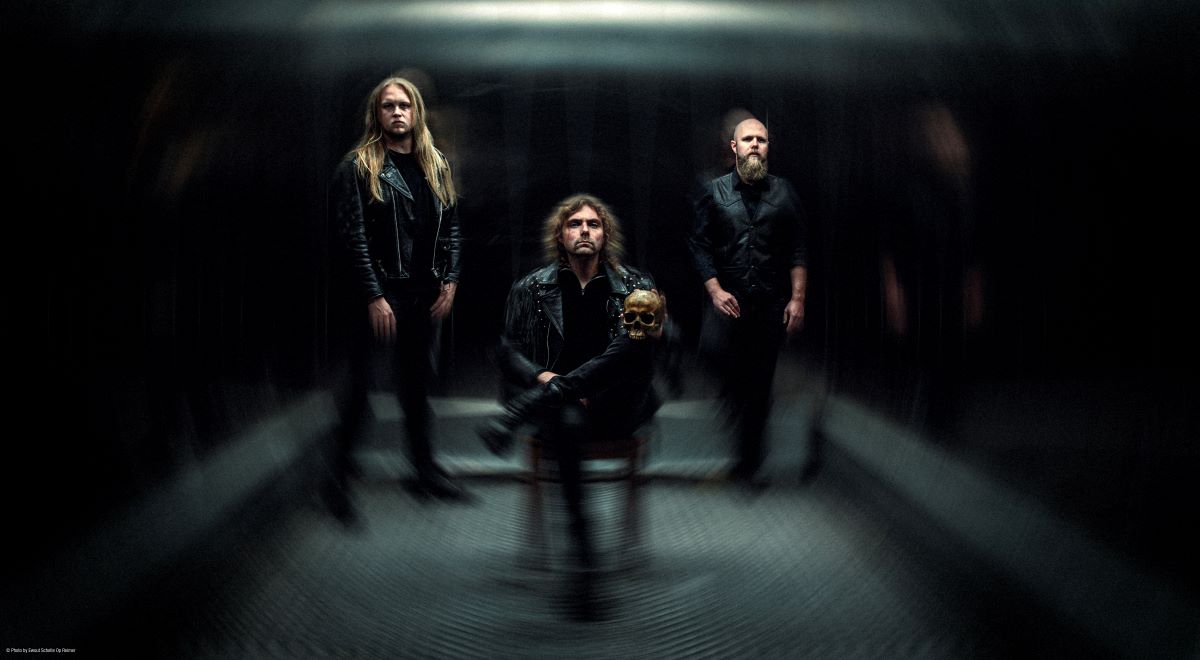
With their fantastic 2021 debut ‘Bionic Swarm’, Cryptosis presented itself as a surprisingly accomplished progressive thrash metal band. On the recently released ‘Celestial Death’, the Dutch trio explores the boundaries of their sound a little more, openly flirting with black metal influences. Vocalist and guitarist Laurens Houvast evaluates the evolution of Cryptosis.
“For us, ‘Celestial Death’ feels like a very logical follow up to ‘Bionic Swarm’”, says Houvast. “We started collecting new ideas from early 2022 onward: little ideas, guitar riffs, entire pieces of songs, which could turn into a cool new chorus. We all saved that in a library in a band cloud. That’s where we collected ideas for about a year, a year and a half. Eventually, we took the best of those ideas, and we turned them into songs.
Since that process took place over such a long time, we were in different phases of our inspiration. So that way, the sound for the album came together quite naturally. When we finished ‘The Silent Call’, which was one of the first songs we finished, we did want to release that as a way of finding out how our fens and the press would like it, and how it would feel to play the song live.
That actually felt super good straight away. Of course, we had already been working on the rest of the songs for a while at that point, but it felt like a confirmation that we were on the right track.”
An Emphasis on Melody and Atmosphere
“In my opinion, one of the biggest differences between this album and ‘Bionic Swarm’ is that these songs are more actual songs. Of course, we made an effort in terms of songwriting for ‘Bionic Swarm’ as well, but if you want to see things in black and white, it was more a collection of riffs, and ‘Celestial Death’ is more song-oriented.
There is also a bigger emphasis on melody and atmosphere. ‘Bionic Swarm’ didn’t have quite as much of that. That was much more a technical thrash record that consisted of playing as many notes as possible. If I look at what I’m playing on guitar, ‘Bionic Swarm’ was generally a lot faster. ‘Celestial Death’ has a few songs that hold back a little more tempo-wise, where I just play chords. That didn’t happen that often on the debut.”
Does that also mean the songs are easier to sing for Houvast? “It’s funny you should ask that, because there are a few parts with which I’m struggling a bit”, he smiles. “But that’s fine. It makes for a fun challenge. That’s not necessarily a tempo thing though, its more that those parts feature a certain groove on guitar and the vocals have a completely different groove. That’s just a matter of practicing a lot, and then it’ll work out at some point.”
The Same, But Different
“One thing we missed in our sound, of which we thought: what can we do more of next time around? That was melody. On ‘Bionic Swarm’, we had a song called ‘Prospect of Immortality’, which could have been on this album vibe-wise. Or ‘Mindscape’, which was a more atmospheric song. It sounded super massive, and we wanted to look into trying to experiment with that a little more.
If you listen to ‘Bionic Swarm’ and ‘Celestial Death’ back-to-back, you can hear it’s the same band, but it does sound different. We are trying to reinvent ourselves, in a way. It didn’t make any sense to make exactly the same album as ‘Bionic Swarm’, also because that generates certain expectations for the upcoming third album.
Since we have released two fairly different albums by now, whatever we will come up with for the third album might be a surprise even to those who have followed us from the beginning. In all honesty, that wasn’t a factor we even considered while writing for ‘Celestial Death’, but looking back on it now, I think we can conclude that things have developed that way.”
More Than Just Thrash Metal
It’s not even the first time the band experienced a change of sound, as Cryptosis had been active as the more conventional thrash metal band Distillator for seven years prior to adopting their current moniker. “The reason we started this band is because we wanted to be more than just thrash metal”, Houvast states. “We created a foundation to not just pigeonhole ourselves to being a thrash band, and to create our own blend of styles.
‘The Silent Call’ was a bit of a transitional song; it has that classic thrash and heavy metal sound, but the more atmospheric black metal influences appear later in the song. We actually finished that song in time to have put it on our debut album, but the album felt more balanced if we left it off, so we decided not to include it.
If you compare Cryptosis to its predecessor, all of us had to physically work on being able to play this stuff live. Distillator did have some fast stuff, but there is more variation here, it’s a little more prog, a bit more technical. I had to really work on my left-hand technique for that.
The debut album was written when we were still known as Distillator. We released two Distillator albums and a split album with Space Chaser. When we were working on the pre-productions for the third album in late 2019, which eventually turned into the first Cryptosis album, we already knew: this is so different, maybe we should just consider releasing this under a different name.”
Some Body to the Guitars
Perhaps the most impressive thing about Cryptosis is that they can construct their bombastic sound without the aid of additional musicians or additional guitar parts on backing tracks. “We really like the trio format”, Houvast admits. “It’s very convenient when it comes to touring, and scheduling in general. We do want to stick to the sound you hear on the album as closely as we possibly can.
Both Frank (te Riet, bassist) and I play on a stereo set-up. I have recently bought myself a Neural DSP Quad Cortex, but I don’t put it straight through the PA, like most people do. Of course, that is the easiest thing to do, but since there are only three of us, the guitar really needs to have some body to it.
That’s why I plug it in the back of the return of my Engl amp. So it’s not in the input. Because I only use the power amp, the Quad Cortex functions more like an effects pedal. I use the power of the amplifier, and throw that through a cab. And that sound goes to the PA. Basically how you normally would use an amplifier. And that works really well.
Frank has a bass amp with a bass cabinet on one side. That’s his normal bass sound. On the other side, he has a guitar amplifier, also with a clean sound, but that goes through an Electro-Harmonix MEL9, which has all the different sounds we use. We use that one a lot. I have recorded some overdubs with the MEL9, but on stage, only Frank uses it.”
The Threshold of an Era
Unlike ‘Bionic Swarm’, ‘Celestial Death’ doesn’t appear to be a concept album. “It is intended as one, but in a different way”, Houvast explains. “For ‘Bionic Swarm’, it was really obvious. In the video clips as well: the futuristic sci-fi theme of living in the year 2149 and everything being about what happens then was very prominent.
This time around, the songs are based on the idea that we’re living on the boundary between the old world and a new world. The old world is the traditional world that you know. It slowly disappears behind you, and you are on the threshold of an era in which society becomes more and more reliant on technology. That’s basically where we are right now.
For example: the first single we released, ‘Faceless Matter’, really enlarges the theme of AI. If you stretch that idea to its logical extreme, you end up with a world in which everyone dresses the same, listens to the same music, is a fan of the same football team, whatever, simply because AI doesn’t create anything new. Anything it creates is a variation on something that already exists.
So that song, and the concept behind the entire album, is that the lyrics are written from the perspective of individual people who cannot keep up with the technological developments. That is the thread running through the album, though with different themes, such as social isolation from moving towards a completely different form of communication.”
A Nice Springboard
Progressive thrash metal with sci-fi elements invariably draws comparisons to Voivod and Vektor by lazy reviewers, two bands Cryptosis does not really sound like. “With the previous record, I could make my peace with it a little more than with this one”, Houvast says. “Of course, our first release as Cryptosis was a split with Vektor. We had known them for a long time, so when we knew they were working on new material around the same time as us, we contacted them, thinking that would be a nice springboard to put our new name on the map. And it was.
Since we were on the same release as Vektor, the comparisons to them eventually started coming in. Then when we released ‘Bionic Swarm’, a lot of people said: it actually does sound like Vektor quite a lot. But of course, it didn’t. Even the guys of Vektor said: come on, that doesn’t make any sense. Of course, we have subconsciously and consciously been influenced by Vektor, but we have always tried to find our own sound. The same goes for Voivod. I’m not a huge Voivod fan myself; I didn’t really start exploring their music until people started comparing us to them.
My guitar work has been formed by guitarists like Michael Romeo from Symphony X and Yngwie Malmsteen. I really loved that sort of stuff. So there will always be a bit of that in the way I play guitar. And then the Megadeth-esque riffing, especially combined with the vocals. The concept of the vocals undulating over the riff a bit. And of course there have been thousands of other sources of inspirations. Eventually, you’ll create your own style out of that. Or at least, that’s what I’ve been trying to do.”
 Kevy Metal
Leave a comment