
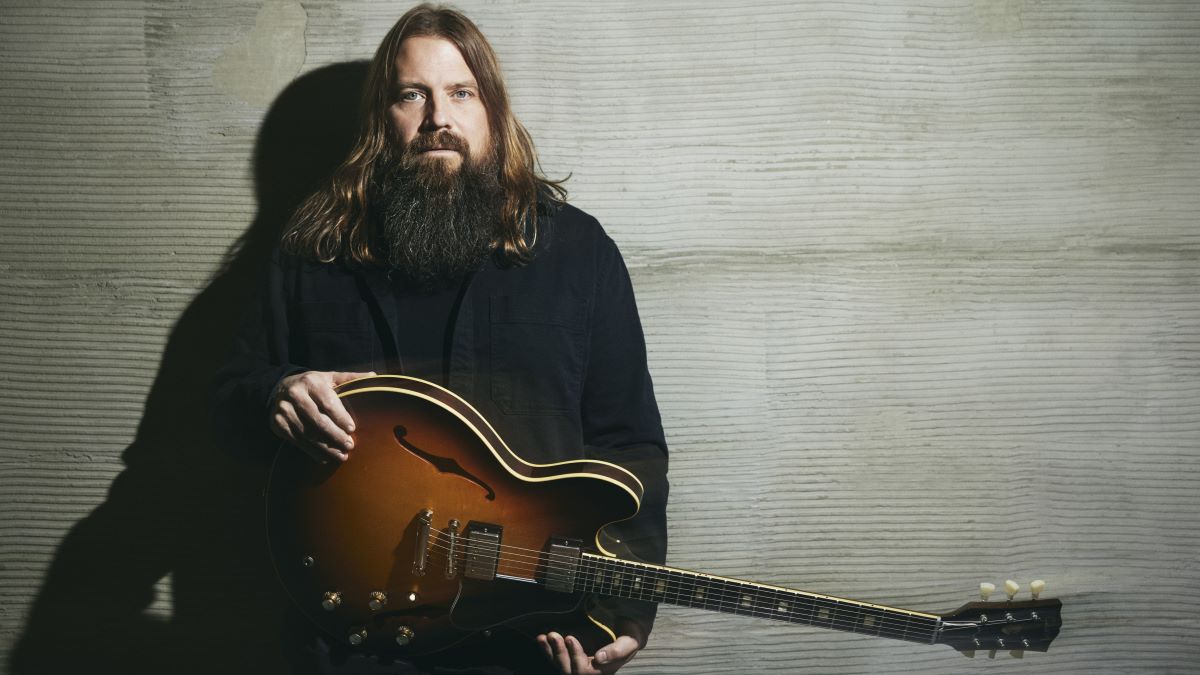
Mark Morton’s lead guitar style in Lamb of God has been displaying a looseness that betrays a more varied musical background throughout the band’s history. On his second solo album ‘Without the Pain’, Morton fully immerses himself in southern rock and country music. His joy of playing this kind of material is tangible on the album.
“This is really how I play at home”, Morton explains. “This is what it sounds like when I play guitar when I come home and I’m on my own time. It feels like home. It really does. It’s a great way to stretch out from the Lamb of God thing, which I’m very much engaged in, and I very much enjoy. But this gives me a place to put all these other ideas and all that other kind of influence that I have, without having to try and force it into Lamb of God.
I think it’s pretty evident that I’ve always really been a blues player. I just find myself in a metal band. And there are other metal players to whom I feel that applies as well. Vivian Campbell to me is always a very, very bluesy guitar player. So are Zakk Wylde and Dimebag Darrell. Black Sabbath is a blues band, if you ask me. So it’s not unheard of.
The other benefit of this is that it really makes metal that much more fun when I come back to it. Now I have all this out of my head, and out of my system, and I can come back and get metal, and let Lamb of God be Lamb of God.”
Making New Friends
Although Morton sang lead vocals on the song ‘Imaginary Days’ on his 2019 solo debut ‘Anesthetic’, the list of singers on ‘Without the Pain’ is a who’s who of the Nashville scene. “It wasn’t as though I had a list of songs that were done, and I would pick and assign singers”, Morton emphasizes. “It was less that, and more like me getting in touch with people I would like to work with, and then kind of writing songs with them.
Even more than the previous solo attempt, this album was very collaborative. In a lot of cases, it was me setting up times to write, and spending time with people that I wanted to work with, and then coming into that with ideas, and seeing what we could come up with. Also, it’s worth noting that it wasn’t like I put a date on the calendar and went: I’m going to start writing a solo record now. This happened over the course of a number of years.
I would just contact people and say: hey, do you want to write? Do you want to get together and see what we can come up with? I spent a lot of time in Nashville. I would go down there and meet people. We would write and make demos. A lot of these people were folks that were already friends of mine anyway: Travis Denning, Charlie Starr, Matt James… And then in some cases, I made new friends.
Cody Jinks and I didn’t know each other personally before we started working on music together, but we have become good friends in the process. That’s really one of my favorite things about these kinds of projects. It’s been my experience that very often, when you spend time working on something creative with someone, you wind up building a real friendship there. That’s pretty priceless.”
Live on the Floor
“The basic electric tracks for the record were recorded in Los Angeles. Since I live on the east coast of the US, in Virginia, I flew to LA with one guitar, and borrowed a guitar from Gibson while I was out there. So really, the basic tracks were recorded with two guitars: my 2018 Gibson Les Paul R9 that I brought, and an ES-335 that I could borrow from Gibson.
We recorded at Studio 606, which is the Foo Fighters’ headquarters and studio, where they’ve got that great, famous Sound City board that so many amazing records were done on. We did this record on that too. They’ve got a bunch of gear there. We used a really cool Friedman-modded Marshall head, and a mid-sixties Fender Bassman as well.
Some of the rhythm tracks would be overdubbed and pieced together, but the basic drum, bass and guitar tracks for most of the songs on this record were done live on the floor. I worked with Gary Novak on drums. He played with Alanis Morissette and Alan Holdsworth, he does a lot of movie score stuff. Just a really heavy kind of session cat. And Tim Lefebvre, who was in David Bowie’s ‘Blackstar’ band, he played with Susan Tedeschi and Derek Trucks, and he was in The Black Crowes for a minute.
To be live on the floor with those guys cutting tracks was really exciting. Really intimidating, but they were so supportive and so encouraging. They really helped me feel comfortable. When we would do takes – and Tim in particular – every time we did a take, it was different. Tim is certainly capable of locking down whatever you want, but it’s really cool to be playing with a couple of guys where we’ll be doing a pass of a song, and take two just has a completely different feel than take one. It’s really fun.
Metal is not like that at all. In metal, everything is very defined, very intentional. And that’s cool too. It’s just so different.”
A Very Centralized Location
“After we were done in Los Angeles, we moved the session to Nashville, because so many of the singers are Nashville-based. And some of the guitar players too. Grace Bowers is on here, and Jared James Nichols, and Cody Jinks met me in Nashville. For these cats, it was a very centralized location to bring in the overdubs and the singers.
Again: a lot of borrowed stuff. The wonderful folks at Gibson take very good care of me. And fortunately, they had a lot of guitars in both LA and Nashville, so they provided me with some really incredible stuff. We used a custom shop SJ-200, and a custom shop J-45. You can most readily hear those on the song ‘Kite String’, which is very, very acoustic.
‘Kite String’ was a late add. It was one of the last songs I wrote for the record. I co-wrote it with Travis Denning, and he sings it. We had just been sending voice messages on our phones back and forth, and texting each other back and forth these ideas. So we didn’t really write the song until the morning we recorded it. And that happened to be in Nashville while were already going to be doing vocals.
So we borrowed some guitars from Gibson… Actually, he brought his own, because he’s left-handed and he lives in Nashville. So he showed up with his own, we set up some mics, and we recorded the song. We finished writing that song at noon, and it was recorded by 6 PM.”
Fingers on the Strings
“The signal path, the type of gear I use, is so different from what I would use for Lamb of God. But those things exist for me simultaneously. We had that mid-seventies Marshall with a Friedman mod, and we plugged a Les Paul straight into it. And it sounded killer, so we rolled with that. For the song ‘Without the Pain’, and I think for ‘Hell and Back’ too, we used a 335 through a Fender Bassman with an EarthQuaker Devices Acapulco Gold fuzz pedal. Real simple signal path.
With metal, it’s a little bit of a different thing. Higher gain, you’ve got to gate stuff and compress stuff. But the compression for a record like ‘Without the Pain’ is done after the microphone, so the signal path in terms of the guitar was really, really simple. To me, the less you have going on, the more dynamically you’re going to be able to play. Because I find that the more stuff you’ve got in between, it just starts to stand in the way of your fingers on the strings.
And then there are some solos that I did here at my studio at home. Most notably ‘Hell and Back’ and ‘Dust’. Those were done on my 1963 Gibson ES-335. I have a lot of vintage guitars.”
Decorating the Spaces Between Vocals
Atypically for a solo album by a guitarist, the guitar work on ‘Without the Pain’ is largely in service of the lead vocals. “They were kind of done together”, Morton explains. “Even with Lamb, but definitely with this, I approach everything as a song. So I try to come as a songwriter first. Then it’s really about getting the song outlined, and then the guitar extras and the guitar decoration comes after the song is kind of in place.
You get the vocal established, and then you sort of decorate the spaces between the vocals with guitar stuff or whatever. You find places for that stuff once the vocal’s in place. I think you’d sacrifice the song if you said: okay, sing in between these really cool guitar sections. There are people who do that, I guess, but it’s a different kind of thing.
I don’t really – ever, really – have leads worked out. I usually just kind of start playing on the spot, and play until something feels cool, make a couple of passes, and then I’ll get a rough idea of what I want to do. And then we’ll really start to try and get a cool, vibey take of it.”
Sacrificing Consistency for Authenticity
The first live plans to promote ‘Without the Pain’ have already been made. “Lamb of God has this Headbangers Boat thing”, Morton says. “It’s like a cruise ship, and we’ve got around twenty bands on it. My solo band plays on that boat. Matt James, who performs on the record – he does the title track ‘Without the Pain’ – is my singer live, and he sings all the stuff.
We have a great band, with keyboards and another guitar player in the band, who is an absolute monster. And we stretch out. We jam. That’s so much of what I get out of it. Because as much as I love Lamb of God, and I do, there’s not a lot of jamming in Lamb. Because it’s metal. Although I will say: in the last four or five years, Lamb has been much more jammy than it was before. We’re not on a click, everything is loosened up, so it’s very live and very jammy within the context of metal.
I have always sort of been the least locked-in of the band. Sometimes that’s good, sometimes that’s bad. I made a deal with myself a long time ago to be authentic in my playing and on stage, and that meant my goal is not to be consistent. Which is counter to what a lot of people maybe strive to do. And I don’t claim that that’s better or worse. It’s just different.
I would rather sacrifice consistency if it means that I can be more in the moment and more authentic to where I’m at, at any given point in time. So on some nights, that means you’re going to hear some mistakes, bad notes, whatever. But on some nights, you’re going to catch something that soars in a way that’s different. That doesn’t mean I’m not staying within the lines of the song. I’ll do that. But I’m not obsessed with playing everything identically to what I played on the album. Or even the night before.”
Like Coming Home
Morton’s enthusiasm about the project is more than obvious. As of now, however, a sequel to ‘Without the Pain’ is not on his mind. “I’m not planning on it”, he says. “But I play music a lot, and I sure had a lot of fun making this record, and I think I’ll probably wind up doing more stuff. But there are no plans at the moment.
The solo project feels like coming home. It really does. It’s just a lot of fun. That’s what it’s about too. No one’s getting rich off of this solo project stuff, so it’s got to be for fun.”
 Kevy Metal
Leave a comment