
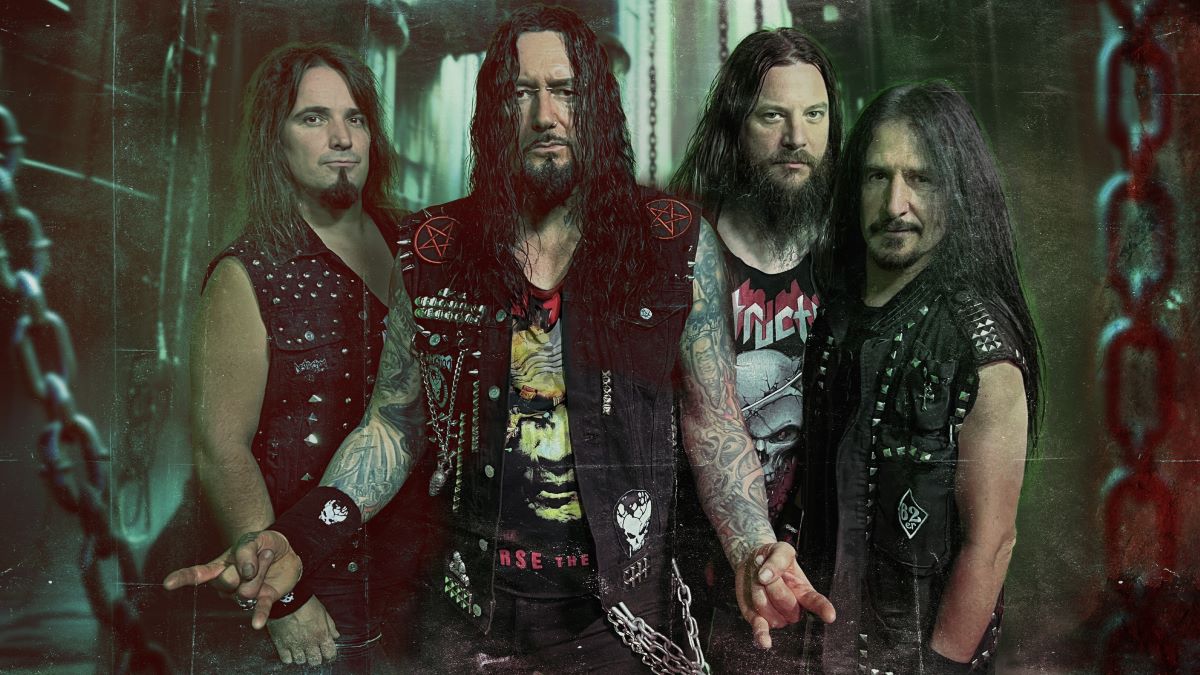
‘Birth of Malice’ is the second album German thrash legends Destruction recorded with Argentine guitarist Martín Furia, and he makes his presence known. The album has some of the most elaborate guitar arrangements Destruction has ever put on record, and it helped inject new energy into the band. Furia, who used to be involved with the band as their sound engineer, is happy with his current place in the band.
“Even compared to ‘Diabolical’ (2022), there is definitely a difference”, Furia says. “When I entered Destruction back in 2021, ‘Diabolical’ was almost finished, so all that was left for me to do was to write and record my solos. This time, I was able to participate more in the actual writing of the album, and I could show Schmier (singer/bassist) some riffs and song that eventually made it to the album. It feels great to be more involved in this new chapter of the band.
I see ‘Birth of Malice’ as the natural successor to ‘Diabolical’. There’s a lot of speed, melody, twin guitar, a lot of right-hand action, groove… We explored a little bit more of what we started with ‘Diabolical’, and took it to the extreme. Destruction has to sound like Destruction, and I think we did a great job in keeping the essence alive, and adding new nuances to still develop the sound of the band further, to keep it fresh.”
Fresh Ears
These days, Furia is more than just one of Destruction’s guitarists. Where V.O. Pulver had been Destruction’s go-to guy for mixing, mastering, and producing their albums, he shared these duties with Furia for the first time on ‘Birth of Malice’. Taking care of Destruction’s sound isn’t anything new for Furia, as he had been Destruction’s live sound engineer in the past.
“I took a lot from being the band’s live sound engineer”, he exclaims. “You really get to know the personality and the sound of the band this way. You get to know the tones of each musician, and that helps you find the right sounds that eventually end up on the album.
Also, being one of the guitarists, you try to make your parts work in the bigger picture, so you kind of produce your performance, keeping in mind what’s going to work in an album format. In any case, the playing is very spontaneous, and we tried not to overproduce or over-arrange. The idea was to make an album that we can translate to the live environment.
‘Diabolical’ is a good-sounding record, and I respect the work that V.O. did for them. In fact, we have done albums in the past for which I have done the production, and he would mix and master the record. We work in different ways, though, and Schmier wanted to try something new this time, in order to get the most out of the production. The big advantage of doing it this way was that I wasn’t involved with all of the recordings. I could start the mix with fresh ears, and do my thing.”
The Creative and the Executive
It’s not just Destruction that Furia is working with; he is an experienced producer and audio engineer whose resumé contains many different bands in studios all over the world. Even on these pages, Chemicide recently gave a glimpse into Furia’s production process. “Oh, Chemicide! They are such awesome people and an awesome band!”, he smiles. “The production does change quite a bit when it concerns your own music.
You inevitably become a tiny bit more picky with yourself when you produce a band you play in, and it’s easy to over-focus, and miss the point here and there. The creative and the executive parts of the brain tend to mix up a bit, and sometimes you need to reset, and take a bit of a distance to keep your hours productive, and not get into the ‘let’s try this little extra tweak’ thing when something is actually finished and sounding great.
Also, it is very important not to lose any spontaneity. When you produce other artists, you are dealing with a different task, and it’s easier to take decisions and keep sight of the goal you are working towards.”
Musical Brainstorming Session
Back when former guitarist Mike Sifringer, who had until then played on every Destruction album, was fired from the band in 2021, frontman Schmier quite strongly implied that he was the one writing nearly all of the material at the time. The guitar arrangements on ‘Birth of Malice’, which are more sophisticated than those on any other Destruction album, highly suggest that Furia and fellow guitarist Damir Eskić are significantly more involved with the songwriting and the arrangements.
“I was not in the studio with Destruction before these two albums, so I can’t say anything useful about the past”, Furia admits. “But what I do know is that Schmier has always been the driving force of Destruction, and he wrote most of the stuff on these two records that I have participated on.
Schmier always comes up with bass riffs, and then Damir and I adapt them to the guitars. Then we have total freedom to come up with our own parts, and propose arrangements, leads, harmonies, and whatever else comes to mind. We play it, we shape it, and then we show it to Schmier. This is a very dynamic process. A kind of musical brainstorming session, where we are together in the studio, and the song starts to show itself, and it really is the song that shows you what to play.
Having said that, I brought quite some riffs and songs to the table, and Schmier eventually took what he found most suitable for Destruction. In the end, he is the one who decides what will stay and what won’t. He knows exactly where the band comes from, and where it wants to go.”
Songs Inside the Songs
Much of Destruction’s classic material has been written and recorded when Sifringer was the only guitarist in the band. Even prior to Eskić joining, Destruction was a trio for a long time. Having two guitarists calls for a different dynamic. “The division of parts between Damir and me is as easy as saying: how about I play this and you play that?”, Furia explains. “There are no big decisions to be made; it comes pretty naturally.
Damir is a much faster shredder, and certain parts call for that. My solos are slower and more melodic. I try to make little songs inside the songs. So our solo styles match and contrast perfectly, which is a thing I really like from this new era of the band.
We both try to respect each other’s playing styles as much as possible. Damir played with Mike for two years before he left the band, so Damir really learned the right way to play these parts from him. Of course, I was their sound tech for five years, so I know how the guitars should sound in Destruction.
That being said, there are two guitars now, and two different players, so it will sound different to how Destruction has always sounded in any case.”
Light and Reliable
“I use Dean guitars. I have a custom Flying V that they made specially for me, and many other Deans: an ML, a Vengeance, a Zero… And I all use them for different bands and different purposes. I use the classic EMG 81 and 85 pickup combo, and an MLC Subzero 93 amplifier miked with sE Electronics microphones.
I use the same for Bark, which is my other band in Belgium. My strings are D’Addario NYXL. For Destruction, it’s .010 to .052, and .012 to .060 for Bark, because they play in a lower tuning. Live, I don’t use any effects for solos. Just a booster. But that might change soon.
My noise gate is a prototype called Rauschtott from a great German builder called Klirrton. It’s a fantastic unit that cleans the input and the effects loop, so it’s incredibly accurate, and in my opinion, the best out there. And I have tried them all. For wireless, I had a Line6 forever, but I recently switched to a new company called Swiff Audio. They are amazing units. Very light, rechargeable, and incredibly reliable.
Also, I use The.Black.Manthra straps. It’s a custom maker in Chile that makes top-quality customized leather straps, and I can’t use anything else anymore since I got the first one. I have four of them with StrapLocks now. This gear travels around the world in ENKI cases.”
Rotating as Time Goes By
A classic band like Destruction can’t rely on just their new material for concerts. Finding a balance between playing the classics and promoting more recent material is a challenge. “That is a whole task in itself”, Furia laughs. “Every time you finish an album, you think it is the best one! It’s hard to combine such an extensive discography as Destructions in ninety minutes of showtime.
There are a lot of classics that we have to play if we don’t want to get impaled by fans, haha! ‘Bestial Invasion’, ‘Total Desaster’, ‘Thrash Till Death’, ‘Curse the Gods’, ‘Nailed to the Cross’, ‘Mad Butcher’, and many others simply have to be there. For this album, we made sure we made all killers and no fillers, so we’ll probably end up rotating as time goes by, and we’ll see what works best in the live context.”
Furia’s native Argentina is quite far away from Destruction’s homebase in southern Germany or Furia’s own studio in Antwerp, Belgium. “I try to go back to Argentina as much as I can, but it’s not so easy, because I want to go for at least a month, and I haven’t had a month off for ages now”, he admits. “Fortunately, we went there with Destruction in 2022 and 2023, so it was a great chance to catch up with friends and family, who I miss dearly.
The scene in Argentina is fantastic. In addition to total classics like Hermética, there are a lot of great bands nowadays, like Poseidotica, Banda de la Muerte, Avernal, Nulo, Against, Medium… Thousands of great bands!”
 Kevy Metal
Leave a comment