
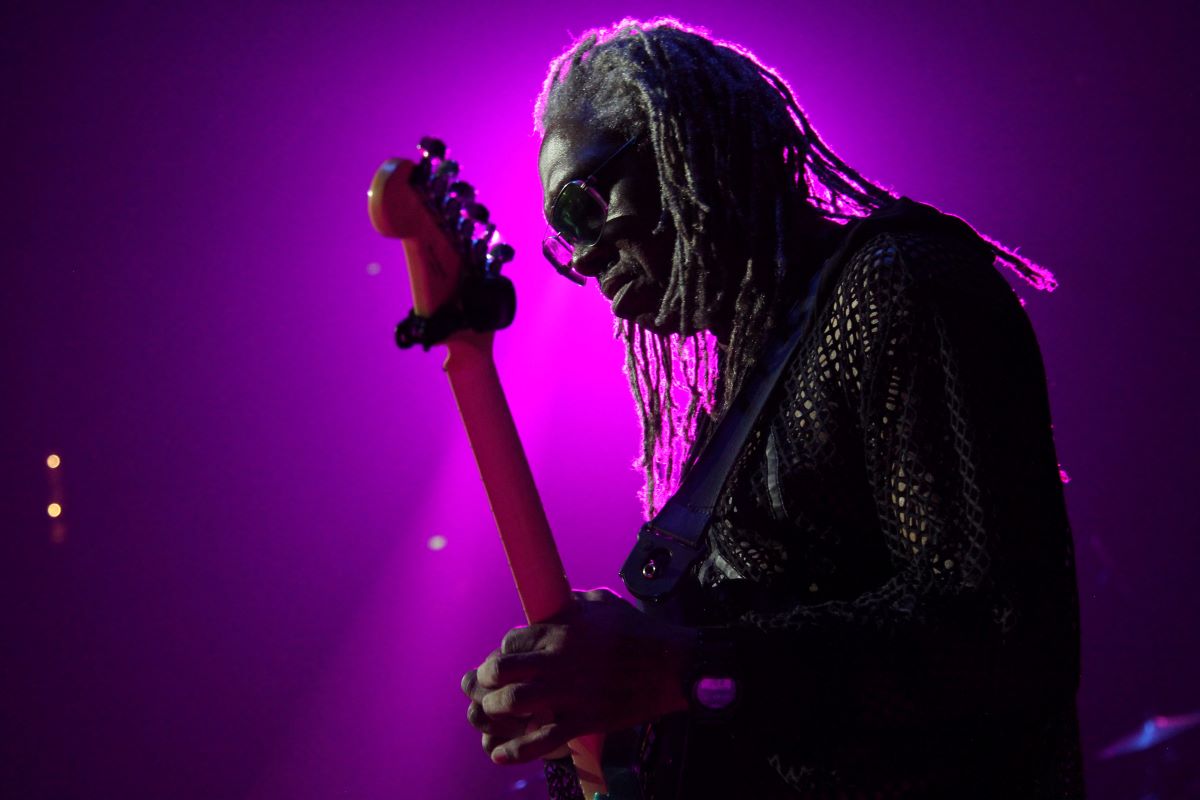
Primarily known for his forty-plus-year stint with funk pioneers Parliament-Funkadelic, guitarist DeWayne ‘Blackbyrd’ McKnight is actually a fearless cross-genre pioneer, extensively experimenting with psychedelic rock, hard rock and jazz, playing with artists as diverse as Herbie Hancock, Sonny Rollins, Warren Zevon, Macy Gray, Marc Anthony Thompson, Miles Davis and the Red Hot Chili Peppers. No matter the context, however, his groovy riffs and highly melodic solos are instantly recognizable.
McKnight rose to prominence in the seventies, and even his early recordings with Charles Lloyd (‘Geeta’, 1973) and Sonny Rollins (‘Nucleus’, 1975) showed clear psychedelic blues and rock tendencies. “At the time, almost everything I saw and heard inspired me, because that style of music – rock and psychedelic – was new to my ears, and that’s what I gravitated towards”, McKnight says. “I was inspired by BB King, Albert King, Freddie King, Jimi Hendrix, Eric Clapton, Jeff Beck, John McLaughlin, Shuggie Otis, Mike Bloomfield, Jimmy Page, Grant Green, Mel Brown, Jim Hall, Django Reinhardt… I’m leaving out a lot, but that’s what I was listening to at the time.
The bands I played with before that were mostly rhythm & blues vocal groups. The Younghearts were one of the most popular bands I played with. The band members for The Younghearts were very talented musicians. Some went on to be in big bands, or phenomenal session players, or both. Nate Morgan on keyboards went on to play with Rufus, Bone Thugs-n-Harmony, and had a great solo career. Greg Tell on drums moved to Australia and became a very popular session player, and still is. Jessie Sharps on reeds is another incredibly talented musician who is still actively working, and Greg McLaughlin on bass is another badass.”
Tagging Along with Advanced Players
“These guys influenced me in a big way. Not to mention they were one of my favorite groups to play with. They were also one of my first introductions to jazz. After rehearsals, we would jam for hours. They were very advanced players for their age. I am thankful to them for letting me tag along with them, although I was primarily a rock and rhythm & blues player at the time, with very little experience in music and life. They helped me grow tremendously.
In my Southwest Los Angeles neighborhood, a couple of blocks from my house, there was a music store called Schmulka Music. The owner Julius Schmulka taught me the basics of how to read music. You know the drill: songs like ‘Mary Had a Little Lamb’, ‘Camptown Races’, and stuff like that. He was a very nice guy, and I liked him, but at the same time – and probably a little before that – I as already picking out songs from the radio that I liked, such as ‘Secret Agent Man’, ‘Gloria’, ‘Day Tripper’, and ‘Soul Man’.
So I wanted to spend time learning more songs, and practicing my skills, which was my thang. After that, my folks insisted that I have some kind of musical training, so they enrolled me into Grants School of Music in Midtown Los Angeles. I liked going to that school, and I loved Mr. and Mrs. Grant, the owners of the school, but I decided to drop out, as I already started working locally in nightclubs, and was picking up as much knowledge as I could along the way as I was playing with older and more experienced people.”
Minimal Verbal Communication
After the aforementioned recordings with Lloyd and Rollins, McKnight eventually landed a gig with Herbie Hancock’s backing band The Headhunters, playing on Hancock’s legendary ‘Man-Child’ album (1975) and recording two albums with just the backing band in 1975’s ‘Survival of the Fittest’ and 1977’s ‘Straight Out of the Gate’. “Although I had been listening to Herbie’s music since my childhood, I started delving deep into Herbie in my mid-teens”, he explains. “His modern jazz arrangements and the personnel he played with opened up my mind to the possibilities of music I had not experienced before.
It probably started with the song ‘Tell Me a Bedtime Story’ from the album ‘Fat Albert Rotunda’, released in 1969. Then I moved onto the album ‘Mwandishi’ (1971), and became a hardcore Herbie Hancock fan ever since. Herbie’s songs influenced me to create songs that went further than the blues or rock genre I was doing at the time. He is one of the main influences that helped me grow.”
McKnight isn’t the only well-known guitarist on ‘Man-Child’; Melvin Ragin – better known as Motown legend Wah Wah Watson – and session giant David T. Walker play on the album as well. “Mr. Walker and I never worked on any songs together”, McKnight emphasizes. “The session I played on with Wah Wah Watson was called ‘Sun Touch’. I locked in with Paul Jackson’s bass part, while Wah Wah played on the top with some beautiful echo effects. We listened to each other, so we wouldn’t clash. Verbal communication was minimal. Communication came from listening to one another and respecting each other’s parts.”
Down with the Funk Mob
Shortly after his stint with Hancock and The Headhunters, McKnight eventually joined the funk collective he is probably best known for, first appearing on Parliament’s ‘Gloryhallastoopid (or Pin the Tail on the Funky’ and Funkadelic’s ‘Uncle Jam Wants You’, as well as ‘Never Buy Texas from a Cowboy’ by The Brides of Funkenstein, all in 1979. “After Herbie Hancock and Miles Davis inspired and elevated me to step up my game and move into a direction of more progressive music, then came Funkadelic”, McKnight says. “After hearing the first record called ‘Funkadelic’ (1970), I immediately fell in love with this band.
The second album ‘Maggot Brain’ (1971) took me into another stratosphere. The music was harder, the solos were fierce, and everything seemed loud and right. The vocals were crazy, funny, and right on point. By the third album I heard, called ‘Free Your Mind… And Your Ass Will Follow’ (1971), they continued that same crazy path: loud, wild, and politically correct.
As time went on, they evolved. I couldn’t get enough of this band. They put an album out, and I copped. I noticed different musicians on certain albums, which made it seem like a mob, a funk mob, and I was down with it. Every which way they went, I went with them, soaking up as much knowledge as I could. Funkadelic is that band that had all of the elements of what I was looking for musically. Funkadelic along with Miles and Herbie made the platform for the type of music I wanted to make.”
A Permanent Blueprint
By the time he joined Funkadelic, McKnight was in his mid-twenties, and already fluent at a vast array of music styles. “I call myself a progressive funk rock guitarist, because those are the elements that I like to draw from”, he asserts. “That is the name I chose to describe my music, which has elements of funk and rock, with hints of jazz. I also have a love for other styles of music, but for now, it’s progressive funk rock where I feel most at home.”
And so, the artists that approach McKnight are from fairly diverse musical backgrounds. “I would say people hire me because they heard of me, know what I do, and what I bring to the table”, he says. “Some hire me for the groove, some for the solos, some for the funk, some for all of those. I do what I do, as long as I can contribute to the project I am approached for.”
His versatility did eventually lead to McKnight playing a handful of shows with his other hero Miles Davis at the tail-end of 1986. “I had also listened to Miles from my infancy”, he says. “The albums ‘Miles Ahead’ (1957) and ‘Sketches of Spain’ (1960) left a permanent blueprint in my brain as a child. Then later, in the sixties, I heard the album ‘Miles Smiles’ (1967), took a liking to it, and quickly bought it.
Tony Williams (legendary jazz drummer who also played with Davis) once said: ‘I thought we were making a new statement in jazz’. He was right. Though I didn’t understand a lot of what they were doing at the time, everybody’s playing on that album just knocked me out. Shortly after this, I was turned onto the Tony Williams Lifetime album ‘Emergency!’ (1969), so my avant-garde training started there. Then came the album ‘Bitches Brew’ (Miles Davis, 1970). From there, it was Miles and Herbie. And I did everything I could to incorporate those styles into my playing.”
An Affection for Recording Alone
After decades of gigging and recording with other artists, McKnight finally released his solo debut album, appropriately titled ‘‘Bout Funkin’ Time’, in 2009. The album shows a crazy mix of hard rock riffs, wild lead guitar work, funky grooves and occasional hip hop rhythms. “I actually could have gotten a lot crazier than that, had I drawn from my freeform jazz and avant-garde style”, McKnight smiles. “This album is a vehicle to express my musical journey in that time period. Yeah, crazy guitar music is exactly what I wanted for this album.”
McKnight largely recorded the album on his own. “I always had an affection for recording music on my own”, he admits. “I had two influences that inspired me to record by myself: Shuggie Otis and Stevie Wonder. They were the first two to make me realize you can record albums by yourself. By the time I discovered the four-track tape recorder, I immediately started recording music I had in my head onto tape. So it was always in my nature to record alone.
Home recording is the freedom to be able to take your time and craft your music. You can take all the time you need to produce your musical statement. I can put my ideas down at any given time of day or night. Most of the recording I did with P-Funk, I did alone. Working with other people in the studio, interacting with musicians, having an engineer with a couple of extra ears and a producer to oversee the project makes for a fail-safe operation. So I would say that they both have their advantages.
For ‘‘Bout Funkin’ Time’, I had decided to do everything on my own, such as writing, performing, and producing, as this was my first solo effort, and I wanted to go through the whole process by myself.”
Encompassing Any Situation
The guitar sounds on ‘‘Bout Funkin’ Time’ are surprisingly modern. “There is always something better as technology advances”, McKnight states. “From the very start, whatever I was given to play with, I made the necessary adjustments to get the sound I wanted, or to come as close to it as possible. In other words: the quest for the perfect tone is never-ending, not only when it comes to gear, but also when it comes to musical skills, life, et cetera.”
McKnight does play with ensembles that vary wildly in size. “Depending on the set-ups I am using, the size of the band doesn’t really matter”, he emphasizes. “My set-ups these days are basically the same for every occasion. I use a Fender Elite Strat with custom-made pickups by Bartolini. My pedalboard is wired up this way: I start with a Shure GLXD wireless receiver, from there it goes into a Jim Dunlop Mini Wah pedal in into a Boss SY-1 synthesizer pedal.
Next comes a Line6 HX Stomp, which is connected to the Morningstar MC6 foot pedal to change the snapshot scenes of each patch. I also use a dual footswitch to change the banks of the Stomp. It’s all powered by a CIOKS DC7.
Locally, I mostly use a Mesa Boogie Recto-Verb 25 or a Mesa Boogie Mark Five. This is how I am rolling these days with pretty much every project, unless I’m out of town and use a backline that has been provided. The gear that I use can encompass any situation as far as adapting to the project. I trust the people who hired me know who I am and what I bring to the table, and will accommodate whatever style lays before me. I always prepare for a situation before I go in.”
Keeping the Mind Free
While the band he is most commonly associated with is primarily known for its grooves, McKnight’s soaring melodic guitar solos are actually out of this world. “Part of my ideas for soloing comes from embellishing scales from my practice sessions”, he explains. “My solos are not really formed or thought out ahead of time. During the course of a day, I might think of something I would like to play in that evening’s performance, but it usually doesn’t pan out, because I am improvising, which means I’m coming off the top of my head with whatever mode I am playing in at the moment.
The audience, the venue, and the crew change, so I have a different energy to perform the show. I want to deliver something different every night, as well as the signature licks and themes that the song contains. In other words, I like to keep my mind free, so I can be spontaneous at that moment.”
What McKnight plays on isn’t necessarily his own music, however. “It depends on the situation”, he says. “When I learn songs I didn’t originally play on, I play them exactly the way they are supposed to go. If I am given the freedom, then I would do my thang. To me, it’s important to know what the original statement consists of. After that is learned, I can start making my way around, and play whatever the party calls for.”
Dropping the Chicken
With a discography as massive and varied as McKnight’s, it might be difficult to find a place to start exploring his music. Fortunately, the guitarist has a few recommendations. “‘Flood’ is a Herbie Hancock live album recorded in 1975 in Japan, which I was more than grateful to participate on”, he says. “If you want to hear my rhythm guitar, this album would be a good place to start. I get quite a lot of comments about my performance on this record even to this day.
‘Dog Star (Fly On)’ was originally recorded under the name of ‘Fly On’ for the Hendrix tribute album ‘Tribute to Jimi Hendrix’ by P-Funk Guitar Army (1994). The song was later released as the lead-off song of the ‘Dope Dogs’ album by George Clinton & The P-Funk All Stars in 1994. I wrote, produced, and performed on this song. This is one of my favorite songs.
I also recommend ‘Nose Bleed’ from the Funkadelic album ‘By Way of the Drum’ (2007). The track was written by me, and I played all the instruments. If you like hardcore stomp and mash funk-rock, you should check that one out. It bangs!
‘Quickie’ from the George Clinton album ‘You Shouldn’t-Nuf Bit Fish’, released in 1983, was a quick one-take solo I did for this album. True story: we were in the studio, and George was eating some chicken when the engineer hit the record button. About two bars into the solo, George stood up, dropped his chicken, and immersed himself into the solo. Another one of my favorite solos.
Then, of course, my solo album ‘‘Bout Funkin’ Time’. I wrote, produced, performed, and engineered this entire album, with a little help from my friends Danny Bedrossian and RonKat Spearman. This is my first solo effort, and I love it. I encourage you to listen to this one to get the direction I am headed for.
I have worked with many bands and gone on countless tours throughout the world. And I will always work with other artists and bands, because, in this life, you go where you are sent. At the same time, I would like to work on my second solo album. I am forever working on my own music, so it’s time to get it finished and released.”
This interview is part of Kevy Metal’s Gateway to Jazz series.
The cd version of Herbie Hancock’s ‘Flood’ was only released in Japan. Order it from nearly anywhere in the world at CD Japan below
Herbie Hancock

 Kevy Metal
Leave a comment