
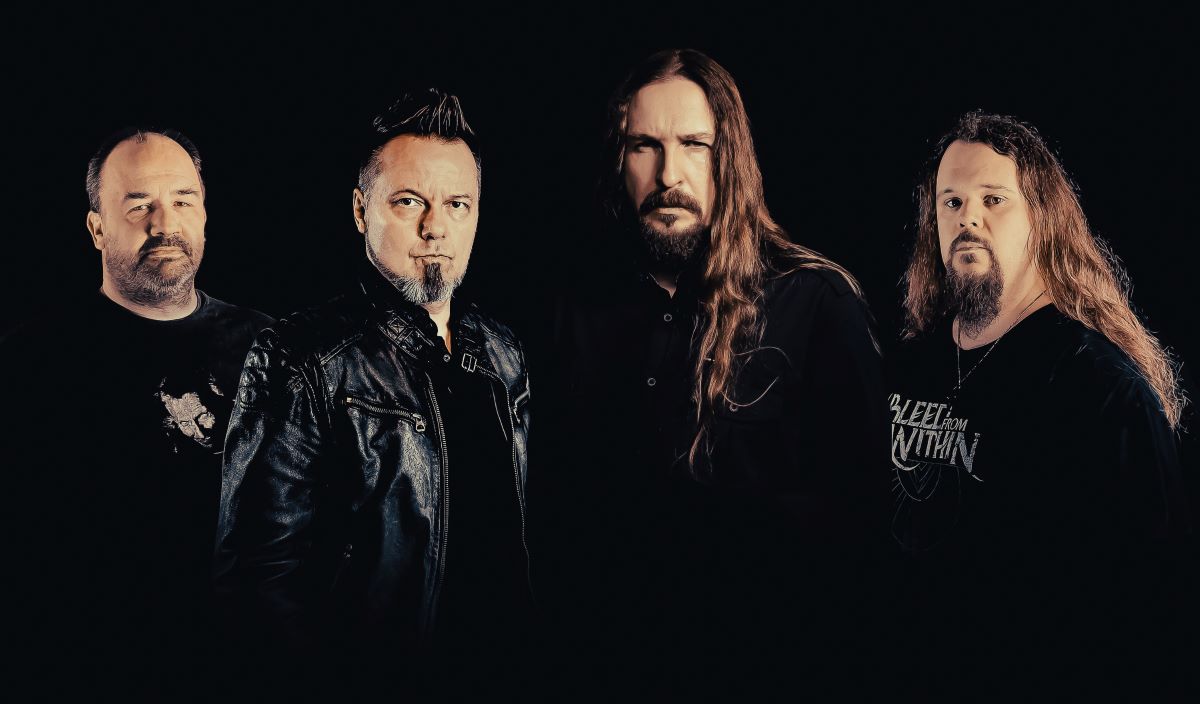
After re-establishing themselves on their 2018 comeback album ‘Necropolis’, Sacrosanct further enhances its more melodic progressive metal sound on ‘Kidron’. Founding guitarist and main songwriter Randy Meinhard – and sole remaining member from the ‘Necropolis’ line-up – sheds some light on the arduous production of ‘Kidron’.
“There are still people who say that ‘Truth Is – What Is’ (1990) is our best album”, Meinhard says. “And I think it’s a great thing to have something like that in our back catalogue that people still love today, even if they may not like ‘Kidron’, ‘Necropolis’ or ‘Tragic Intense’ (1993). We’re always happy if people enjoy something we did, regardless of which album it is.
What always connects our material, I think, is the progressive playing, and the fact that we like to wander. But when you pick up playing in a band again after such a long time: of course, I’m twenty-five years older. I don’t have this youthful anger anymore; I recently turned 56. And of course, everyone involved has their influence on how things sound.
‘Necropolis’ also sounds a little bit different than ‘Kidron’. I think it would have sounded different if Jonas (Schütz, drummer) would have played on it. I did it with EZdrummer, but we worked on it to make it sound as natural as possible, so that it has a soul. Jonas plays with soul, and he puts it in his musical input. That makes a big difference, and I think people will notice it on the new album.
We can play melodically, but we can also be in-your-face. We like to play around with that. Otherwise we wouldn’t come up with the idea of writing a song like ‘Still Open Sore’, or we would be sticking closer to something like Fates Warning or Queensrÿche than people would expect from us with ‘Doorway of Dreams’. ‘Kidron’ isn’t one-dimensional. And I don’t think any of our albums are.”
Turning to Writing Songs Again
“Roel van Reijmersdal from Vic Records played a big part in the fact that there was another Sacrosanct all these years later. The first people I got in touch with were Collin and Mike (Kock), who sang and played guitar on ‘Tragic Intense’. Unfortunately, they weren’t able to do it at the time, but a good friend with whom I worked at EMP Merchandising was: Richard Hesselink. He had a difficult time in his private life, but he promised to write songs together with me. That’s how ‘Necropolis’ took shape.
Then Covid came, and we weren’t able to play live in 2020, so we turned to writing songs again. Basically wrote a bunch of new riffs and songs, then Ron (Brouwer) entered the picture as our singer. We made a lot of demos and produced a completely recorded album in 2021. Eventually, things didn’t work out the way all of us wanted them to with Ron. He didn’t want to use his lyrics, and I think we have to respect that.
We have taken fifteen, sixteen months to re-write things. The songs were more or less done, but we worked on the vocals a lot. Max Morton, who also produces the likes of Jinjer, offer to help out as a singer. Sadly, he lives in Kyiv, so he was hit by the war directly. He started working in parallel with the invasion of Ukraine; he started working on the album in January or February of 2021.
He really took the time to do the vocals, and that is not a given in such an extremely terrible, tragic situation. Even practically speaking: if you’re working in the studio, and suddenly you’re out of power, that can’t be good for the equipment. There were a lot of air strikes. He was forced to work at night a lot.”
A Litte More Special
“Ron’s voice is a bit like a singer in musical theater would sound, and we had to make sure that his voice fit the material. I still think the things we recorded together are good to this day. We’ll see if there is anything we can do with those recordings in the future. At the moment, we don’t know yet.
Max is a singer, a producer, and a multi-instrumentalist. He also plays bass on ‘Kidron’. He has a style that is very much his own. We have worked together with two bassists in a relatively short time, with whom we are very close, both of them from the Frankfurt area. Professional bassists, very proficient technically. Both of them said that what Kees Harrison played on ‘Necropolis’ is much more accessible to them than what Max played. Which makes it a little more special.
Max had to adapt to the finished material that I wrote with Ron. He had to live with what was recorded already. But it is important that it’s his own interpretation. We didn’t want the songs to be cover versions of what we did with Ron. But I’ve always been a fan of Max’s voice.
There is a video of Max from 2016 where he tested some Framus amps on his Max Morton Studio channel. He recorded some riffs and recorded vocals over that. He has such an emotional voice. He can summon images and emotions. And his vocal range is great. He can sing higher than my wife, haha! That flexibility makes him fantastic.”
A Creative Exchange
Although Meinhard is clearly the main man in Sacrosanct, the songwriting and arrangements are more of a group process than some people might assume. “A bit more than on ‘Necropolis’ even”, he clarifies. “I worked with Richard a lot of that material, and also with Christian (Göwert), who plays guitar on the album. It’s cool to me that there is a creative exchange, that we can somehow have the creative process of a band, despite living quite far away from each other.
It probably can’t be compared to rehearsing together every weekend, which we did twenty, thirty years ago, but there is still a certain creative exchange going on. Sure, I completely lay down the foundation for everything. I even write the drum tracks down to the last note in Superior Drummer, until it’s perfect for me. But when I give it to Jonas, I will say: you are the drummer, make it yours. The same applies to the bass. I’m not a bassist, so I gave Max complete free rein to play what he thought was right.
You can see in the credits that I play a large portion of the guitar parts. However, Gerrit (Knol, guitarist) does write his solos himself. We decide on those together: here are the solo slots, which do you want to do? It’s a creative dialogue. He also sends me riff tapes. Sometimes those contain a minute or a minute and a half of a song, and he is so nice to give me complete freedom in picking out what fits the songs.
Sometimes, the result ends up sounding very different. For ‘Doorway of Dreams’, for example, he sent me a riff, which I remained the same, but I made a completely different song out of it. What he sent me originally was notably heavier, but ‘Doorway’ has become quite the opposite of that, with the acoustic guitars and everything. Even Gerrit was surprised.”
A Snappy Title
“Per Albinsson helped us out with the lyrics. He is the guy who also writes for Therion. It was of course a great honor for us that someone like him would be interested in writing lyrics for us. And to be honest, it was necessary at that particular time. After a few months, things had gotten quite urgent for us, and I contacted him. After he heard one or two songs, he said he would do it. He was familiar with our back catalogue as well.
The only thing he wondered is what the lyrics should be like. During the songwriting process, we had written some scratch lyrics, but they had to be altered a bit rhythmically, to make the phrasing work. Within two weeks, he had written completely new lyrics, and a completely new concept even, including the song titles. Very impressive.
Kidron Valley, the valley between the Mount of Olives and Jerusalem, is the thread that ties everything together. Back in the day, people in Jerusalem weren’t allowed to bury their dead in Jerusalem itself, so they had to do it on the Mount of Olives. That’s how the Mount of Olives turned into a necropolis, into a city of the dead. Kidron Valley used to have water, and vegetation, it was green. These days, it’s very dry. Also, to get to the last supper, Jesus had to get across Kidron Valley first.
There are so many small threads that come together in this term. That convinced us that ‘Kidron’ is the perfect title for the album. Also, it’s a snappy title that people haven’t heard a thousand times before. I was looking for something special. You can’t avoid using something that has been used in the past these days, but the idea was to avoid that, and ‘Kidron’ isn’t as known as a term yet.”
Imperfection Makes Perfection
“I am a complete noob concerning music theory. Sure, I used to have guitar lessons, and I know a few chords. But in the bigger picture, I never built up any theoretical knowledge. I have always done many things by ear. I trained my ear by listening to many things. I write my solos. There will always be a few that come to me spontaneously, but the idea of: what key is this? Okay, then I’ll play that, and a solo evolves through playing it two or three times: I can’t do that.
Gerrit is more spontaneous. He’ll listen a few times, then play something, and work things out from there. I feel like I take more time working everything out though, haha! Sometimes I record my solos piece by piece, and then I’ll practice that until I have a nice ending, a nice tone, after which I record it in one go, so that it has as much soul as possible. Sometimes I prefer it being a little imperfect, but with a cool feel, to having every last note perfect and it sounding sterile.
In general, I think imperfection makes perfection. Many things that aren’t perfect sound beautiful to me. When it’s too polished, I don’t like it. Musicians in the seventies weren’t perfect. There are no official mistakes, tonally or whatever, but those live albums from that era sounded great because they were alive. It’s allowed not to be perfect, because that comes with a certain rawness. Also in the studio. A lot has been composed to death these days.”
Switching to the Digital World
“I have been playing Kemper Profilers and modelers for a while. In the past, I used to have one of the first Dual Rectifiers, but I ended up selling that one. It simply weighed too much. Also, I didn’t want to have it standing around my house, with those oversized 4×12″ Mesa Boogie cabinets. A fantastic set-up, really, with a great sound, but it was always easier for me to switch to the digital world.
I am the type of person who does a lot digitally in my private life anyway. It’s much more flexible for me. My entire set-up fits in a case, with a wireless connection, the Kemper Player, and a Seymour Duncan Powerstage. I do still think there’s a difference between playing with a real cabinet or not. Especially if you play at a lower volume. At the end of the day, there will always be people who claim to hear the difference, but everyone can decide for themselves whether that’s better or worse.
Gerit has a ToneX, and Gerrit also has his own pedalboard with all high-end effects you can think of. ToneX does have a number of effects, and they are all really good. I use the Kemper effects exclusively, but only for live. I record everything in my home studio, apart from the drums and all of Gerrit’s guitars. Max gets the complete project we do in Logic, which he then transfers to Cubase. He can work with everything I send him. We talk about what he needs in advance. Max receives everything totally dry, and the effects are all added in the studio.”
Hitting the Strings
“The main guitar for ‘Kidron’ is my Suhr, but that won’t be the main guitar for live. Because those guitars are simply far too expensive, haha! There are stories of stuff being stolen off the tour bus and everything, and I don’t want that to happen. So for live, I recently got myself a PRS. There are expensive PRS’es, of course, but this is a cheaper model. We modified it a little, with locking tuners, and things like that. It sounds fantastic as well.
I’m quite fond of the pickups. I also have an LTD that I equipped with Seymour Duncan pickups. That PRS has its standard pickups, and even though I am a Seymour Duncan fan, the original PRS pickups sound great. They will remain in that guitar. They sound a little warmer. I’m not a fan of these sharp guitar tones coming from EMG’s, these active pickups. They simply have too much gain, too much output for me.
You always have to find a balance. Too much warmth doesn’t always work well within the mix, especially for the staccato stuff like ‘Still Open Sore’. That shouldn’t be too warm, because the guitar won’t stand out that way; you won’t hear the right hand hitting the strings. But somewhere between that and how active pickups would sound is ideal. I like it when the guitar has its own character.”
A True Original
As Meinhard already alluded to, there are finally Sacrosanct concerts in the works again. “Our first gigs will be in March, followed by Elsrock”, he confirms. “And we’ll see from there. We want to further professionalize our bookings. Musically, it generally isn’t much of a problem, but the question always remains: who is going to sing? As you can probably imagine, we can’t do these shows with Max. Which is truly a pity, but we have found a great solution.
Collin, who sang on ‘Tragic Intense’, is available right now. A true original. ‘Tragic Intense’ is probably one of our milestones, since the difference between ‘Recesses for the Depraved’ (1991) and ‘Tragic Intense’ was so big. We tried to put more effort into songwriting, because songwriting for clean singers is completely different compared to writing for a shouter or a growler.
Writing melodies when the song is already finished, and keeping those interesting, that was the biggest challenge for us when writing that album. And it still is today, but that’s where we taught ourselves a different method of songwriting. From ‘Tragic Intense’ onward, we started writing for clean singers, and working out harmonies.
Collin is someone who is always perfectly prepared. He can sing his own stuff very well, and because Rich’s vocal range suits him quite well, he sounds great on the songs from ‘Necropolis’ as well. Collin can sing a bit rawer as well, which is good for the stuff that Mike Lucarelli originally sang. He is very flexible.
What is special about Max is that he can sing very, very high, so we had to make some adjustments for live. We will also blend Max in on a backing track, because I would like Max to be part of our live shows somehow. ‘Avenging Angel’ without the high voice would simply lack something, so at least for the chorus, we will blend him in every now and then, so he can be there as well.”
A Lot to Catch Up On
The vocals aren’t the only challenge Sacrosanct has to face for the upcoming concerts. “We have a lot to catch up on”, Meinhard admits. “We haven’t rehearsed for years. Also because we live quite far away from each other. It’s not possible for us to develop a certain routine. We are currently rehearsing. I also do a few rehearsals with Gerrit at my place. He lives about 60 kilometers away from me, so that’s never a problem.
Sometimes we even do remote rehearsals, with SonoBus. I don’t think it works well enough to have a drummer and a full band included as well, but in order to sort out the guitar parts together, I think it works well. Of course, it doesn’t work as well as when you play together in one room, but at least it enables us to work on some things together.
Jonas is someone who can sight-read. He writes out all his drum parts and plays directly from the sheet music. Unimaginable for me. Tobi (Jung, bassist) just joined us, and he learned to play ten of our songs in eight weeks! And these aren’t songs with three riffs only…
We meet every four to six weeks in Southern Germany. That means driving nine hours in a weekend, but it just has to be this way. Before Christmas, we had our first rehearsal with Collin, because he wasn’t available for the earlier rehearsals. He even worked out all the parts with his brother: I can’t sing this that high, what can I do instead that fits and still has a similar character? He was very well-prepared, and his voice is great.”
Making a Story
Meinhard looks forward to several things. “In 2020, we completely avoided playing old songs; nothing from ‘Truth Is – What Is’ or ‘Recesses for the Depraved’.”, he says. “This time around, we will at least play ‘Injured’, something from ‘Recesses’, something from ‘Tragic Intense’ for sure, because Collin is there. There will be something from every album. I’m just not sure if we will be able to do all of them for the first live shows in March, or whether we need to drop one or two of them to bring them back later. We’ll see.
For ‘Doorway of Dreams’, we have finally recorded a real video, for which we have received videos of Max singing. That way, we have been able to include him in at least one video. I’m not a fan of AI videos, but we have to rely on this technology in order to be able to even make any videos, simply because we aren’t able to make three or four real ones. For us, this was the perfect way to do it, and to also make a story out of it.”
 Kevy Metal
Leave a comment